Yes! You can use AI to fill out ACT Interstate Patient Travel Assistance Scheme (ACT IPTAS) Claim Form (Reviewed: July 2023)
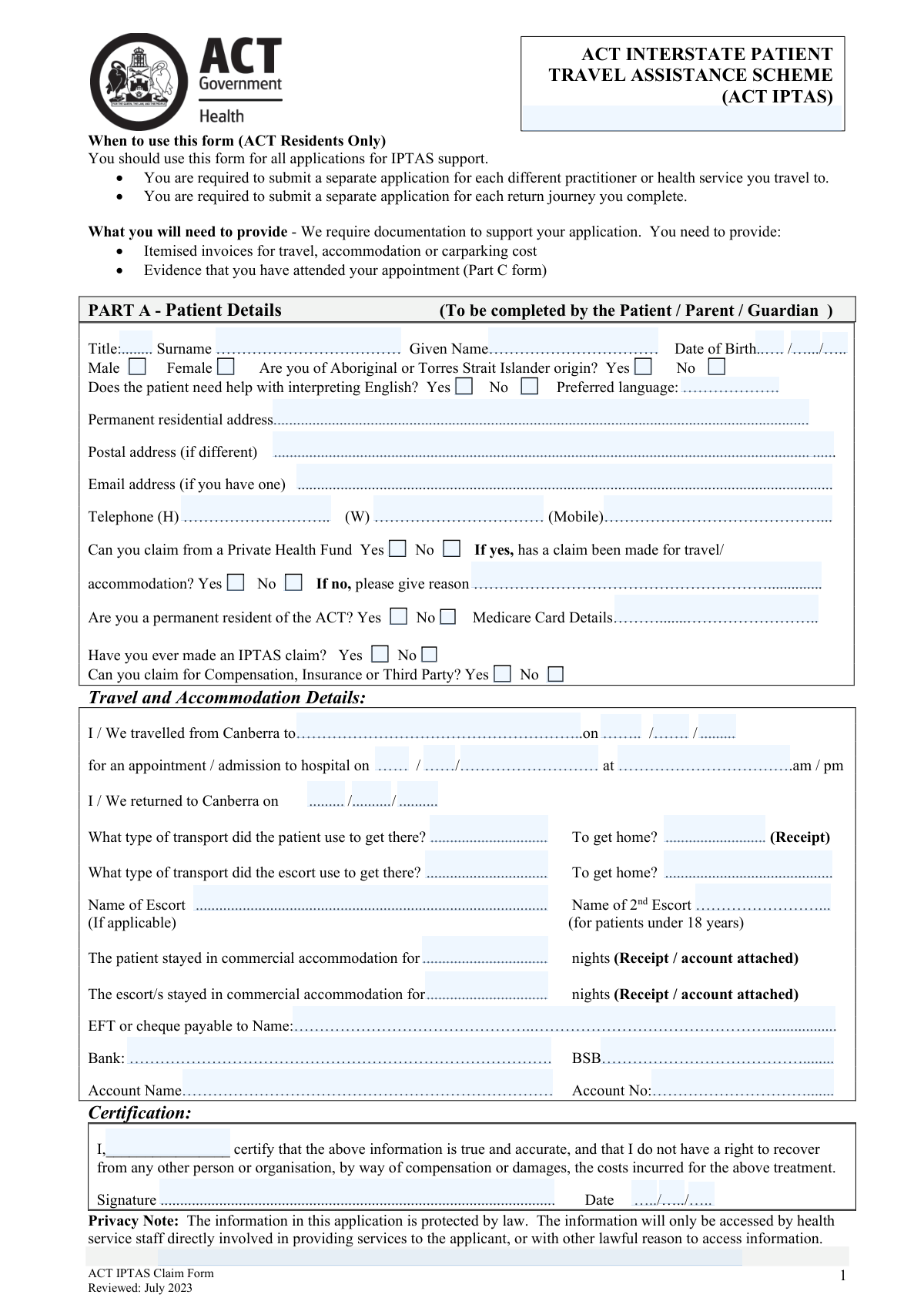
The ACT IPTAS Claim Form is an official application/claim document for ACT residents seeking financial assistance for travel and accommodation when they must travel interstate for specialist medical services not available in the ACT. It captures patient details (Part A), the ACT/Queanbeyan referring practitionerâs certification and medical justification (Part B), and confirmation of attendance/admission by the treating specialist or authorised representative (Part C), along with receipts and payment details. Submitting complete and accurate information is important because claims must be supported by itemised tax invoices/receipts and generally must be lodged within six months of return travel. Today, this form can be filled out quickly and accurately using AI-powered services like Instafill.ai, which can also convert non-fillable PDF versions into interactive fillable forms.
Our AI automatically handles information lookup, data retrieval, formatting, and form filling.
It takes less than a minute to fill out ACT IPTAS Claim Form using our AI form filling.
Securely upload your data. Information is encrypted in transit and deleted immediately after the form is filled out.
Form specifications
| Form name: | ACT Interstate Patient Travel Assistance Scheme (ACT IPTAS) Claim Form (Reviewed: July 2023) |
| Number of pages: | 6 |
| Language: | English |
Instafill Demo: filling out a legal form in seconds
How to Fill Out ACT IPTAS Claim Form Online for Free in 2026
Are you looking to fill out a ACT IPTAS CLAIM FORM form online quickly and accurately? Instafill.ai offers the #1 AI-powered PDF filling software of 2026, allowing you to complete your ACT IPTAS CLAIM FORM form in just 37 seconds or less.
Follow these steps to fill out your ACT IPTAS CLAIM FORM form online using Instafill.ai:
- 1 Go to Instafill.ai and upload the ACT IPTAS Claim Form PDF (or select it from the form library if available).
- 2 Let the AI detect and map the fields, then enter patient details in Part A (identity, contact details, ACT residency/Medicare, private health fund/other compensation questions).
- 3 Enter the trip and claim details in Part A (destination, travel/return dates, appointment time, transport types for patient/escort, accommodation nights, and attach/prepare itemised receipts).
- 4 Add payment information (payee name, bank, BSB, account name/number) and complete the patient/guardian certification (printed name, signature, date).
- 5 Send Part B to the referring medical practitioner to complete in Instafill.ai (specialist details, service availability/nearest provider, escort/transport/air travel medical reasons, provider details, signature/date).
- 6 Send Part C to the treating specialist or authorised representative to confirm attendance/admission dates, treatment period, escort need, accommodation requirement, and obtain signature/date (on/after the latest appointment/discharge).
- 7 Review for completeness (Parts A, B, and C completed; receipts attached; dates consistent), export the final PDF, and submit via the listed channels (email to [email protected], post, or deliver to the Canberra Hospital/Community Health Centres) within the required timeframe.
Our AI-powered system ensures each field is filled out correctly, reducing errors and saving you time.
Why Choose Instafill.ai for Your Fillable ACT IPTAS Claim Form Form?
Speed
Complete your ACT IPTAS Claim Form in as little as 37 seconds.
Up-to-Date
Always use the latest 2026 ACT IPTAS Claim Form form version.
Cost-effective
No need to hire expensive lawyers.
Accuracy
Our AI performs 10 compliance checks to ensure your form is error-free.
Security
Your personal information is protected with bank-level encryption.
Frequently Asked Questions About Form ACT IPTAS Claim Form
This form is used to apply for financial assistance under the ACT Interstate Patient Travel Assistance Scheme (IPTAS) for eligible travel and accommodation costs when you must travel interstate for specialist treatment.
The patient (or a parent/guardian) can submit the claim, but eligibility requires the patient to be a permanent ACT resident and have a Medicare card (or be a Medicare-ineligible asylum seeker). The referral must be from an ACT or Queanbeyan doctor.
Yes. You must submit a separate application for each different practitioner/health service you travel to, and a separate application for each return journey you complete.
You must attach itemised tax invoices/receipts for travel, accommodation, or parking, and you must include evidence you attended the appointment via Part C completed and signed by the treating specialist or authorised representative.
No. Part C is required because it confirms the appointment/admission dates and proves the travel occurred; the form notes it must be signed on or after the latest appointment or hospital discharge date.
Part B is only required on the first visit to a new specialist. It then remains valid for 2 years for subsequent visits to the same specialist.
You must submit your claim and receipts within 6 months of your return travel. Claims submitted after six months are not payable.
IPTAS does not reimburse items like meals, taxis/ride share, local public transport, tolls, car hire, hospital costs, emergency transport (ambulance/air ambulance), second opinions, or claims covered by other schemes (e.g., DVA, WorkCover, third party insurance).
No. The form notes no rebate is paid for staying in private accommodation at no cost; accommodation support applies to commercial or eligible not-for-profit accommodation with receipts.
Adults (18+) may have one escort only if medically required and supported by the referring practitioner (Part B) or treating specialist (Part C). Patients under 18 can have two escorts for travel (as noted for travel after 1 July 2020).
Yes, but you must provide itemised receipts and follow the fuel guidance: fill up before travel, during travel if needed, and at the end of travel, keeping receipts. Credit card slips alone are not accepted as proof of what you spent.
Yes, you can claim parking up to the stated limit (e.g., $25 from 1 July 2023) if you are not claiming commercial accommodation and another service (like Ronald McDonald House) is not claiming accommodation costs for you.
You can submit by email to [email protected], post to ACT IPTAS Administrator, GPO Box 11, WODEN ACT 2606, or deliver to The Canberra Hospital Main Reception Desk or participating Community Health Centres (Tuggeranong, Belconnen, Phillip, City, or Gungahlin).
Yes. Provide the payee name, bank name, BSB, account name, and account number in Part A; otherwise payment may be made by cheque.
YesâAI tools like Instafill.ai can help auto-fill form fields accurately using the information you provide, saving time and reducing errors. If your PDF is flat/non-fillable, Instafill.ai can convert it into an interactive fillable form and then guide you to complete and export it for submission.
Compliance ACT IPTAS Claim Form
Validation Checks by Instafill.ai
1
Validates Part A required patient identity fields are complete
Checks that Patient Surname, Patient Given Name(s), Title, and Date of Birth (day/month/year) are all provided in Part A. These fields are essential to correctly identify the claimant and match the claim to medical records. If any are missing, the submission should be rejected or routed to manual review because eligibility and appointment matching cannot be reliably performed.
2
Ensures Date of Birth is a real date and indicates plausible age
Validates that the DOB is in DD/MM/YYYY format, is a real calendar date, and is not in the future. Also checks that the resulting age is plausible (e.g., 0â120) to catch data entry errors such as swapped day/month or wrong year. If invalid, the form should fail validation and request correction because age drives escort rules and identity verification.
3
Enforces single selection for sex and other Yes/No questions
Ensures mutually exclusive checkboxes (e.g., Male vs Female; Indigenous origin Yes vs No; Interpreter Yes vs No; ACT resident Yes vs No; prior IPTAS claim Yes vs No; compensation/insurance Yes vs No; private health fund Yes vs No) have exactly one selection. This prevents ambiguous responses that can break downstream eligibility and payment logic. If both or neither are selected, the submission should be flagged as incomplete and returned for clarification.
4
Interpreter preference language required when interpreter assistance is Yes
If 'Needs help with interpreting English â Yes' is selected, validates that 'Preferred language' is populated with a non-empty value. This is important for arranging appropriate communication support and meeting accessibility obligations. If missing, the form should be rejected or held until the language is provided.
5
Validates ACT residency and Medicare details consistency
If 'Are you a permanent resident of the ACT? â Yes' is selected, checks that Medicare Card Details are provided and appear structurally valid (e.g., numeric card number with optional reference). If ACT residency is 'No', the claim should be flagged as likely ineligible for ACT IPTAS and routed for eligibility review rather than normal processing. If Medicare details are missing/invalid when required, payment and eligibility checks cannot proceed and the submission should fail validation.
6
Validates contact details format and minimum contact method provided
Checks that at least one reliable contact method is provided (mobile, home phone, work phone, or email). Validates phone numbers to Australian formats (allowing spaces) and validates email address syntax if supplied. If no valid contact method exists, the claim should be rejected because staff cannot request missing documents or clarify discrepancies.
7
Private Health Fund claim logic and reason requirement
If 'Can you claim from a Private Health Fund? â Yes' is selected, requires a selection for 'Has a claim been made for travel/accommodation? â Yes/No'. If 'Has a claim been made â No' is selected, requires 'Private Health Fund claim â reason if no claim made' to be completed. If these dependencies are not met, the submission should fail validation because IPTAS requires claimants to seek maximum private benefit first.
8
Travel dates and appointment/admission date are complete and chronologically consistent
Validates that departure date (travel to), appointment/admission date, and return date are present and are real dates in DD/MM/YYYY format. Ensures the appointment/admission date falls on or after the departure date and on or before the return date (or within a reasonable window if multi-day treatment is indicated elsewhere). If chronology fails, the claim should be flagged for correction because reimbursement depends on a valid journey tied to a verified appointment.
9
Validates appointment time format and AM/PM selection
Checks that appointment time is provided in a valid time format (e.g., HH:MM) and that AM/PM is specified where the form requires it. This helps reconcile Part A travel details with Part C attendance certification and reduces ambiguity for same-day travel. If time is missing or malformed, the submission should be flagged for manual review or returned for correction depending on business rules.
10
Transport mode fields required and restricted to allowable claimable categories
Ensures patient transport to destination and to get home are provided, and if escort transport is provided it must be consistent with escort presence. Optionally validates transport values against an allowed list (e.g., private car, coach, rail, air) and flags disallowed/non-reimbursable modes noted in guidelines (e.g., taxi/ride share/local transport) for review. If transport fields are blank or clearly non-claimable while costs are being claimed, the submission should be held to prevent incorrect reimbursement.
11
Escort eligibility and second escort rule for minors
Calculates patient age from DOB and enforces that a Second Escort Name is only provided/required when the patient is under 18 (per form note). For patients 18 or older, flags a second escort as potentially ineligible unless supported by policy exceptions and documentation. If a minor has escort travel claimed but escort names are missing, the submission should fail validation because escort reimbursement cannot be assessed.
12
Accommodation nights must be numeric, non-negative, and consistent with travel window
Validates that patient and escort commercial accommodation nights are integers (or blank if none), not negative, and within a reasonable maximum based on departure/return dates. Also flags cases where nights are claimed but travel dates indicate same-day return, or where both accommodation and parking are claimed in ways that violate the parking rule conditions. If inconsistent, the claim should be routed to manual review or rejected to prevent overpayment.
13
Payment method completeness: EFT details required when EFT is selected/used
Validates that 'EFT or cheque payable to (payee name)' is provided, and if EFT is intended then Bank name, BSB, Account name, and Account number are all present. Checks BSB is exactly 6 digits and account number is within typical Australian length (commonly 6â10 digits, allowing leading zeros). If banking details are incomplete/invalid, the claim should be accepted only for cheque processing (if allowed) or returned for correction to avoid failed payments.
14
Certification in Part A must include printed name, signature, and date
Ensures the certifierâs printed name, signature, and certification date are all present in Part A. This attestation is required to confirm the claimantâs declaration about accuracy and no other recovery rights. If any element is missing, the submission should be rejected because it is not a valid claim authorization.
15
Part B (referring practitioner) completeness and conditional medical-reason requirements
Validates that Part B includes patient name, specialist name, specialty, location/city-state, and referring practitioner identification (name, provider number, contact details) plus signature and date. Enforces conditional text requirements: if service is available in ACT = Yes then 'Reason for interstate referral' must be completed; if nearest specialist = No then the medical reason must be completed; if escort during travel/treatment = Yes then medical reason must be completed; if private car/public transport = No then medical reason must be completed; if air travel recommended = Yes then air travel medical reason must be completed. If any required dependency is missing, the claim should fail validation because eligibility and travel mode approvals cannot be justified.
16
Part C attendance certification and signature date rule
Checks that Part C includes the patient name and at least one verified attendance event (appointment date/time range, admission/discharge dates, or outpatient treatment range). Enforces the form rule that the treating specialist/representative signature date must be on or after the latest appointment date or hospital discharge date recorded in Part C. If Part C is missing, lacks attendance dates, or violates the signature-date rule, the claim should be rejected because proof of attendance is mandatory for reimbursement.
Common Mistakes in Completing ACT IPTAS Claim Form
People often assume one claim can cover several appointments, specialists, or multiple return journeys, especially when travel is frequent. IPTAS requires a separate application for each different practitioner/health service and a separate application for each return journey, so bundling trips can lead to delays, partial payment, or rejection. To avoid this, prepare one claim packet per return trip and per provider, and label each set of receipts to match the specific journey. AI-powered tools like Instafill.ai can help duplicate and pre-fill consistent patient details while keeping each claim separated correctly.
A very common issue is submitting only Part A (patient section) and forgetting that Part B (referring practitioner) and Part C (treating specialist/authorised representative attendance confirmation) are required for a complete claim. Part B is only required on the first visit to a new specialist and is valid for 2 years, but many people either omit it on the first visit or unnecessarily re-do it every time, creating confusion and processing delays. Part C is the evidence that the appointment/hospitalisation occurred; without it, the claim may not be payable. Instafill.ai can flag missing sections and required signatures before submission so you donât send an incomplete claim.
Applicants frequently attach EFTPOS/credit card payment slips or booking confirmations, thinking they count as receipts. The form notes IPTAS requires itemised tax receipts/invoices and cannot accept credit card receipts as proof of what was spent, which can result in the claim being unpaid until correct documents are provided. To avoid this, request and attach itemised tax invoices for accommodation, parking, and any eligible travel costs, and keep copies. Instafill.ai can help by prompting for the correct receipt type and ensuring each claimed cost has supporting documentation attached.
People often mix up the travel date versus the appointment/admission date, leave the return date blank, or forget to mark AM/PM for appointment times. These inconsistencies can conflict with Part C attendance confirmation and may trigger follow-up requests or rejection due to unclear eligibility for the journey. To avoid this, copy dates directly from booking letters and discharge summaries, and ensure the travel-to date, appointment/admission date, and return date are all present and logically consistent. Instafill.ai can automatically format dates (DD/MM/YYYY) and validate that required date fields are not missing.
Many applicants include costs that IPTAS explicitly does not reimburse (e.g., meals, taxi/ride share, local transport, tolls, car hire, ambulance/emergency transport, transfers between hospitals). This usually happens because people assume âtravelâ means any transport-related cost, but IPTAS has strict exclusions, and including them can slow assessment or lead to reduced reimbursement. To avoid this, cross-check each expense against the âIPTAS cannot reimburse you forâ list and only claim eligible categories (e.g., approved travel modes, commercial accommodation within rules, limited parking). Instafill.ai can help prevent this by categorising expenses and warning when an entered item is typically ineligible.
Applicants often tick that they have a private health fund but leave the âhas a claim been madeâ question unanswered, or they select âNoâ and forget to provide a reason. IPTAS requires patients to claim the maximum benefit from their private health fund first (if applicable), and missing this information can delay processing while staff request clarification. To avoid this, complete the full private health fund section: indicate whether you can claim, whether you have claimed, and if not, provide a clear reason (e.g., policy excludes travel). Instafill.ai can enforce conditional logic so the âreasonâ field is completed when required.
Because eligibility is limited to ACT permanent residents (with Medicare requirements), people sometimes tick âYesâ to ACT residency but omit Medicare card details, or they provide an address that appears outside the ACT without explanation. This can trigger eligibility checks and requests for additional proof (driverâs licence, electoral roll, utility bill), delaying payment. To avoid this, ensure the permanent residential address is complete (including suburb/state/postcode) and matches ACT residency, and enter Medicare card details exactly as shown on the card. Instafill.ai can standardise address formatting and reduce omissions in key eligibility fields.
Applicants often list an escort (or a second escort) in Part A without ensuring the medical justification is documented in Part B and/or Part C. For adult patients, an escort generally requires a medical reason stated by the referring practitioner or treating specialist; for patients under 18, two escorts may be allowed, but the second escort name is often left blank. Missing escort justification can lead to escort costs being denied even if the patientâs costs are approved. To avoid this, only include escort travel/accommodation when the relevant medical section is completed with a clear reason, and ensure under-18 claims include the second escort name if applicable.
For private vehicle fuel-related claims, people frequently submit only one petrol receipt or submit receipts that donât align with the required process (fill up before travel, during travel if needed, and at the end). This happens because applicants treat fuel like a flat allowance, but IPTAS requires receipts to substantiate the claim, and missing receipts can reduce or invalidate reimbursement. To avoid this, follow the stated fill-up steps and keep all itemised fuel receipts, then attach them to the specific journeyâs claim. Instafill.ai can remind users of the required receipt set when âprivate vehicleâ is selected as the transport type.
A common payment issue is incorrect BSB/account numbers, missing account name, or entering a payee name that doesnât match the bank account holder, which can cause EFT failure or require re-issuance by cheque. This often happens when someone enters a nickname, a parent/escort name without matching bank details, or transposes digits in the BSB/account number. To avoid this, copy details directly from online banking, ensure the payee name aligns with the account name, and double-check digit counts before submitting. Instafill.ai can validate common BSB/account formats and reduce transposition errors through automated checks.
People frequently forget to sign and date the patient certification in Part A, or they obtain Part C signatures dated before the latest appointment/discharge, which the form explicitly says is not acceptable. These mistakes happen because forms are often prepared in advance and signed too early, but IPTAS needs confirmation after the service occurred. The consequence is a request for re-signing/re-dating or outright processing delays. To avoid this, sign Part A at submission time and ensure Part C is signed on or after the latest appointment/discharge date; Instafill.ai can flag missing signatures/dates and highlight date-order conflicts before you send the claim.
Applicants often wait until multiple trips accumulate or until they have time to organise paperwork, and then miss the rule that claims must be submitted within six months of return travel. Late submissions are typically not payable, meaning you may lose reimbursement entirely. To avoid this, submit each return journey claim soon after you return and have Part C completed, and set reminders tied to your return date. Instafill.ai can help by tracking required fields and generating a ready-to-send packet quickly so you can submit well before the deadline.
Saved over 80 hours a year
âI was never sure if my IRS forms like W-9 were filled correctly. Now, I can complete the forms accurately without any external help.â
Kevin Martin Green
Your data stays secure with advanced protection from Instafill and our subprocessors

Robust compliance program
Transparent business model
Youâre not the product. You always know where your data is and what it is processed for.
ISO 27001, HIPAA, and GDPR
Our subprocesses adhere to multiple compliance standards, including but not limited to ISO 27001, HIPAA, and GDPR.
Security & privacy by design
We consider security and privacy from the initial design phase of any new service or functionality. Itâs not an afterthought, itâs built-in, including support for two-factor authentication (2FA) to further protect your account.
Fill out ACT IPTAS Claim Form with Instafill.ai
Worried about filling PDFs wrong? Instafill securely fills act-interstate-patient-travel-assistance-scheme-act-iptas-claim-form-reviewed-july-2023 forms, ensuring each field is accurate.