Fill out public safety forms
with AI.
Public safety forms are essential documents used by professionals in law enforcement, firefighting, and emergency medical services to manage the intersection of their service and administrative requirements. These documents ensure that those who protect the community can access the benefits, certifications, and resources they have earned through their careers. Whether it's managing personnel records or coordinating with specialized retirement systems, these forms ensure that public safety operations remain organized and compliant with state and federal regulations.
By continuing, you acknowledge Instafill's Privacy Policy and agree to get occasional product update and promotional emails.
About public safety forms
These forms are typically required by active-duty officers, retired first responders, and administrative staff within municipal or state agencies. They are used in critical situations such as requesting distributions from retirement accounts or documenting specialized training and equipment certifications. For instance, documents like the Public Safety Officer Distribution Request (Form F11645) are vital for retired personnel looking to manage their financial future under specific legislative acts. Navigating these administrative requirements can be time-consuming, but tools like Instafill.ai use AI to fill these forms in under 30 seconds, handling the data accurately and securely to save first responders and their families valuable time.
Every form on this page can be completed without typing. Instafill is form filling software that reads a PDF and fills it for you — including flat and scanned documents that carry no fillable fields at all.
Forms in This Category
The forms in this category have a median Form Complexity Index of 70/100 (Complex), measured across 4 forms by field count, input difficulty, length, conditional logic and structure. See how it is calculated.
| Form Name | Pages | FCI | |
|---|---|---|---|
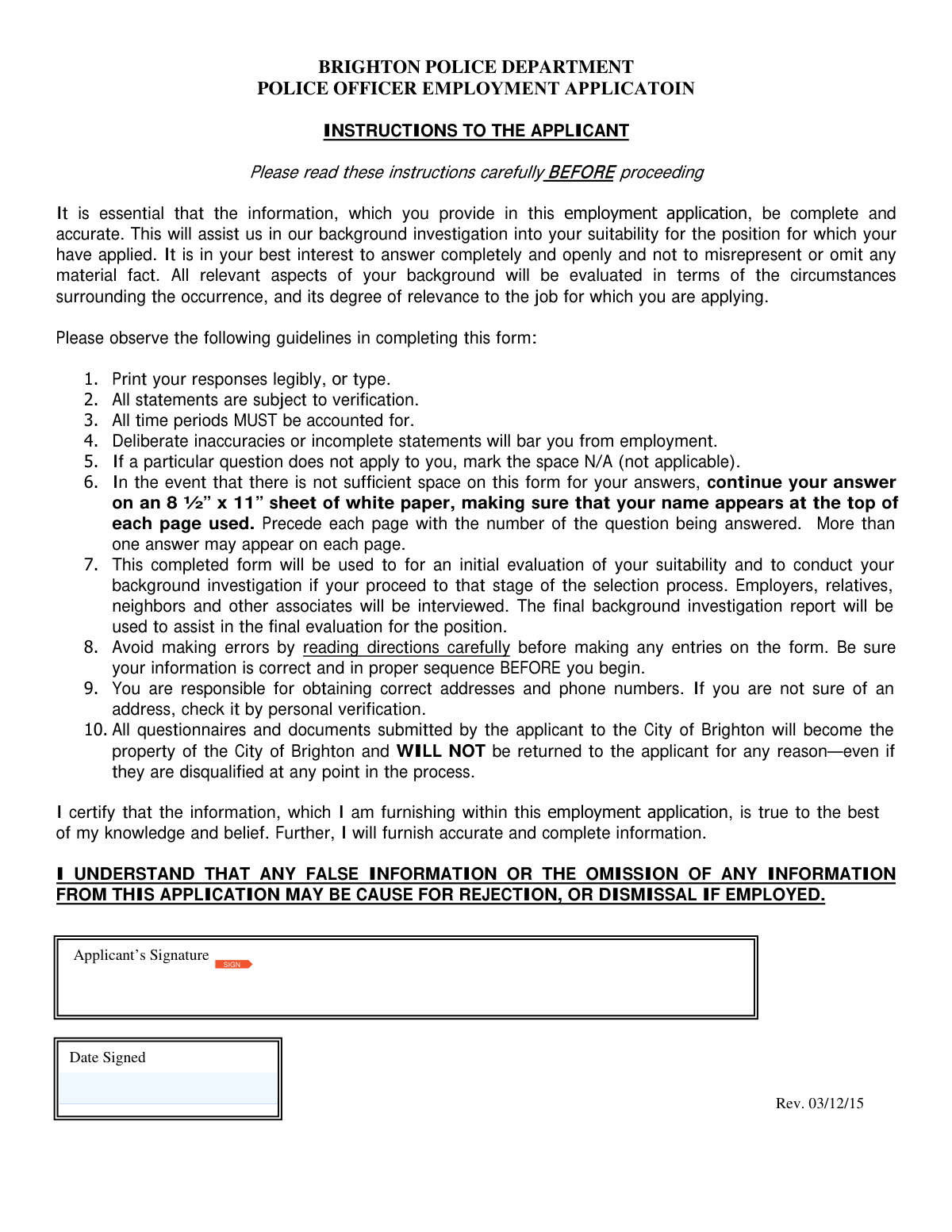
| 1. | Brighton Police Department Police Officer Employment Application | 28 | Complex 75 |
| 2. | Form F11645, Public Safety Officer Distribution Request | 1 | – |
| 3. | Maryland Department of Public Safety and Correctional Services Application for Pardon | 27 | Complex 70 |
| 4. | Republic of Namibia Ministry of Home Affairs, Immigration, Safety and Security Power of Attorney | 2 | Basic 40 |
- Enterprise-grade security & data encryption
- 99%+ accuracy powered by AI
- 1,000+ forms from all industries
- Complete forms in under 60 seconds
How to Choose the Right Form
Navigating retirement as a public safety professional requires specific documentation to ensure you receive the benefits you have earned without unnecessary tax burdens. While this category currently focuses on financial distributions, it is essential to identify if your specific career path and retirement status align with the available forms.
Retirement and Pension Distributions
If you are a retired first responder looking to access your retirement savings, you will likely need Form F11645, Public Safety Officer Distribution Request. This TIAA-specific document is designed for those who have dedicated their careers to public service and are now transitioning into retirement.
You should choose this specific form if you meet the following criteria:
- Professional Role: You served as a police officer, firefighter, or in emergency medical services (EMS).
- Age and Status: You have officially retired and have reached at least age 50.
- Financial Goal: You wish to take a distribution from your retirement account while qualifying for penalty-free withdrawals.
Understanding the Legal Benefits
The primary reason to select Form F11645 is to leverage the Defending Public Safety Employees’ Retirement Act. This act allows eligible public safety officers to avoid the standard 10% early withdrawal penalty usually applied to retirement distributions taken before age 59½. By using this specific form, you ensure that your request is processed under the correct tax guidelines, protecting your hard-earned savings from avoidable fees.
Streamlining the Process
Public safety forms often require precise financial data and personal identification. Instead of printing and manually signing, you can use Instafill.ai to complete Form F11645 digitally. Our AI tools help ensure every field—from your plan number to your distribution amount—is filled accurately, reducing the risk of processing delays with TIAA. If you have a static PDF version of a similar public safety document, you can also use our platform to convert it into a fillable, interactive format instantly.
Form Comparison
| Form | Purpose | Eligibility | Key Benefit |
|---|---|---|---|
| Form F11645, Public Safety Officer Distribution Request | Request distributions from TIAA retirement accounts for qualified public safety personnel. | Retired police, fire, or EMS personnel who have reached age 50. | Enables penalty-free withdrawals under the Defending Public Safety Employees’ Retirement Act. |
Tips for public safety forms
Before starting the form, ensure you meet the federal definition of a public safety officer and have reached the specific age requirements for penalty-free distributions. These forms are designed specifically for those qualifying under the Defending Public Safety Employees’ Retirement Act.
While these distributions may be exempt from the 10% early withdrawal penalty, they are still considered taxable income. Carefully review the withholding sections to ensure enough tax is being set aside, preventing a large bill during the next tax season.
Have your specific plan numbers and current account balances ready before you begin. Referencing your most recent TIAA statement ensures that the account identifiers you provide match their records exactly, which prevents processing rejections.
AI-powered tools like Instafill.ai can complete these forms in under 30 seconds with high accuracy, even if the original PDF isn't interactive. Your data stays secure during the process, providing a fast and reliable way to handle complex retirement paperwork.
Decide whether you want the funds sent via direct deposit or a physical check before you start the form. If choosing direct deposit, double-check your routing and account numbers, as even a minor typo can cause significant delays in receiving your funds.
Always save a digital or physical copy of the completed and signed distribution request. This documentation is essential for your personal tax records and serves as proof of your request should any discrepancies arise with the plan administrator.
Frequently Asked Questions
This category includes documents used by law enforcement, fire, and emergency medical personnel to manage employment benefits, retirement distributions, and certification records. These forms are designed to handle the unique regulatory requirements and tax benefits available specifically to public safety professionals.
Eligibility usually extends to individuals employed by a state or political subdivision who provide police protection, firefighting services, or emergency medical services. Specific forms, such as those for account distributions, often require the individual to have reached a certain age or years of service milestone as defined by federal law.
Special forms exist to help officers take advantage of legislation like the Defending Public Safety Employees’ Retirement Act. This allows eligible personnel who retire at or after age 50 to access their retirement funds without the standard 10% early withdrawal penalties often associated with other retirement accounts.
You will typically need your personal identification details, retirement account numbers, and specific instructions on how you want the funds distributed. Some forms may also require verification of your status as a qualified public safety officer from your former employer or plan administrator.
Yes, AI tools like Instafill.ai can process public safety forms by accurately extracting data from your source documents and placing it into the correct fields. This technology ensures that complex retirement and benefit documents are completed with high precision and minimal manual effort.
Filling out these forms manually can be time-consuming, but using AI-powered platforms can reduce the process to under 30 seconds. The AI quickly maps your information to the PDF, allowing for a fast and efficient completion process without manual typing.
Submission instructions vary depending on the specific document; for example, retirement distribution forms are usually submitted directly to the financial institution or plan administrator, such as TIAA. Always check the 'Where to File' section on the form instructions to ensure it reaches the correct department.
This is a federal law that allows certain public safety employees to take penalty-free distributions from governmental defined benefit and defined contribution plans. It specifically benefits those who separate from service during or after the year they reach age 50, rather than the standard age of 59 and a half.
While many organizations provide standard PDF versions, they are not always interactive or easy to type into directly. AI services can convert these static documents into fillable forms, making it easier to enter your information digitally without needing to print, hand-write, and scan the document.
Some distribution and benefit forms require a signature to be witnessed by a plan representative or a notary public to prevent fraud and verify identity. It is important to review the specific requirements of the form before finalizing it to ensure the submission is legally valid.
AI tools like Instafill.ai use advanced data extraction to pull information directly from your official records, significantly reducing the risk of human error. Users should always perform a final review of the generated PDF to confirm that all sensitive details, such as account numbers and distribution amounts, are correctly placed.
Using the incorrect form can lead to significant processing delays or unintended tax penalties from the IRS. It is essential to choose the form that matches your specific retirement plan type and your status as a public safety officer to ensure you receive the correct tax treatment and legal protections.
Glossary
- Form Complexity Index
- Instafill’s 0–100 measure of how much effort a form takes to complete, calculated deterministically from the form’s own structure rather than estimated. It combines the number of fillable fields (the largest factor), how difficult those fields are to complete based on their type, the number of pages that contain fields, the amount of conditional “fill-only-if” logic, and how many sections the form is divided into, then adds modifiers for tables and repeating lists, bundled instruction pages, and dense page layouts. A higher score means the form is harder to fill out by hand. The forms in this category have a median Form Complexity Index of 70/100 (Complex). See exactly how it is calculated.
- Qualified Public Safety Employee
- A state or local government employee who provides police protection, firefighting services, or emergency medical services within a specific jurisdiction.
- Defending Public Safety Employees’ Retirement Act
- A federal law that allows eligible public safety officers who retire at age 50 or older to withdraw funds from their retirement plans without paying the standard 10% early withdrawal penalty.
- Early Withdrawal Penalty
- An additional 10% federal tax typically applied to retirement account distributions taken before age 59½, from which certain public safety officers are exempt.
- Separation from Service
- The formal conclusion of an individual's employment due to retirement or resignation, which is a primary requirement for becoming eligible to receive retirement plan distributions.
- Distribution
- The act of withdrawing money from a retirement account, which can be taken as a one-time lump sum or through regular scheduled payments.
- Direct Rollover
- A tax-free transfer of retirement funds directly from one plan provider to another or to an Individual Retirement Account (IRA) to avoid immediate taxation.
- HELPS Act
- A tax provision that allows retired public safety officers to exclude up to $3,000 from their taxable income if the distribution is used to pay for health or long-term care insurance premiums.
- TIAA
- The Teachers Insurance and Annuity Association of America, the specific financial services organization that manages the retirement accounts associated with Form F11645.