Fill out Raleigh city forms
with AI.
Raleigh city forms cover the official paperwork required by the City of Raleigh to carry out construction, renovation, and utility work within city limits. These documents ensure that residential and commercial projects meet local zoning regulations, building codes, and North Carolina legal requirements. Whether you're adding a deck, installing a new HVAC system, building an accessory structure, or connecting to city water and sewer services, the appropriate permit application must be submitted and approved before work can begin.
By continuing, you acknowledge Instafill's Privacy Policy and agree to get occasional product update and promotional emails.
About Raleigh city forms
Homeowners, contractors, and developers are the most common users of these forms. A general contractor breaking ground on a new home, a licensed plumber handling a single-trade changeout, or a property owner replacing a retaining wall will all need to navigate the permit process. These applications collect detailed information about the project scope, site impacts, estimated costs, and licensed trade contractors — all of which feed directly into the city's zoning review, inspection scheduling, and compliance tracking systems.
Because accuracy matters — errors can delay approvals or create compliance issues — tools like Instafill.ai use AI to fill these forms in under 30 seconds, helping applicants submit complete, correctly formatted information without the usual frustration of working through dense municipal paperwork.
Every form on this page can be completed without typing. Instafill is form filling software that reads a PDF and fills it for you — including flat and scanned documents that carry no fillable fields at all.
Forms in This Category
The forms in this category have a median Form Complexity Index of 70/100 (Complex), measured across 1 forms by field count, input difficulty, length, conditional logic and structure. See how it is calculated.
| Form Name | Pages | FCI | |
|---|---|---|---|
| 1. | City of Raleigh Residential Permit Application (Revision 08-20-2025) | 2 | Complex 70 |
- Enterprise-grade security & data encryption
- 99%+ accuracy powered by AI
- 1,000+ forms from all industries
- Complete forms in under 60 seconds
How to Choose the Right Form
Navigating municipal requirements in North Carolina’s capital requires identifying the specific scope of your project. Whether you are a homeowner planning a DIY renovation or a contractor managing a professional build, selecting the correct documentation ensures your project stays compliant with local zoning and building codes.
Residential Construction and Renovations
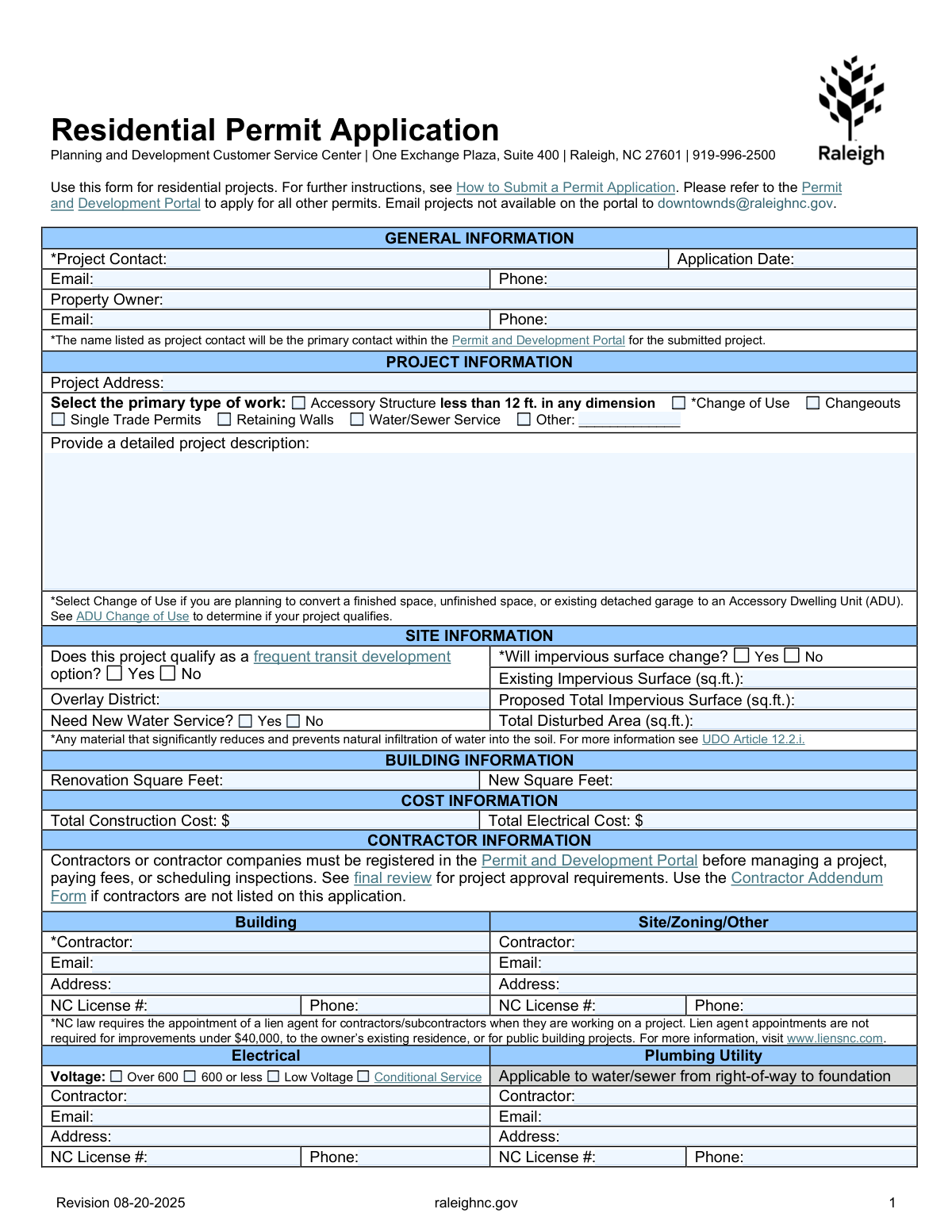
For most home-based projects within city limits, the City of Raleigh Residential Permit Application (Revision 08-20-2025) is the standard requirement. You should select this form if your project involves:
- New Structures: Building a single-family home, a duplex, or accessory structures like detached garages or sheds.
- Additions and Alterations: Expanding your living space, finishing a basement, or changing the designated use of a room.
- Repairs: Significant structural repairs that require municipal oversight.
Specialized Trade Work and Site Impacts
The City of Raleigh Residential Permit Application (Revision 08-20-2025) is also the correct choice for projects that do not involve a full building permit but still require inspections for safety and utility compliance. Use this form for:
- Single-Trade Work: This includes electrical, plumbing, or mechanical (HVAC) changeouts and upgrades.
- Exterior Site Improvements: Projects involving retaining walls, new water or sewer service stubs, or modifications to impervious surfaces (like large patios or driveways) that affect stormwater runoff.
Key Information to Have Ready
Before you begin filling out the form, ensure you have your project’s estimated costs, building square footage, and licensed contractor details (including trade license numbers) on hand. Because this application is a public record, accuracy is vital for a smooth review process. Using Instafill.ai allows you to quickly convert this municipal PDF into a fillable format, ensuring all fields—from site impact data to utility meter requests—are completed clearly and professionally.
Form Comparison
| Form | Project Scope | Key Requirements | Primary Use |
|---|---|---|---|
| City of Raleigh Residential Permit Application (Revision 08-20-2025) | Covers residential construction, accessory structures, change of use, and single-trade utility work. | Requires project address, site impact data, building square footage, and licensed contractor details. | Used to obtain official authorization for residential building projects and utility connections. |
Tips for Raleigh city forms
Ensure the street address and Parcel Identification Number (PIN) match Wake County tax records exactly. Incorrect location data is a leading cause of application delays and can lead to significant zoning review complications.
Raleigh has strict regulations regarding impervious surface and disturbed area totals. Accurately reporting these figures is essential for stormwater management compliance and determining if additional environmental permits are required for your project.
For projects requiring licensed trades, provide the full business name and North Carolina license numbers for electrical, plumbing, or mechanical contractors. Omitting these details often prevents the issuance of final permits and delays the inspection schedule.
The estimated cost of work should reflect the total market value of labor and materials. This figure is used to calculate permit fees and verify project scope, so ensure it aligns with current industry standards to avoid reassessment.
AI-powered tools like Instafill.ai can complete these complex municipal forms in under 30 seconds with high accuracy. Your data stays secure during the process, making it a significant time-saver when managing multiple permits for the same project.
Most information submitted on City of Raleigh permit applications becomes part of the public record. Avoid including sensitive personal information that isn't explicitly required to protect your privacy while ensuring municipal compliance.
Use the project scope section to provide a concise but thorough description of the work being performed, such as 'deck addition' or 'HVAC changeout.' Clear descriptions help city reviewers route your application to the correct department faster.
Ensure the square footage and dimensions listed on your application form match your submitted site plans and blueprints exactly. Any discrepancy between the application and the technical drawings can trigger a request for revision.
Frequently Asked Questions
Raleigh city forms are required for a variety of residential projects including new construction, additions, and structural alterations. You also need these permits for accessory structures, retaining walls, significant mechanical or plumbing changeouts, and new water or sewer service connections.
Either the property owner or a licensed contractor can submit the necessary forms to the City of Raleigh. However, the application must include specific details for all licensed trades involved, such as electrical, plumbing, and mechanical contractors.
Yes, you can use AI-powered tools like Instafill.ai to complete these forms quickly. The AI can accurately extract information from your project notes or source documents and place it directly into the form fields in under 30 seconds.
Most forms are submitted through the City of Raleigh's online development portal or directly to the Planning and Development department. It is recommended to verify the current submission requirements on the city's official website as some processes may require digital-only filing.
While manual entry can be time-consuming due to the level of detail required, using an AI service like Instafill.ai allows you to fill these forms in less than 30 seconds. This method reduces manual errors by automatically mapping data from your documents to the official Raleigh PDF.
You will need the project address, owner contact details, and a clear scope of work including estimated costs. Additionally, be prepared to provide data on site impacts, such as disturbed area and impervious surface square footage.
In many cases, single-trade work like an HVAC changeout can be handled through a specific simplified application. However, for larger renovations, these trades are often included as part of the comprehensive residential permit application.
Yes, once submitted, permit applications and their associated documents are generally subject to public records disclosure under North Carolina law. This includes information regarding the property owner, contractor details, and the estimated value of the construction.
Performing work without permits can result in civil penalties, stop-work orders, and requirements to uncover completed work for inspection. It can also create significant legal and financial hurdles when trying to sell or insure the property in the future.
Impervious surfaces include areas like rooftops, driveways, and patios that do not allow water to soak into the ground. You should calculate the total area of these surfaces on your site plan to ensure compliance with Raleigh's stormwater and zoning regulations.
Glossary
- Form Complexity Index
- Instafill’s 0–100 measure of how much effort a form takes to complete, calculated deterministically from the form’s own structure rather than estimated. It combines the number of fillable fields (the largest factor), how difficult those fields are to complete based on their type, the number of pages that contain fields, the amount of conditional “fill-only-if” logic, and how many sections the form is divided into, then adds modifiers for tables and repeating lists, bundled instruction pages, and dense page layouts. A higher score means the form is harder to fill out by hand. The forms in this category have a median Form Complexity Index of 70/100 (Complex). See exactly how it is calculated.
- Impervious Surface
- Any surface that prevents water from soaking into the ground, such as rooftops, driveways, and patios; Raleigh tracks this to manage stormwater runoff.
- Disturbed Area
- The total area of land where the ground cover is removed or altered by construction activities like grading, clearing, or excavating.
- Single-Trade Work
- A permit request that involves only one specialized field of construction, such as electrical, plumbing, or mechanical work.
- Changeout
- The replacement of an existing mechanical system or appliance, such as an HVAC unit or water heater, with a new model.
- Accessory Structure
- A secondary building located on the same lot as the main residence, such as a detached garage, shed, or pool house.
- Utility Stub
- A connection point for water or sewer lines extended from the city main to the property line to allow for future service hookups.
- Change of Use
- A legal modification in how a building or land is utilized, which may require the structure to meet different safety and zoning standards.
- UDO (Unified Development Ordinance)
- The comprehensive set of Raleigh's local laws that regulates land use, zoning, and how buildings must be designed and situated on a lot.