Fill out special assessment forms
with AI.
Special assessment forms are official government documents used to formally record and recover unpaid costs, fines, or penalties tied to specific properties. These forms create a legally recognized paper trail that allows local municipalities to place outstanding amounts — such as code enforcement fees or unremediated violation costs — onto a property's tax record, where they can be collected alongside delinquent taxes. Because they carry legal and financial consequences for property owners, accuracy in documenting property identifiers, dollar amounts, and applicable legal authority is essential.
By continuing, you acknowledge Instafill's Privacy Policy and agree to get occasional product update and promotional emails.
About special assessment forms
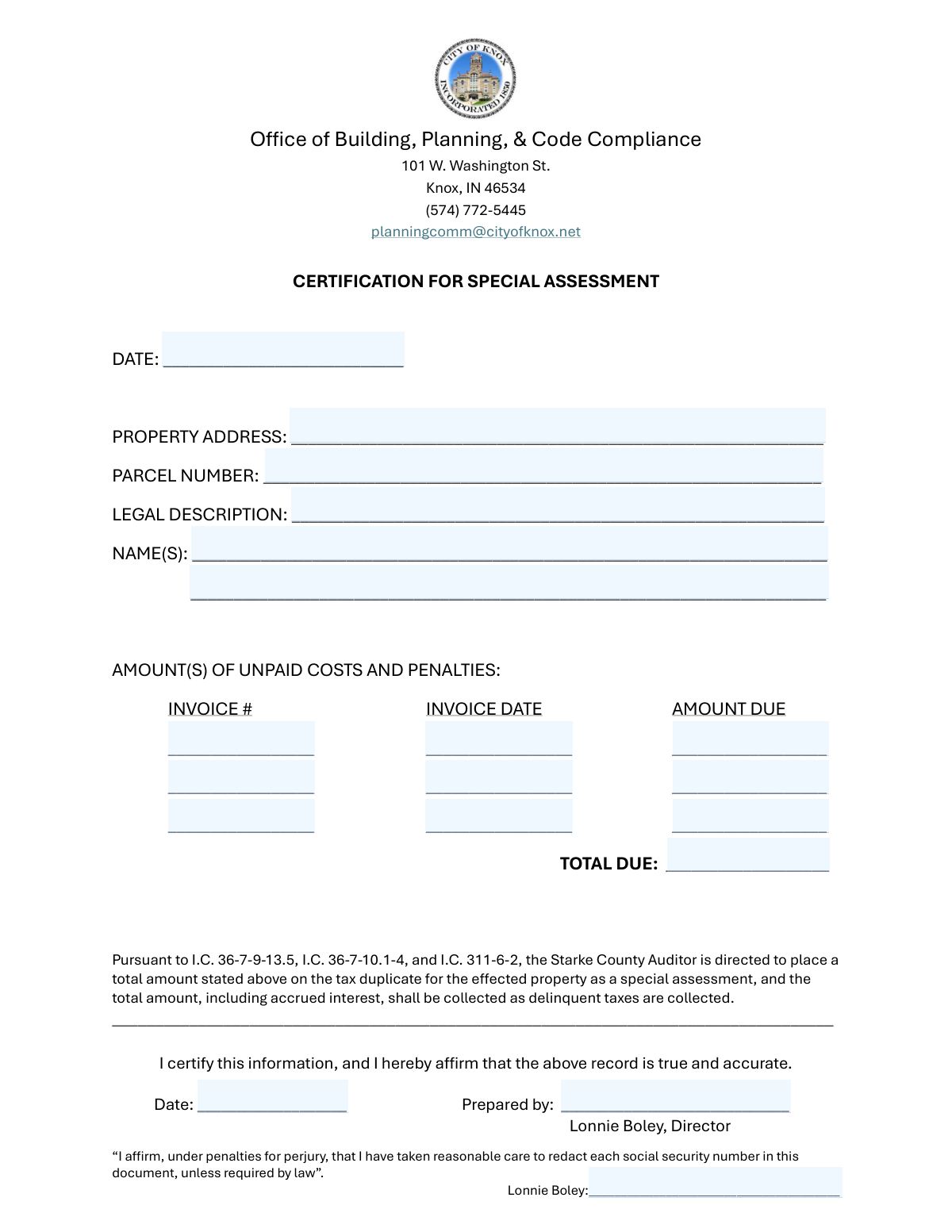
These forms are typically used by local government offices — such as building, planning, and code compliance departments — when a property owner has failed to pay costs associated with code violations, abatement work, or other municipal actions. A common example is the Certification for Special Assessment issued by the City of Knox, Indiana, which documents unpaid costs tied to a specific parcel and initiates the process of adding those amounts to the county tax duplicate under Indiana state law. Property owners, municipal clerks, and compliance officers may all encounter these documents during enforcement proceedings.
Because these forms require precise property information and must be properly signed and certified, errors can cause delays or legal complications. Tools like Instafill.ai use AI to fill these forms accurately in under 30 seconds, and can even convert non-fillable PDF versions into interactive forms — making the process faster and more reliable for everyone involved.
Every form on this page can be completed without typing. Instafill is form filling software that reads a PDF and fills it for you — including flat and scanned documents that carry no fillable fields at all.
Forms in This Category
The forms in this category have a median Form Complexity Index of 37/100 (Basic), measured across 1 forms by field count, input difficulty, length, conditional logic and structure. See how it is calculated.
| Form Name | Pages | FCI | |
|---|---|---|---|
| 1. | Certification for Special Assessment (Office of Building, Planning, & Code Compliance, City of Knox, Indiana) | 1 | Basic 37 |
- Enterprise-grade security & data encryption
- 99%+ accuracy powered by AI
- 1,000+ forms from all industries
- Complete forms in under 60 seconds
How to Choose the Right Form
When managing property compliance and local tax obligations, selecting the correct documentation is essential to ensure legal standing. Currently, this category focuses on municipal enforcement within specific Indiana jurisdictions.
Identifying the Correct Document
In this category, the primary document available is the Certification for Special Assessment (Office of Building, Planning, & Code Compliance, City of Knox, Indiana). You should select this form if you are dealing with property violations or municipal services that have gone unpaid within the City of Knox.
This form is specifically designed for:
- Municipal Officials: To certify that a property owner has failed to pay for services like weed abatement, debris removal, or building code compliance repairs.
- Tax Collection: To move delinquent costs from a simple invoice to the county tax duplicate, allowing the city to collect the funds in the same manner as property taxes.
- Legal Record Keeping: To provide a formal, signed statement of the total amount due, including accrued interest and administrative penalties.
When This Form is Required
You will need the Certification for Special Assessment if you have been instructed by the Indiana Code to report unpaid penalties tied to a specific property address or parcel number. It serves as the official bridge between the Building Department and the County Auditor’s office.
Essential Details for Completion
To fill out this form accurately using Instafill.ai, ensure you have the following information ready:
- Property Identifiers: The full legal description and the official parcel number.
- Financial Breakdown: The specific costs incurred and any penalties authorized by local ordinance.
- Authorization: The names of the certifying officials from the City of Knox.
Using our AI-powered tools, you can quickly convert the standard PDF version of this certification into an interactive format, ensuring that all legal descriptions and parcel numbers are entered precisely to avoid processing delays at the county level.
Form Comparison
| Form | Purpose | Who Files It | Key Information | Legal Authority |
|---|---|---|---|---|
| Certification for Special Assessment (Office of Building, Planning, & Code Compliance, City of Knox, Indiana) | Reports unpaid property costs and penalties for collection via county tax duplicate. | Building, Planning, and Code Compliance officials in the City of Knox. | Property address, parcel number, legal description, and total amount owed. | Indiana Code provisions regarding delinquent tax collection and special assessments. |
Tips for special assessment forms
Ensure the property address matches the official parcel identification number and legal description exactly. Even small errors in these identifiers can lead to the assessment being applied to the wrong property or rejected by the county auditor.
Calculate the total unpaid costs and penalties carefully before entering them into the certification. Since these amounts will be added to the county tax duplicate, any discrepancies can complicate the collection process and require formal corrections later.
When filling out assessment forms, ensure that the relevant state or local codes—such as Indiana Code provisions—are correctly cited. This establishes the legal authority for the assessment and ensures the document is enforceable during the tax collection cycle.
AI-powered tools like Instafill.ai can complete these complex forms in under 30 seconds with high accuracy. This is a significant time-saver for officials managing multiple properties, and the data stays secure throughout the entire process.
A certification for special assessment is only valid once it has been signed by the authorized building or planning official. Confirm that all required signature lines are completed to prevent delays when submitting the document for inclusion on the tax duplicate.
Keep a digital copy of every certified form to track when assessments were sent to the county. This documentation is essential for resolving disputes with property owners or verifying tax records during year-end audits.
While the certification creates the record, it must be submitted to the county treasurer or auditor in time for the next tax cycle. Check local administrative calendars to ensure the assessment is recorded on the upcoming tax bill rather than being delayed.
Frequently Asked Questions
These forms are used by local government offices to document and certify unpaid costs, penalties, or fees associated with a specific property. Once certified, these amounts are added to the county tax duplicate, allowing the government to collect the debt in the same manner as property taxes.
This form is typically completed by officials within departments like the Office of Building, Planning, & Code Compliance. They use the form to provide a formal record of property violations or cleanup costs that have not been settled by the property owner.
A certification is usually issued after a property owner fails to pay for municipal services, such as weed removal, demolition, or code violation penalties. It serves as the final step to move those private debts into the public tax collection system.
To ensure the assessment is applied correctly, the form must include the property's physical address, the parcel number, and a full legal description. This precision prevents the assessment from being applied to the wrong owner or property record.
The total typically includes the original cost of the service or penalty, plus any administrative fees or accrued interest allowed by state law. These figures are verified by the issuing department before the certification is signed and submitted to the county.
Once the issuing department completes the certification, it is generally sent to the county auditor or the official responsible for the tax duplicate. From there, the assessment is officially recorded against the property's tax bill.
Yes, AI tools like Instafill.ai can be used to fill out these forms in under 30 seconds by accurately extracting data from source documents and placing it into the correct fields. This technology simplifies the process for government staff who need to process multiple certifications efficiently.
Using traditional manual entry can be time-consuming, but digital tools can complete the process almost instantly. Platforms like Instafill.ai can even convert static PDF versions into interactive, fillable documents, reducing the administrative burden on planning and compliance offices.
While they are collected through the same system, they are distinct from general property taxes. Special assessments are specific charges for specific services or violations tied to an individual parcel, rather than a broad tax based on property value.
These forms are typically backed by state codes, such as the Indiana Code for properties in Knox. These laws grant local municipalities the power to recover costs by placing liens or assessments on properties that do not comply with local ordinances.
Glossary
- Form Complexity Index
- Instafill’s 0–100 measure of how much effort a form takes to complete, calculated deterministically from the form’s own structure rather than estimated. It combines the number of fillable fields (the largest factor), how difficult those fields are to complete based on their type, the number of pages that contain fields, the amount of conditional “fill-only-if” logic, and how many sections the form is divided into, then adds modifiers for tables and repeating lists, bundled instruction pages, and dense page layouts. A higher score means the form is harder to fill out by hand. The forms in this category have a median Form Complexity Index of 37/100 (Basic). See exactly how it is calculated.
- Special Assessment
- A specific charge or tax levied against a property to recover costs for local improvements or to penalize violations of building and safety codes.
- Tax Duplicate
- The official county record or ledger that lists all properties and the specific taxes, assessments, and penalties owed by the property owners.
- Parcel Number
- A unique identification number assigned to a specific piece of real estate by the local government to track property records and tax obligations.
- Legal Description
- A detailed formal description of a property's boundaries and location used in legal documents to distinguish it from all other parcels of land.
- Indiana Code (IC)
- The collection of state laws that provides the legal authority for local governments to collect unpaid costs and penalties through the tax system.
- Delinquent Taxes
- Taxes or assessments that have not been paid by their required due date and are subject to late fees, interest, or collection through property liens.
- Accrued Interest
- The amount of interest that has built up over time on an unpaid balance, which is added to the total amount owed on the special assessment.
- Code Compliance
- The department or process responsible for ensuring properties follow local laws regarding safety, building standards, and property maintenance.