
Instafill.ai
7 days free
AI form filling · 137 fields · 3 pages · done in seconds

Yes! You can use AI to fill out Form 8038, Information Return for Tax-Exempt Private Activity Bond Issues

Don't type 137 fields by hand. Tell our AI about yourself, or upload a document you already have, and it fills every field in seconds. You check it, then download, print or sign.
7 days free, then $19.99/month · Cancel anytime
AI fills it, no typingEncrypted, never used to train AICancel in two clicks
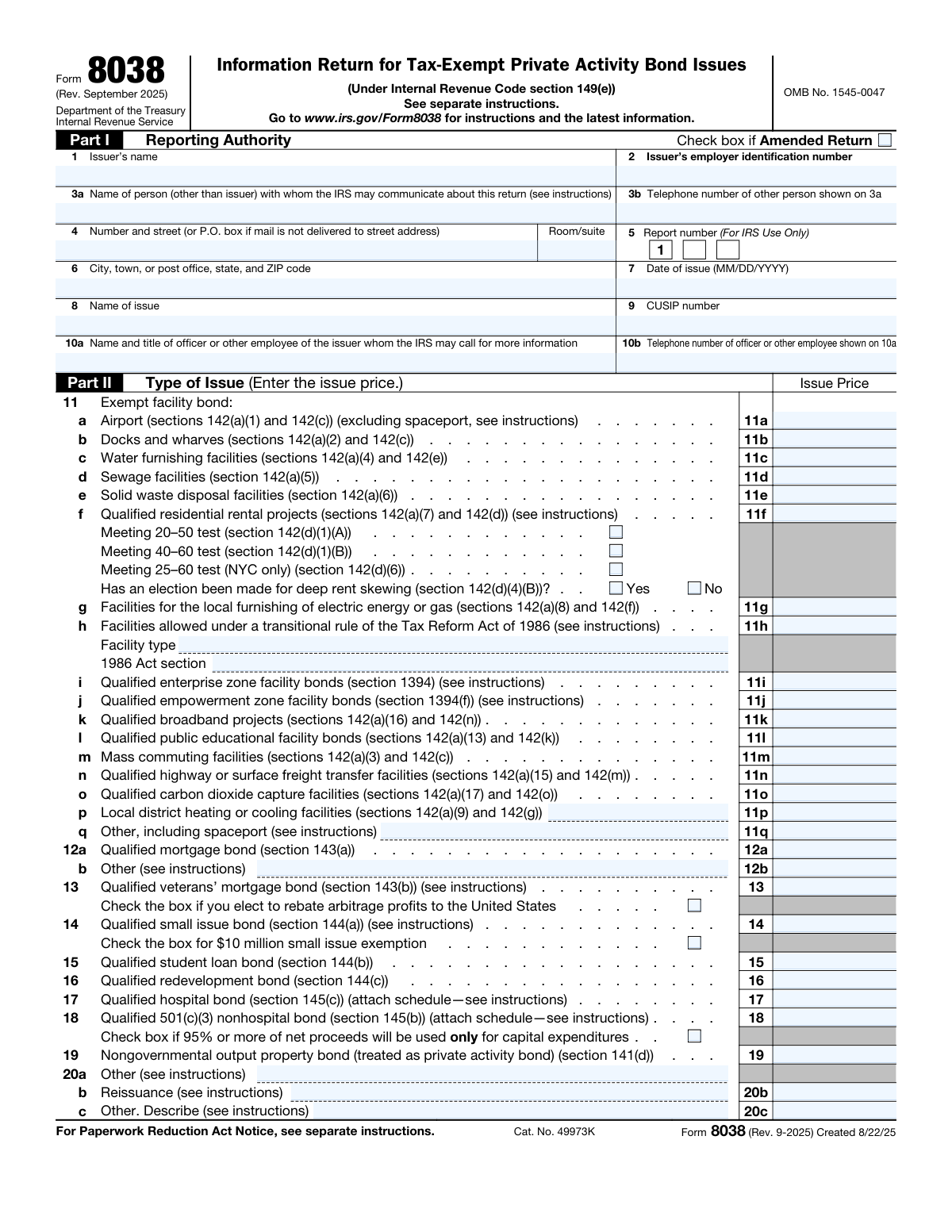
Form 8038, Information Return for Tax-Exempt Private Activity Bond Issues, page 1
Complex · 63/100Form Complexity Index

The AI does the filling. You just check it.

No typing into boxes, nothing to install.

Tell the AI about youAnswer a few questions in plain words, or upload a document you already have. That is all the typing there is.
AI fills every field in secondsIt puts each answer in the right box on every page, checkboxes included.
Check it and downloadReview every field, change anything, then download, print or sign the PDF.

What this form asks for

The AI fills all of it, from your answers or your documents.

Form 8038, Information Return for Tax-Exempt Private Activity Bonds, is used to report details about tax-exempt private activity bond issues. This form is important for issuers to comply with IRS regulations and to provide necessary information about the bonds issued.
Fillable fields137
Pages3
Sections20
Form Complexity IndexComplex, 63/100

The AI checks your answers before you download

15 checks built for this form, so a wrong date or a missing answer is caught before anyone else sees it.

Ensures that all information reflects the facts as of the issue date of the bonds

The AI ensures that all data entered on the Information Return for Tax-Exempt Private Activity Bond Issues accurately represents the situation as of the specific date the bonds were issued. This involves cross-referencing the provided information with the bond documents to confirm its validity. The AI also maintains a log of the issue date to prevent any post-issue changes from being incorrectly reflected. This validation is crucial for maintaining the integrity of the form and ensuring compliance with tax laws.

Confirms that the form is filed by the 15th day of the 2nd calendar month after the close of the calendar quarter in which the bond was issued

The AI confirms that the filing of the Information Return for Tax-Exempt Private Activity Bond Issues adheres to the stipulated deadline, which is the 15th day of the second month following the end of the calendar quarter in which the bond was issued. It calculates the deadline based on the issue date and alerts the user if the current date is approaching the filing deadline. This ensures timely submission and helps avoid potential penalties for late filing.

Verifies that a request for relief under section 3 of Rev. Proc. 2002-48 is included if filing late, along with an explanation letter

The AI verifies the inclusion of a request for relief pursuant to section 3 of Revenue Procedure 2002-48 if the Information Return for Tax-Exempt Private Activity Bond Issues is being filed after the due date. It checks for the presence of an accompanying explanation letter detailing the reasons for the delay. This validation is essential for the filer to potentially receive relief from penalties associated with late filing.

Checks that the form is filed with the Internal Revenue Service Center in Ogden, UT 84201, or the correct address for a private delivery service as per IRS.gov/PDS

The AI checks that the Information Return for Tax-Exempt Private Activity Bond Issues is directed to the correct filing location, which is the Internal Revenue Service Center in Ogden, UT 84201. For submissions via private delivery services, it verifies the address against the latest information available on IRS.gov/PDS. This ensures that the form is sent to the right place and reduces the risk of misdirected or lost submissions.

Confirms that no copies of the trust indenture or other bond documents are sent unless requested by the IRS

The AI confirms that no additional documents, such as copies of the trust indenture or other bond-related documents, are included with the Information Return for Tax-Exempt Private Activity Bond Issues unless specifically requested by the IRS. This validation helps to streamline the filing process and adheres to IRS guidelines, preventing the submission of unnecessary or unsolicited documentation.

Authorized Representative Signature Verification

Ensures that the Information Return for Tax-Exempt Private Activity Bond Issues is signed by an authorized representative of the issuer. This validation check confirms that the individual signing has the authority to consent to the disclosure of return information. It also verifies the presence of the signature, which is a critical component for the validity of the form. The check is designed to prevent unauthorized disclosures and maintain compliance with legal requirements.

And 9 more checks
  • Paid Preparer Information and Signature Check
  • Record Retention Compliance Check
  • Amended Return Completeness Verification
  • Issuer Details Accuracy Confirmation
  • Ensures that the type of bonds issued is correctly identified in Part II with the issue price and additional required information
  • Verifies that details about the bonds, such as final maturity date, issue price, and yield, are accurately provided in Part III
  • Checks that the allocation of proceeds is detailed correctly in Part IV for various purposes
  • Confirms that the amount of proceeds used for different categories of property and NAICS codes for each project financed are entered in Part V
  • Ensures that information on public approval, elections made, and other miscellaneous details are provided in Part VII

Let AI fill out your Form 8038

No typing. Every field filled in seconds, checked, ready to sign.

7 days free, then $19.99/month · Cancel anytime

How to Fill Out Form 8038 Online for Free in 2026

What the AI walks you through.

  1. Visit instafill.ai site and select Form 8038.
  2. Enter issuer's name and EIN.
  3. Provide contact information for IRS communication.
  4. Fill in details about the bond issue and proceeds.
  5. Sign and date the form electronically.
  6. Check for accuracy and submit the form.

Common Mistakes in Completing Form 8038

The ones the AI is built to catch.

Failure to file the form by the due date
The Information Return for Tax-Exempt Private Activity Bond Issues (TR-205) form must be filed in a timely manner to ensure compliance with tax regulations. Failure to file the form by the due date may result in penalties and interest charges. To avoid this mistake, it is recommended to familiarize yourself with the filing deadlines and set reminders to ensure timely submission. It is also advisable to plan ahead and gather all necessary information and documentation well before the due date to allow for adequate time to complete and file the form.
Incorrect issuer details, including name or EIN
Providing incorrect issuer details, such as an incorrect name or Employer Identification Number (EIN), can lead to processing delays and potential penalties. To avoid this mistake, it is essential to double-check the issuer's name and EIN against official records and ensure that they are accurately entered on the form. It is also recommended to maintain up-to-date records of the issuer's details to ensure their accuracy when filing future forms.
Incomplete or inaccurate contact information for authorized officer or employee
Providing incomplete or inaccurate contact information for the authorized officer or employee can cause delays in processing the form and may result in follow-up requests for additional information. To avoid this mistake, it is recommended to ensure that the contact information provided is complete and accurate, including the name, title, mailing address, phone number, and email address of the authorized officer or employee. It is also advisable to maintain up-to-date records of this information to ensure its accuracy when filing future forms.
Failure to provide required information for the specific type of bond in Part II
Part II of the TR-205 form requires specific information related to the type of bond being issued. Failure to provide this information can result in processing delays and potential penalties. To avoid this mistake, it is essential to carefully review the instructions for completing Part II and ensure that all required information is accurately and completely entered on the form. It is also recommended to maintain detailed records of the bond issuance and related information to ensure its availability when filing the form.
Incorrect or incomplete information in Part III
Part III of the TR-205 form requires detailed information about the bond, including the final maturity date and yield. Providing incorrect or incomplete information in this section can result in processing delays and potential penalties. To avoid this mistake, it is recommended to carefully review the instructions for completing Part III and ensure that all required information is accurately and completely entered on the form. It is also advisable to maintain detailed records of the bond issuance and related information to ensure its availability when filing the form.
Misallocation of Proceeds in Part IV
One of the most critical sections of the Information Return for Tax-Exempt Private Activity Bond Issues form is Part IV, which requires the issuer to allocate the bond proceeds to specific projects. Misallocation of proceeds can lead to significant errors in reporting and potential tax consequences. To avoid this mistake, it is essential to carefully review the bond documents and ensure that the proceeds are accurately allocated to each project based on the intended use. It is also recommended to maintain detailed records of the allocation and keep them on file for future reference.
Failure to Provide NAICS Codes for Each Project Financed in Part V
Part V of the form requires the issuer to provide the North American Industry Classification System (NAICS) codes for each project financed with the bond proceeds. Failure to provide these codes can result in incomplete or inaccurate reporting, which may impact the tax-exempt status of the bonds. To avoid this mistake, it is recommended to research and obtain the correct NAICS codes for each project before filling out the form. It is also essential to double-check the codes for accuracy and completeness before submitting the form.
Failure to Complete Part VI if Bonds are Used to Refund a Prior Issue
Part VI of the form is required if the bonds are used to refund a prior issue. Failure to complete this section can result in incomplete reporting and potential tax consequences. To avoid this mistake, it is essential to carefully review the bond documents and determine if the bonds are being used to refund a prior issue. If so, all required information in Part VI must be completed accurately and completely. It is also recommended to maintain detailed records of the refunding bonds and keep them on file for future reference.
Incomplete or Inaccurate Information in Part VII
Part VII of the form requires the issuer to provide various types of information, including the issuer's name, address, and taxpayer identification number. Incomplete or inaccurate information in this section can result in delays or rejections of the form. To avoid this mistake, it is recommended to double-check all information provided in Part VII for accuracy and completeness before submitting the form. It is also essential to ensure that all required information is provided in full.
Failure to Sign the Form by an Authorized Representative of the Issuer
Failure to sign the form by an authorized representative of the issuer can result in delays or rejections of the form. It is essential to ensure that the form is signed by an individual with the authority to bind the issuer to the information provided. To avoid this mistake, it is recommended to designate an individual with signing authority and ensure that they are aware of their responsibilities in regards to signing the form. It is also essential to maintain a record of the signed form for future reference.
Neglecting to Retain All Required Documentation
Failure to retain all documentation related to the Information Return for Tax-Exempt Private Activity Bond Issues as required by law can lead to complications and potential penalties. It is essential to keep all records related to the bond issuance, including the original return, supporting documents, and any amendments or corrections. Proper record-keeping not only ensures compliance with tax regulations but also facilitates efficient and accurate reporting. To avoid this mistake, maintain a complete and organized file of all documentation related to the bond issuance and keep it in a secure location.
Incomplete or Inaccurate Information on Amended Returns
Another common mistake is failing to provide all the information reported on the original return for amended filings. Amended returns may be necessary to correct errors or provide additional information. However, failing to include all relevant data can result in discrepancies and potential penalties. To prevent this mistake, carefully review the original return and ensure that all necessary corrections and updates are included in the amended filing. Double-check all data for accuracy and completeness before submitting the amended return.
Ignoring Instructions for Filing
Failure to follow instructions for filing, such as sending copies of bond documents or using incorrect addresses, can result in delayed or rejected filings. It is crucial to read and understand the instructions provided in the form carefully and ensure that all required documentation is included and sent to the correct address. To avoid this mistake, carefully review the instructions for filing and gather all necessary documentation before submitting the form. Double-check the address and ensure that all required documents are included in the submission package.

Frequently Asked Questions About Form 8038


Is it really free for 7 days?
Yes. You pay $0 today. Cancel before Oct 31 and you are never charged. Keep it, and it is $19.99 a month for 5 fills of your Form 8038.
Can I fill other forms too?
This plan is for your Form 8038: your own AI agent fills it as often as 5 times a month. To fill other forms and upload your own, choose a Professional plan from your account.
How do I cancel?
From your account, in two clicks, any time. No email, no call.
How does the AI fill out Form 8038?
You answer a few questions in plain words, or upload a document you already have. The AI reads what you give it and puts each answer into the right field of Form 8038, on every page, in seconds. It checks the answers against the form's own rules, and you review and change anything before you download, print or sign.
What happens to my information?
It is encrypted in transit and at rest, and it is never used to train AI.
How complex is Form 8038 to fill out?
Form 8038 has a Form Complexity Index of 63 out of 100, in the complex tier: 137 fillable fields across 3 pages. Instafill.ai's AI fills it in under a minute, with every field there for you to review before you download.
What is Form 8038 used for?
Form 8038, also known as the Information Return for Tax-Exempt Private Activity Bond Issues, is used to report information about tax-exempt private activity bond issues to the Internal Revenue Service (IRS).
Who is required to file Form 8038?
The issuer of a tax-exempt private activity bond is required to file Form 8038 with the IRS.
What information is required to be reported on Form 8038?
Form 8038 requires reporting of information about the issuer, the bond issue, and the use of proceeds. It also requires information about the type of facility financed and the proceeds used for various purposes.
What is the difference between an exempt facility bond and a qualified residential rental project?
An exempt facility bond is a bond issued for facilities such as airports, docks, wharves, and water furnishing facilities. A qualified residential rental project, on the other hand, is a project that provides rental housing for low-income individuals.
What is the difference between a qualified mortgage bond and a qualified veterans’ mortgage bond?
A qualified mortgage bond is a bond issued for financing the acquisition, construction, or refinancing of one- to four-family residential rental property. A qualified veterans’ mortgage bond, however, is a bond issued for financing the acquisition, construction, or refinancing of a home for a veteran or certain other individuals.
What is the difference between a qualified redevelopment bond and a qualified hospital bond?
A qualified redevelopment bond is a bond issued for the redevelopment of a blighted area. This type of bond is intended to promote economic development and community revitalization in distressed areas. A qualified hospital bond, on the other hand, is a bond issued for financing or refinancing a hospital or certain other healthcare facilities. The proceeds from a qualified hospital bond are used to provide essential healthcare services to the community.
What is the difference between a qualified student loan bond and a qualified redevelopment bond?
A qualified student loan bond is a bond issued for financing student loans. The proceeds from this type of bond are used to provide educational opportunities to students, often in the form of lower-cost loans. A qualified redevelopment bond, as previously mentioned, is a bond issued for the redevelopment of a blighted area. The proceeds from this type of bond are used to promote economic development and community revitalization in distressed areas.
What is the difference between a qualified small issue bond and a qualified mortgage bond?
A qualified small issue bond is a bond issued by a small issuer with an average annual bonded indebtedness of $10 million or less. This type of bond is intended to provide financing opportunities for smaller entities that may not have access to other forms of financing. A qualified mortgage bond, on the other hand, is a bond issued for financing the acquisition, construction, or refinancing of one- to four-family residential rental property. The proceeds from this type of bond are used to provide affordable housing for individuals and families.
What is the difference between a qualified broadband project and a qualified highway or surface freight transfer facility?
A qualified broadband project is a project that provides broadband service to a rural area or an area without adequate broadband service. Broadband service is essential for economic development and community connectivity in today's digital age. A qualified highway or surface freight transfer facility, on the other hand, is a project that involves the construction, reconstruction, or improvement of a highway or surface freight transfer facility. This type of project is intended to improve transportation infrastructure and facilitate the movement of goods and people.
What is the difference between a qualified carbon dioxide capture facility and a local district heating or cooling facility?
A qualified carbon dioxide capture facility is a facility that captures and utilizes carbon dioxide from a point source. This type of facility is intended to reduce greenhouse gas emissions and promote environmental sustainability. A local district heating or cooling facility, on the other hand, is a facility that provides heating or cooling to a community through a district heating or cooling system. This type of facility is intended to improve energy efficiency and reduce energy costs for individuals and businesses in the community.
What is the difference between a qualified enterprise zone facility bond and a qualified empowerment zone facility bond?
A qualified enterprise zone facility bond is a bond issued for financing a project located in a qualified enterprise zone. This type of bond is designed to encourage economic development in designated areas by providing tax incentives to investors. A qualified empowerment zone facility bond, on the other hand, is a bond issued for financing a project located in a qualified empowerment zone and meeting certain other requirements. Empowerment zones are designated areas where local economic conditions are particularly distressed, and these bonds offer even more generous tax incentives than enterprise zone bonds.
What is the difference between a qualified 501(c)(3) nonhospital bond and a qualified hospital bond?
A qualified 501(c)(3) nonhospital bond is a bond issued for financing a project of a 501(c)(3) organization that is not a hospital. A 501(c)(3) organization is a nonprofit organization that is tax-exempt under the Internal Revenue Code. Nonhospital projects can include a wide range of activities, such as affordable housing, community centers, and educational facilities. A qualified hospital bond, on the other hand, is a bond issued for financing or refinancing a hospital or certain other healthcare facilities. Hospitals and other healthcare facilities are essential infrastructure that provide critical services to communities, and these bonds offer tax incentives to investors to help finance the construction or renovation of these facilities.
What is the difference between a nongovernmental output property bond and a qualified mortgage bond?
A nongovernmental output property bond is a bond that is treated as a private activity bond even though it is not issued for a private activity. This can occur when the bond finances a project that is not a traditional private activity but still has a significant public purpose or benefit. A qualified mortgage bond, on the other hand, is a bond issued for financing the acquisition, construction, or refinancing of one- to four-family residential rental property. These bonds are designed to encourage the development of affordable rental housing and offer tax incentives to investors to help make these projects financially viable.
What is the difference between a qualified redevelopment bond and a qualified student loan bond?
A qualified redevelopment bond is a bond issued for the redevelopment of a blighted area. These bonds are designed to encourage economic development in distressed areas by providing tax incentives to investors for financing projects that will help revitalize the area. A qualified student loan bond, on the other hand, is a bond issued for financing student loans. These bonds offer tax incentives to investors to help make student loans more affordable for borrowers and to encourage students to attend educational institutions.
What is the difference between a qualified hospital bond and a qualified 501(c)(3) nonhospital bond?
A qualified hospital bond is a bond issued for financing or refinancing a hospital or certain other healthcare facilities. These bonds offer tax incentives to investors to help make these projects financially viable and to provide essential healthcare services to communities. A qualified 501(c)(3) nonhospital bond, on the other hand, is a bond issued for financing a project of a 501(c)(3) organization that is not a hospital. These bonds offer tax incentives to investors to help finance a wide range of projects that serve the public good, such as affordable housing, community centers, and educational facilities.
What is a 'Information Return for Tax-Exempt Private Activity Bond Issues' form?
This form is used to report certain information about tax-exempt private activity bond issues to the Internal Revenue Service (IRS).
What is the difference between a qualified redevelopment bond and a qualified redevelopment project?
A qualified redevelopment bond is a bond issued for financing a qualified redevelopment project. A qualified redevelopment project is a project for the redevelopment of a blighted area. The project must be located in a qualified census tract or a qualified target area, and it must meet certain other requirements.
What information is required to be reported on this form?
The form requires reporting various details about the bond issue, including the issuer, the borrower, the amount of the bond issue, the interest rate, the term of the bond, and the use of the bond proceeds. It also requires reporting information about the project, such as its location, the nature of the redevelopment, and the expected economic benefits.
Who is required to file this form?
The person required to file this form is the issuer of the tax-exempt private activity bond issue. However, in some cases, the borrower may be required to file a separate form reporting similar information.
When is this form due?
The form is due on the later of the date that is 30 days after the date of the issuance of the bond or the date that is 30 days after the end of the calendar year in which the bond was issued. However, if the bond is issued in January, the form is due on March 15th of the following year.
Encrypted in transit and at restNever used to train AIDelete your forms any time

Get your Form 8038 filled out by AI

$0 today. Cancel before Oct 31 and you pay nothing.

7 days free, then $19.99/month · Cancel anytime