Yes! You can use AI to fill out Agreement of Financial Responsibility - Medicaid

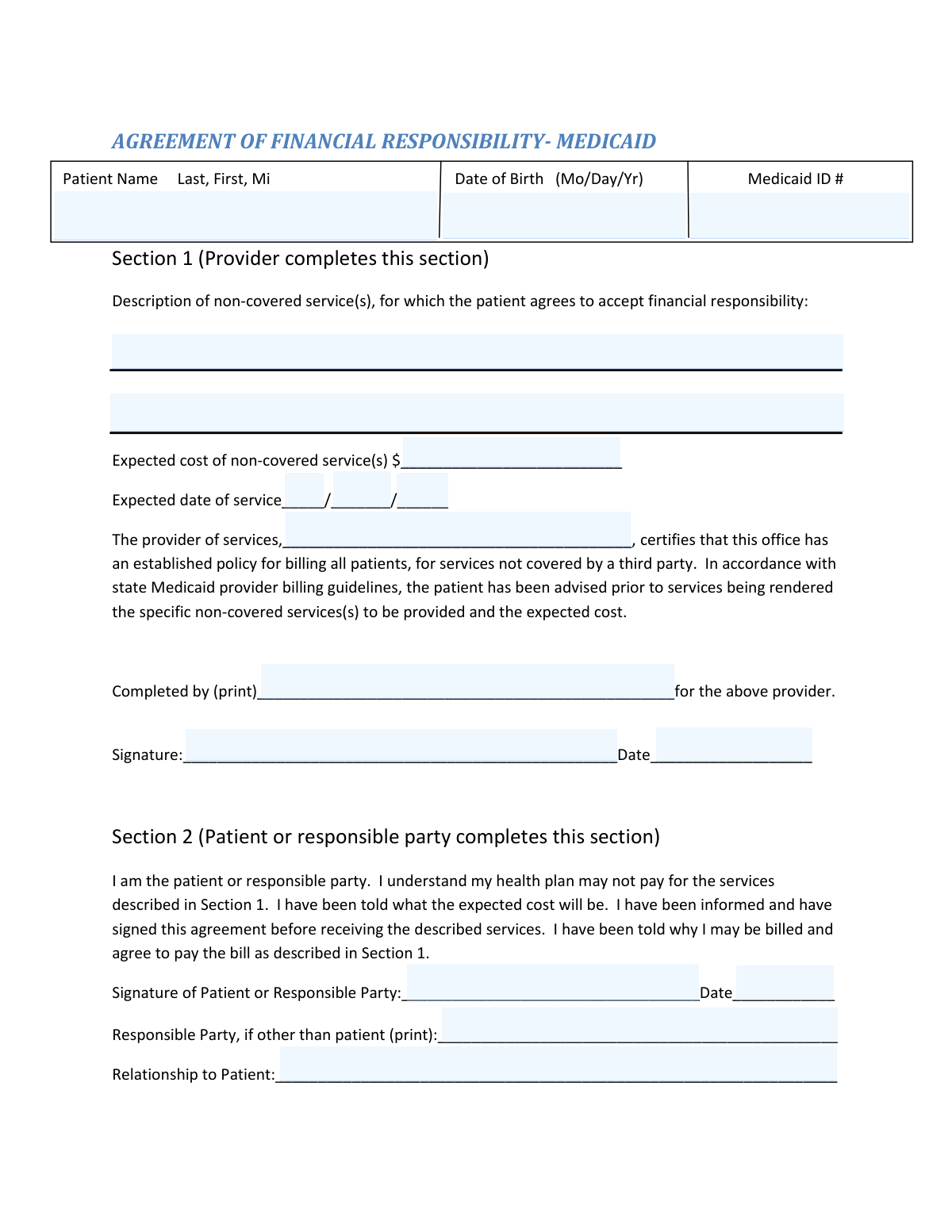
This form is a binding agreement between a healthcare provider and a Medicaid patient, documenting the patient's consent to accept financial responsibility for specific services that are not covered by their Medicaid benefits. It ensures the patient is informed of the non-covered services and their expected costs before they are rendered, protecting the provider's right to bill the patient directly. Today, this form can be filled out quickly and accurately using AI-powered services like Instafill.ai, which can also convert non-fillable PDF versions into interactive fillable forms.
Our AI automatically handles information lookup, data retrieval, formatting, and form filling.
It takes less than a minute to fill out Medicaid Financial Responsibility Agreement using our AI form filling.
Securely upload your data. Information is encrypted in transit and deleted immediately after the form is filled out.

Form specifications

Form name: Agreement of Financial Responsibility - Medicaid
Number of pages: 1
Language: English
Categories: financial forms, financial aid forms, Medicaid forms
main-image

Instafill Demo: How to fill out PDF forms in seconds with AI

How to Fill Out Medicaid Financial Responsibility Agreement Online for Free in 2026

Are you looking to fill out a MEDICAID FINANCIAL RESPONSIBILITY AGREEMENT form online quickly and accurately? Instafill.ai offers the #1 AI-powered PDF filling software of 2026, allowing you to complete your MEDICAID FINANCIAL RESPONSIBILITY AGREEMENT form in just 37 seconds or less.
Follow these steps to fill out your MEDICAID FINANCIAL RESPONSIBILITY AGREEMENT form online using Instafill.ai:
  1. 1 Navigate to Instafill.ai and upload or select the 'Agreement of Financial Responsibility - Medicaid' form.
  2. 2 The provider uses the AI tool to complete Section 1, specifying the non-covered services, their expected cost, and the date of service.
  3. 3 The provider's representative certifies the information in Section 1 by providing their printed name, signature, and the date.
  4. 4 The patient or their responsible party reviews the details in Section 1 to ensure they understand the services and costs they are agreeing to pay for.
  5. 5 The patient or responsible party completes Section 2 by providing their signature, date, and required personal information such as name, date of birth, and Medicaid ID.
  6. 6 Review the entire completed form for accuracy, ensuring all required fields in both sections are filled out correctly.
  7. 7 Securely download, print, or share the finalized agreement for both the provider's and patient's records.

Our AI-powered system ensures each field is filled out correctly, reducing errors and saving you time.

Why Choose Instafill.ai for Your Fillable Medicaid Financial Responsibility Agreement Form?

Speed

Complete your Medicaid Financial Responsibility Agreement in as little as 37 seconds.

Up-to-Date

Always use the latest 2026 Medicaid Financial Responsibility Agreement form version.

Cost-effective

No need to hire expensive lawyers.

Accuracy

Our AI performs 10 compliance checks to ensure your form is error-free.

Security

Your personal information is protected with bank-level encryption.

Frequently Asked Questions About Form Medicaid Financial Responsibility Agreement

This form is used when a healthcare provider offers a service that is not covered by Medicaid. It documents your agreement to be personally responsible for the cost of that specific service.

The healthcare provider completes Section 1, and the patient or their legally responsible party completes Section 2. Both parties must sign the form.

This agreement must be completed and signed by you before you receive the non-covered services. This ensures you are fully informed of your financial responsibility ahead of time.

You will need to provide the patient's full name, date of birth, and Medicaid ID number. You must also sign and date the form and, if applicable, print the name and relationship of the responsible party.

Your healthcare provider is responsible for describing the non-covered services and providing an estimate of the expected cost in Section 1.

If you do not agree to pay for the non-covered service and refuse to sign, the provider will likely not perform that specific service. Signing indicates your consent to pay.

No, signing this form only applies to the specific non-covered services listed on it. Your eligibility and coverage for other Medicaid-approved services remain unaffected.

The provider keeps the signed form in your medical and billing records as proof of the agreement. It is generally not sent to Medicaid.

A responsible party is someone other than the patient who is legally authorized to make financial and healthcare decisions on their behalf, such as a parent of a minor or a legal guardian.

Your Medicaid ID is used for accurate patient identification and to document that this service is an exception to your standard Medicaid coverage.

Yes, services like Instafill.ai use AI to help you accurately auto-fill your personal information like name, date of birth, and ID numbers, which saves time and helps prevent errors.

Upload the form to the Instafill.ai platform, and its AI will make the fields fillable. You can then use the web app or browser extension to automatically populate your information before printing the form for a physical signature.

You can use a tool like Instafill.ai, which can convert flat, non-fillable PDFs into interactive forms. This allows you to type your information directly into the fields before printing.

Compliance Medicaid Financial Responsibility Agreement
Validation Checks by Instafill.ai

1
Ensures Service Description is Provided
This check verifies that at least one of the 'Non-Covered Service Description' lines is filled out. It is critical for the patient to have a clear, written description of the services they are agreeing to pay for. A failure in this validation means the agreement is ambiguous and legally unenforceable.
2
Validates Expected Cost is a Positive Number
This validation ensures the 'Expected cost of non-covered service(s)' field contains a numeric value greater than zero. An agreement for a service with no cost or a negative cost is invalid. This check prevents data entry errors and ensures the financial responsibility is clearly and correctly stated.
3
Verifies Chronological Date Integrity
This is a crucial logical check that verifies the sequence of dates on the form. The 'Certification Date' must be on or before the patient's 'Signature Date', and both dates must be on or before the 'Expected date of service'. This ensures the agreement was properly explained, certified, and signed by all parties *before* the service was rendered, which is a core requirement of the agreement.
4
Patient Information Completeness Check
This check confirms that the 'Patient Name', 'Date of Birth', and 'Medicaid ID #' fields are all completed. These fields are essential for correctly identifying the patient and linking the financial agreement to the correct individual's record. Missing information could lead to billing errors or inability to process the form.
5
Validates Patient Date of Birth and Age
This check ensures the 'Date of Birth' is a valid date in the past and calculates the patient's age to confirm it is within a reasonable range (e.g., not in the future, and not over 120 years old). This prevents typographical errors and confirms the identity of the patient. An invalid date would make the form legally questionable.
6
Provider Certification Section Completeness
This validation verifies that all fields in the provider's section are complete, including 'Provider of services', 'Completed by (print)', 'Signature', and 'Date'. A complete provider certification is necessary to prove that the provider has followed the required disclosure protocol. An incomplete section invalidates the provider's side of the agreement.
7
Patient Signature and Date Requirement
This check ensures that both the 'Signature of Patient or Responsible Party' and the corresponding 'Date' field are filled. The signature and date are the patient's formal acknowledgment and acceptance of financial responsibility. Without both, there is no proof of consent, rendering the entire agreement void.
8
Conditional Responsible Party Information
This validation checks that if the 'Responsible Party, if other than patient' field is filled, the 'Relationship to Patient' field must also be completed. This logic ensures that when a third party signs on behalf of a patient, their identity and legal relationship are clearly documented. If the relationship is missing, the authority of the signatory is unknown.
9
Validates Medicaid ID Format
This check verifies that the 'Medicaid ID #' is not only present but also conforms to the expected format (e.g., specific length, character types) for the state's Medicaid program. An invalid ID format can cause processing failures and prevent the form from being correctly associated with the patient's Medicaid file. This helps catch typos at the point of entry.
10
Validates Expected Service Date
This check ensures the 'Expected date of service' is a complete and valid calendar date. It also confirms the date is not in the distant past, as the agreement is for a future or very recent service. This validation is important for establishing the context and timeline of the financial agreement.
11
Patient Name Format Validation
This check ensures the 'Patient Name' field contains at least a first and last name, as indicated by the 'Last, First, Mi' prompt. A full name is required for unambiguous patient identification. A partial or missing name could lead to record-matching failures and administrative complications.
12
Signature Date Consistency Check
This validation confirms that the patient's 'Signature Date' is on or after the provider's 'Certification Date'. This ensures the patient is signing an agreement that has already been finalized and certified by the provider. A patient signature dated before the provider's certification would imply they agreed to terms that were not yet formally declared.

Common Mistakes in Completing Medicaid Financial Responsibility Agreement

Vague or Incomplete Service Description

Providers often write a generic description like 'office procedure' instead of specifying the exact non-covered service. This ambiguity can lead to disputes, as the patient can later claim they did not agree to the specific service they were billed for. To avoid this, clearly list each service and its corresponding medical code if available, ensuring there is no room for misinterpretation.

Missing or Inaccurate Expected Cost

Leaving the 'Expected cost' field blank or entering a vague range like '$100-$500' invalidates the core purpose of the agreement. This happens when the exact cost is unknown, but a good-faith estimate is required for the form to be legally binding. Failing to provide a specific expected cost makes it difficult to enforce payment and can lead to the patient successfully disputing the charge.

Incorrect Signature Date

A critical error is dating the signature after the service has already been provided, which contradicts the form's statement that it was signed 'prior to services being rendered'. This mistake, often made when catching up on paperwork, can render the entire agreement unenforceable. Always ensure both the provider and patient sign and date the form before any non-covered service is performed.

Ambiguous Responsible Party Information

When someone other than the patient signs the form, they frequently forget to print their name and specify their relationship to the patient (e.g., 'Parent', 'Legal Guardian'). This omission creates ambiguity about who has legally accepted financial responsibility, complicating collection efforts if the bill goes unpaid. The responsible party must always clearly print their full name and their specific legal relationship to the patient.

Mismatched Patient Identifiers

Simple typos in the patient's name, date of birth, or Medicaid ID number are extremely common. These data entry errors can cause a mismatch with official records, leading to administrative delays, claim rejections, or the inability to link the financial agreement to the correct patient file. Using an AI-powered tool like Instafill.ai can help prevent these mistakes by auto-filling and validating patient data against existing records.

Signing as an Unauthorized Party

The form is sometimes signed by a person who lacks the legal authority to accept financial responsibility, such as a friend, a non-guardian relative, or the patient themselves if they are a minor. This occurs due to a misunderstanding of who qualifies as a 'Responsible Party'. The signature must be from the patient (if an adult with capacity) or their legal guardian/power of attorney to be legally binding.

Inconsistent Dates Between Sections

The provider's signature date in Section 1 and the patient's signature date in Section 2 are often different, which is acceptable, but they must both be prior to the service date. A common mistake is having one signature dated after the service date, which invalidates the agreement. To prevent this, both parties should ideally sign on the same day before the service, or at least ensure their respective signature dates precede the 'Expected date of service'.

Using an Incorrect or Abbreviated Provider Name

Staff may enter an individual physician's name or a common abbreviation instead of the full, legal name of the practice or healthcare organization. This can cause issues with billing and legal challenges, as the entity on the form may not match the entity sending the bill. Always use the complete, official name of the provider entity as it appears on legal and billing documents.

Illegible Handwriting in Key Fields

Signatures, printed names, and service descriptions are often written illegibly, making it impossible to verify who signed the form or what was agreed upon. This is a significant problem for legal enforceability and record-keeping. To avoid this, print all information clearly and ensure signatures are accompanied by a legible printed name. If the form is a non-fillable PDF, a tool like Instafill.ai can convert it into a fillable version to ensure all text is typed and legible.

Incorrect Date Formatting

Users frequently enter dates in the wrong format, such as using a two-digit year (YY) instead of a four-digit year (YYYY) or swapping the month and day. These formatting errors can cause data processing issues and confusion regarding the timeline of the agreement and service. To avoid this, carefully follow the specified format (Mo/Day/Yr) and double-check all dates. AI form-filling tools can automatically format dates correctly, reducing the chance of error.
Saved over 80 hours a year

“I was never sure if my IRS forms like W-9 were filled correctly. Now, I can complete the forms accurately without any external help.”

Kevin Martin Green

Your data stays secure with advanced protection from Instafill and our subprocessors

Robust compliance program

Transparent business model

You’re not the product. You always know where your data is and what it is processed for.

ISO 27001, HIPAA, and GDPR

Our subprocesses adhere to multiple compliance standards, including but not limited to ISO 27001, HIPAA, and GDPR.

Security & privacy by design

We consider security and privacy from the initial design phase of any new service or functionality. It’s not an afterthought, it’s built-in, including support for two-factor authentication (2FA) to further protect your account.

Fill out Medicaid Financial Responsibility Agreement with Instafill.ai

Worried about filling PDFs wrong? Instafill securely fills agreement-of-financial-responsibility-medicaid forms, ensuring each field is accurate.