
Yes! You can use AI to fill out Fidelity Transfer of Assets
Don't type 83 fields by hand. Tell our AI about yourself, or upload a document you already have, and it fills every field in seconds. You check it, then download, print or sign.
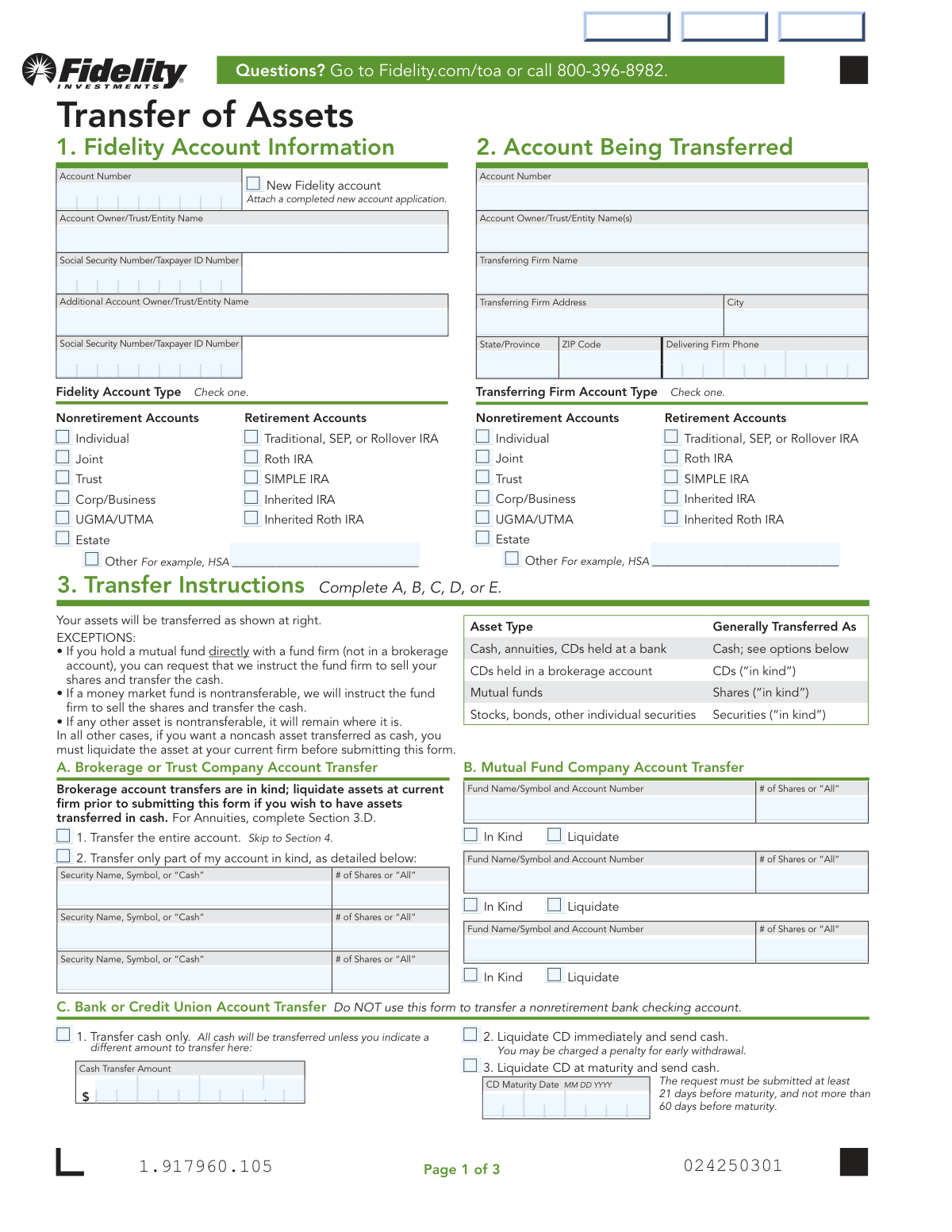
The AI does the filling. You just check it.
No typing into boxes, nothing to install.
What this form asks for
The AI fills all of it, from your answers or your documents.
The AI checks your answers before you download
12 checks built for this form, so a wrong date or a missing answer is caught before anyone else sees it.
This check ensures that the Social Security Number or Taxpayer ID Number entered in Section 1 is in a valid format (e.g., XXX-XX-XXXX for SSN or XX-XXXXXXX for TIN). This is critical for correctly identifying the account owner for tax reporting and legal purposes. If the format is incorrect, the submission will be rejected, and the user will be prompted to correct the number before the transfer can be processed.
This validation verifies that in Section 1, the user has either provided an existing 'Fidelity Account Number' or checked the 'New Fidelity account' box, but not both. These two options are mutually exclusive and one must be chosen to define the destination account. A failure in this check indicates a conflicting instruction and will halt processing until the user clarifies whether the transfer is to an existing or a new account.
This check compares the account owner names listed in Section 1 (Fidelity Account) and Section 2 (Account Being Transferred) to confirm that at least one owner is common to both accounts. This is a fundamental legal and security requirement for asset transfers to prevent unauthorized movement of funds. If no common owner is found, the transfer is invalid and will be rejected, requiring the user to correct the account information or use a different process.
This check ensures that the user has provided instructions in only one of the subsections within Section 3 (A, B, C, D, or E). Each subsection corresponds to a different type of account being transferred (e.g., Brokerage, Mutual Fund, Bank), and providing instructions in multiple sections creates ambiguity. If more than one subsection is filled out, the form will be considered invalid and the user must clarify which single transfer type they intend to execute.
For each mutual fund listed in Section 3.B, this validation ensures that the user has selected exactly one action: either 'In Kind' or 'Liquidate'. Failing to select an action or selecting both creates an ambiguous instruction for how to handle the asset. The form cannot be processed until a clear choice is made for each specified fund, preventing potential financial errors or delays.
If the user selects 'Liquidate CD at maturity' in Section 3.C, this check verifies that the submission date is within the required window: at least 21 days before, but not more than 60 days before, the provided 'CD Maturity Date'. This rule is crucial for ensuring the delivering firm has adequate time to process the request without incurring penalties for early withdrawal or missing the maturity date. A submission outside this window will be rejected.
And 6 more checks
- Ensures Signature Completeness for All Owners
- Validates Conditional 'New Account' Application Requirement
- Prohibits Invalid Retirement Account Transfers
- Requires 'Other' Account Type Specification
- Verifies Completeness of Transferring Firm Information
- Ensures Date Fields are Valid and Formatted Correctly
Let AI fill out your Fidelity TOA
No typing. Every field filled in seconds, checked, ready to sign.
How to Fill Out Fidelity TOA Online for Free in 2026
What the AI walks you through.
- Navigate to Instafill.ai and upload the Fidelity Transfer of Assets form or select it from their template library.
- Provide your Fidelity account information in Section 1, including the account number and owner details. If it's a new account, indicate that an application is attached.
- Enter the details of the account you are transferring from in Section 2, including the firm's name, address, and your account number there.
- Complete Section 3 with your specific transfer instructions, choosing whether to transfer the entire account, specific assets, or liquidate holdings like CDs or annuities.
- Carefully review all the information populated by the AI to ensure the details for both the receiving and transferring accounts are accurate.
- Digitally sign and date the form in Section 4. Ensure all owners of both the Fidelity account and the account being transferred provide their signatures.
- Download the completed form and submit it to Fidelity, along with a copy of a recent account statement from the transferring firm, as instructed on the form.
Common Mistakes in Completing Fidelity TOA
The ones the AI is built to catch.
Mismatched Account Owner Names
Missing Signatures from All Account Owners
Forgetting to Attach a Recent Account Statement
Using the Form for an Ineligible Transfer Type
Incorrectly Specifying Transfer Instructions
Incomplete or Inaccurate Transferring Firm Information
Failing to Address Registration Differences
Mistiming a Certificate of Deposit (CD) Transfer
Failing to Obtain a Required Medallion Signature Guarantee
Submitting an Unfillable or Illegible Form
Frequently Asked Questions About Fidelity TOA
Is it really free for 7 days?
Can I fill other forms too?
How do I cancel?
How does the AI fill out Fidelity TOA?
What happens to my information?
How complex is Fidelity TOA to fill out?
What is the purpose of this Transfer of Assets form?
Are there any transfers I cannot make with this form?
What documents do I need to submit with this form?
Who needs to sign the form in Section 4?
What happens if my name is different on the two accounts?
Can I transfer only some of my assets, or do I have to move the whole account?
I want my stocks to be sold and transferred as cash. How do I request that?
Is it better to use this form or transfer my assets online?
I have assets in two different accounts at another firm. Can I use one form for both?
How do I submit the completed form?
Can AI tools help me fill out this form?
How can I use Instafill.ai to complete this form online?
The PDF version of this form I have is not fillable. What can I do?
What do I need to do if there are differences in the account registration, like one is individual and one is joint?
Get your Fidelity TOA filled out by AI
$0 today. Cancel before Nov 3 and you pay nothing.
Other forms like this one
benefit forms: Form SSA-16, Application for Disability Benefits, Form SSA-1-BK, Application for Retirement Benefits, Form SSA-2-BK, Application for Spouse's Benefits, Form SSA-4-BK, Application for Child's Insurance Benefits, Form SSA-10, Application for Widow's or Widower's Insurance Benefits, Form SSA-10, Widow's or Widower's Benefits, Form SSA-4-BK, Application for Social Security Benefits, Form SSA-5-BK, Application for Mother's or Father's Benefits, Form DBQ, Knee and Lower Leg Disability Benefits, Form DBQ, Heart Conditions Disability Benefits, Form DBQ, Hypertension Disability Benefits, Form DBQ, Scars/Disfigurement Disability Benefits, Form DBQ, Diabetes Mellitus Disability Benefits Questionnaire, Form DBQ, Endocrine Diseases Disability Benefits, Form DBQ, Diabetes Mellitus Disability Benefits Questionnaire, Back (Thoracolumbar Spine) Conditions Disability Benefits Questionnaire, Ankle Conditions Disability Benefits Questionnaire, Back (Thoracolumbar Spine) Conditions Disability Benefits Questionnaire, Elbow and Forearm Conditions Disability Benefits Questionnaire, Foot Conditions, Including Flatfoot (Pes Planus) Disability Benefits Questionnaire
asset transfer forms: Fidelity Funds Account Transfer of Assets Form, How to Transfer Assets from Morgan Stanley to Fidelity Investments (Fidelity Stock Plan Services Guide), Transfer of Assets Out - Partial Account or Charitable Gift Transfers, Schwab Charitable Fund Transfer of Assets, Vanguard Asset Transfer Authorization Form for the Emory University Retirement Plan, Vanguard Asset Transfer Authorization, TIAA Trust, N.A. Private Asset Management, Request for a Direct Transfer From IRA Contracts, Inherited IRA Transfer of Assets/ Direct Rollover Form, Outgoing Partial Asset/Gifting Transfer Authorization Letter, RL360 Asset Transfer Form, Thrivent Funds Transfer of Assets, Form MF11502, Inherited IRA Transfer of Assets/Direct Rollover
Fidelity forms: Fidelity Funds Account Transfer of Assets Form, Fidelity Stock Plan Services (SPS) Transfer Request Form, How to Transfer Assets from Morgan Stanley to Fidelity Investments (Fidelity Stock Plan Services Guide), Fidelity Investments Transfer/Rollover/Exchange Form, Fidelity Investments Standing Transfer Instructions Form, Fidelity Charitable 144/145 Contribution Form, One-Time Withdrawal – IRA, Fidelity Investments, Fidelity Investments Transfer/Rollover Form, Fidelity Advisor 403(b) Distribution Request Form, Fidelity Advisor IRA Distribution Request for Automatic Rollover Accounts, Special Tax Notice: Your Rollover Options - Fidelity Investments, Fidelity Charitable Letter of Authorization, Fidelity Advisor Trading Authorization and Indemnification, Fidelity Investment-Only (Non-Prototype) Retirement Account Application, Fidelity NetBenefits Send a Document Form, Fidelity NetBenefits Auditor's Guide: An Overview of Fidelity's 2024 Plan Year Reporting Package, Fidelity NetBenefits Distribution - Recurring Payments, Fidelity Investments® Beneficiary Distribution Form, Fidelity Investments Distribution Form, Fidelity One-Time Withdrawal Form — Nonretirement
transfer forms: Form REG 227, Application for Replacement or Transfer of Title, City of Harvey Real Estate Transfer Declaration & Application (with Certificate for Exemption), DBPR ABT-6002 – Application for Transfer of Ownership of an Alcoholic Beverage License, DBPR ABT-6002, Division of Alcoholic Beverages and Tobacco Application for Transfer of Ownership of an Alcoholic Beverage License, Request for Transfer of Records (Adelaide Health Care) – AHC-0013-05-PS (Version 2), DBPR Form ABT-6002, Division of Alcoholic Beverages and Tobacco Application for Transfer of Ownership of an Alcoholic Beverage License, Pfändungs- und Überweisungsbeschluss (Garnishment and Transfer Order) – German Civil Enforcement Court Form, Fidelity Funds Account Transfer of Assets Form, Fidelity Stock Plan Services (SPS) Transfer Request Form, How to Transfer Assets from Morgan Stanley to Fidelity Investments (Fidelity Stock Plan Services Guide), Transfer Due to Divorce — IRA/HSA/529, Fidelity Investments Transfer/Rollover/Exchange Form, Fidelity Investments Standing Transfer Instructions Form, Fidelity Investments Transfer/Rollover Form, Group Transfer Form Fidelity Health Savings Account (HSA), Plan–to-Plan Transfer, Plan Exchange, or Service Credit Authorization Form, Beneficiaries — Nonretirement Transfer on Death, Transfer Shares as a Gift — Nonretirement, Form APP13017-29, Transfer Your Account to Schwab, Transfer of Assets Out - Partial Account or Charitable Gift Transfers
Let AI fill out your Fidelity TOA
Your trial starts once a card is added. You pay nothing before Nov 3.
Our AI already knows this form, all 83 fields of it. Skip the typing: tell it about yourself, or upload what you have, and it fills the whole form in seconds.
- AI fills every field on all 3 pages, checkboxes included
- No typing into boxes: answer a few questions, or upload a document you already have, an old copy of this form, a photo of a document
- The AI checks the answers; you review and change anything before you download
- Download the finished PDF, print it, or sign it online
- Encrypted, and never used to train AI
Cancel before Nov 3 and you pay nothing.
A card is needed to start the trial. Cancel in two clicks from your account.
Terms · Privacy