Fill out asset transfer forms
with AI.
Asset transfer forms are essential documents for moving financial holdings, such as stocks, mutual funds, and cash, from one institution to another. Whether you are consolidating multiple brokerage accounts or transitioning retirement funds into a new plan, these forms provide the legal and regulatory framework necessary to ensure the movement is handled securely and without unnecessary tax consequences. Properly executing these documents is vital for maintaining the continuity of your investment strategy and ensuring that your assets are correctly registered at their new destination.
By continuing, you acknowledge Instafill's Privacy Policy and agree to get occasional product update and promotional emails.
About asset transfer forms
These forms are typically utilized by individual investors, financial planners, and beneficiaries during major life transitions. Common scenarios include rolling over a 403(b) into an IRA, transferring assets from a former employer's stock plan, or directing charitable gifts from a brokerage account to a donor-advised fund. For instance, common documents like the Fidelity Transfer of Assets (TOA) or the Schwab Charitable Fund Transfer allow for "in-kind" transfers, meaning you can move your holdings without liquidating them first, which helps avoid triggering capital gains taxes.
Navigating the specific requirements of financial institutions like Vanguard, TIAA, or Morgan Stanley often involves complex paperwork that must be precisely accurate to avoid processing delays. Modern tools like Instafill.ai use AI to fill these forms in under 30 seconds, handling sensitive data accurately and securely to streamline the administrative process. This allows you to focus on your long-term financial goals rather than the technicalities of the paperwork.
Every form on this page can be completed without typing. Instafill is form filling software that reads a PDF and fills it for you — including flat and scanned documents that carry no fillable fields at all.
Forms in This Category
The forms in this category have a median Form Complexity Index of 47/100 (Moderate), measured across 13 forms by field count, input difficulty, length, conditional logic and structure. See how it is calculated.
- Enterprise-grade security & data encryption
- 99%+ accuracy powered by AI
- 1,000+ forms from all industries
- Complete forms in under 60 seconds
How to Choose the Right Form
Moving financial assets between institutions requires specific documentation to ensure the process is secure and tax-compliant. To find the right form, first identify whether you are moving assets into a new account or transferring them out to another party.
Moving Assets to Fidelity
If you are consolidating your investments into a Fidelity account, your choice depends on the account type:
- General Brokerage: Use the Fidelity Transfer of Assets form for standard "in-kind" transfers of stocks, bonds, and mutual funds.
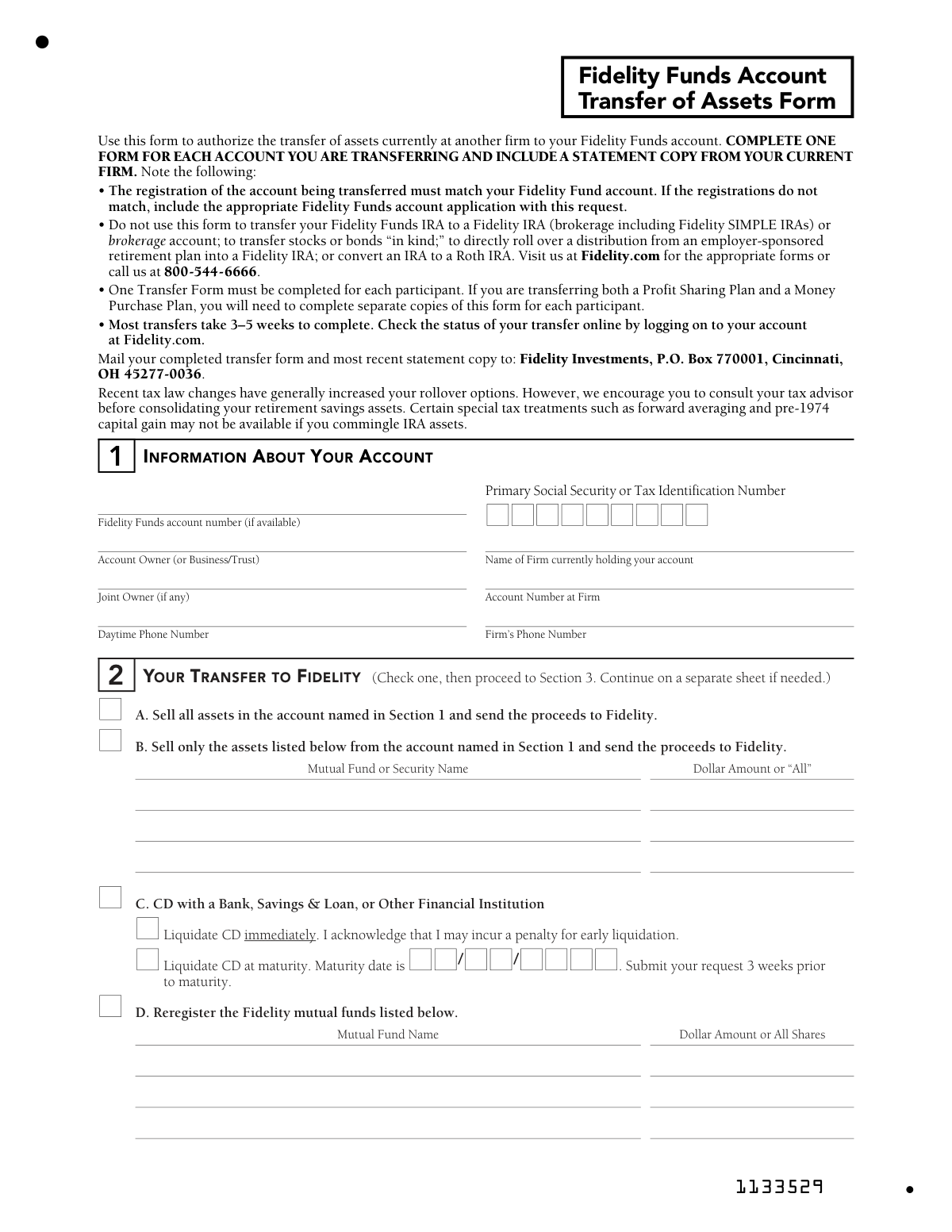
- Fidelity Funds Accounts: If you are specifically moving mutual funds or CDs into a Fidelity Funds account, use the Fidelity Funds Account Transfer of Assets Form.
- Employer-Specific Plans: For those under a Veolia benefits plan, the Fidelity Transfer of Assets Form (TOA) - Your Veolia Benefits is the required document.
- From Morgan Stanley: If you are moving a stock plan, follow the How to Transfer Assets from Morgan Stanley to Fidelity Investments guide to ensure you have the correct DTC and account details.
Retirement Plan Transfers (403(b) and IRA)
Consolidating retirement savings often requires forms specific to the plan provider or employer:
- Vanguard: Use the Vanguard Asset Transfer Authorization for general 403(b) moves. If you are an Emory employee, use the Vanguard Asset Transfer Authorization Form for the Emory University Retirement Plan.
- TIAA: To move funds between IRA contracts, use the TIAA Trust, N.A. Private Asset Management, Request for a Direct Transfer From IRA Contracts.
- Inherited Assets: If you are the beneficiary of a deceased participant, use the Inherited IRA Transfer of Assets/ Direct Rollover Form to move funds into an Inherited IRA at Voya.
Charitable Giving and Outbound Transfers
- Donations to Schwab: To contribute stocks or mutual funds to a donor-advised fund, use the Schwab Charitable Fund Transfer of Assets.
- Moving Assets Out: If you need to send assets from a Schwab account to a different person or a charitable organization, use the Transfer of Assets Out - Partial Account or Charitable Gift Transfers form.
Form Comparison
| Form | Primary Purpose | Target Account Type | Direction of Transfer |
|---|---|---|---|
| Fidelity Funds Account Transfer of Assets Form | Authorizes moving external mutual funds or CDs into Fidelity Funds accounts. | Mutual funds, CDs, or securities. | Inbound to Fidelity. |
| Fidelity Transfer of Assets Form (TOA) - Your Veolia Benefits | Consolidates Veolia employee benefit assets into a central Fidelity account. | Employer benefits and retirement assets. | Inbound to Fidelity. |
| How to Transfer Assets from Morgan Stanley to Fidelity Investments (Fidelity Stock Plan Services Guide) | Outlines moving restricted stock awards from Morgan Stanley to Fidelity. | Stock plan and equity compensation accounts. | Inbound to Fidelity. |
| Transfer of Assets Out - Partial Account or Charitable Gift Transfers | Instructs Schwab to move specific assets to external individuals or charities. | General brokerage and charitable accounts. | Outbound from Schwab. |
| Schwab Charitable Fund Transfer of Assets | Authorizes irrevocable asset transfers into a Schwab donor-advised fund. | Donor-advised charitable funds. | Inbound to Schwab Charitable. |
| Vanguard Asset Transfer Authorization Form for the Emory University Retirement Plan | Directs transfer of Emory retirement assets from external firms to Vanguard. | 403(b) Retirement plans. | Inbound to Vanguard. |
| Vanguard Asset Transfer Authorization | Moves retirement assets into a Vanguard 403(b)(7) custodial account. | 403(b) Retirement plans. | Inbound to Vanguard. |
| Fidelity Transfer of Assets | Initiates in-kind transfer of stocks, bonds, or cash to Fidelity. | General brokerage and investment accounts. | Inbound to Fidelity. |
| TIAA Trust, N.A. Private Asset Management, Request for a Direct Transfer From IRA Contracts | Requests direct, non-taxable transfer from TIAA IRA contracts to another IRA. | IRA Retirement contracts. | Inbound or Outbound. |
| Inherited IRA Transfer of Assets/ Direct Rollover Form | Moves inherited retirement funds from a deceased participant to Voya. | Inherited IRA accounts. | Inbound to Voya. |
Tips for asset transfer forms
One of the most common reasons for a rejected transfer is a name mismatch between the sending and receiving institutions. Before submitting, verify that the names, middle initials, and titles on both accounts are identical to prevent the forms from being returned for corrections.
Decide whether you want to move your specific stocks and mutual funds as-is or liquidate them into cash before the transfer. Choosing an 'in-kind' transfer can help you avoid unintended tax consequences that occur when selling assets for a profit.
Many brokerage and investment firms require a Medallion Signature Guarantee rather than a standard notary stamp for asset movements. Verify if your form requires this specific validation from a participating bank or credit union to avoid processing delays.
Including a copy of your latest statement from the delivering financial institution helps the receiving firm verify account numbers and asset symbols quickly. This practice significantly reduces the risk of clerical errors during the manual data entry phase of the transfer.
Manually typing out complex account details and asset lists is time-consuming and prone to typos. AI-powered tools like Instafill.ai can complete these forms in under 30 seconds with high accuracy, and your sensitive financial data stays secure throughout the entire process.
Once your assets arrive at the new institution, double-check that the original cost basis was recorded correctly. Keeping your own records of purchase prices and dates ensures you have the necessary data for tax reporting if the automated data transfer is incomplete.
Most asset transfers take between three to five weeks to fully settle, depending on the complexity of the holdings. Set a reminder to follow up with the receiving firm two weeks after submission to ensure no additional documentation is needed.
Frequently Asked Questions
Asset transfer forms are used to move financial holdings, such as stocks, bonds, mutual funds, or cash, from one brokerage or bank to another. They allow investors to consolidate their accounts or move to a new financial provider without necessarily having to sell their investments first.
You should generally choose the form provided by the receiving institution—the firm where you want your assets to end up. The specific form will also depend on the account type, such as a standard brokerage account, a retirement plan like a 403(b), or a charitable donor-advised fund.
An "in-kind" transfer means moving your actual investments, such as specific shares of stock or mutual funds, directly to the new firm without selling them. This is a common strategy to avoid the tax consequences that would occur if you liquidated the assets and moved the cash instead.
Financial institutions require that the name and tax identification number on the source account match the new account exactly to prevent unauthorized transfers. If the names do not match—for example, moving from an individual account to a joint account—you may need to provide additional legal documentation or a Letter of Authorization.
Yes, institutions like Vanguard and TIAA provide specialized Asset Transfer Authorization forms for employer-sponsored plans like 403(b) or 401(k) accounts. These forms ensure that the movement of funds is treated as a direct rollover or trustee-to-trustee transfer, which helps you avoid early withdrawal penalties and taxes.
Yes, specialized forms like the Schwab Charitable Transfer of Assets form are designed for irrevocable transfers to donor-advised funds or charitable organizations. These forms allow you to specify which assets you are gifting, which can provide significant tax benefits compared to donating cash.
Many brokerage firms require a Medallion Signature Guarantee for asset transfers to verify the identity of the person authorizing the transaction and protect against fraud. This is a special certification stamp provided by a bank or financial institution and is more rigorous than a standard notary public seal.
Most asset transfers take between 3 to 5 weeks to fully process, depending on the complexity of the assets and whether the firms use electronic transfer systems like ACATS. Transfers involving physical certificates, annuities, or restricted stock plans may take longer than standard mutual fund or cash transfers.
Yes, AI tools like Instafill.ai can be used to fill out asset transfer forms accurately by extracting data directly from your existing brokerage statements. This ensures that sensitive information like account numbers and registration details are placed correctly, reducing the risk of the transfer being rejected due to clerical errors.
Using AI-powered services, you can complete complex asset transfer forms in under 30 seconds. The AI quickly identifies the required fields and maps the data from your source documents to the PDF, making the process much faster than manual entry.
You should have a copy of your most recent statement from the firm currently holding your assets, as it contains your account number, exact registration name, and the list of assets to be moved. You will also need your new account number at the receiving firm and, in some cases, a government-issued ID.
A total transfer moves every asset and all cash out of an account, typically resulting in the old account being closed. A partial transfer allows you to specify exactly which shares or dollar amounts you want to move, leaving the remaining assets in the original account.
Glossary
- Form Complexity Index
- Instafill’s 0–100 measure of how much effort a form takes to complete, calculated deterministically from the form’s own structure rather than estimated. It combines the number of fillable fields (the largest factor), how difficult those fields are to complete based on their type, the number of pages that contain fields, the amount of conditional “fill-only-if” logic, and how many sections the form is divided into, then adds modifiers for tables and repeating lists, bundled instruction pages, and dense page layouts. A higher score means the form is harder to fill out by hand. The forms in this category have a median Form Complexity Index of 47/100 (Moderate). See exactly how it is calculated.
- ACATS
- The Automated Customer Account Transfer Service is the standard electronic system used by the financial industry to move securities from one brokerage firm to another.
- In-Kind Transfer
- A method of moving assets where stocks, bonds, or mutual funds are transferred exactly as they are, without being sold for cash first.
- Direct Rollover
- The movement of retirement funds directly from one plan or custodian to another, ensuring the funds remain tax-deferred and avoid early withdrawal penalties.
- Cost Basis
- The original value of an asset for tax purposes, which must be transferred to the new firm to properly calculate future capital gains or losses.
- DTC Number
- A unique four-digit identification number assigned to financial institutions to facilitate the electronic clearing and settlement of securities transfers.
- Trustee-to-Trustee Transfer
- A process where retirement assets are sent directly between financial institutions, preventing the account holder from receiving the funds and triggering a taxable event.
- Donor-Advised Fund (DAF)
- A private fund administered by a third party that allows donors to make a charitable contribution, receive an immediate tax benefit, and then recommend grants from the fund over time.
- Inherited IRA
- A specific type of account used to hold retirement assets that have been transferred to a beneficiary following the death of the original account owner.