
Yes! You can use AI to fill out Fidelity Transfer/Rollover/Exchange Form
Don't type 90 fields by hand. Tell our AI about yourself, or upload a document you already have, and it fills every field in seconds. You check it, then download, print or sign.
The AI does the filling. You just check it.
No typing into boxes, nothing to install.
What this form asks for
The AI fills all of it, from your answers or your documents.
The AI checks your answers before you download
14 checks built for this form, so a wrong date or a missing answer is caught before anyone else sees it.
This check ensures that the Social Security Number or Tax ID provided in Section 1 consists of exactly nine digits. This is critical for correctly identifying the individual's account and for tax reporting purposes. If the number is not in the correct format, the form submission will be rejected to prevent identity mismatches and processing errors.
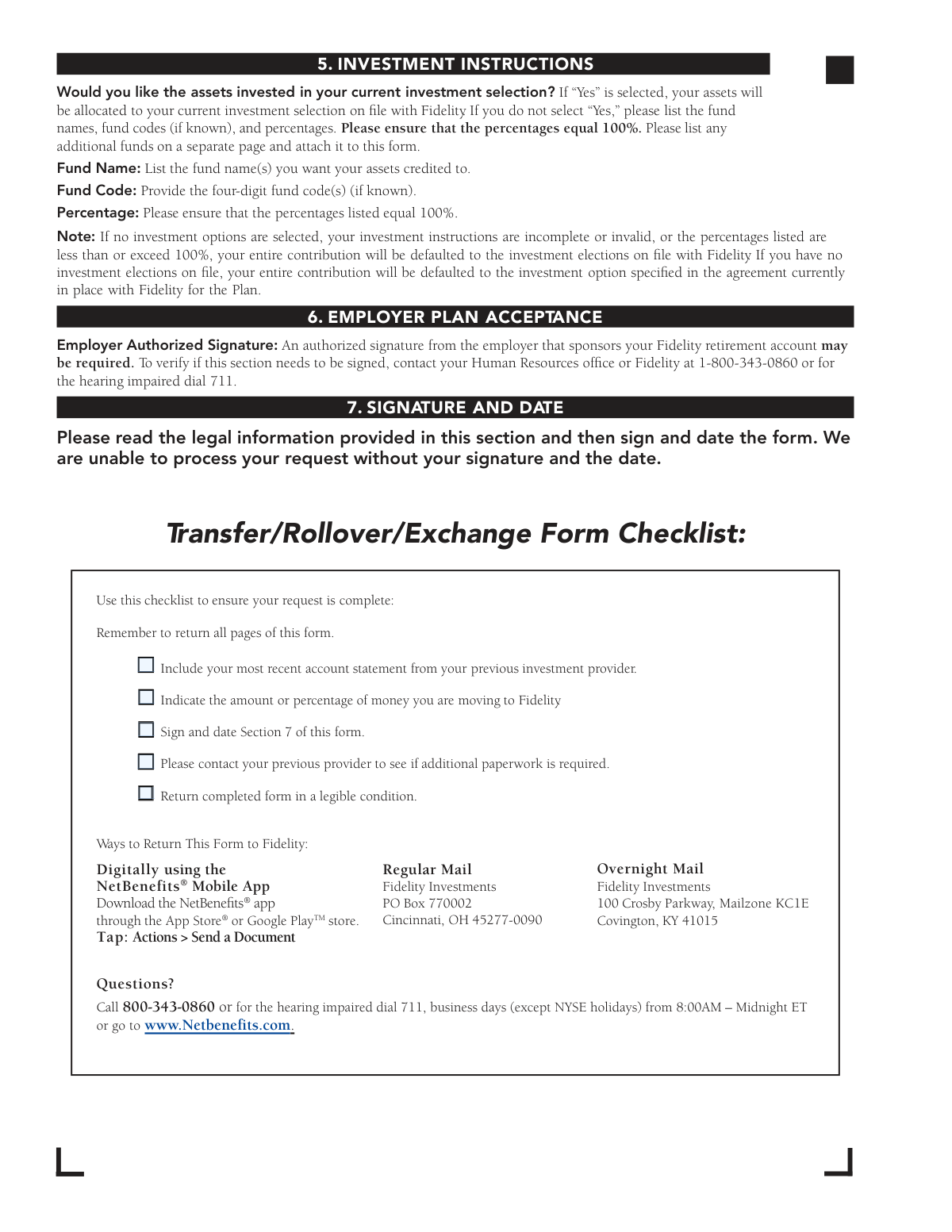
This validation verifies that the signature and date fields in Section 7 are both completed. A signature is legally required to authorize the transaction, and the date establishes when the authorization was given. An incomplete form lacking a signature or date cannot be processed and will be returned to the applicant, delaying the transfer.
If the user opts to specify new investment instructions in Section 5, this check confirms that the sum of all entered percentages equals exactly 100%. This ensures the entire rolled-over amount is allocated according to the user's wishes without ambiguity. If the total is not 100%, the form indicates the instructions are invalid and the funds will be placed in a default option, which may not align with the user's investment strategy.
This check is triggered if the user selects 'A Previous Employer' in Section 3. It validates that the 'Previous Employer Name' field has been filled out. This information is necessary for Fidelity to correctly classify the transaction as a rollover and ensure compliance with plan rules. Failure to provide the name will result in an incomplete request and processing delays.
When 'Partial Liquidation' is selected in Section 3, this check ensures that either a percentage OR a dollar amount is specified, but not both. This prevents ambiguity in the transfer request to the previous provider. If neither is specified, or if both are, the request is considered invalid and will require clarification, halting the process.
For each account being moved (3A and 3B), this validation confirms that at least one account type (e.g., 403(b), 401(a)/(k)) has been selected. This information is fundamental for determining the nature of the assets being moved and ensuring they are handled correctly under IRS rules. Without an account type, Fidelity cannot properly categorize the funds, and the request will be rejected.
And 8 more checks
- Enforces Single Transaction Source Selection
- Validates Roth Balance Inclusion Logic
- Checks for Plan Type Compatibility
- Requires Investment Details if 'No' is Selected
- Verifies Completeness of User's Personal Information
- Ensures Previous Provider Information is Complete
- Validates Date of Birth
- Confirms Fidelity Destination Account is Specified
Let AI fill out your Fidelity Rollover Form
No typing. Every field filled in seconds, checked, ready to sign.
How to Fill Out Fidelity Rollover Form Online for Free in 2026
What the AI walks you through.
- Navigate to Instafill.ai and upload or select the Fidelity Transfer/Rollover/Exchange Form.
- Use the AI assistant to automatically fill in your personal details in Section 1, such as name, address, and Social Security Number.
- Provide information about the investment provider you are moving assets from in Section 2. You will need a recent account statement for this.
- Detail the specific account(s) or contract(s) to be moved in Section 3, including account numbers, types (e.g., 401k, 403b), and the liquidation amount.
- Enter your destination Fidelity account information in Section 4 and specify your investment instructions for the transferred funds in Section 5.
- Review all the auto-filled information for accuracy, then digitally sign and date the form in Section 7.
- Download the completed form and submit it to Fidelity via their mobile app, mail, or overnight service, along with a copy of your most recent statement from the previous provider.
Common Mistakes in Completing Fidelity Rollover Form
The ones the AI is built to catch.
Forgetting to Include the Previous Provider's Statement
Missing Required Employer Signature in Section 6
Incorrect or Incomplete Previous Provider Information
Mismatching Account Types and Transaction Sources
Submitting an Illegible, Handwritten Form
Incomplete or Incorrect Investment Instructions
Forgetting to Sign and Date the Form
Failing to Check for Additional Paperwork from the Old Provider
Ambiguous Partial Liquidation Instructions
Entering an Incorrect Fidelity Plan Number or Type
Frequently Asked Questions About Fidelity Rollover Form
Is it really free for 7 days?
Can I fill other forms too?
How do I cancel?
How does the AI fill out Fidelity Rollover Form?
What happens to my information?
How complex is Fidelity Rollover Form to fill out?
What is the purpose of the Transfer/Rollover/Exchange Form?
What documents do I need to submit with this form?
Where can I find the account number for the account I'm moving?
What's the difference between 'Full Liquidation' and 'Partial Liquidation' in Section 3?
What happens if I don't fill out the 'Investment Instructions' in Section 5?
Does my employer need to sign this form?
How can I submit the completed form to Fidelity?
I want to move money from two different old providers. Can I use one form?
What if I don't have a Fidelity retirement account yet?
Can I use this form to roll over a Roth IRA?
What should I do if I'm not sure what my Fidelity Plan Type or Plan Number is?
Can AI tools help me fill out this form?
How can I fill out this Fidelity form online?
The PDF version of this form I have is not fillable. What can I do?
Get your Fidelity Rollover Form filled out by AI
$0 today. Cancel before Nov 1 and you pay nothing.
Other forms like this one
investment forms: Form 3468, Investment Credit, Form 8960, Net Investment Income Tax, How to Transfer Assets from Morgan Stanley to Fidelity Investments (Fidelity Stock Plan Services Guide), Fidelity Investments Transfer/Rollover/Exchange Form, Fidelity Investments Standing Transfer Instructions Form, One-Time Withdrawal – IRA, Fidelity Investments, Fidelity Investments Transfer/Rollover Form, Special Tax Notice: Your Rollover Options - Fidelity Investments, Fidelity Investment-Only (Non-Prototype) Retirement Account Application, Fidelity Investments® Beneficiary Distribution Form, Fidelity Investments Distribution Form, One-Time Withdrawal – Investment-Only (Non-Prototype) Retirement Account, Fidelity Investments Withdrawal — One-Time, Fidelity Investments Withdrawals—529 College Savings Plan, Fidelity Investments Change of Account Ownership — Mutual Fund Only Accounts, Fidelity Investments 403(b) Beneficiary Designation, Fidelity Investments Qualified Plan Beneficiary Designation, Fidelity Investments 403(b)/401(a) Beneficiary Designation, Fidelity Investments Qualified Plan Beneficiary Designation, Fidelity Investments Earnings Automatic Withdrawal Plan — IRA
rollover forms: Fidelity Investments Transfer/Rollover/Exchange Form, Rollover Request — 529 College Savings Plan, Fidelity Investments Transfer/Rollover Form, Fidelity Advisor IRA Distribution Request for Automatic Rollover Accounts, Special Tax Notice: Your Rollover Options - Fidelity Investments, Rollover Contribution Instructions & Application, A Place for Mom 401(k) Plan Request for Rollover Contribution Form, 401(k) Program Rollover Certification, New York State Deferred Compensation Plan Outgoing Rollover, Rollover Valet™ Request Form, Special Tax Notice: Your Rollover Options, New York State Deferred Compensation Plan Direct Rollover to a Roth IRA, WTIA 401(k) Plan Rollover Contribution Employee Certification, Fidelity Plan-to-Plan Direct Rollover Form, Fidelity Distribution—Rollover, Plan-to-Plan Direct Rollover Form, Rollover/Transfer Request — ABLE Account, Rollover Valet™ Request Form, Vanguard Direct Rollover IRA Adoption Agreement, The Vanguard 529 College Savings Plan Direct Rollover Out to Roth IRA Form
investment transfer forms: How to Transfer Assets from Morgan Stanley to Fidelity Investments (Fidelity Stock Plan Services Guide), Fidelity Investments Transfer/Rollover/Exchange Form, Fidelity Investments Standing Transfer Instructions Form, Fidelity Investments Transfer/Rollover Form, HSA Bank Investment Account Transfer Form, TIAA 1035 Exchange Authorization to Alternate Investment Company Transfer Payout Annuity for ATRA, U.S. Bancorp Investments Account Transfer Form, Computershare Alternative Investment Product Transfer Request, Pershing LLC Account Transfer Form, Thrivent Funds Transfer of Assets, Form MF11502, Electronic Funds Transfer (EFT) Authorization, Fidelity Transfer/Rollover/Exchange Form
Fidelity forms: Fidelity Funds Account Transfer of Assets Form, Fidelity Stock Plan Services (SPS) Transfer Request Form, How to Transfer Assets from Morgan Stanley to Fidelity Investments (Fidelity Stock Plan Services Guide), Fidelity Investments Transfer/Rollover/Exchange Form, Fidelity Investments Standing Transfer Instructions Form, Fidelity Charitable 144/145 Contribution Form, One-Time Withdrawal – IRA, Fidelity Investments, Fidelity Investments Transfer/Rollover Form, Fidelity Advisor 403(b) Distribution Request Form, Fidelity Advisor IRA Distribution Request for Automatic Rollover Accounts, Special Tax Notice: Your Rollover Options - Fidelity Investments, Fidelity Charitable Letter of Authorization, Fidelity Advisor Trading Authorization and Indemnification, Fidelity Investment-Only (Non-Prototype) Retirement Account Application, Fidelity NetBenefits Send a Document Form, Fidelity NetBenefits Auditor's Guide: An Overview of Fidelity's 2024 Plan Year Reporting Package, Fidelity NetBenefits Distribution - Recurring Payments, Fidelity Investments® Beneficiary Distribution Form, Fidelity Investments Distribution Form, Fidelity One-Time Withdrawal Form — Nonretirement
transfer forms: Form REG 227, Application for Replacement or Transfer of Title, City of Harvey Real Estate Transfer Declaration & Application (with Certificate for Exemption), DBPR ABT-6002 – Application for Transfer of Ownership of an Alcoholic Beverage License, DBPR ABT-6002, Division of Alcoholic Beverages and Tobacco Application for Transfer of Ownership of an Alcoholic Beverage License, Request for Transfer of Records (Adelaide Health Care) – AHC-0013-05-PS (Version 2), DBPR Form ABT-6002, Division of Alcoholic Beverages and Tobacco Application for Transfer of Ownership of an Alcoholic Beverage License, Pfändungs- und Überweisungsbeschluss (Garnishment and Transfer Order) – German Civil Enforcement Court Form, Fidelity Funds Account Transfer of Assets Form, Fidelity Stock Plan Services (SPS) Transfer Request Form, How to Transfer Assets from Morgan Stanley to Fidelity Investments (Fidelity Stock Plan Services Guide), Transfer Due to Divorce — IRA/HSA/529, Fidelity Investments Transfer/Rollover/Exchange Form, Fidelity Investments Standing Transfer Instructions Form, Fidelity Investments Transfer/Rollover Form, Group Transfer Form Fidelity Health Savings Account (HSA), Plan–to-Plan Transfer, Plan Exchange, or Service Credit Authorization Form, Beneficiaries — Nonretirement Transfer on Death, Transfer Shares as a Gift — Nonretirement, Form APP13017-29, Transfer Your Account to Schwab, Transfer of Assets Out - Partial Account or Charitable Gift Transfers
UK investment forms: Triple Point Venture VCT plc | Investor Application Form, Form 3468, Investment Credit, Form 8960, Net Investment Income Tax, How to Transfer Assets from Morgan Stanley to Fidelity Investments (Fidelity Stock Plan Services Guide), Fidelity Investments Transfer/Rollover/Exchange Form, Fidelity Investments Standing Transfer Instructions Form, One-Time Withdrawal – IRA, Fidelity Investments, Fidelity Investments Transfer/Rollover Form, Special Tax Notice: Your Rollover Options - Fidelity Investments, Fidelity Investment-Only (Non-Prototype) Retirement Account Application, Fidelity Investments® Beneficiary Distribution Form, Fidelity Investments Distribution Form, One-Time Withdrawal – Investment-Only (Non-Prototype) Retirement Account, Fidelity Investments Withdrawal — One-Time, Fidelity Investments Withdrawals—529 College Savings Plan, Fidelity Investments Change of Account Ownership — Mutual Fund Only Accounts, Fidelity Investments 403(b) Beneficiary Designation, Fidelity Investments Qualified Plan Beneficiary Designation, Fidelity Investments 403(b)/401(a) Beneficiary Designation, Fidelity Investments Qualified Plan Beneficiary Designation
Let AI fill out your Fidelity Rollover Form
Your trial starts once a card is added. You pay nothing before Nov 1.
Our AI already knows this form, all 90 fields of it. Skip the typing: tell it about yourself, or upload what you have, and it fills the whole form in seconds.
- AI fills every field on all 6 pages, checkboxes included
- No typing into boxes: answer a few questions, or upload a document you already have, an old copy of this form, a photo of a document
- The AI checks the answers; you review and change anything before you download
- Download the finished PDF, print it, or sign it online
- Encrypted, and never used to train AI
Cancel before Nov 1 and you pay nothing.
A card is needed to start the trial. Cancel in two clicks from your account.
Terms · Privacy