Fill out rollover forms
with AI.
Rollover forms are essential financial documents used to move retirement assets between different investment providers or employer-sponsored plans. Whether you are transferring funds from a 401(k), 403(b), or 457(b), these forms are the primary mechanism for ensuring your savings maintain their tax-advantaged status. By correctly documenting a direct rollover, you avoid the heavy tax penalties and mandatory withholdings that often accompany early or improper distributions, allowing your investments to continue growing uninterrupted.
By continuing, you acknowledge Instafill's Privacy Policy and agree to get occasional product update and promotional emails.
About rollover forms
Most individuals encounter these forms during major life transitions, such as starting a new job, retiring, or consolidating multiple old accounts into a single, easier-to-manage portfolio. You might need a Fidelity Transfer/Rollover/Exchange Form to bring assets into a current employer's plan or a Vanguard Direct Rollover IRA Adoption Agreement to move funds into a personal retirement account. Additionally, these forms are frequently used for specialized accounts, such as 529 college savings plans or ABLE accounts for individuals with disabilities.
Completing these documents accurately is vital to prevent processing delays or misdirected funds. Tools like Instafill.ai use AI to fill these forms in under 30 seconds, handling your sensitive data accurately and securely to streamline your financial transitions.
Every form on this page can be completed without typing. Instafill is form filling software that reads a PDF and fills it for you — including flat and scanned documents that carry no fillable fields at all.
Forms in This Category
The forms in this category have a median Form Complexity Index of 45/100 (Basic), measured across 51 forms by field count, input difficulty, length, conditional logic and structure. See how it is calculated.
- Enterprise-grade security & data encryption
- 99%+ accuracy powered by AI
- 1,000+ forms from all industries
- Complete forms in under 60 seconds
How to Choose the Right Form
Navigating retirement rollovers can be complex, but choosing the right form depends primarily on where your money is going and which financial institution is managing the destination account.
Consolidating into an Employer-Sponsored Plan
If you have recently started a new job and want to move funds from a previous 401(k), 403(b), or IRA into your current workplace plan, look for "Incoming" or "Transfer" forms specific to your provider:
- Fidelity: Use the Fidelity Investments Transfer/Rollover/Exchange Form to consolidate various retirement assets into a Fidelity employer-sponsored account.
- Vanguard: Use the Vanguard Rollover Contribution Request for general transfers, or plan-specific versions like the Vanguard Phillips 66 Savings Plan Rollover Contribution Request.
- Empower/Schwab: Select the Empower Incoming Rollover Form or the Rollover Contribution Instructions & Application for Charles Schwab accounts.
Moving Funds Out or Between Internal Accounts
If you are leaving a company or moving funds between two plans managed by the same provider, you need distribution or "Plan-to-Plan" forms:
- Fidelity Users: The Fidelity NetBenefits Distribution—Rollover Form is for moving assets out to an IRA or a new employer. If you are moving assets between two different Fidelity-managed employer plans, use the Fidelity NetBenefits Plan-to-Plan Direct Rollover Form.
- Government/State Employees: Use specific forms like the New York State Deferred Compensation Plan Outgoing Rollover or the Oklahoma Pathfinder 457 Plan Incoming Transfer/Rollover Request for governmental 457(b) plans.
Specialized Rollovers: 529, ABLE, and Inherited IRAs
Not all rollovers involve standard 401(k)s. Specific life events or savings goals require specialized documentation:
- Education: Use the Rollover Request — 529 College Savings Plan to move funds between 529 plans or the The Vanguard 529 College Savings Plan Direct Rollover Out to Roth IRA Form for transfers to a beneficiary's Roth IRA.
- Disability Savings: The Fidelity ABLE Account Rollover/Transfer Request Form is required for moving assets into a tax-advantaged ABLE account.
- Beneficiaries: If you are managing assets from a deceased participant, use the Inherited IRA Transfer of Assets/ Direct Rollover Form to ensure assets are correctly titled.
Form Comparison
| Form | Purpose | Source Account | Destination Account | Key Feature |
|---|---|---|---|---|
| Fidelity Investments Transfer/Rollover/Exchange Form | Consolidates retirement assets into a Fidelity employer-sponsored retirement plan. | Previous employer plans (401k, 403b, 457b) or existing IRAs. | A Fidelity employer-sponsored 401(k), 403(b), or 457(b) account. | Used to bring outside retirement savings into your current workplace plan. |
| Fidelity NetBenefits Distribution—Rollover Form | Requests an outgoing rollover from a workplace plan to another provider. | Current or former Fidelity-managed workplace retirement plan. | An Individual Retirement Account (IRA) or a new employer's plan. | Essential for individuals changing jobs or retiring to preserve tax-advantaged status. |
| Rollover Request — 529 College Savings Plan | Moves education savings from an existing plan into a Fidelity 529. | External 529 plans, Coverdell ESAs, or qualified U.S. Savings Bonds. | A Fidelity-managed 529 College Savings Plan. | Ensures compliance with the IRS once-per-12-months rollover rule for education. |
| Fidelity ABLE Account Rollover/Transfer Request Form | Transfers funds into a tax-advantaged account for individuals with disabilities. | Non-Fidelity ABLE accounts or 529 college savings accounts. | A Fidelity ABLE (Achieving a Better Life Experience) account. | Allows 529-to-ABLE rollovers without triggering tax penalties for eligible individuals. |
| Vanguard Direct Rollover IRA Adoption Agreement | Opens a new Vanguard IRA using funds from a workplace plan. | Employer-sponsored retirement plan currently administered by Vanguard. | A new Vanguard Traditional or Roth Individual Retirement Account. | Combines the account opening process with the asset transfer instructions. |
| The Vanguard 529 College Savings Plan Direct Rollover Out to Roth IRA Form | Transfers unused education savings into a retirement account for the beneficiary. | The Vanguard 529 College Savings Plan. | A Roth IRA established for the 529 plan's designated beneficiary. | Navigates specific IRS lifetime limits and account age requirements for transfers. |
| New York State Deferred Compensation Plan Outgoing Rollover | Authorizes the transfer of assets from a NYS 457(b) plan. | New York State Deferred Compensation Plan (NYSDCP) account. | An IRA or a new employer's qualified retirement plan. | Specific to public sector employees who have separated from service. |
| Inherited IRA Transfer of Assets/ Direct Rollover Form | Moves assets from a deceased participant's plan to a beneficiary account. | Retirement plan account of a deceased individual. | An Inherited IRA at Voya Investment Management. | Ensures inherited assets are correctly titled and managed under inheritance rules. |
| Oklahoma Pathfinder 457 Plan Incoming Transfer/Rollover Request | Consolidates retirement funds into the Oklahoma state retirement system. | Previous employer's 401(k), 403(b), or 457(b) accounts. | Oklahoma Pathfinder Governmental 457(b) Plan. | Designed specifically for Oklahoma public sector employees to centralize savings. |
| Special Tax Notice: Your Rollover Options | Provides mandatory legal information regarding tax consequences of plan distributions. | Any employer-sponsored retirement plan. | N/A (Informational Document). | Required IRS disclosure that must be read before making a rollover election. |
| Fidelity Advisor IRA Distribution Request for Automatic Rollover Accounts | Requests a distribution from an IRA established by a former employer. | An Automatic Rollover IRA created when leaving a previous job. | Cash distribution or rollover to a new retirement account. | Handles accounts that were automatically set up without the participant's direct initiation. |
| Voya Individual Retirement Account (IRA) Application and Adoption Agreement | Establishes a new Voya IRA account via transfer or rollover. | Existing IRAs or previous employer-sponsored retirement plans. | Voya Traditional, Roth, Rollover, or SEP IRA. | Comprehensive package including custodial agreements, applications, and investment selections. |
Tips for rollover forms
Double-check your old account number and the new plan's delivery instructions before finalizing the document. Even a small typo in a plan ID can lead to funds being misdirected or checks being mailed to the wrong address, causing significant delays in your asset transfer.
Whenever possible, opt for a direct trustee-to-trustee transfer to prevent the 20% mandatory federal tax withholding associated with indirect rollovers. This ensures the full balance of your retirement savings reaches the new account without you having to replace the withheld amount out-of-pocket to maintain tax-deferred status.
Many financial institutions require a Medallion Signature Guarantee or a Notary Public to witness your signing, especially for high-value distributions. Identifying these requirements before you start can prevent your form from being rejected for lack of proper authorization and save you an extra trip to the bank.
Clearly label which portion of your rollover consists of Roth after-tax funds versus traditional pre-tax contributions on the form. Failing to categorize these correctly can lead to permanent tax reporting errors and potential penalties when you eventually begin taking distributions in retirement.
Consolidating multiple retirement accounts often involves complex and repetitive paperwork. AI-powered tools like Instafill.ai can complete these forms in under 30 seconds with high accuracy, and your data stays secure during the process, making it a major time-saver for those managing several rollovers.
Save a digital or physical copy of every signed form and the accompanying Special Tax Notice for your records. These documents are essential for verifying the tax-free status of the transfer if the IRS questions the transaction or if there is a discrepancy in your year-end tax statements.
Frequently Asked Questions
Rollover forms are used to move retirement or education savings from one account or provider to another without triggering immediate taxes or penalties. These forms ensure that assets from 401(k)s, IRAs, 403(b)s, or 529 plans are correctly tracked and credited to your new account while maintaining their tax-advantaged status.
You typically need these forms when you change jobs and want to move your old 401(k) into your new employer's plan or an IRA. They are also used when consolidating multiple retirement accounts into a single provider to simplify management or when transferring inherited retirement assets to a new custodian.
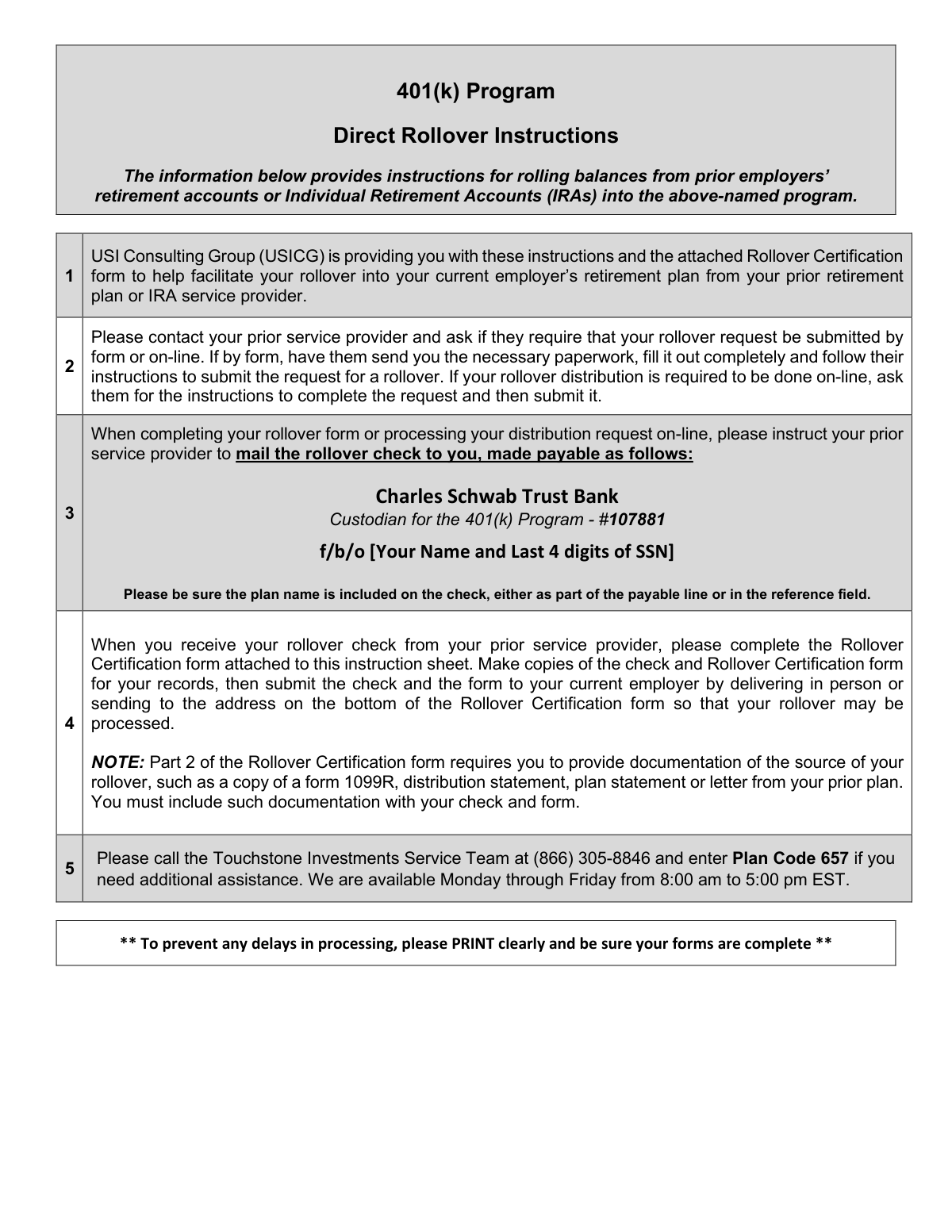
A direct rollover moves funds directly from one financial institution to another, often via a check made out to the new custodian, which avoids mandatory tax withholding. An indirect rollover involves the funds being paid to you first; you then have 60 days to deposit the full amount into a new retirement account to avoid taxes and potential early withdrawal penalties.
Yes, you can use AI tools like Instafill.ai to fill out complex retirement and rollover forms in under 30 seconds. The AI accurately extracts data from your source documents—such as existing account statements or old plan details—and places it into the correct fields on the PDF automatically.
Most rollover forms require your personal identification, the account number and name of the distributing plan, and the details of the receiving institution. You may also need to specify the breakdown of funds being moved, such as pre-tax, after-tax, or Roth contributions, to ensure they are handled correctly by the new custodian.
While manually filling out these forms can take 15 to 20 minutes due to the technical nature of the fields, using an AI-powered service can reduce this to less than 30 seconds. These tools help ensure that long account numbers and technical plan names are entered correctly, significantly reducing the risk of processing delays.
Some rollover forms, especially those involving large sums or requiring spousal consent for distributions, may require a notary public or a Medallion Signature Guarantee. You should check the specific instructions on the form to see if you need to visit a bank or a notary before submitting the document.
Yes, there are specific forms designed for 529 plan rollovers, which allow you to move education savings between state plans or even into a Roth IRA for the beneficiary under certain conditions. These forms help track the principal and earnings portions of the account to ensure the transfer remains tax-free.
Depending on the type of rollover, you may need to submit the form to your new plan's custodian, your former employer's plan administrator, or both. Always review the 'Submission Instructions' section of the specific form to determine if it should be mailed, faxed, or uploaded through a secure provider portal.
Errors on rollover forms can lead to rejected transfers, delayed funding, or even unintended tax consequences if the IRS views the transaction as a taxable distribution. Using digital tools to verify information before submission is a common way to avoid these issues and ensure all required signatures are in place.
Yes, individuals with disabilities can use specific rollover forms to move assets between ABLE (Achieving a Better Life Experience) accounts or from a 529 plan into an ABLE account. These forms ensure the transfer remains tax-free and complies with IRS rules regarding annual contribution limits and beneficiary eligibility.
Glossary
- Form Complexity Index
- Instafill’s 0–100 measure of how much effort a form takes to complete, calculated deterministically from the form’s own structure rather than estimated. It combines the number of fillable fields (the largest factor), how difficult those fields are to complete based on their type, the number of pages that contain fields, the amount of conditional “fill-only-if” logic, and how many sections the form is divided into, then adds modifiers for tables and repeating lists, bundled instruction pages, and dense page layouts. A higher score means the form is harder to fill out by hand. The forms in this category have a median Form Complexity Index of 45/100 (Basic). See exactly how it is calculated.
- Direct Rollover
- A distribution from a retirement plan paid directly to an IRA or another employer-sponsored plan. This method is preferred because the funds are not taxed at the time of the transfer and no money is withheld for federal income tax.
- Indirect Rollover
- A rollover where the retirement funds are paid directly to the account holder, who must then deposit them into a new eligible plan within 60 days. If the 60-day deadline is missed, the distribution is generally treated as taxable income and may be subject to early withdrawal penalties.
- Qualified Plan
- An employer-sponsored retirement plan that meets IRS tax-code requirements, such as a 401(k), 403(b), or 457(b). These plans allow for tax-deferred growth and are the most common sources of rollover assets.
- Medallion Signature Guarantee
- A special certification stamp provided by a financial institution that confirms a signature is genuine and the signer has the legal authority to transfer the assets. This is more rigorous than a standard notary and is often required for high-value transfers.
- Vested Balance
- The portion of a retirement account that an employee legally owns and is entitled to take with them when they leave a job. While employee contributions are always 100% vested, employer matching funds may require a certain number of years of service before they can be rolled over.
- QDRO (Qualified Domestic Relations Order)
- A legal order, typically issued during a divorce, that grants a spouse or dependent the right to receive a portion of a participant's retirement plan assets. Special rollover forms are often required to move these funds into the recipient's own account.
- Plan Sponsor
- The employer or organization that establishes and maintains the retirement plan for its employees. The plan sponsor often must sign off on rollover requests to certify that the distribution is allowed under the plan's specific rules.
- Trustee-to-Trustee Transfer
- A transfer of retirement assets directly from one financial institution to another without the account owner ever taking possession of the funds. This is the standard procedure for moving funds between two IRAs of the same type.