Yes! You can use AI to fill out Special Tax Notice: Your Rollover Options
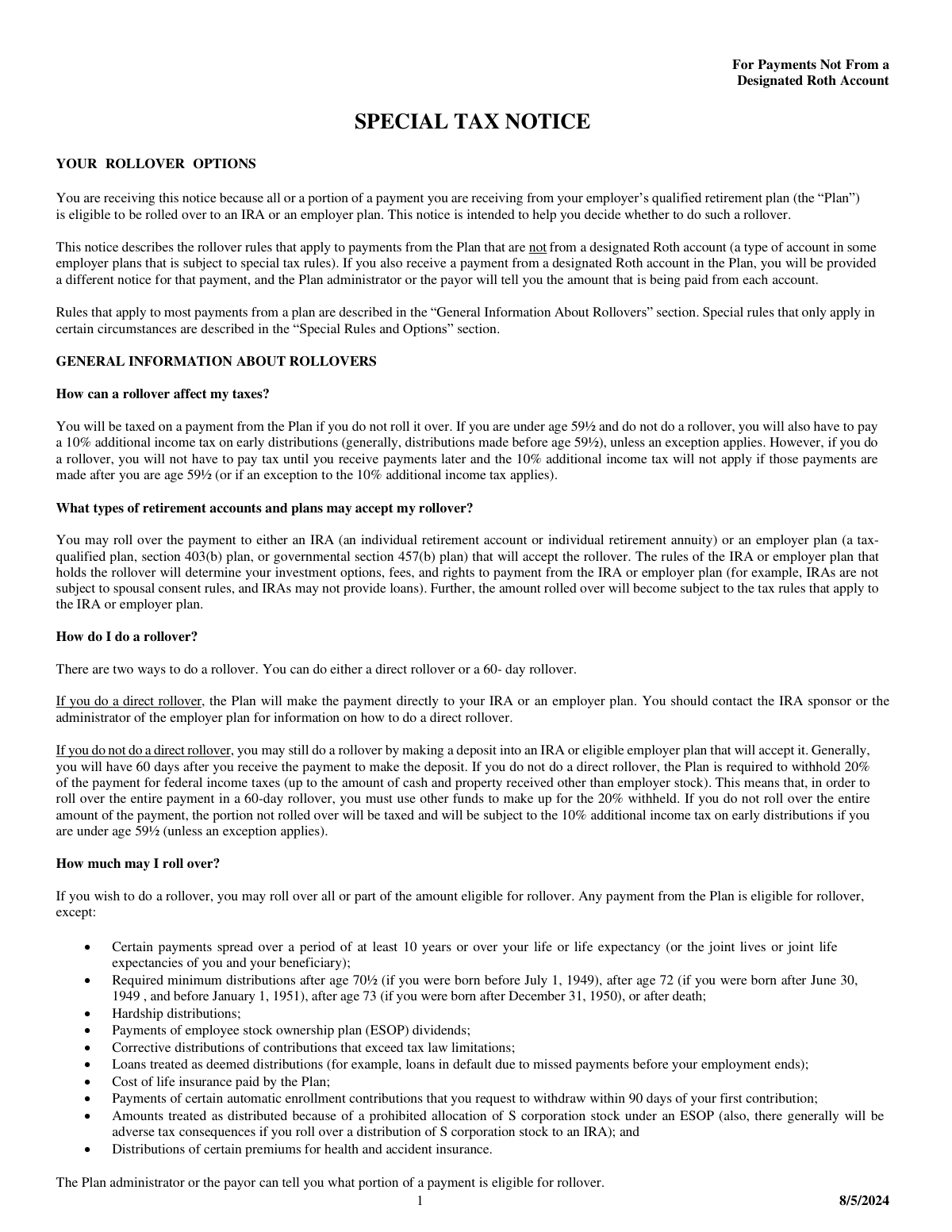
The Special Tax Notice is a mandatory document provided to individuals receiving an eligible rollover distribution from an employer's retirement plan. It outlines the rules for rollovers, explains the tax consequences of taking a cash distribution versus rolling it over, and describes the different types of accounts that can receive the funds. Understanding this notice is crucial for making informed financial decisions to avoid immediate taxes and potential penalties; today, this form can be filled out quickly and accurately using AI-powered services like Instafill.ai, which can also convert non-fillable PDF versions into interactive fillable forms.
Rather not fill this in by hand? Instafill is an online form filler that completes PDF forms automatically — upload the blank form, answer a few questions, and the AI fills every field.
Form specifications
| Form name: | Special Tax Notice: Your Rollover Options |
| Number of pages: | 1 |
| Language: | English |
Our AI automatically handles information lookup, data retrieval, formatting, and form filling.
It takes less than a minute to fill out Special Tax Notice using our AI form filling.
Securely upload your data. Information is encrypted in transit and deleted immediately after the form is filled out.
Instafill Demo: How to fill out PDF forms in seconds with AI
How to Fill Out Special Tax Notice Online for Free in 2026
Are you looking to fill out a SPECIAL TAX NOTICE form online quickly and accurately? Instafill.ai offers the #1 AI-powered PDF filling software of 2026, allowing you to complete your SPECIAL TAX NOTICE form in just 37 seconds or less.
Follow these steps to fill out your SPECIAL TAX NOTICE form online using Instafill.ai:
- 1 Navigate to Instafill.ai and upload your Special Tax Notice and any accompanying distribution or rollover forms.
- 2 Use Instafill's AI to review the notice and automatically extract key details, such as the eligible rollover amount and deadlines.
- 3 The AI will guide you through the associated rollover/distribution form, pre-filling information based on the notice and your personal data.
- 4 Indicate your choice, such as a direct rollover, 60-day rollover, or cash distribution, by selecting the appropriate options on the interactive form.
- 5 Review the completed form for accuracy, ensuring all rollover instructions, destination account details, and personal information are correct.
- 6 Electronically sign the form if required and securely download or submit it directly to your plan administrator as instructed.
Our AI-powered system ensures each field is filled out correctly, reducing errors and saving you time.
Why Choose Instafill.ai for Your Fillable Special Tax Notice Form?
Speed
Complete your Special Tax Notice in as little as 37 seconds.
Up-to-Date
Always use the latest 2026 Special Tax Notice form version.
Cost-effective
No need to hire expensive lawyers.
Accuracy
Our AI performs 10 compliance checks to ensure your form is error-free.
Security
Your personal information is protected with bank-level encryption.
Frequently Asked Questions About Special Tax Notice
This notice explains your options for an upcoming payment from your employer's retirement plan. It details the tax implications and helps you decide whether to roll over the funds to an IRA or another plan to defer taxes.
You received this notice because you are eligible to receive a payment from your retirement plan that can be rolled over. This document is required by law to inform you of your choices and their tax consequences.
A direct rollover sends the money straight from your old plan to your new IRA or plan with no tax withholding. For a 60-day rollover, you receive a check with 20% withheld for taxes, and you have 60 days to deposit the full amount into a new account to avoid taxes and penalties.
If you do not roll over the payment, it will be taxed as ordinary income in the current year. If you are under age 59½, you will likely also face an additional 10% early distribution tax.
No, this is an informational notice, not a form to be completed. To initiate a rollover, you will need to complete separate paperwork provided by your plan administrator or the financial institution receiving the funds.
Yes, you can roll over all or part of the amount that is eligible for rollover. Any portion you receive directly and do not roll over will be subject to income tax and potential penalties.
Certain payments are not eligible for rollover, including required minimum distributions (RMDs), hardship distributions, and loan defaults treated as distributions. Your plan administrator can tell you exactly what portion of your payment is eligible.
As a surviving spouse, you have the same rollover options as the participant, including rolling it into your own IRA or an inherited IRA. Each option has different rules for required distributions and taxes, so you should review them carefully.
A non-spouse designated beneficiary can only roll over the payment via a direct rollover to an inherited IRA. This avoids the 10% early withdrawal penalty, but you will have to take required minimum distributions from the account.
The 60-day deadline is strict, but the IRS has limited authority to grant a waiver for extraordinary circumstances. You may be able to self-certify or may need to request a private letter ruling from the IRS, which requires a user fee.
Yes, services like Instafill.ai use AI to accurately auto-fill the necessary rollover or distribution forms from your plan administrator. This can save time and help you avoid common errors on complex paperwork.
Simply upload the distribution or rollover forms provided by your plan to the Instafill.ai platform. The AI will identify all the fields, allowing you to fill them out quickly and accurately online.
You can use a service like Instafill.ai to convert the non-fillable PDF into an interactive, fillable form. Just upload the document, and the platform will make it easy to complete, sign, and download electronically.
Compliance Special Tax Notice
Validation Checks by Instafill.ai
1
Verifies Age for Early Distribution Penalty
This check validates the participant's age based on their date of birth against the distribution date. If the participant is under age 59½, it confirms that a valid exception (e.g., disability, separation from service at age 55+) is documented to waive the 10% additional income tax. This is critical for ensuring correct tax withholding and reporting to the IRS and preventing incorrect penalties from being assessed.
2
Ensures Correct Required Minimum Distribution (RMD) Calculation
This validation cross-references the participant's date of birth with IRS rules to determine the correct RMD age (72 or 73). It then calculates any RMD amount for the current year, which is ineligible for rollover. This check is essential for compliance, as failing to properly identify and handle RMDs can lead to significant tax penalties for the participant.
3
Validates Rollover Eligibility of Distribution Components
The system checks the source of all funds within the distribution to ensure the final rollover-eligible amount is calculated correctly. It must exclude ineligible amounts such as hardship distributions, RMDs, certain ESOP dividends, and corrective distributions. An incorrect calculation could lead to an illegal rollover and subsequent tax complications.
4
Confirms Public Safety Officer Exception Criteria
If a participant claims an early distribution exception as a public safety officer, this check verifies their employment classification is 'qualified public safety employee'. It also validates that they meet the required criteria, such as separation from service in or after the year they turn 50 or after completing 25 years of service. This prevents misapplication of this special tax rule.
5
Validates Non-Spouse Beneficiary Rollover Restrictions
This check identifies if the recipient is a non-spouse designated beneficiary. If so, it restricts their rollover options exclusively to a direct rollover into an 'Inherited IRA'. The validation prevents the system from offering or processing a 60-day rollover or a rollover to an employer plan, which are not permitted for non-spouse beneficiaries.
6
Restricts Rollover Method for After-Tax Contributions to Employer Plans
This validation enforces the rule that after-tax contributions can only be moved to another employer plan via a direct rollover. It will block any transaction attempting to process a 60-day rollover of after-tax funds to an employer plan. This is important for maintaining proper tax basis tracking in the receiving plan.
7
Applies Correct Rollover Deadline for Loan Offsets
This check determines the reason for a plan loan offset to apply the correct rollover deadline. It distinguishes between a 'qualified plan loan offset' (due to separation/termination), which has an extended deadline, and other offsets (due to default), which have a 60-day deadline. This ensures participants are given the correct timeframe to avoid having the offset amount taxed.
8
Flags Eligibility for Special 1936 Birth Year Tax Rule
The system validates the participant's date of birth to see if they were born on or before January 1, 1936. If this condition is met, a flag is set to ensure the participant is notified of potential special tax calculation rules for their lump-sum distribution. This provides crucial information for their tax planning and filing.
9
Verifies Nonresident Alien Status for Tax Withholding
This check confirms the participant's residency status. If the participant is identified as a nonresident alien, the system validates that the mandatory tax withholding rate is set to 30% for any payment not processed as a direct rollover, instead of the standard 20%. This is critical for maintaining compliance with federal tax laws for foreign entities.
10
Enforces De Minimis Distribution Rules
This validation checks if the total annual payment amount is less than $200. If it is, the system confirms that direct rollover options are disabled and that tax withholding is not applied, as per plan rules. This check simplifies processing for very small distributions and aligns with regulatory allowances.
11
Validates Recipient Status for QDRO Payments
When a payment is designated as being made under a Qualified Domestic Relations Order (QDRO), this check verifies the recipient is a spouse or former spouse. It ensures the payment is correctly exempted from the 10% early distribution tax. This validation is crucial for correct tax treatment and reporting for payments related to divorce settlements.
12
Ensures Plan Type and Distribution Rules are Consistent
This validation checks the participant's plan type (e.g., governmental 457(b), 401(k), ESOP) and ensures the rules and options presented are appropriate for that plan. For instance, it would confirm that the 10% early withdrawal penalty is not mentioned as a default for a 457(b) plan distribution. This prevents providing confusing or incorrect information to the participant.
13
Validates Mandatory Cash-Out Rollover Logic
For involuntary distributions, this check verifies if the amount is over $1,000 (and below the plan's upper limit). If the participant does not make an election, the system validates that the process for a mandatory direct rollover to a plan-selected IRA is initiated. This ensures compliance with safe harbor rules designed to preserve retirement savings.
Common Mistakes in Completing Special Tax Notice
When choosing a 60-day rollover instead of a direct rollover, the plan is required to withhold 20% for federal taxes. Many people don't realize they must use their own funds to make up this 20% to roll over the full distribution amount. This results in the withheld portion becoming a taxable distribution, potentially subject to a 10% early withdrawal penalty. To avoid this, opt for a direct rollover where funds are sent straight to the new institution, which prevents any mandatory withholding.
The notice lists several payment types that cannot be rolled over, such as hardship distributions and Required Minimum Distributions (RMDs). Individuals often mistakenly try to include these amounts in their rollover request. This can lead to the rollover being rejected or, if accepted in error, result in tax penalties for an invalid rollover. Before filling out any forms, confirm the exact rollover-eligible amount with your plan administrator.
When a distribution includes after-tax contributions, the individual is responsible for tracking that non-taxable basis, especially when rolling into an IRA. People often forget this step, leading to the entire amount being taxed again upon withdrawal from the IRA. To prevent this double taxation, maintain meticulous records of after-tax amounts and ensure they are reported correctly on future tax returns when taking distributions.
Individuals who receive a check for their distribution have only 60 days to deposit it into a new retirement account. This deadline is strict and often missed due to procrastination or unforeseen delays. Missing the deadline makes the entire distribution taxable for that year and subject to penalties, with IRS waivers being rare and costly to obtain. The simplest way to avoid this is to choose a direct rollover; if you must do a 60-day rollover, deposit the funds immediately.
Rolling pre-tax funds from a traditional plan into a Roth IRA is a taxable conversion event, a fact many people overlook. They are surprised by a large, unexpected income tax bill for the year of the rollover. Before choosing a Roth rollover, you must understand that the entire pre-tax amount becomes taxable income and plan accordingly. Consulting a tax advisor can help determine if a Roth conversion is appropriate for your financial situation.
The rules for avoiding the 10% early withdrawal penalty differ between employer plans and IRAs. For example, the exception for separating from service at age 55 applies to plans but not to IRAs. This confusion can lead to taking a distribution from an IRA and incurring an unexpected 10% penalty. Carefully review the specific exceptions listed in the notice for the type of account you are withdrawing from before making a decision.
A non-spouse beneficiary has very specific rules: they can only perform a direct rollover to a properly titled 'inherited IRA'. Many beneficiaries mistakenly try to do a 60-day rollover or move the funds into their own personal IRA. This invalidates the rollover, makes the entire distribution immediately taxable, and forfeits the ability to stretch distributions over time. It is crucial to instruct the plan administrator to make a direct transfer to an inherited IRA.
A surviving spouse can treat an inherited plan as their own IRA or as an inherited IRA, each with different rules for RMDs and penalties. A younger spouse might accidentally treat it as their own, subjecting them to early withdrawal penalties, while an older spouse might miss strategic advantages by choosing the inherited option. This decision has long-term consequences and should be made after carefully comparing the rules based on your age and financial needs, preferably with a financial advisor.
When employment ends, an outstanding plan loan is often offset against the account balance, which is treated as a taxable distribution. People frequently fail to realize this offset amount is eligible for a rollover and that they must use other funds to complete it. This oversight results in the loan balance being taxed as income and potentially penalized. To avoid this, be prepared to roll over the offset amount within the specified timeframe to defer taxation.
The tax notice explicitly warns that it does not cover state or local tax rules, which is a detail many people ignore. State tax laws on retirement distributions and rollovers can vary significantly from federal rules, potentially leading to an unexpected tax liability. Always research your state's specific tax laws or consult a local tax professional before taking a distribution to avoid a surprise tax bill.
When a distribution contains both pre-tax and after-tax money, the notice explains you can choose which destination receives the after-tax portion in a direct rollover. People often fail to make this designation on the distribution form. This can result in a non-optimal allocation by the plan administrator, missing a key opportunity to segregate after-tax funds, for instance, into a Roth IRA. Carefully specifying the allocation on the form is critical for tax efficiency.
This notice covers complex financial and tax topics and explicitly recommends consulting a tax advisor and reading detailed IRS publications. A common mistake is to make a significant, irreversible decision based on a quick skim of the notice alone. This can lead to costly errors due to misunderstanding nuanced rules. To avoid mistakes, it is essential to seek professional advice or use the referenced IRS publications (e.g., 575, 590-A) for comprehensive guidance.
Saved over 80 hours a year
“I was never sure if my IRS forms like W-9 were filled correctly. Now, I can complete the forms accurately without any external help.”
Kevin Martin Green
Your data stays secure with advanced protection from Instafill and our subprocessors




Robust compliance program
Transparent business model
You’re not the product. You always know where your data is and what it is processed for.
ISO 27001, HIPAA, and GDPR
Our subprocesses adhere to multiple compliance standards, including but not limited to ISO 27001, HIPAA, and GDPR.
Security & privacy by design
We consider security and privacy from the initial design phase of any new service or functionality. It’s not an afterthought, it’s built-in, including support for two-factor authentication (2FA) to further protect your account.
Fill out Special Tax Notice with Instafill.ai
Worried about filling PDFs wrong? Instafill securely fills special-tax-notice-your-rollover-options forms, ensuring each field is accurate.
