
Yes! You can use AI to fill out Fidelity Advisor IRA Distribution Request for Automatic Rollover Accounts
Don't type 39 fields by hand. Tell our AI about yourself, or upload a document you already have, and it fills every field in seconds. You check it, then download, print or sign.
The AI does the filling. You just check it.
No typing into boxes, nothing to install.
What this form asks for
The AI fills all of it, from your answers or your documents.
The AI checks your answers before you download
16 checks built for this form, so a wrong date or a missing answer is caught before anyone else sees it.
Validates that the SSN field (AC_SSN) contains exactly 9 numeric digits in the standard format (XXX-XX-XXXX or 9 consecutive digits). The SSN is required for IRS tax reporting purposes, as Fidelity must issue a Form 1099-R for the distribution. If the SSN is missing, incorrectly formatted, or does not match IRS records, federal income tax will be automatically withheld at the default 10% rate and the form cannot be processed.
Validates that the Date of Birth (AC_DOB) is in MM/DD/YYYY format, represents a valid calendar date, and is logically consistent with the distribution reason code selected in Section 3 (RD_Distribution). For example, if the account owner's calculated age is 59½ or older, an Early Distribution code (Code 1 or J) should not be selected, and conversely, if the owner is under 59½, a Normal Distribution code (Code 7 or T) should not be selected. Mismatches between age and distribution code could result in incorrect IRS tax reporting and potential penalties for the account holder.
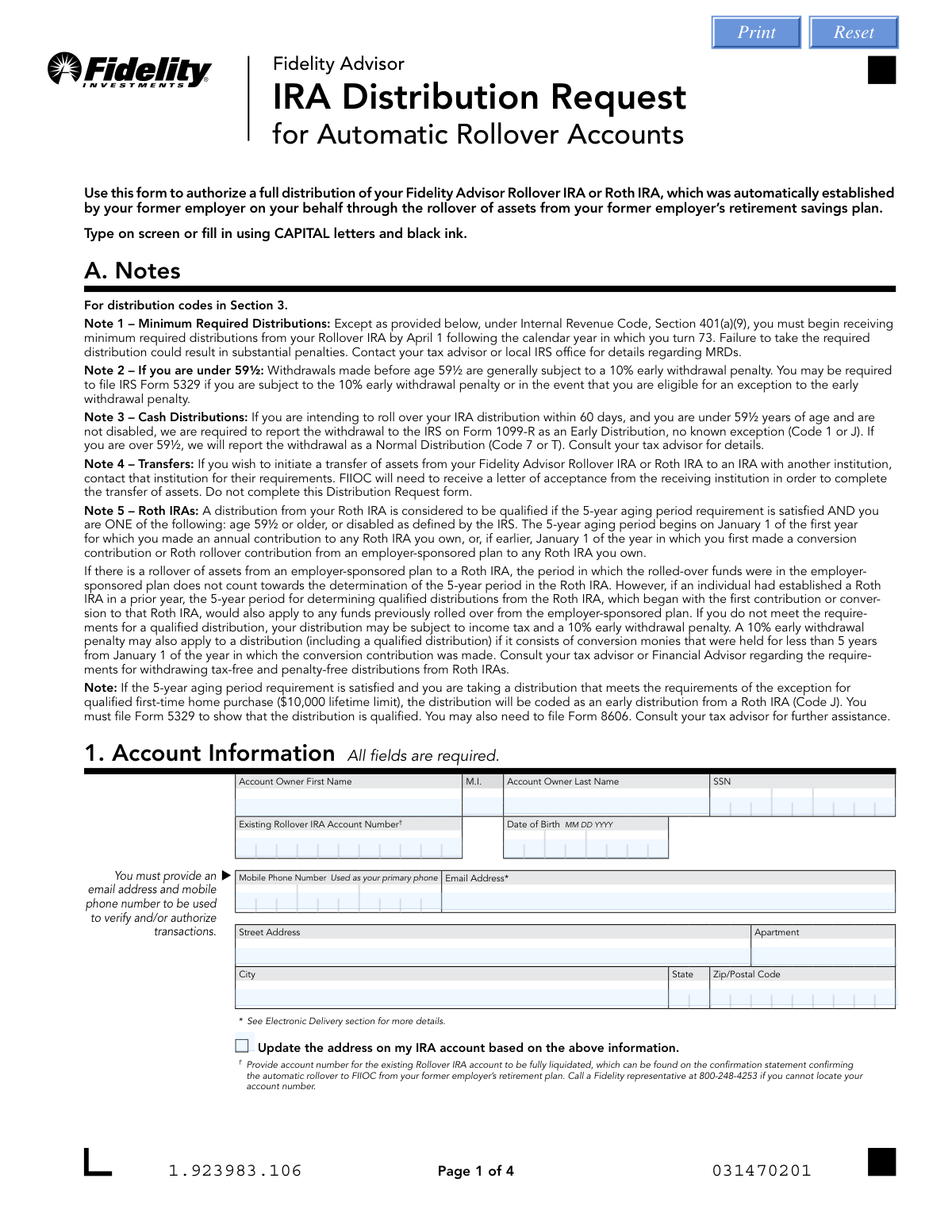
Validates that all fields marked as required in Section 1 are populated, including Account Owner First Name (AC_FirstName), Last Name (AC_LastName), SSN (AC_SSN), Existing Rollover IRA Account Number (AC_Account), Date of Birth (AC_DOB), Mobile Phone Number (AI_MobileNumber), and Email Address (AI_Email). The form explicitly states 'All fields are required' in Section 1, and missing any of these fields will prevent the form from being processed. Incomplete submissions will be returned to the account owner, delaying the distribution.
Validates that the Email Address field (AI_Email) contains a properly formatted email address following the standard pattern (e.g., [email protected]), is not left blank, and does not belong to an authorized agent or representative as explicitly prohibited by the form's instructions. The email address is required for electronic delivery consent verification, and Fidelity will send a confirmation message to this address to complete the consent process. An invalid or agent-owned email address will prevent the electronic delivery consent from being confirmed and may delay processing.
Validates that the Mobile Phone Number (AI_MobileNumber) is entered in a valid U.S. phone number format containing exactly 10 digits (e.g., XXX-XXX-XXXX or (XXX) XXX-XXXX), with no letters or special characters other than standard formatting. The mobile number is designated as the primary contact and is used by Fidelity to verify and authorize transactions via call or text message. An incorrectly formatted or missing phone number will prevent transaction verification and block form processing.
Validates that one and only one distribution reason code is selected in Section 3 (RD_Distribution), and that the selection is appropriate for the account type (Rollover IRA vs. Roth IRA). The form provides separate sets of codes for Rollover IRA accounts (Codes 7, 1, 3, G) and Roth IRA accounts (Codes T, J), and selecting a code from the wrong account type or selecting multiple codes would result in incorrect IRS Form 1099-R reporting. Failure to select exactly one valid code will cause the form to be rejected or result in an incorrect tax filing.
And 10 more checks
- Trustee Employer Plan Name Required When Code G Is Selected
- Exactly One Distribution Method Selected in Section 4
- Alternate Address Fields Completeness When Option B Is Selected
- Overnight Delivery Eligibility Consistency Check
- Federal Tax Withholding Election Completeness and Percentage Range Validation
- State Tax Withholding Eligibility Based on State of Residence
- Dollar Amount Provided for States Without Minimum Withholding Requirement
- Signature and Date Presence and Format Validation
- Printed Name Matches Account Owner Name in Section 1
- IRA Account Number Format and Presence Validation
Let AI fill out your Fidelity Advisor IRA Distribution Request
No typing. Every field filled in seconds, checked, ready to sign.
How to Fill Out Fidelity Advisor IRA Distribution Request Online for Free in 2026
What the AI walks you through.
- Navigate to Instafill.ai and upload the Fidelity Advisor IRA Distribution Request form or select it from the available form library.
- Enter your account owner information in Section 1, including your first name, last name, Social Security Number, existing Rollover IRA account number, date of birth, mobile phone number, email address, and current mailing address.
- Review and acknowledge the Electronic Delivery consent in Section 2, confirming your email address for receiving account-related communications electronically.
- Select the appropriate reason for distribution in Section 3, such as Normal Distribution, Early Distribution, Disability, or Direct Rollover to an eligible retirement plan, and provide trustee information if applicable.
- Choose your preferred distribution method in Section 4, indicating whether the check should be sent to your address of record, via overnight delivery, or to an alternate address.
- Complete the federal and state income tax withholding elections in Section 5, specifying whether you want taxes withheld and at what percentage or dollar amount.
- Review all entered information for accuracy, print your name, sign and date the form in Section 6, and submit the completed form to Fidelity via upload through Accounts.Fidelity.com, fax, or mail as instructed.
Common Mistakes in Completing Fidelity Advisor IRA Distribution Request
The ones the AI is built to catch.
Providing an incorrect or missing Rollover IRA account number
Selecting the wrong distribution reason code for age or situation
Misunderstanding the 10% early withdrawal penalty for those under 59½
Failing to provide both a mobile phone number and email address
Using a P.O. Box instead of a residential street address
Incorrectly electing federal tax withholding or leaving it blank
Ignoring state-specific tax withholding rules
Attempting to use this form for an IRA transfer instead of a distribution
Not understanding Roth IRA qualified distribution requirements before requesting a distribution
Selecting overnight delivery without meeting the eligibility requirement
Entering the date of birth in the wrong format
Forgetting to sign and date the form or printing the name incorrectly
Frequently Asked Questions About Fidelity Advisor IRA Distribution Request
Is it really free for 7 days?
Can I fill other forms too?
How do I cancel?
How does the AI fill out Fidelity Advisor IRA Distribution Request?
What happens to my information?
How complex is Fidelity Advisor IRA Distribution Request to fill out?
What is the purpose of the Fidelity Advisor IRA Distribution Request form for Automatic Rollover Accounts?
Who needs to fill out this form?
What information do I need to complete Section 1 (Account Information)?
What happens if I am under 59½ and take a distribution?
What are the distribution reason codes and which one should I select?
Can I transfer my IRA to another institution using this form?
How do federal income tax withholding elections work on this form?
How does state income tax withholding work, and does it vary by state?
What are the rules for qualified distributions from a Roth IRA?
How can I submit the completed form to Fidelity?
Can I receive my distribution check at an address other than my address of record?
What is the minimum required distribution (MRD) rule for Rollover IRAs?
Can I use AI tools like Instafill.ai to help fill out this form?
How do I fill out this form online using Instafill.ai?
What should I do if I have questions or need help completing the form?
Get your Fidelity Advisor IRA Distribution Request filled out by AI
$0 today. Cancel before Nov 1 and you pay nothing.
Other forms like this one
rollover forms: Fidelity Investments Transfer/Rollover/Exchange Form, Rollover Request — 529 College Savings Plan, Fidelity Investments Transfer/Rollover Form, Special Tax Notice: Your Rollover Options - Fidelity Investments, Rollover Contribution Instructions & Application, A Place for Mom 401(k) Plan Request for Rollover Contribution Form, 401(k) Program Rollover Certification, New York State Deferred Compensation Plan Outgoing Rollover, Rollover Valet™ Request Form, Special Tax Notice: Your Rollover Options, New York State Deferred Compensation Plan Direct Rollover to a Roth IRA, WTIA 401(k) Plan Rollover Contribution Employee Certification, Fidelity Plan-to-Plan Direct Rollover Form, Fidelity Distribution—Rollover, Plan-to-Plan Direct Rollover Form, Rollover/Transfer Request — ABLE Account, Rollover Valet™ Request Form, Vanguard Direct Rollover IRA Adoption Agreement, The Vanguard 529 College Savings Plan Direct Rollover Out to Roth IRA Form, Your guide to completing a rollover - Vanguard
IRA forms: Form 5498, IRA Contribution Information, SIRA Allied health treatment request (Catalogue no. SIRA09191), Transfer Due to Divorce — IRA/HSA/529, One-Time Withdrawal – IRA, Fidelity Investments, Fidelity Beneficiaries — IRA /HSA, Fidelity Advisor IRA Beneficiary Designation, IRA/HSA Beneficiary Designation, Fidelity IRA Beneficiary Distribution — Charity, Foundation, or a University, Form 8606, Nondeductible IRAs, Fidelity Investments Earnings Automatic Withdrawal Plan — IRA, Inherited IRA Application for Individual Beneficiaries, SIMPLE IRA Contribution Transmittal Form, IRA Distribution Form, Open a Schwab IRA, New York State Deferred Compensation Plan Direct Rollover to a Roth IRA, Charles Schwab IRA Distribution Form, Sample IRA Distribution Letter for a Qualified Charitable Distribution (QCD), Beneficiary Designation Form For IRA and 403(b)(7) Accounts, IRA Beneficiary Designation Form, Schwab IRA Account Application
Fidelity forms: Fidelity Funds Account Transfer of Assets Form, Fidelity Stock Plan Services (SPS) Transfer Request Form, How to Transfer Assets from Morgan Stanley to Fidelity Investments (Fidelity Stock Plan Services Guide), Fidelity Investments Transfer/Rollover/Exchange Form, Fidelity Investments Standing Transfer Instructions Form, Fidelity Charitable 144/145 Contribution Form, One-Time Withdrawal – IRA, Fidelity Investments, Fidelity Investments Transfer/Rollover Form, Fidelity Advisor 403(b) Distribution Request Form, Special Tax Notice: Your Rollover Options - Fidelity Investments, Fidelity Charitable Letter of Authorization, Fidelity Advisor Trading Authorization and Indemnification, Fidelity Investment-Only (Non-Prototype) Retirement Account Application, Fidelity NetBenefits Send a Document Form, Fidelity NetBenefits Auditor's Guide: An Overview of Fidelity's 2024 Plan Year Reporting Package, Fidelity NetBenefits Distribution - Recurring Payments, Fidelity Investments® Beneficiary Distribution Form, Fidelity Investments Distribution Form, Fidelity One-Time Withdrawal Form — Nonretirement, Fidelity Investments Withdrawal — One-Time
distribution forms: Fischer Homes Request for In-Service Distribution, Form 1099-DIV, Dividends and Distributions, Form 1099-R, Distributions From Pensions etc., Form 1099-PATR, Taxable Distributions from Cooperatives, Form 1099-SA, Distributions from HSA/MSA, Nationwide Retirement Solutions Participant Distribution Request Form (PNF-0875M9, TRAC Version, 01/2025), Nationwide Retirement Solutions Participant Distribution Request Form (PNF-0875M9, TRAC Version, 01/2025), Fidelity Advisor 403(b) Distribution Request Form, Fidelity NetBenefits Distribution - Recurring Payments, Fidelity Investments® Beneficiary Distribution Form, Fidelity Investments Distribution Form, Fidelity IRA Beneficiary Distribution — Charity, Foundation, or a University, IRA Distribution Form, New York State Deferred Compensation Plan Benefit Distribution Request, Individual 401(k) Distribution Request Form, Fidelity Distribution—Rollover, Charles Schwab IRA Distribution Form, Sample IRA Distribution Letter for a Qualified Charitable Distribution (QCD), Vanguard IRA Distribution Kit (including IRA Distribution Form RRDFT and Form W-4R), Vanguard Required Minimum Distribution Service Form
distribution request forms: ABA Retirement Funds Program Distribution Request Form, Nationwide Retirement Solutions Participant Distribution Request Form (PNF-0875M9, TRAC Version, 01/2025), Nationwide Retirement Solutions Participant Distribution Request Form (PNF-0875M9, TRAC Version, 01/2025), Fidelity Advisor 403(b) Distribution Request Form, New York State Deferred Compensation Plan Benefit Distribution Request, Individual 401(k) Distribution Request Form, Fischer Homes Request for In-Service Distribution, Vanguard 403(b)(7) ERISA Retirement Plan Distribution Request (Retirement / Severance from Employment / Disability), Elevator Constructors Union Local No.1 Annuity and 401(k) Fund Distribution Request Due to Qualified Domestic Relations Order, Empower Hardship Distribution Request Form, Fidelity Distribution—Rollover Request Form, Fidelity Advisor 403(b) Distribution Request Form, Empower Corrective Distribution Request Form, Alternate Payee QDRO Distribution Request form, Empower Required Minimum Distribution Request Form, Distribution Request Form - ISC MEP, Transamerica Retirement Solutions Distribution Request Form, Transamerica Distribution Request (Distribution of Traditional 401(k) to Roth IRA), Minimum Distribution Request, Transamerica Retirement Distribution Request Form and Special Tax Notice
IRA rollover forms: BlackRock IRA Rollover Certification Form, New York State Deferred Compensation Plan Direct Rollover to a Roth IRA, Vanguard Direct Rollover IRA Adoption Agreement, The Vanguard 529 College Savings Plan Direct Rollover Out to Roth IRA Form, Transamerica Premier Funds Direct Rollover IRA Application (704-TRS Investor Class), IRA Direct Rollover to QRP - American Century Investments, TIAA IRA Transfer or Rollover Authorization, Form F11260, TIAA IRA 60-Day Rollover Request, TIAA-CREF Funds IRA 60-Day Rollover Request (Retail Class Only), Inherited IRA Transfer of Assets/ Direct Rollover Form, Voya Investment Management Traditional, Roth, Rollover, and SEP Individual Retirement Account (IRA) Application and Adoption Agreement, Inherited IRA Transfer of Assets/Direct Rollover, Fidelity Advisor IRA Application for Automatic Rollover Accounts
IRA distribution forms: Fidelity Automatic Withdrawals — RMD/Life Expectancy, Fidelity IRA Beneficiary Distribution — Charity, Foundation, or a University, IRA Distribution Form, Charles Schwab IRA Distribution Form, Sample IRA Distribution Letter for a Qualified Charitable Distribution (QCD), Vanguard IRA Distribution Kit (including IRA Distribution Form RRDFT and Form W-4R), IRA Distribution to Charitable Beneficiary, IRA Distribution to Charitable Beneficiary, IRA Distribution Form, Transamerica Distribution Request (Distribution of Traditional 401(k) to Roth IRA), TIAA Brokerage IRA Distribution Request (Form F11025), TIAA-CREF Funds IRA Distribution Form (Retail Class Only), Request for a Qualified Charitable Distribution (QCD) from a Brokerage Individual Retirement Account (IRA), Request for a Charitable Distribution from an Individual Retirement Account (IRA), Individual Retirement Account (IRA) Distribution Request Form, SIMPLE Individual Retirement Account (IRA) Distribution Request Form, Merrill IRA/IRRA®/Roth IRA/SEP/SRA One Time Distribution Form, IRA/IRRA®/Roth IRA/SEP/SRA Distribution Form For Standing Letters, IRA/IRRA®/ROTH IRA/SEP/SRA Beneficiary Distribution Form, Merrill IRA/IRRA®/SEP/SRA Substantially Equal Periodic Payment (72(t)) Distribution Form
IRA account forms: Beneficiary Designation Form For IRA and 403(b)(7) Accounts, Schwab IRA Account Application, Request for a Qualified Charitable Distribution (QCD) from a Brokerage Individual Retirement Account (IRA), Request for a Charitable Distribution from an Individual Retirement Account (IRA), Voya Investment Management Traditional, Roth, Rollover, and SEP Individual Retirement Account (IRA) Application and Adoption Agreement, Individual Retirement Account (IRA) Distribution Request Form, SIMPLE Individual Retirement Account (IRA) Distribution Request Form, Individual Retirement Account (IRA) — Qualified Charitable Distribution Form, Fidelity Advisor IRA Application for Automatic Rollover Accounts, New Fidelity Account® — SIMPLE IRA, New Fidelity Account® — Inherited IRA for a Non-Spouse Individual, Charles Schwab IRA Account Application, Merrill Edge® Self-Directed SIMPLE IRA Retirement Account Application, Merrill Edge® Self-Directed SIMPLE IRA Retirement Account Application, Merrill Edge Self-Directed SIMPLE IRA Plan/Account Establishment Checklists, Charles Schwab IRA Account Application, IRA Account Application
Let AI fill out your Fidelity Advisor IRA Distribution Request
Your trial starts once a card is added. You pay nothing before Nov 1.
Our AI already knows this form, all 39 fields of it. Skip the typing: tell it about yourself, or upload what you have, and it fills the whole form in seconds.
- AI fills every field on all 4 pages, checkboxes included
- No typing into boxes: answer a few questions, or upload a document you already have, an old copy of this form, a photo of a document
- The AI checks the answers; you review and change anything before you download
- Download the finished PDF, print it, or sign it online
- Encrypted, and never used to train AI
Cancel before Nov 1 and you pay nothing.
A card is needed to start the trial. Cancel in two clicks from your account.
Terms · Privacy