Yes! You can use AI to fill out Request for a Charitable Distribution from an Individual Retirement Account (IRA)
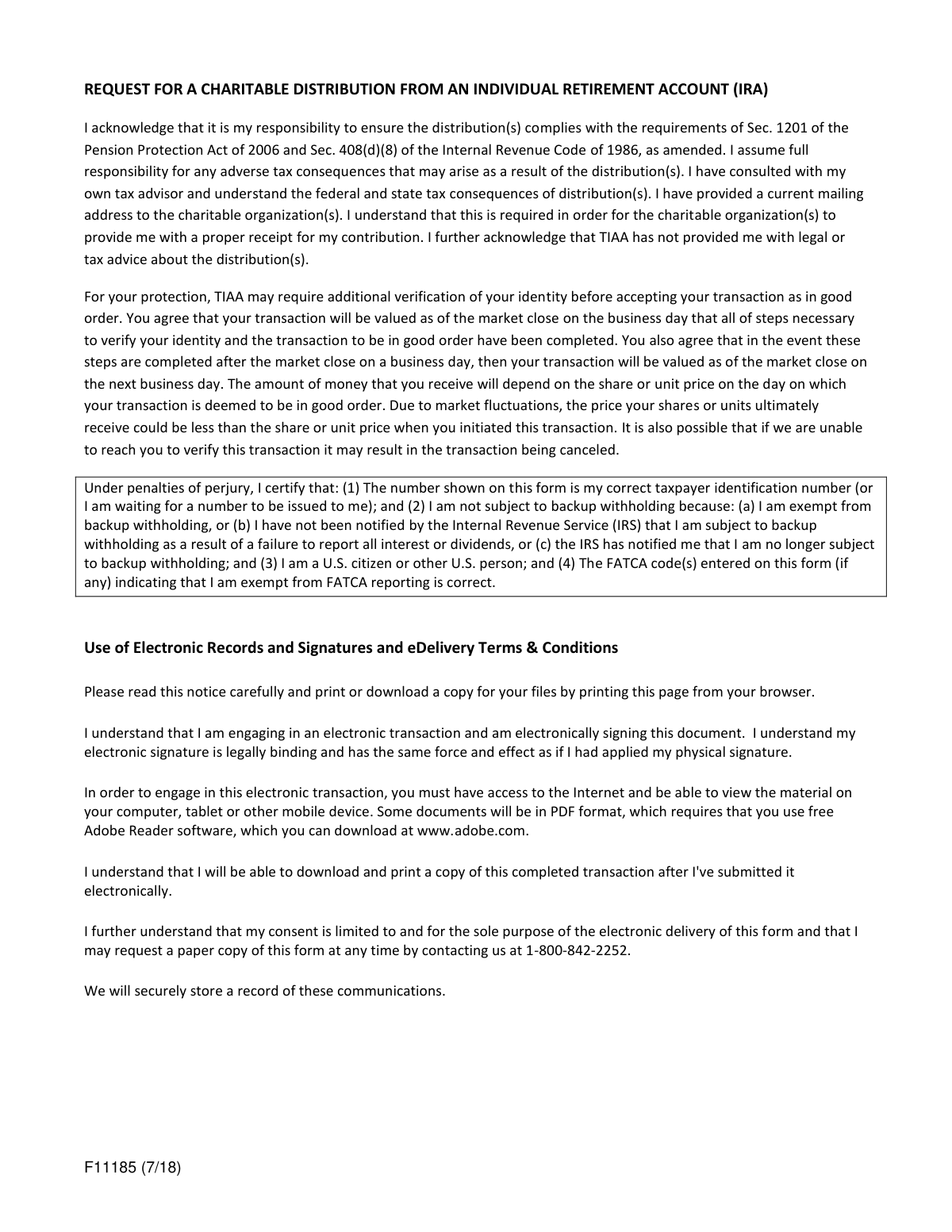
TIAA Form F11185 allows an IRA holder to formally request a direct payment from their retirement account to a qualified charitable organization. This action, known as a Qualified Charitable Distribution (QCD), is important as it can help satisfy Required Minimum Distributions (RMDs) and may provide tax advantages by excluding the amount from the owner's taxable income. Today, this form can be filled out quickly and accurately using AI-powered services like Instafill.ai, which can also convert non-fillable PDF versions into interactive fillable forms.
F11185 is part of the
IRA forms, charitable forms, ABLE account forms, retirement account forms, charitable distribution forms, retirement distribution forms, distribution request forms, IRA distribution forms, IRA account forms and charitable account forms categories on Instafill.
Rather not fill this in by hand? Instafill is an online form filler that completes PDF forms automatically — upload the blank form, answer a few questions, and the AI fills every field.
Form specifications
| Form name: | Request for a Charitable Distribution from an Individual Retirement Account (IRA) |
| Number of pages: | 1 |
| Language: | English |
Our AI automatically handles information lookup, data retrieval, formatting, and form filling.
It takes less than a minute to fill out F11185 using our AI form filling.
Securely upload your data. Information is encrypted in transit and deleted immediately after the form is filled out.
Instafill Demo: How to fill out PDF forms in seconds with AI
How to Fill Out F11185 Online for Free in 2026
Are you looking to fill out a F11185 form online quickly and accurately? Instafill.ai offers the #1 AI-powered PDF filling software of 2026, allowing you to complete your F11185 form in just 37 seconds or less.
Follow these steps to fill out your F11185 form online using Instafill.ai:
- 1 Navigate to Instafill.ai and upload or select the TIAA Form F11185.
- 2 Provide your personal details, including your name, address, and TIAA account number, allowing the AI to populate the fields.
- 3 Enter the full name, address, and tax ID number of the charitable organization(s) receiving the distribution.
- 4 Specify the exact dollar amount or percentage of the account to be distributed to each designated charity.
- 5 Review all the information automatically filled in by the AI to ensure accuracy and completeness.
- 6 Electronically sign and date the form to certify your request and acknowledge your understanding of the distribution's tax implications.
- 7 Submit the completed form as directed by the service, or download the final document to mail to TIAA.
Our AI-powered system ensures each field is filled out correctly, reducing errors and saving you time.
Why Choose Instafill.ai for Your Fillable F11185 Form?
Speed
Complete your F11185 in as little as 37 seconds.
Up-to-Date
Always use the latest 2026 F11185 form version.
Cost-effective
No need to hire expensive lawyers.
Accuracy
Our AI performs 10 compliance checks to ensure your form is error-free.
Security
Your personal information is protected with bank-level encryption.
Frequently Asked Questions About F11185
This form is used by an IRA account holder to request a direct payment from their TIAA Individual Retirement Account (IRA) to a qualified charitable organization. This type of donation is often referred to as a Qualified Charitable Distribution (QCD).
This form is for TIAA IRA owners, typically those age 70½ or older, who want to make a tax-advantaged donation directly from their retirement funds. It is your responsibility to ensure the distribution meets all IRS requirements for a QCD.
A Qualified Charitable Distribution (QCD) made using this form is sent directly to the charity and is generally excluded from your taxable income. This can help you satisfy your Required Minimum Distribution (RMD) for the year without increasing your tax liability.
You will need your personal details, your TIAA IRA account number, the full name and mailing address of the qualified charity, and the specific dollar amount you wish to contribute. You must also certify your taxpayer identification number.
Yes, it is highly recommended because TIAA does not provide tax advice and the rules for QCDs are complex. A tax professional can verify your eligibility, confirm the charity qualifies, and explain the specific tax implications for your situation.
You must ensure the charitable organization has your current address so they can provide you with a proper receipt for your contribution. This written acknowledgement from the charity is required by the IRS to substantiate the donation.
Processing times can vary, as TIAA may need to perform additional identity verification before completing the transaction. The value of your distribution will be based on the market close on the business day that your request is deemed to be in good order.
No, a Qualified Charitable Distribution is a direct payment to a charity and is not a rollover. The attached tax notice is a standard disclosure for many types of plan payments, but its detailed rules about rollovers do not apply to this specific transaction.
You assume full responsibility for any negative tax consequences that may arise from the distribution. If the donation does not comply with IRS rules, it may be treated as a regular taxable withdrawal from your IRA.
While the document doesn't specify, you can typically submit completed forms by mail to the address provided by TIAA or by uploading it to your secure online account. For specific instructions, call TIAA at 1-800-842-2252.
Yes, services like Instafill.ai use AI to auto-fill form fields accurately and save time. This can help you complete your personal information and other required sections quickly and reduce the risk of errors.
To fill the form online, upload the PDF to the Instafill.ai platform. The AI will make the document interactive, allowing you to easily type in your information and the charity's details before downloading the completed form.
If you have a flat, non-fillable PDF, Instafill.ai can convert it into an interactive form. Simply upload the file, and the service's AI will make the fields fillable so you can complete your request on your computer.
Compliance F11185
Validation Checks by Instafill.ai
1
Verifies Account Holder's Age for Qualified Charitable Distribution (QCD)
This check confirms that the IRA account holder is age 70½ or older at the time of the requested distribution. This is a strict requirement under IRS rules for a distribution to qualify as a tax-free QCD. If the account holder does not meet the age requirement, the transaction will be rejected or processed as a normal taxable distribution, which could have significant tax consequences.
2
Validates Taxpayer Identification Number (TIN) Format
This validation ensures the provided Taxpayer Identification Number (SSN or ITIN) is in a valid 9-digit format (XXX-XX-XXXX or XXXXXXXXX). A correct TIN is legally required for tax reporting purposes by TIAA to the IRS. Failure to provide a correctly formatted TIN will result in the form being rejected until a valid number is supplied.
3
Confirms Charitable Organization is a Qualified 501(c)(3) Entity
This check verifies that the recipient organization is a qualified public charity under IRS Section 501(c)(3), as certain organizations like private foundations are ineligible for QCDs. This is often done by checking the organization's Employer Identification Number (EIN) against the IRS database. If the organization is not qualified, the distribution cannot be processed as a QCD, and the request will be flagged for correction or cancellation.
4
Checks if Distribution Amount Exceeds Available Account Balance
This validation compares the requested distribution amount against the available funds in the specified IRA. This is a critical check to prevent transaction failures due to insufficient funds. If the requested amount is greater than the available balance, the form submission will be rejected, and the user will be prompted to enter a lower amount or choose a different account.
5
Ensures Annual QCD Limit is Not Exceeded
This check verifies that the requested distribution, combined with any previous QCDs in the current calendar year for the same individual, does not exceed the annual IRS limit (e.g., $100,000). This protects the account holder from making a non-qualified distribution that would be subject to income tax. If the request would cause the total to exceed the annual limit, the transaction will be blocked or adjusted, and the user will be notified.
6
Validates Completeness of Charitable Organization's Mailing Address
This check ensures that the full mailing address for the charitable organization, including street, city, state, and ZIP code, has been provided. The physical check for the distribution is sent directly to the charity, so a complete and accurate address is essential for the funds to be delivered correctly. An incomplete address will halt the processing of the request until the information is provided.
7
Verifies Presence of Account Holder's Signature
This validation confirms that the form has been legally signed by the account holder, either electronically or with a physical signature. A signature is required to authorize TIAA to execute the distribution from the retirement account. A form submitted without a valid signature is not considered 'in good order' and will be rejected immediately.
8
Confirms Certification of U.S. Person Status
This check ensures the account holder has certified their status as a U.S. citizen or other U.S. person. This certification is required to determine the correct tax withholding rules, as non-resident aliens are subject to different regulations (e.g., a mandatory 30% withholding). Failure to complete this certification will prevent the form from being processed.
9
Validates IRA Account Number
This check ensures that the provided IRA contract or account number is a valid, active account held at TIAA and belongs to the individual submitting the request. This prevents fraudulent requests and ensures funds are drawn from the correct source. If the account number is invalid or does not match the account holder's profile, the transaction will be rejected.
10
Ensures Distribution Amount is a Valid Positive Number
This validation checks that the value entered for the distribution amount is a positive numerical value and is formatted correctly as currency. The system must reject any non-numeric characters, negative values, or zero, as a distribution must be for a specific, positive monetary amount. If the format is invalid, the user will be prompted to correct the entry before proceeding.
11
Verifies Certification of Backup Withholding Status
This check confirms the account holder has certified that they are not subject to backup withholding as required by the IRS. This is a mandatory declaration under penalty of perjury. If this section is not completed, the form is considered incomplete and cannot be processed, or TIAA may be required to apply backup withholding to the distribution.
12
Checks Applicant Status for Beneficiary-Specific Rules
This validation determines if the person requesting the distribution is the original account holder or a beneficiary. As noted in the form, a non-spouse beneficiary has different, more restrictive rollover and distribution options than a spouse or the original owner. If the applicant is a non-spouse beneficiary, the system must ensure their requested action (e.g., a direct rollover to an inherited IRA) is permissible, otherwise the request will be rejected.
Common Mistakes in Completing F11185
Users frequently enter an incorrect IRA account number or Social Security Number (Taxpayer ID). This simple data entry error prevents TIAA from identifying the correct account, leading to an immediate rejection of the request or significant processing delays. To avoid this, meticulously double-check all numbers against your account statements before submission. AI-powered tools like Instafill.ai can help prevent these errors by auto-filling and validating information from saved profiles.
A core requirement for a Qualified Charitable Distribution (QCD) is that the IRA owner must be at least 70½ years old on the date of the transfer. Individuals sometimes confuse this with other retirement ages or make the request too early in the year they turn 70½. If the owner is not of age, the distribution is not a valid QCD and will be treated as a regular, taxable IRA withdrawal, negating the intended tax benefit.
Submitting a request with an inaccurate name or mailing address for the charitable organization is a frequent problem. This can cause the distribution check to be lost, delayed, or sent to the wrong entity, jeopardizing the donation. It is the IRA owner's responsibility to verify the charity's exact legal name and current mailing address for donations to ensure the funds are received correctly.
Not all non-profits are eligible to receive QCDs. A common mistake is directing funds to a donor-advised fund, private foundation, or supporting organization, which are explicitly disallowed by the IRS for this purpose. A distribution to an ineligible entity is not a valid QCD and will be considered a taxable event for the IRA owner. Always confirm the recipient is a public 501(c)(3) organization before submitting the form.
The IRS imposes an annual limit on the total amount an individual can contribute via QCDs across all their IRAs. People often forget about QCDs made from other accounts during the same tax year, causing them to inadvertently exceed this cap. Any amount distributed above the annual limit does not qualify for the tax-free treatment and must be reported as taxable income.
While a QCD can satisfy an RMD, many people misunderstand the ordering rule. If you take a withdrawal to satisfy your RMD first and then attempt a QCD later, you cannot retroactively designate the RMD as the charitable gift. The first dollars withdrawn from an IRA each year are always applied toward the RMD, so the QCD must be the first distribution or part of it to count toward the RMD.
This form is specifically for distributions from an Individual Retirement Account (IRA). A frequent error is attempting to request a QCD directly from an employer-sponsored plan like a 401(k) or 403(b), or from an active SEP or SIMPLE IRA. Such requests will be rejected, as the law only permits QCDs from traditional, Roth, or inactive SEP/SIMPLE IRAs.
For a distribution to be a valid QCD, the funds must be transferred directly from the IRA custodian (TIAA) to the charity. Some individuals mistakenly withdraw the funds into their personal bank account and then write a check to the charity. This action disqualifies the transaction as a QCD, making the withdrawal fully taxable and turning the donation into a standard charitable contribution subject to different deduction rules.
Forgetting to sign and date the request is a simple but very common oversight that renders the form invalid. An unsigned request is not considered 'in good order' and cannot be processed, leading to delays that could cause the distribution to miss a critical year-end tax deadline. If the form is a non-fillable PDF, a tool like Instafill.ai can convert it into a fillable version where you can easily add a digital signature and date.
The IRA owner is responsible for obtaining a written acknowledgment from the charity for the contribution. This receipt must state the amount, confirm that no goods or services were provided in return, and is required by the IRS as proof of the QCD. Failing to get this documentation can lead to the IRS disallowing the tax-free treatment of the distribution during an audit.
Saved over 80 hours a year
“I was never sure if my IRS forms like W-9 were filled correctly. Now, I can complete the forms accurately without any external help.”
Kevin Martin Green
Your data stays secure with advanced protection from Instafill and our subprocessors




Robust compliance program
Transparent business model
You’re not the product. You always know where your data is and what it is processed for.
ISO 27001, HIPAA, and GDPR
Our subprocesses adhere to multiple compliance standards, including but not limited to ISO 27001, HIPAA, and GDPR.
Security & privacy by design
We consider security and privacy from the initial design phase of any new service or functionality. It’s not an afterthought, it’s built-in, including support for two-factor authentication (2FA) to further protect your account.
Fill out F11185 with Instafill.ai
Worried about filling PDFs wrong? Instafill securely fills request-for-a-charitable-distribution-from-an-individual-retirement-account-ira forms, ensuring each field is accurate.
