Fill out charitable forms
with AI.
Charitable forms encompass a wide range of documentation required to facilitate donations, manage non-profit operations, and ensure tax compliance. These documents are vital for accurately recording the transfer of assets—from cash and securities to non-cash property—ensuring that donors receive proper tax credit while organizations maintain their legal status. Whether you are reporting a non-cash contribution on IRS Form 8283 or authorizing a transfer to a donor-advised fund, these forms serve as the official record of your philanthropic intent and financial responsibility.
By continuing, you acknowledge Instafill's Privacy Policy and agree to get occasional product update and promotional emails.
About charitable forms
These forms are typically used by individual taxpayers, financial advisors, and non-profit administrators during key financial milestones. For instance, retirees over the age of 70½ often utilize Qualified Charitable Distribution (QCD) letters to fulfill their Required Minimum Distributions tax-efficiently. Similarly, investors using platforms like Fidelity Charitable or Schwab Charitable require specific letters of authorization to move stocks or mutual funds into giving accounts. Because these transactions often involve irrevocable commitments and strict IRS deadlines, precision in the documentation is paramount to avoid processing delays or lost tax advantages.
Managing this paperwork can be time-consuming, but tools like Instafill.ai use AI to fill these forms in under 30 seconds while handling data accurately and securely. This practical solution simplifies the administrative side of giving, allowing donors and organizations to focus on their charitable missions rather than manual data entry.
Every form on this page can be completed without typing. Instafill is form filling software that reads a PDF and fills it for you — including flat and scanned documents that carry no fillable fields at all.
Forms in This Category
The forms in this category have a median Form Complexity Index of 58/100 (Moderate), measured across 24 forms by field count, input difficulty, length, conditional logic and structure. See how it is calculated.
- Enterprise-grade security & data encryption
- 99%+ accuracy powered by AI
- 1,000+ forms from all industries
- Complete forms in under 60 seconds
How to Choose the Right Form
Reporting Noncash Donations to the IRS
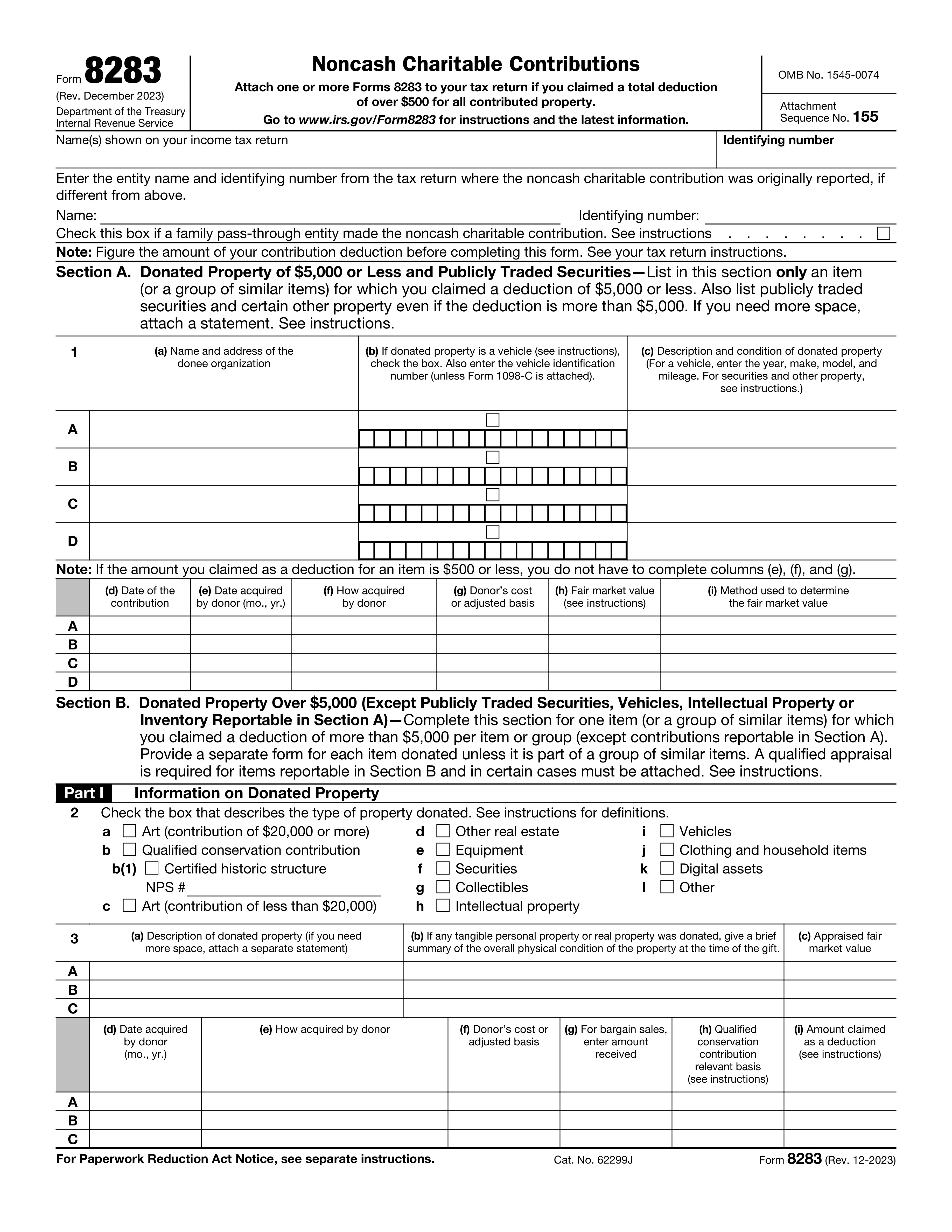
If you have donated property, vehicles, or securities worth more than $500, you must file Form 8283, Noncash Charitable Contributions with your tax return. This form is essential for substantiating your deduction and ensuring compliance with IRS regulations for any non-monetary gift.
Funding a Donor-Advised Fund (DAF)
If you are transferring assets into a managed giving account, select the form associated with your specific financial institution:
- Fidelity Charitable: Use the Fidelity Charitable Irrevocable Contribution Form and Letter of Instruction to move cash or stocks. If you are dealing with restricted or control securities, use the Fidelity Charitable 144/145 Contribution Form. For granting permission to an agent to handle transfers, the Fidelity Charitable Letter of Authorization is required.
- Schwab Charitable: Use the Schwab Charitable Fund Transfer of Assets for moving assets from external firms, or the Contribute to a Charitable Gift Account form for internal transfers. For donating specific stock positions via the Depository Trust Company, use the Charles Schwab Charitable Gift Donation - Letter Of Authorization for DTC Transfer.
- Vanguard Charitable: Use the Make a contribution - Vanguard Charitable form to document the transfer of mutual funds, bonds, or cash into your account.
Giving from an Individual Retirement Account (IRA)
For donors aged 70½ or older, a Qualified Charitable Distribution (QCD) allows you to give directly to a charity tax-free:
- Standard Requests: Use the Sample IRA Distribution Letter as a template to notify your IRA custodian.
- TIAA Accounts: Select Form F41205 (Request for a Qualified Charitable Distribution) or Form F11185 to satisfy your Required Minimum Distribution (RMD) through giving.
- Charitable Beneficiaries: If you represent a non-profit claiming assets from a deceased donor’s account, use the Vanguard IRA Distribution to Charitable Beneficiary or Form DIRDISTVBA.
Regulatory and State Compliance
If you are involved in operating fantasy contests within the Commonwealth of Virginia, you must complete Form 501A, Fantasy Contest Operator Personal Information Form. This is a mandatory disclosure for the Office of Charitable & Regulatory Programs to investigate eligibility and compliance.
Form Comparison
| Form | Primary Purpose | Asset Type Involved | Target Recipient |
|---|---|---|---|
| Form 8283, Noncash Charitable Contributions | Reports noncash donations exceeding $500 for federal tax deduction purposes. | Property, vehicles, stocks, or other noncash assets. | Internal Revenue Service (IRS). |
| Fidelity Charitable Irrevocable Contribution Form and Letter of Instruction | Directs the irrevocable transfer of assets into a Fidelity Giving Account. | Cash, stocks, mutual funds, or securities. | Fidelity Charitable Giving Account. |
| Schwab Charitable Fund Transfer of Assets | Authorizes moving assets from an external financial institution to Schwab Charitable. | Publicly traded stocks or mutual fund shares. | Schwab Charitable donor-advised fund. |
| Vanguard Make a contribution | Facilitates irrevocable contributions to a Vanguard philanthropic account for tax substantiation. | Mutual funds, stocks, bonds, or cash. | Vanguard Charitable. |
| Request for a Qualified Charitable Distribution (QCD) from a Brokerage Individual Retirement Account (IRA) | Directs tax-free donations from an IRA to satisfy required minimum distributions. | IRA distributions (up to annual legal limits). | Qualified 501(c)(3) charitable organizations. |
| Fidelity Charitable Letter of Authorization | Grants permission to move assets from a brokerage account to Fidelity Charitable. | Non-retirement brokerage account assets. | National Charitable Services LLC and Fidelity Charitable. |
| IRA Distribution to Charitable Beneficiary | Allows a charity to claim assets from a deceased individual's retirement account. | Inherited IRA funds and liquidated securities. | Designated nonprofit organization beneficiary. |
| Fidelity Charitable 144/145 Contribution Form | Documents the contribution of restricted or control securities under SEC rules. | Rule 144 or 145 restricted shares. | Fidelity Charitable Giving Account. |
| Charles Schwab Charitable Gift Donation - Letter Of Authorization for DTC Transfer | Instructs a brokerage to transfer stock positions via the Depository Trust Company. | Specific stock positions and securities. | Designated charitable organization. |
| Sample IRA Distribution Letter for a Qualified Charitable Distribution (QCD) | Template for IRA owners to request direct transfers to a charity. | Cash distributions from an Individual Retirement Account. | Any eligible charitable organization. |
| Contribute to a Charitable Gift Account | Official document for funding a new or existing donor-advised gift account. | Checks, wire transfers, or brokerage account assets. | Schwab Fund for Charitable Giving. |
| Form 501A, Fantasy Contest Operator Personal Information Form | Discloses personal and financial history for charitable fantasy contest registration. | Personal background and financial interest disclosures. | Virginia Department of Agriculture and Consumer Services. |
Tips for charitable forms
When transferring stocks or mutual funds, ensure ticker symbols and CUSIP numbers are completely accurate. A small typo in these identifiers can delay the transfer or result in the wrong assets being moved from your brokerage account.
Most charitable contribution forms are irrevocable, meaning once the assets are transferred, they cannot be returned to you. Carefully review the dollar amount or share count before submitting to avoid unintended permanent transfers.
For Qualified Charitable Distributions (QCDs) from an IRA, the funds must move directly from the financial institution to the charity. If you withdraw the money yourself first, you may lose the tax-free benefits associated with the distribution.
Many financial institutions require signatures on Letters of Authorization to match the exact signature they have on file. If your signature has changed over time, consider updating your account records before submitting transfer requests to prevent rejection.
AI-powered tools like Instafill.ai can complete these complex charitable forms in under 30 seconds with high accuracy. Your data stays secure during the process, providing a practical way to handle multiple donations or donor-advised fund transfers efficiently.
Save a copy of every Letter of Instruction and Transfer of Assets form you submit alongside the final receipt from the charity. This documentation is essential for completing IRS Form 8283 and substantiating your deductions during tax preparation.
If you are contributing to several different funds or charities, try to process them in a single session. Many donor-advised fund forms allow you to list multiple assets or instructions on one sheet, significantly reducing your administrative burden.
Frequently Asked Questions
These forms facilitate the transfer of assets—such as cash, stocks, or property—from individuals or businesses to nonprofit organizations. They ensure that donations are properly documented for tax purposes and provide financial institutions with the legal authority to move assets to a designated charity or donor-advised fund.
You are generally required to file Form 8283 if you are claiming a tax deduction for noncash charitable contributions that total more than $500 for the year. This form helps the IRS track the value and nature of donated property, such as vehicles, artwork, or household items.
A QCD allows individuals aged 70½ or older to donate directly from their IRA to a qualified charity without the distribution being counted as taxable income. This can be a tax-efficient way to satisfy a Required Minimum Distribution (RMD) while supporting a philanthropic cause.
Most donations to donor-advised funds or charities must be irrevocable to qualify for a tax deduction under IRS rules. Once the assets are transferred and the tax receipt is issued, the donor cannot reclaim the funds, although they may still have advisory privileges over how the funds are invested or granted.
Yes, you can use AI tools like Instafill.ai to complete these forms in under 30 seconds. The AI accurately extracts data from your source documents and places it into the correct fields, ensuring that complex details like account numbers and security identifiers are entered correctly.
A Letter of Authorization is a legal document that grants a brokerage or financial institution permission to transfer specific assets from your account to a charity. It typically includes details about the recipient organization, the specific shares or funds to be moved, and the donor's signature to verify the request.
While manually filling out multi-page financial forms can take 15 to 30 minutes, using an AI-powered service can reduce this time significantly. Tools like Instafill.ai can process and populate these forms in less than 30 seconds by intelligently mapping your information to the required fields.
This form is required for individuals involved in operating fantasy contests in Virginia, such as officers, directors, or those with a significant financial interest. It is a regulatory disclosure used by the Office of Charitable and Regulatory Programs to investigate eligibility for registration under the Virginia Fantasy Contests Act.
You will usually need the name of the security, the number of shares, the CUSIP number or ticker symbol, and the receiving organization’s account information, such as a DTC number. You may also need to provide the original acquisition date and cost basis for accurate tax reporting.
Submission requirements vary by form; IRS forms are typically attached to your annual tax return, while brokerage-specific forms from companies like Fidelity, Schwab, or Vanguard must be sent directly to the financial institution. Many institutions now allow for secure digital uploads, though some may still require a physical signature or a medallion signature guarantee.
If a charitable organization is named as a beneficiary of an IRA, they must complete specific distribution forms provided by the financial institution, such as Vanguard or TIAA. These forms require details about the decedent and the charity's tax ID to process the legal transfer of inherited funds into the organization's account.
Glossary
- Form Complexity Index
- Instafill’s 0–100 measure of how much effort a form takes to complete, calculated deterministically from the form’s own structure rather than estimated. It combines the number of fillable fields (the largest factor), how difficult those fields are to complete based on their type, the number of pages that contain fields, the amount of conditional “fill-only-if” logic, and how many sections the form is divided into, then adds modifiers for tables and repeating lists, bundled instruction pages, and dense page layouts. A higher score means the form is harder to fill out by hand. The forms in this category have a median Form Complexity Index of 58/100 (Moderate). See exactly how it is calculated.
- Donor-Advised Fund (DAF)
- A private fund managed by a third party that allows donors to make a charitable contribution, receive an immediate tax deduction, and then recommend grants from the fund to charities over time.
- Qualified Charitable Distribution (QCD)
- A tax-free transfer of funds directly from an IRA to a qualified charity, available to individuals aged 70½ or older, which can satisfy part of a required minimum distribution.
- Irrevocable Contribution
- A donation that, once accepted by the receiving organization, cannot be withdrawn, refunded, or returned to the donor.
- Required Minimum Distribution (RMD)
- The minimum amount that retirement account owners must withdraw annually once they reach a certain age, often used as the basis for charitable gifting to reduce taxable income.
- Letter of Authorization (LOA)
- A legal document signed by an account holder that provides specific instructions and permission for a financial institution to transfer assets to a third party or charity.
- Noncash Contribution
- A donation of property other than money, such as stocks, mutual funds, or physical goods, which often requires IRS Form 8283 for tax reporting if the value exceeds $500.
- DTC Transfer
- The electronic transfer of securities from one brokerage to another through the Depository Trust Company, commonly used to move stock donations into a charity's account.
- Rule 144/145 Securities
- Stocks that are subject to specific SEC restrictions because they were acquired in private sales or are held by corporate insiders, requiring special documentation when donated.