Fill out distribution request forms
with AI.
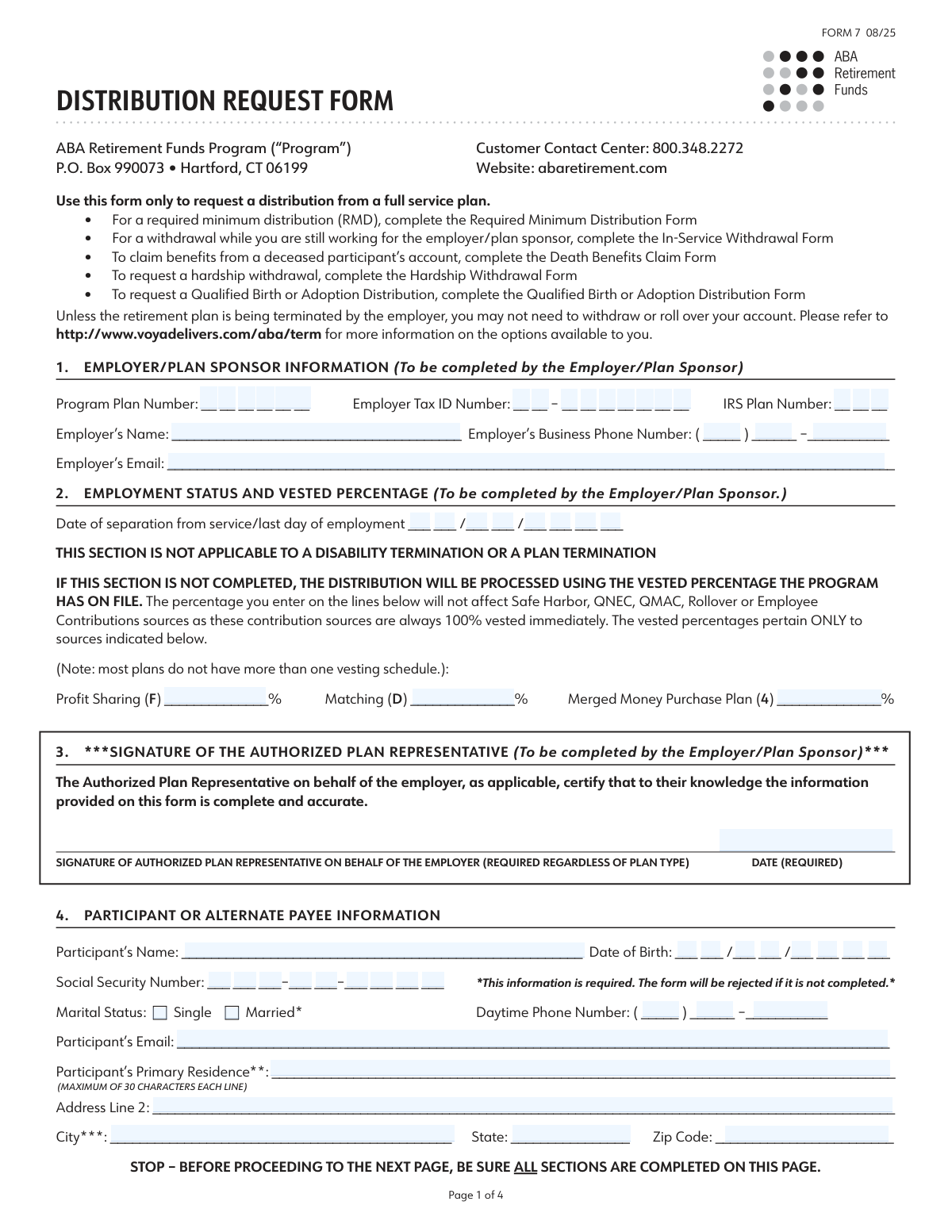
Distribution request forms are essential documents used to authorize the withdrawal or transfer of funds from various financial accounts, most commonly retirement plans like 401(k)s, 403(b)s, and IRAs. These forms serve as formal instructions to plan administrators, detailing how much money should be moved and where it should go—whether that is a direct cash payment to your bank account or a rollover to another qualified retirement plan. Because these transactions often carry significant tax implications, these forms include critical sections for federal and state tax withholding elections to ensure compliance with IRS regulations.
By continuing, you acknowledge Instafill's Privacy Policy and agree to get occasional product update and promotional emails.
About distribution request forms
These forms are typically required during major life transitions or specific financial milestones. For example, individuals who have reached retirement age need to file Required Minimum Distribution (RMD) forms, while those leaving an employer might use a termination distribution form to roll over their savings. Other common scenarios include requesting a hardship distribution for emergency expenses or processing a Qualified Domestic Relations Order (QDRO) following a legal separation. Beneficiaries also use these documents to claim inherited assets from a deceased loved one's account.
Completing these multi-page documents can be tedious, but tools like Instafill.ai use AI to fill these forms in under 30 seconds while handling the data accurately and securely. By automating the repetitive parts of the paperwork, you can focus on managing your finances rather than navigating complex PDF fields.
Every form on this page can be completed without typing. Instafill is form filling software that reads a PDF and fills it for you — including flat and scanned documents that carry no fillable fields at all.
Forms in This Category
The forms in this category have a median Form Complexity Index of 57/100 (Moderate), measured across 47 forms by field count, input difficulty, length, conditional logic and structure. See how it is calculated.
- Enterprise-grade security & data encryption
- 99%+ accuracy powered by AI
- 1,000+ forms from all industries
- Complete forms in under 60 seconds
Frequently Asked Questions
These forms are used to formally request the withdrawal or transfer of funds from a retirement or investment account. Common reasons for filing include retirement, leaving an employer, financial hardship, or reaching the age for required minimum distributions (RMDs).
The correct form depends on your specific retirement plan type—such as a 401(k), 403(b), or IRA—and the financial institution managing the funds. You must also select a form that matches your reason for withdrawal, such as a standard distribution, a hardship request, or a beneficiary claim.
Most forms require your personal identification details, account number, the specific reason for the distribution, and your preferred payment method. You will also need to make tax withholding elections and, in some cases, provide banking information for direct deposits or details for a rollover account.
The account owner or plan participant must always sign the form to authorize the request. Depending on the plan rules and the amount being withdrawn, a spouse's notarized consent or an additional signature from the employer or plan administrator may also be required.
Yes, you can use AI tools like Instafill.ai to complete these forms in under 30 seconds. The AI accurately extracts data from your source documents and places it into the correct fields, ensuring the form is legible and reducing the risk of processing delays.
A direct rollover moves funds directly from your current retirement plan to another eligible plan or IRA without triggering immediate taxes. A cash distribution sends the funds directly to you, which usually results in mandatory tax withholding and potential early withdrawal penalties if you are under age 59½.
Hardship distributions are specifically for immediate and heavy financial needs, such as medical expenses, preventing eviction, or tuition costs. These requests usually require additional documentation to prove the financial need and are subject to specific IRS and plan-level regulations.
While manual completion can take 15 to 20 minutes, using an AI-powered service like Instafill.ai allows you to finish the process in less than 30 seconds. This efficiency helps you submit your request faster so the financial institution can begin processing your funds sooner.
Completed forms should generally be submitted to your plan administrator or the financial institution that holds your account, such as Fidelity, Vanguard, or TIAA. Many providers allow for digital uploads through their secure portals, while others may require the form to be mailed or faxed.
A Qualified Domestic Relations Order (QDRO) form is used when retirement assets are being divided due to a divorce or legal separation. It allows an alternate payee, such as a former spouse, to request their court-awarded portion of the participant's retirement account.
Most distributions from retirement accounts are considered taxable income and must be reported to the IRS. Unless you are performing a direct rollover, the plan administrator is typically required to withhold federal income tax, and you will receive a Form 1099-R at the end of the year for tax filing purposes.
Glossary
- Form Complexity Index
- Instafill’s 0–100 measure of how much effort a form takes to complete, calculated deterministically from the form’s own structure rather than estimated. It combines the number of fillable fields (the largest factor), how difficult those fields are to complete based on their type, the number of pages that contain fields, the amount of conditional “fill-only-if” logic, and how many sections the form is divided into, then adds modifiers for tables and repeating lists, bundled instruction pages, and dense page layouts. A higher score means the form is harder to fill out by hand. The forms in this category have a median Form Complexity Index of 57/100 (Moderate). See exactly how it is calculated.
- Required Minimum Distribution (RMD)
- The minimum amount the IRS requires you to withdraw from your retirement account each year once you reach a specific age, typically 73.
- Direct Rollover
- A tax-free transfer of retirement funds where the assets are sent directly from one financial institution to another, rather than being paid to you as a check.
- Qualified Domestic Relations Order (QDRO)
- A legal judgment or decree that grants a spouse, former spouse, or child the right to receive a portion of a participant's retirement plan benefits.
- Hardship Distribution
- An emergency withdrawal from a retirement plan to meet an immediate and heavy financial need, such as medical expenses, funeral costs, or preventing eviction.
- Alternate Payee
- An individual, typically a former spouse, who is designated by a QDRO to receive a specific portion of a retirement plan participant's account assets.
- Qualified Charitable Distribution (QCD)
- A direct transfer of funds from an IRA to a qualified charity, which can satisfy RMD requirements without being counted as taxable income.
- Vested Balance
- The portion of your retirement account that you legally own and are entitled to withdraw, including all of your own contributions and any employer contributions that have met service requirements.
- In-Service Distribution
- A withdrawal from a retirement plan that occurs while the participant is still actively employed by the company that sponsors the plan.