
Yes! You can use AI to fill out Individual 401(k) Distribution Request Form
Don't type 137 fields by hand. Tell our AI about yourself, or upload a document you already have, and it fills every field in seconds. You check it, then download, print or sign.
The AI does the filling. You just check it.
No typing into boxes, nothing to install.
What this form asks for
The AI fills all of it, from your answers or your documents.
The AI checks your answers before you download
14 checks built for this form, so a wrong date or a missing answer is caught before anyone else sees it.
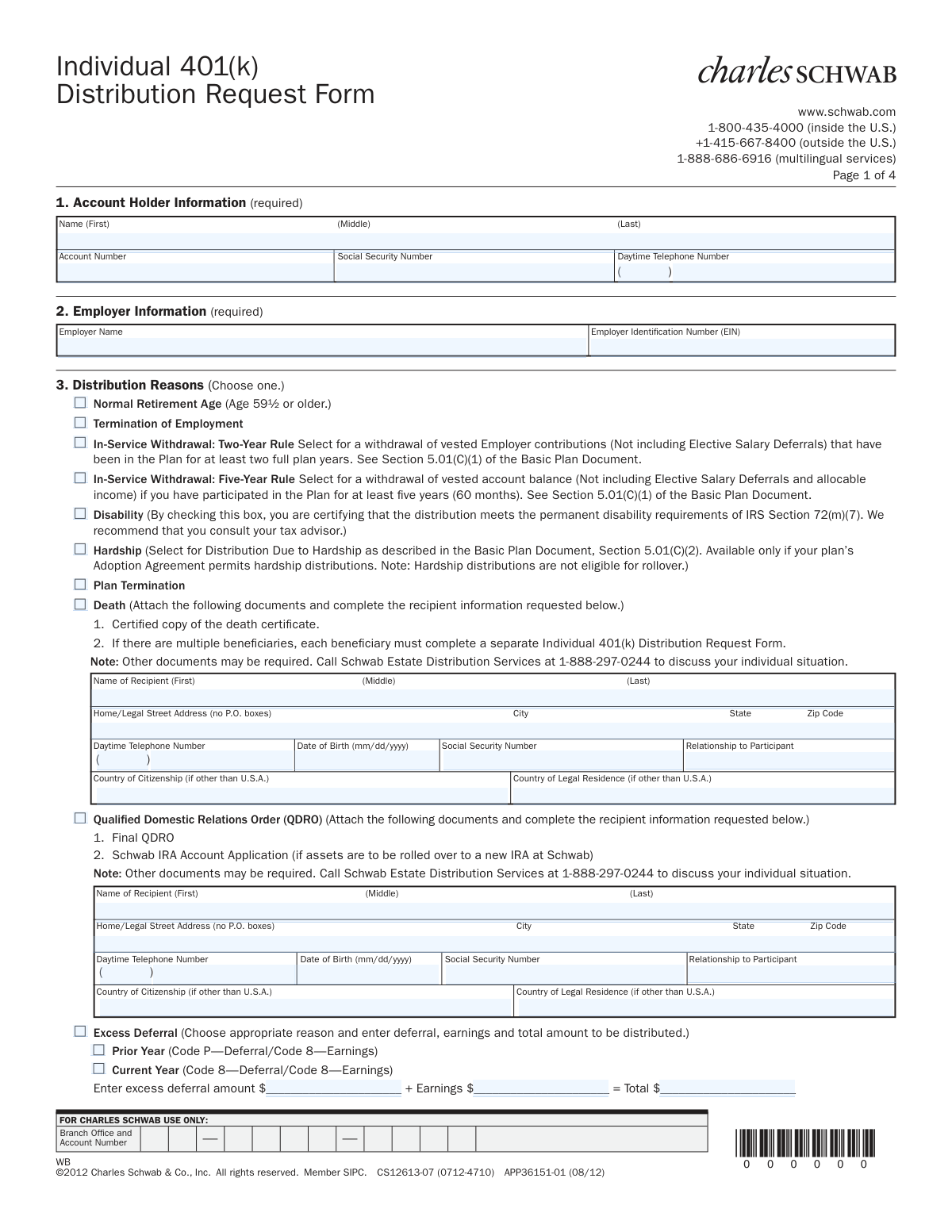
Ensures all fields in Section 1 (Name, Account Number, Social Security Number, Daytime Telephone) are completed. This information is fundamental for identifying the correct account and participant for the distribution. Failure to provide this information will prevent the form from being processed, as the request cannot be linked to a specific individual or account.
Verifies that the Social Security Number (SSN) in Section 1 and Section 3 (if applicable) follows the standard 9-digit format (XXX-XX-XXXX or XXXXXXXXX). The SSN is a critical unique identifier for tax reporting and identity verification. An invalid or incorrectly formatted SSN will lead to processing delays, tax reporting errors, and potential rejection of the distribution request.
Ensures the Employer Identification Number (EIN) in Section 2 is entered in the correct 9-digit format (XX-XXXXXXX or XXXXXXXXX). The EIN is the unique identifier for the business entity with the IRS and is crucial for verifying the 401(k) plan's legitimacy. An invalid EIN format will cause the form to be rejected until a valid number is provided.
Validates that the user has selected exactly one checkbox for the distribution reason in Section 3. Each reason has different legal, tax, and processing implications, so selecting multiple reasons creates ambiguity. This ambiguity makes it impossible to process the request correctly, leading to rejection of the form for clarification.
Checks that if the distribution reason is 'Death' or 'Qualified Domestic Relations Order (QDRO)' in Section 3, the corresponding recipient details (Name, Address, Phone, DOB, SSN) are fully completed. This information is legally required to process payments to a beneficiary or alternate payee. Failure to provide complete recipient information will suspend the request until the necessary details are submitted.
Verifies that if 'Excess Deferral' is chosen in Section 3, the sum of the 'excess deferral amount' and 'Earnings' fields correctly equals the 'Total' amount entered. This calculation is critical for accurate corrective distributions and proper tax reporting. A mathematical error will cause the form to be flagged for manual review and correction, delaying the distribution.
And 8 more checks
- Hardship Distribution Rollover Ineligibility
- Single Payment Option Selection
- Required Amount for Partial and Periodic Payments
- Periodic Payment Schedule Completeness
- Single Payment Method Selection
- Federal Tax Withholding Minimum Rate
- Required Signatures and Dates for Authorization
- Date of Birth Plausibility
Let AI fill out your CS12613-07
No typing. Every field filled in seconds, checked, ready to sign.
How to Fill Out CS12613-07 Online for Free in 2026
What the AI walks you through.
- Navigate to Instafill.ai and upload or select the Individual 401(k) Distribution Request Form.
- Use the AI assistant to accurately fill in your Account Holder Information in Section 1 and Employer Information in Section 2.
- In Section 3, select the appropriate reason for your distribution, such as Normal Retirement Age, Termination of Employment, or Hardship.
- Specify your desired payment option in Section 4 (e.g., lump-sum, partial, or periodic payment) and provide payment instructions in Section 5.
- Choose your payment method in Section 6, indicating if you want a direct rollover, a conversion to a Roth IRA, or a direct payment.
- Complete the Federal and State Tax Withholding Election in Section 7, if applicable to your distribution type.
- Carefully review all entered information, then provide the required employer and participant signatures and dates in Section 8 to authorize the distribution.
Common Mistakes in Completing CS12613-07
The ones the AI is built to catch.
Missing Required Employer Signature
Selecting an Inappropriate Distribution Reason
Forgetting to Include Required Documentation
Confusing Direct Rollover with a 60-Day Rollover
Incomplete Instructions for Sourcing Funds
Entering Incorrect Receiving Account Information
Making Contradictory Payment Option Choices
Attempting to Waive Mandatory Tax Withholding
Using a P.O. Box for a Recipient's Address
Providing an Incorrect Employer Identification Number (EIN)
Frequently Asked Questions About CS12613-07
Is it really free for 7 days?
Can I fill other forms too?
How do I cancel?
How does the AI fill out CS12613-07?
What happens to my information?
How complex is CS12613-07 to fill out?
What is the purpose of the Individual 401(k) Distribution Request Form?
Who needs to fill out this form?
What information do I need to have ready to complete this form?
In Section 8, why do I have to sign as both the 'Employer' and the 'Plan Participant'?
What is a 'Direct Rollover' and why should I consider it?
How long does it take to process my distribution request?
I am a beneficiary of a deceased participant. What documents do I need?
Do I have to have taxes withheld from my distribution?
Can I set up recurring payments from my Individual 401(k)?
Can I roll over a hardship distribution?
Can AI tools help me fill out this form?
How can I fill out this Schwab 401(k) form online?
The PDF I downloaded is not fillable. What can I do?
Get your CS12613-07 filled out by AI
$0 today. Cancel before Nov 1 and you pay nothing.
Other forms like this one
distribution forms: Fischer Homes Request for In-Service Distribution, Form 1099-DIV, Dividends and Distributions, Form 1099-R, Distributions From Pensions etc., Form 1099-PATR, Taxable Distributions from Cooperatives, Form 1099-SA, Distributions from HSA/MSA, Nationwide Retirement Solutions Participant Distribution Request Form (PNF-0875M9, TRAC Version, 01/2025), Nationwide Retirement Solutions Participant Distribution Request Form (PNF-0875M9, TRAC Version, 01/2025), Fidelity Advisor 403(b) Distribution Request Form, Fidelity Advisor IRA Distribution Request for Automatic Rollover Accounts, Fidelity NetBenefits Distribution - Recurring Payments, Fidelity Investments® Beneficiary Distribution Form, Fidelity Investments Distribution Form, Fidelity IRA Beneficiary Distribution — Charity, Foundation, or a University, IRA Distribution Form, New York State Deferred Compensation Plan Benefit Distribution Request, Fidelity Distribution—Rollover, Charles Schwab IRA Distribution Form, Sample IRA Distribution Letter for a Qualified Charitable Distribution (QCD), Vanguard IRA Distribution Kit (including IRA Distribution Form RRDFT and Form W-4R), Vanguard Required Minimum Distribution Service Form
distribution request forms: ABA Retirement Funds Program Distribution Request Form, Nationwide Retirement Solutions Participant Distribution Request Form (PNF-0875M9, TRAC Version, 01/2025), Nationwide Retirement Solutions Participant Distribution Request Form (PNF-0875M9, TRAC Version, 01/2025), Fidelity Advisor 403(b) Distribution Request Form, Fidelity Advisor IRA Distribution Request for Automatic Rollover Accounts, New York State Deferred Compensation Plan Benefit Distribution Request, Fischer Homes Request for In-Service Distribution, Vanguard 403(b)(7) ERISA Retirement Plan Distribution Request (Retirement / Severance from Employment / Disability), Elevator Constructors Union Local No.1 Annuity and 401(k) Fund Distribution Request Due to Qualified Domestic Relations Order, Empower Hardship Distribution Request Form, Fidelity Distribution—Rollover Request Form, Fidelity Advisor 403(b) Distribution Request Form, Empower Corrective Distribution Request Form, Alternate Payee QDRO Distribution Request form, Empower Required Minimum Distribution Request Form, Distribution Request Form - ISC MEP, Transamerica Retirement Solutions Distribution Request Form, Transamerica Distribution Request (Distribution of Traditional 401(k) to Roth IRA), Minimum Distribution Request, Transamerica Retirement Distribution Request Form and Special Tax Notice
Let AI fill out your CS12613-07
Your trial starts once a card is added. You pay nothing before Nov 1.
Our AI already knows this form, all 137 fields of it. Skip the typing: tell it about yourself, or upload what you have, and it fills the whole form in seconds.
- AI fills every field on all 4 pages, checkboxes included
- No typing into boxes: answer a few questions, or upload a document you already have, an old copy of this form, a photo of a document
- The AI checks the answers; you review and change anything before you download
- Download the finished PDF, print it, or sign it online
- Encrypted, and never used to train AI
Cancel before Nov 1 and you pay nothing.
A card is needed to start the trial. Cancel in two clicks from your account.
Terms · Privacy