Yes! You can use AI to fill out IRA/ESA Distribution Request
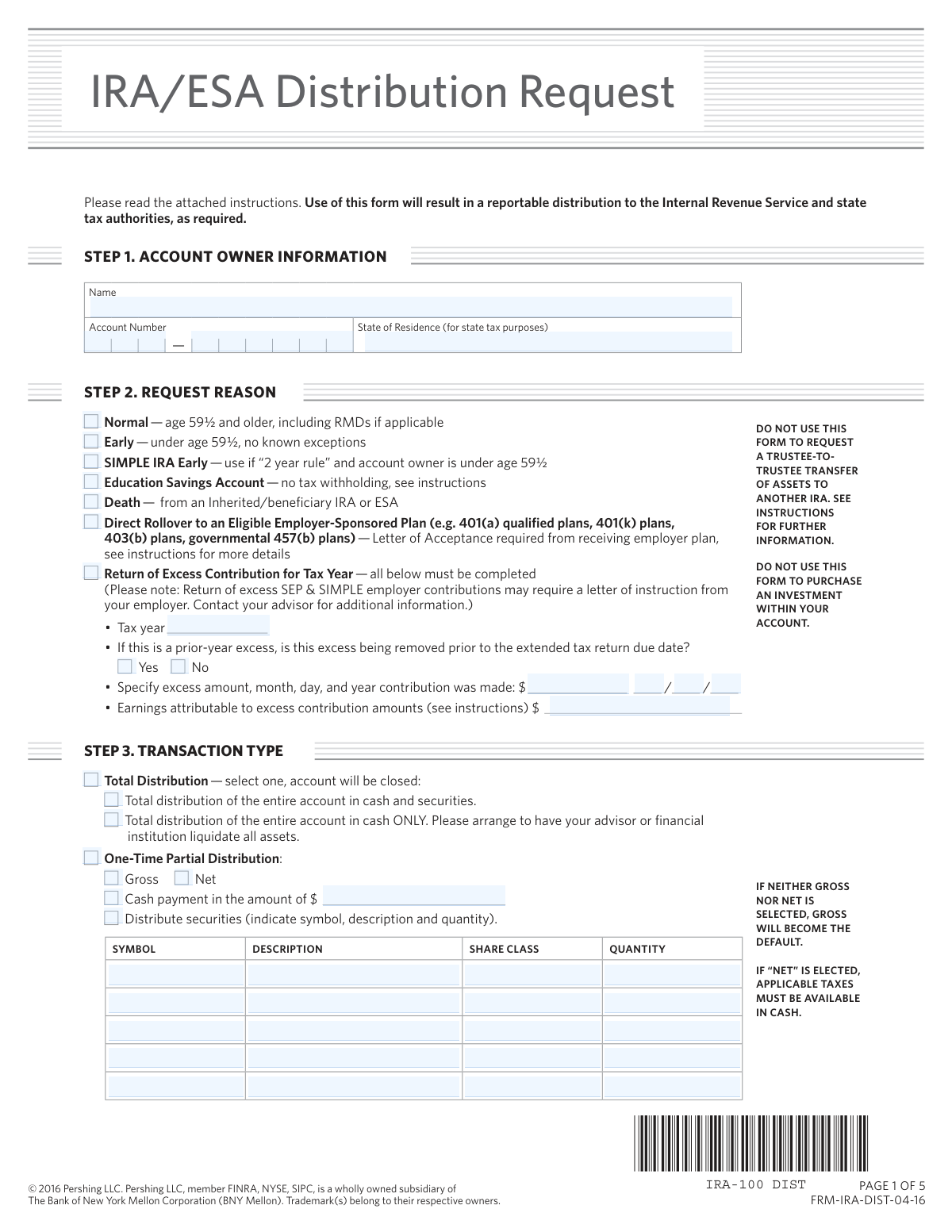
This form, provided by Pershing LLC, is used to initiate a reportable distribution of assets from accounts such as Traditional IRAs, Roth IRAs, SEP IRAs, and Education Savings Accounts (ESAs). It is a crucial document for account holders who need to withdraw funds, as it details the reason for the distribution, the amount, tax withholding elections, and delivery method, all of which are reported to the IRS. Today, this form can be filled out quickly and accurately using AI-powered services like Instafill.ai, which can also convert non-fillable PDF versions into interactive fillable forms.
Our AI automatically handles information lookup, data retrieval, formatting, and form filling.
It takes less than a minute to fill out FRM-IRA-DIST-04-16 using our AI form filling.
Securely upload your data. Information is encrypted in transit and deleted immediately after the form is filled out.
Form specifications
| Form name: | IRA/ESA Distribution Request |
| Number of pages: | 1 |
| Language: | English |
| Categories: | IRA forms, distribution forms |
Instafill Demo: How to fill out PDF forms in seconds with AI
How to Fill Out FRM-IRA-DIST-04-16 Online for Free in 2026
Are you looking to fill out a FRM-IRA-DIST-04-16 form online quickly and accurately? Instafill.ai offers the #1 AI-powered PDF filling software of 2026, allowing you to complete your FRM-IRA-DIST-04-16 form in just 37 seconds or less.
Follow these steps to fill out your FRM-IRA-DIST-04-16 form online using Instafill.ai:
- 1 Navigate to Instafill.ai and upload or select the IRA/ESA Distribution Request form.
- 2 Use the AI assistant to automatically fill in your Account Owner Information, including name, account number, and state of residence.
- 3 Select the reason for your distribution request, such as Normal, Early, Death, or Return of Excess Contribution.
- 4 Specify the transaction type, whether it's a total distribution, a one-time partial distribution, or a recurring periodic distribution.
- 5 Complete the Tax Withholding Election section for both federal and state taxes, following the guided instructions.
- 6 Choose your preferred Method of Delivery for the funds, such as a check, ACH transfer, or wire.
- 7 Review all the information populated by the AI for accuracy, then electronically sign and submit the completed form to your financial advisor.
Our AI-powered system ensures each field is filled out correctly, reducing errors and saving you time.
Why Choose Instafill.ai for Your Fillable FRM-IRA-DIST-04-16 Form?
Speed
Complete your FRM-IRA-DIST-04-16 in as little as 37 seconds.
Up-to-Date
Always use the latest 2026 FRM-IRA-DIST-04-16 form version.
Cost-effective
No need to hire expensive lawyers.
Accuracy
Our AI performs 10 compliance checks to ensure your form is error-free.
Security
Your personal information is protected with bank-level encryption.
Frequently Asked Questions About Form FRM-IRA-DIST-04-16
This form is used to request a reportable distribution of assets from your IRA or Education Savings Account (ESA). This includes Traditional, SEP, SIMPLE, and Roth IRAs, as well as Inherited accounts.
No, this form is for reportable distributions only. Do not use it for trustee-to-trustee transfers, Roth conversions, or transfers due to death or divorce; contact your advisor for the appropriate form for those transactions.
You will need your account number, the reason for your distribution, your tax withholding preferences, and your desired delivery method. It is also critical to ensure sufficient funds are available in your account to cover the distribution amount and any applicable taxes or fees.
If you are under age 59½, you should select 'Early' in Step 2. Be aware that early distributions may be subject to a 10% penalty, which you can address when filing your taxes with IRS Form 5329 if an exception applies.
In Step 3, under 'Periodic Instructions,' select your desired frequency (e.g., Annually) and start date, then choose the 'Required Minimum Distribution' option. This will create a schedule to automatically pay your annual RMD amount.
Federal tax withholding is optional for most IRA distributions; 10% will be withheld by default unless you elect a different amount or choose not to have taxes withheld in Step 4. State tax withholding rules vary by state and may be mandatory.
A 'Total Distribution' closes your account and pays out all assets, while a 'One-Time Partial Distribution' allows you to withdraw a specific amount of cash or securities while keeping your account open.
In Step 2, select 'Return of Excess Contribution' and provide the tax year, the excess amount, and the date of the original contribution. You must also calculate and include any earnings on that excess amount if you are removing it before the tax-filing deadline.
Select 'Normal' distribution in Step 2, and in Step 5, provide the charity's name and address as the 'Alternate Payee'. Always consult your tax advisor to ensure your distribution meets all QCD requirements.
After signing and dating the form, return the completed document to your advisor or financial institution. The request must be processed within 30 days of the signature date.
Standing Instructions allow you to save your tax withholding and delivery method choices for future on-demand payments. This saves you from having to complete a new form for every similar future request.
Yes, services like Instafill.ai use AI to accurately auto-fill form fields, which can save you time and help prevent common errors. This is especially helpful for complex forms with many fields.
Simply upload the IRA/ESA Distribution Request PDF to the Instafill.ai platform. The AI will identify all the form fields, allowing you to fill them out interactively online before downloading the completed, signed document.
If you have a non-fillable or 'flat' PDF, you can upload it to a service like Instafill.ai. It will automatically convert the document into an interactive, fillable form that you can easily complete on your computer.
Compliance FRM-IRA-DIST-04-16
Validation Checks by Instafill.ai
1
Ensures Signature Date is Recent
This check verifies that the signature date in Step 8 is present and is not more than 30 days in the past. This is critical because the form instructions state the request must be processed within 30 days of the signature. If the date is missing or older than 30 days, the request is considered stale and cannot be processed, requiring the client to submit a new form.
2
Validates Exclusive Request Reason Selection
This validation ensures that exactly one request reason has been selected in Step 2. The form's logic and subsequent tax reporting depend on a single, specific reason for the distribution. Selecting multiple reasons or none at all creates ambiguity and prevents correct processing, so the form would be rejected for clarification.
3
Verifies Age-Based Distribution Reason
This check cross-references the account owner's age (stored in their profile) with the selected request reason in Step 2. If 'Normal' is selected, the owner must be age 59½ or older; if 'Early' is selected, they must be under 59½. This is crucial for correct IRS reporting and penalty assessment, and a mismatch would require correction to avoid tax complications for the owner.
4
Confirms Completeness of 'Return of Excess Contribution' Data
If 'Return of Excess Contribution' is chosen in Step 2, this validation confirms that the 'Tax year', 'excess amount', and 'date contribution was made' fields are all filled. These details are mandatory for the custodian to correctly identify and remove the specific contribution and report it to the IRS. Incomplete information would halt the request until all required data is provided.
5
Checks for Incompatible Tax Withholding on ESA and Rollover
This validation ensures that if the request reason is 'Education Savings Account' or 'Direct Rollover to an Eligible Employer-Sponsored Plan', no tax withholding options are selected in Step 4. The instructions explicitly state that tax withholding does not apply to these transaction types. An invalid selection would cause a processing error and require the form to be corrected.
6
Validates Data Integrity for Beneficiary RMD
When 'Required Minimum Distribution due to death' is selected in Step 3, this check verifies that the 'Decedent’s Date of Birth', 'Decedent’s Date of Death', 'Original Beneficiary’s Date of Birth', and 'Relationship to Decedent' fields are all populated with valid data. This information is essential for the system to accurately calculate the annual RMD amount based on IRS rules. Missing or invalid data would prevent the RMD schedule from being established.
7
Ensures Logical Dates for Periodic Instructions
For 'Periodic Instructions' in Step 3, this check validates that the 'Start Date' is not in the past and that if an 'End Date' is provided, it occurs after the 'Start Date'. This prevents the creation of impossible or immediately expired payment schedules. An illogical date entry would cause the request to be rejected for correction.
8
Confirms Required Fields for Federal Fund Wire
If 'Federal Fund Wire' is selected as the delivery method in Step 5, this validation confirms that the 'ABA/Routing Number' and 'DDA/Bank Account Number' fields are both completed. These numbers are non-negotiable requirements for a wire transfer to be successfully initiated and routed to the correct bank account. The request will fail if this information is missing.
9
Validates ABA Routing Number Format
This check ensures that the 'ABA/Routing Number' provided for a wire transfer consists of exactly nine digits. This is the standard format for all U.S. financial institutions. An incorrectly formatted number will cause the wire transfer to be rejected by the banking system, so this check prevents failed transactions and delays.
10
Verifies Fee Payment Method for Fee-Based Services
This validation confirms that if a delivery method with an associated fee (e.g., 'Overnight delivery', 'Federal Fund Wire') is chosen in Step 5, a fee payment option is specified in Step 7. This ensures the custodian can collect the service fee as part of the transaction. If a fee-based service is selected without a payment instruction, the form will be flagged as incomplete.
11
Checks for Incompatible Standing Instructions
If 'Standing Instructions' are selected in Step 6, this check ensures that incompatible delivery methods like 'Journal entry', 'Overnight delivery', or 'Saturday delivery' are not also selected in Step 5. The form explicitly states these delivery methods are not available for standing or periodic instructions. This prevents the creation of an invalid standing instruction that would fail on subsequent use.
12
Validates Withholding Type for Securities Distribution
If a 'One-Time Partial Distribution' of securities is requested, this check verifies that any tax withholding selected in Step 4 is a percentage, not a fixed dollar amount. The form notes that for non-cash assets, withholding must be calculated based on value, which requires a percentage. Electing a dollar amount is not operationally possible and would cause the request to be rejected.
13
Ensures Sufficient Cash for Net Distributions and Fees
This check verifies that the account contains sufficient available cash to cover any selected tax withholding and/or fees, especially when distributing securities or requesting a 'Net' cash amount. If cash is insufficient, the withholding or fee deduction will fail. This validation prevents transaction failures due to a lack of settled cash for taxes and service charges.
14
Validates State of Residence Abbreviation
This check ensures the 'State of Residence' field in Step 1 contains a valid two-letter state abbreviation. This information is used for state tax withholding and reporting purposes, so it must be accurate and in the correct format. An invalid entry could lead to incorrect tax calculations or reporting issues.
Common Mistakes in Completing FRM-IRA-DIST-04-16
People often mistakenly use this distribution form for transactions like trustee-to-trustee transfers, Roth conversions, or transfers due to divorce, which require different paperwork. This error results in the creation of a reportable, and likely taxable, event when none was intended, potentially leading to unexpected tax bills and penalties. To avoid this, carefully read the 'Do not use this form' warnings in the instructions and confirm with your advisor that you have the correct form for your specific financial action.
In Step 2, filers may confuse the nuances between 'Normal,' 'Early,' and 'SIMPLE IRA Early' distributions, especially regarding age requirements and specific account rules. Selecting the wrong reason leads to incorrect coding on the year-end Form 1099-R, which can trigger an improper penalty assessment by the IRS or cause tax reporting complications. Always verify your age and account type against the definitions provided, and consult a tax advisor if you are unsure which reason applies to your situation.
When requesting a return of an excess contribution, filers frequently omit one of the required data points, such as the original contribution date, the tax year, or the calculated earnings on the excess amount. The custodian cannot process the request with incomplete information, causing delays that could push the withdrawal past tax deadlines and result in penalties. Before filling out this section, gather all required details, including the earnings calculation which may require assistance from your advisor.
A frequent mistake is requesting a specific cash amount without first ensuring the funds are settled and available, often because the money is still invested in securities. This causes the distribution to be delayed until assets are sold and settled, or results in only a partial payment of the available cash. This can be especially problematic for time-sensitive requests like RMDs; always coordinate with your advisor to liquidate assets well before submitting the form.
When requesting a one-time partial distribution, people often fail to select 'Gross' or 'Net' or misunderstand the implication. Requesting a 'Gross' amount means taxes are taken from that amount, resulting in a smaller payment to you. Requesting 'Net' requires extra cash in the account to cover the taxes, and the request will fail if those funds aren't available, delaying your payment. Carefully consider if you want the specified amount before or after taxes are withheld.
The section for a beneficiary RMD requires highly specific information, such as the deceased original owner's date of birth and the 'original beneficiary's' date of birth, which is easily confused. An error here will lead to an inaccurate RMD calculation, potentially causing an under-distribution and a 50% IRS excise tax on the shortfall. To avoid this, meticulously verify all dates and relationships, especially if you are a successor beneficiary.
Filers often make errors in the complex tax withholding section, such as attempting to waive mandatory state withholding or requesting a dollar amount when only a percentage is allowed for a specific distribution type. This can lead to the form being rejected or, more seriously, an unexpectedly large tax bill and underpayment penalties if you elect not to withhold enough. Remember that 10% federal withholding is the default and that your election remains in effect for future distributions until you change it.
For electronic delivery in Step 5, it is very common to mistype an ABA routing or bank account number, or to omit required information like the bank's city and state. A single incorrect digit will cause the transfer to fail, be rejected, or in a worst-case scenario, be sent to the wrong account, leading to significant delays and risk of loss. To prevent this, use an AI-powered form filler like Instafill.ai, which can help validate routing numbers and ensure all required fields are completed, reducing data entry errors.
People sometimes select a delivery method in Step 5 that is incompatible with their request, such as requesting overnight delivery to a P.O. Box or setting up a periodic distribution via wire transfer. The instructions explicitly forbid these combinations, which will cause the request to be rejected or defaulted to a standard check via mail, delaying your receipt of funds. Since this form is a non-fillable PDF, using a tool like Instafill.ai can convert it to a smart, fillable version that could help flag such incompatible selections.
A simple but critical error is forgetting to sign and date the final page. The form explicitly states that an unsigned request cannot be processed, leading to an automatic rejection and forcing you to restart the entire process. Furthermore, the signature must be dated within 30 days of processing, so submitting a stale-dated form will also cause it to be rejected, delaying your access to your funds.
Saved over 80 hours a year
“I was never sure if my IRS forms like W-9 were filled correctly. Now, I can complete the forms accurately without any external help.”
Kevin Martin Green
Your data stays secure with advanced protection from Instafill and our subprocessors

Robust compliance program
Transparent business model
You’re not the product. You always know where your data is and what it is processed for.
ISO 27001, HIPAA, and GDPR
Our subprocesses adhere to multiple compliance standards, including but not limited to ISO 27001, HIPAA, and GDPR.
Security & privacy by design
We consider security and privacy from the initial design phase of any new service or functionality. It’s not an afterthought, it’s built-in, including support for two-factor authentication (2FA) to further protect your account.
Fill out FRM-IRA-DIST-04-16 with Instafill.ai
Worried about filling PDFs wrong? Instafill securely fills iraesa-distribution-request forms, ensuring each field is accurate.