Yes! You can use AI to fill out Special Tax Notice: Your Rollover Options - Fidelity Investments
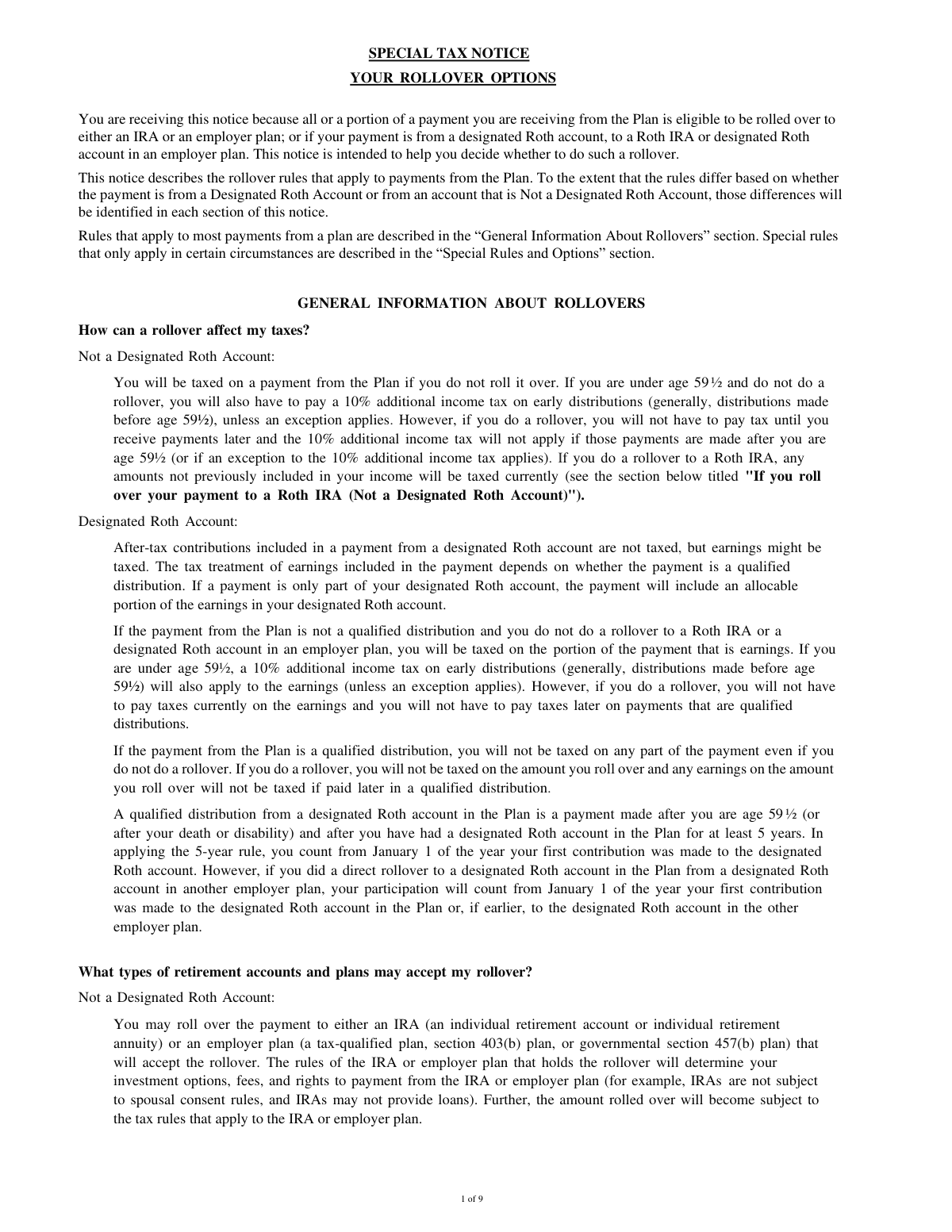
The Special Tax Notice: Your Rollover Options is a required IRS disclosure document provided by Fidelity Investments to retirement plan participants who are receiving a distribution eligible for rollover to an IRA or employer-sponsored retirement plan. It explains the tax consequences of rolling over or not rolling over plan distributions, including rules for Designated Roth Accounts, early distribution penalties, special circumstances such as QDRO payments, and options for surviving beneficiaries. The notice is mandated under federal law to ensure participants make informed decisions about their retirement funds before taking a distribution. Today, related rollover election and retirement distribution forms can be filled out quickly and accurately using AI-powered services like Instafill.ai, which can also convert non-fillable PDF versions into interactive fillable forms.
Fidelity Special Tax Notice / Rollover Options is part of the
investment forms, rollover forms, Fidelity forms and UK investment forms categories on Instafill.
Rather not fill this in by hand? Instafill is an online form filler that completes PDF forms automatically — upload the blank form, answer a few questions, and the AI fills every field.
Form specifications
| Form name: | Special Tax Notice: Your Rollover Options - Fidelity Investments |
| Number of pages: | 1 |
| Field instructions: | Fidelity Special Tax Notice / Rollover Options Instructions |
| Filled form examples: | Fidelity Special Tax Notice / Rollover Options Examples |
| Language: | English |
Our AI automatically handles information lookup, data retrieval, formatting, and form filling.
It takes less than a minute to fill out Fidelity Special Tax Notice / Rollover Options using our AI form filling.
Securely upload your data. Information is encrypted in transit and deleted immediately after the form is filled out.
Instafill Demo: How to fill out PDF forms in seconds with AI
How to Fill Out Fidelity Special Tax Notice / Rollover Options Online for Free in 2026
Are you looking to fill out a FIDELITY SPECIAL TAX NOTICE / ROLLOVER OPTIONS form online quickly and accurately? Instafill.ai offers the #1 AI-powered PDF filling software of 2026, allowing you to complete your FIDELITY SPECIAL TAX NOTICE / ROLLOVER OPTIONS form in just 37 seconds or less.
Follow these steps to fill out your FIDELITY SPECIAL TAX NOTICE / ROLLOVER OPTIONS form online using Instafill.ai:
- 1 Navigate to Instafill.ai and upload the Fidelity Special Tax Notice or any associated rollover election form, or search for it directly in the Instafill.ai form library.
- 2 Read through the Special Tax Notice carefully to understand the tax implications of your rollover options, including rules for Designated Roth Accounts versus non-Roth accounts.
- 3 Determine your rollover preference—direct rollover to an IRA, Roth IRA, or employer plan, or a 60-day rollover—based on your tax situation and retirement goals.
- 4 Use Instafill.ai's AI-powered assistant to complete any required rollover election or distribution request form, entering your personal information, plan details, and chosen rollover destination.
- 5 Review all entered information for accuracy, ensuring your rollover destination account details, contribution type (Roth or non-Roth), and withholding elections are correct.
- 6 Electronically sign the completed form using Instafill.ai's built-in e-signature feature and submit it to Fidelity Investments or your plan administrator as directed.
- 7 Save or download a copy of the completed form and the Special Tax Notice for your records, and consult a tax advisor if you have questions about your specific tax situation.
Our AI-powered system ensures each field is filled out correctly, reducing errors and saving you time.
Why Choose Instafill.ai for Your Fillable Fidelity Special Tax Notice / Rollover Options Form?
Speed
Complete your Fidelity Special Tax Notice / Rollover Options in as little as 37 seconds.
Up-to-Date
Always use the latest 2026 Fidelity Special Tax Notice / Rollover Options form version.
Cost-effective
No need to hire expensive lawyers.
Accuracy
Our AI performs 10 compliance checks to ensure your form is error-free.
Security
Your personal information is protected with bank-level encryption.
Frequently Asked Questions About Fidelity Special Tax Notice / Rollover Options
This notice explains your rollover options when you receive a payment from your retirement plan. It is required by law and helps you understand the tax consequences of rolling over your funds to an IRA or another employer plan versus taking the payment directly.
If you do not roll over your payment, it will be taxed as ordinary income in the year you receive it. Additionally, if you are under age 59½, you may owe a 10% additional income tax on early distributions unless a specific exception applies.
For non-Roth accounts, you can roll over to a traditional IRA, a tax-qualified plan, a section 403(b) plan, or a governmental section 457(b) plan. For Designated Roth Accounts, you can roll over to a Roth IRA or a designated Roth account in an eligible employer plan.
A direct rollover means the plan sends your payment directly to your IRA or new employer plan, with no taxes withheld. A 60-day rollover means the payment is sent to you first, 20% is withheld for federal taxes, and you must deposit the full original amount (including the withheld 20% from your own funds) into a qualifying account within 60 days to avoid taxes and penalties.
Payments that cannot be rolled over include required minimum distributions, hardship distributions, payments spread over 10 or more years, ESOP dividends, corrective distributions exceeding tax law limits, loans treated as deemed distributions, life insurance costs paid by the plan, and certain automatic enrollment contributions withdrawn within 90 days.
Yes, there are many exceptions, including payments made after separating from service at age 55 or older, payments due to disability or death, payments under a qualified domestic relations order (QDRO), qualified birth or adoption distributions up to $5,000, payments to domestic abuse victims up to $10,000 (on or after January 1, 2024), and emergency personal expense distributions up to $1,000 per year (on or after January 1, 2024), among others.
A qualified distribution from a Designated Roth Account is a payment made after you are age 59½ (or after your death or disability) AND after you have had a designated Roth account in the plan for at least 5 years, counting from January 1 of the year your first contribution was made. Qualified distributions are not taxed.
Generally, the 60-day deadline cannot be extended, but the IRS has limited authority to waive it under extraordinary circumstances. You may be able to self-certify eligibility for a waiver in writing, or you can apply for a formal waiver by filing a private letter ruling request with the IRS (which requires a nonrefundable fee). See IRS Publication 590-A for more details.
Yes, you may request a direct rollover of your annuity investment to another employer-sponsored retirement plan that accepts annuities, or to an IRA. You may also request a distribution in the form of a qualified plan distribution annuity. This option is available regardless of whether the distributing plan permits the distribution.
As a surviving spouse, you have the same rollover options the participant would have had, including treating a rolled-over IRA as your own or as an inherited IRA. As a non-spouse designated beneficiary, your only rollover option is a direct rollover to an inherited IRA or inherited Roth IRA, and you will be required to take minimum distributions from that account.
If you roll over a non-Roth payment to a Roth IRA, the amount rolled over (minus any after-tax contributions) will be taxed in the year of the rollover. The 10% early distribution penalty generally does not apply to the rollover itself, but will apply if you withdraw the rolled-over amount from the Roth IRA within 5 years of the rollover (unless an exception applies).
If you are a nonresident alien and do not do a direct rollover to a U.S. IRA or U.S. employer plan, the plan is generally required to withhold 30% (instead of 20%) for federal income taxes. You may be eligible for a reduced withholding rate under an income tax treaty by filing Form W-8BEN. See IRS Publications 519 and 515 for more information.
A mandatory cashout occurs when your plan balance does not exceed $5,000 ($7,000 for distributions on or after January 1, 2024) and you are paid out before age 62 without your consent. If the cashout exceeds $1,000, it will automatically be rolled over to an IRA chosen by the plan administrator unless you elect otherwise. Amounts of $1,000 or less may also be transferred if your plan uses an auto portability provider.
Yes, AI-powered services like Instafill.ai can help you accurately auto-fill retirement and rollover-related forms, saving you time and reducing errors. If you have a flat, non-fillable PDF version of a form, Instafill.ai can also convert it into an interactive fillable form so you can complete it digitally.
This Special Tax Notice only covers federal income tax rules and does not address state or local income tax rules, including state withholding requirements. You should consult your state's tax authority or a professional tax advisor to understand any state tax obligations related to your distribution or rollover.
Compliance Fidelity Special Tax Notice / Rollover Options
Validation Checks by Instafill.ai
1
Rollover Destination Account Type Compatibility
Validates that the selected rollover destination account type is compatible with the source account type. Non-Designated Roth Account funds may only be rolled over to a traditional IRA or eligible employer plan, while Designated Roth Account funds may only be rolled over to a Roth IRA or a designated Roth account in an employer plan. If a participant attempts to roll over Designated Roth Account funds to a non-Roth IRA, the submission must be rejected with an explanation of the incompatibility to prevent adverse tax consequences.
2
Participant Age Verification for Early Distribution Penalty
Validates the participant's date of birth to determine whether the 10% additional income tax on early distributions applies to the requested payment. If the participant is under age 59½ and is not selecting a direct rollover, the system must confirm that an applicable exception has been identified and documented. Failure to capture this information accurately could result in the participant being unaware of significant tax penalties on their distribution.
3
60-Day Rollover Deadline Acknowledgment
Ensures that participants selecting a 60-day (indirect) rollover explicitly acknowledge the 60-day deposit deadline from the date of payment receipt. The form must capture a signed or checked acknowledgment that failure to deposit within 60 days will result in the distribution being treated as taxable income, subject to applicable penalties. Without this acknowledgment, the participant may inadvertently miss the deadline and face unexpected tax liability.
4
20% Federal Withholding Disclosure for Indirect Rollovers
Validates that participants choosing an indirect (60-day) rollover from a Non-Designated Roth Account have been informed that 20% of the taxable payment will be withheld for federal income taxes. The form must confirm the participant understands they must use other funds to make up the withheld 20% if they wish to roll over the entire distribution amount. If this disclosure is not acknowledged, the participant may unknowingly receive a reduced distribution and fail to complete a full rollover.
5
Eligible Rollover Distribution Exclusion Check
Validates that the payment type selected for rollover is not among the categories explicitly excluded from rollover eligibility, such as required minimum distributions, hardship distributions, ESOP dividends, corrective distributions, or payments spread over 10 or more years. If the participant attempts to roll over an ineligible payment type, the form submission must be flagged and rejected with a clear explanation of why the selected distribution does not qualify. Allowing an ineligible rollover could result in an excess contribution to the receiving account and associated tax penalties.
6
Required Minimum Distribution (RMD) Status Validation
Checks whether the participant is subject to required minimum distributions based on their age and account type, and ensures that any RMD amount is excluded from the rollover request. For distributions on or after January 1, 2024, the form must also account for the rule that participants are no longer required to take RMDs from designated Roth accounts in employer-sponsored plans. Failure to exclude the RMD portion from a rollover could result in an excess contribution and IRS penalties.
7
Designated Roth Account 5-Year Rule Compliance
Validates that the participant's first contribution date to the designated Roth account is captured and that the 5-year holding period requirement is assessed when determining whether a distribution qualifies as a tax-free qualified distribution. The form must also account for prior designated Roth account contributions from another employer plan if a direct rollover was previously completed. If this check is omitted, earnings on non-qualified distributions may be incorrectly treated as tax-free, resulting in underreported income.
8
Nonresident Alien Withholding Rate Validation
Validates the participant's residency status and applies the correct federal withholding rate: 20% for U.S. residents not doing a direct rollover, or 30% for nonresident aliens not doing a direct rollover to a U.S. IRA or employer plan. The form must require completion of Form W-8BEN if the participant claims a reduced withholding rate under an applicable income tax treaty. Applying the incorrect withholding rate to a nonresident alien could result in under-withholding and IRS compliance issues.
9
Surviving Beneficiary Rollover Option Restriction
Validates that non-spouse designated beneficiaries are restricted to a direct rollover into an inherited IRA or inherited Roth IRA, and that the option for a 60-day rollover or rollover into a personal (non-inherited) IRA is not presented or permitted. Surviving spouses must be distinguished from other beneficiaries, as they have broader rollover options including treating the IRA as their own. Allowing a non-spouse beneficiary to select an ineligible rollover option would result in a failed rollover and a fully taxable distribution.
10
Qualified Plan Loan Offset Rollover Deadline Validation
Validates the type of plan loan offset (qualified vs. non-qualified) and enforces the correct rollover completion deadline: the tax return due date including extensions for a qualified plan loan offset, or 60 days from the offset date for all other loan offsets. The form must capture the offset date and loan offset type to calculate and display the applicable deadline. Using the wrong deadline could cause a participant to miss the rollover window, resulting in the offset amount being treated as a taxable distribution subject to early withdrawal penalties.
11
Mandatory Cashout Threshold and Auto-Rollover Validation
Validates that mandatory cashout distributions are correctly identified based on the applicable benefit balance thresholds ($1,000 and $5,000, or $7,000 for distributions on or after January 1, 2024) and that amounts exceeding $1,000 are automatically directed to a plan administrator-selected IRA unless the participant elects otherwise. The form must separately evaluate Non-Designated Roth Account and Designated Roth Account balances, as they are not aggregated for this purpose. Failure to apply the correct threshold or account separation could result in improper distribution handling and regulatory non-compliance.
12
In-Plan Roth Conversion Special Withdrawal Option Identification
Validates that when a participant is electing an in-plan Roth conversion, the form clearly identifies this election and notifies the participant that the standard rollover options and disclosures described in the notice do not apply to this specific withdrawal type. The form must prevent the participant from simultaneously selecting standard rollover options alongside an in-plan Roth conversion election. Mixing these election types could result in incorrect tax treatment and processing errors.
13
Birth Date Validation for Pre-1936 Special Tax Rule Applicability
Validates the participant's date of birth to determine whether the special lump-sum distribution tax calculation rules applicable to individuals born on or before January 1, 1936 may apply. If the participant (or deceased participant, in the case of a beneficiary) was born on or before this date and is receiving a lump-sum distribution that will not be rolled over, the form must flag this condition and direct the participant to consult IRS Publication 575. Failing to identify this condition could cause the participant to miss a potentially favorable tax calculation method.
14
Governmental Section 457(b) Plan Early Distribution Penalty Exception
Validates that when the distributing plan is a governmental section 457(b) plan, the 10% early distribution penalty is correctly identified as not applicable to direct distributions from that plan, unless the payment originates from a separate rollover contribution account funded by a tax-qualified plan, 403(b) plan, or IRA. The form must also warn participants that rolling over a 457(b) distribution to a non-457(b) IRA or employer plan will subject future early distributions to the 10% penalty. Misidentifying the plan type could lead to incorrect penalty disclosures and participant misunderstanding of their tax obligations.
15
After-Tax Contribution Tracking and Allocation Validation
Validates that when a payment includes after-tax contributions, the form correctly captures and allocates the after-tax portion versus the pre-tax portion, particularly when only a partial rollover is being completed. For partial direct rollovers, the system must confirm that the rolled-over portion is treated as consisting first of taxable (pre-tax) amounts, with after-tax contributions allocated to the retained portion. Incorrect allocation of after-tax contributions could result in double taxation of amounts that should be tax-free upon distribution.
16
Series Payment Rollover Election Consistency Check
Validates that when a payment is part of a series of payments spanning less than 10 years, the participant's direct rollover election is flagged as applying to all subsequent payments in the series unless a different election is explicitly made for later payments. The form must capture whether the current payment is part of such a series and present a clear disclosure of this continuity rule. Failure to enforce this consistency check could result in unintended tax withholding or rollover treatment being applied to future payments in the series.
Common Mistakes in Completing Fidelity Special Tax Notice / Rollover Options
Many recipients fail to distinguish between distributions from a Designated Roth Account and those from a non-Designated Roth Account, leading them to apply the wrong tax rules. For example, rolling a non-Roth distribution into a Roth IRA triggers immediate taxation on amounts not previously included in income, which surprises many people. Carefully read each section of the notice that specifies 'Designated Roth Account' versus 'Not a Designated Roth Account' and confirm with your plan administrator which type of account your distribution is coming from before making any rollover decisions.
A very common and costly mistake is failing to deposit the distributed funds into an eligible IRA or employer plan within 60 days of receiving the payment. Missing this deadline means the entire distribution becomes taxable income, and if you are under age 59½, the 10% early distribution penalty also applies. Mark the deadline on your calendar immediately upon receiving the distribution, and consider requesting a direct rollover instead to eliminate this risk entirely. Tools like Instafill.ai can help you track and organize rollover documentation to avoid missing critical deadlines.
When recipients choose a 60-day rollover instead of a direct rollover, the Plan is required to withhold 20% of the taxable payment for federal income taxes. Many people mistakenly believe they can simply redeposit the net amount they received and complete a full rollover, but this results in the withheld 20% being treated as a taxable distribution. To roll over the entire amount and avoid taxes on the withheld portion, you must use other personal funds to make up the 20% difference when depositing into the IRA or employer plan within 60 days.
People frequently attempt to roll over distributions that are not eligible for rollover, such as required minimum distributions (RMDs), hardship distributions, substantially equal periodic payments over 10+ years, or corrective distributions. Attempting to roll over these amounts can result in excess contribution penalties and additional tax complications. Always confirm with your plan administrator or payor which portion of your payment is eligible for rollover before initiating any transfer, as the rules vary by distribution type.
Many participants mistakenly believe that rolling over a traditional (non-Roth) plan distribution to a Roth IRA is a tax-free event. In reality, any amounts not previously included in income will be taxed in the year of the rollover, which can result in a significant and unexpected tax bill. Before electing a rollover to a Roth IRA from a non-Designated Roth Account, consult a tax advisor to understand the full tax impact and ensure you have funds available to pay the resulting income taxes.
Recipients often misapply the 5-year rule, not realizing that the clock starts on January 1 of the year the first contribution was made to any Roth IRA (not the year of the rollover), or that a separate 5-year period may apply to a designated Roth account in an employer plan. Withdrawing funds from a Roth IRA within the 5-year period can trigger the 10% early distribution tax even if you are over age 59½ in some circumstances. Carefully track the start date of your Roth account contributions and consult IRS Publication 590-B for guidance on how the 5-year rule applies to your specific situation.
Designated beneficiaries who are not the surviving spouse frequently attempt to do a 60-day rollover, not realizing that their only rollover option is a direct rollover to an inherited IRA or inherited Roth IRA. Attempting an indirect rollover as a non-spouse beneficiary will result in the distribution being fully taxable with no ability to undo the mistake. Non-spouse beneficiaries must contact the receiving IRA custodian and the plan administrator to arrange a direct rollover to an inherited IRA before any funds are distributed to them personally.
Participants who hold employer stock in their plan often automatically roll over the stock without considering the special NUA tax rule, which can result in paying ordinary income tax rates on gains that could otherwise be taxed at lower long-term capital gains rates. By not rolling over the employer stock and instead taking a lump-sum distribution, the NUA (the increase in value of the stock since the plan acquired it) is taxed at capital gains rates when the stock is later sold. Consult a financial advisor or tax professional to evaluate whether the NUA strategy is more advantageous than a rollover before making a decision about employer stock.
When employment ends with an outstanding plan loan, the loan balance is typically offset against the plan benefit and treated as a taxable distribution, which catches many people off guard. Participants often do not realize they can roll over the offset amount to avoid taxes and penalties, or they miss the rollover deadline — which for a qualified plan loan offset extends to the tax return due date (including extensions) for the year the offset occurs. If you have an outstanding loan and are leaving your employer, immediately contact your plan administrator to understand the offset timeline and arrange a rollover of the offset amount to an IRA or eligible employer plan.
Nonresident aliens often assume the same 20% withholding rate applies to them as it does to U.S. residents, but the Plan is generally required to withhold 30% of the payment for federal income taxes if a direct rollover to a U.S. IRA or U.S. employer plan is not completed. Failing to plan for this higher withholding rate can leave nonresident aliens with an unexpected tax burden or a complex refund process requiring Form 1040NR and Form 1042-S. Nonresident aliens should review applicable tax treaties using Form W-8BEN to determine if a reduced withholding rate applies and should strongly consider a direct rollover to avoid the 30% withholding altogether.
Participants with small account balances (under $5,000, or $7,000 for distributions on or after January 1, 2024) often do not realize that if they do not make an affirmative election, their balance may be automatically rolled over to an IRA chosen by the plan administrator, potentially with fees and investment options they did not select. Additionally, participants may not be aware of the auto portability option that could transfer their balance to a new employer's plan. Review any mandatory cashout notices carefully, make an affirmative rollover election to an IRA or employer plan of your choosing, and compare fees and investment options before accepting the plan administrator's default IRA selection.
Many recipients focus exclusively on federal tax rules described in this notice and fail to research their state's income tax treatment of retirement plan distributions and rollovers. Some states do not conform to federal rollover rules, may impose their own withholding requirements, or may tax distributions differently, leading to unexpected state tax liabilities. Before completing a rollover or taking a distribution, consult a tax advisor familiar with your state's rules or contact your state's department of revenue to understand any additional withholding or reporting obligations that may apply.
Saved over 80 hours a year
“I was never sure if my IRS forms like W-9 were filled correctly. Now, I can complete the forms accurately without any external help.”
Kevin Martin Green
Your data stays secure with advanced protection from Instafill and our subprocessors




Robust compliance program
Transparent business model
You’re not the product. You always know where your data is and what it is processed for.
ISO 27001, HIPAA, and GDPR
Our subprocesses adhere to multiple compliance standards, including but not limited to ISO 27001, HIPAA, and GDPR.
Security & privacy by design
We consider security and privacy from the initial design phase of any new service or functionality. It’s not an afterthought, it’s built-in, including support for two-factor authentication (2FA) to further protect your account.
Fill out Fidelity Special Tax Notice / Rollover Options with Instafill.ai
Worried about filling PDFs wrong? Instafill securely fills special-tax-notice-your-rollover-options-fidelity-investments forms, ensuring each field is accurate.
