Form 6198, At-Risk Limitations Completed Form Examples and Samples
Explore practical examples and samples of how to fill out IRS Form 6198, At-Risk Limitations. Learn how to accurately report investment losses, adjusted basis, and at-risk amounts with our step-by-step guides.
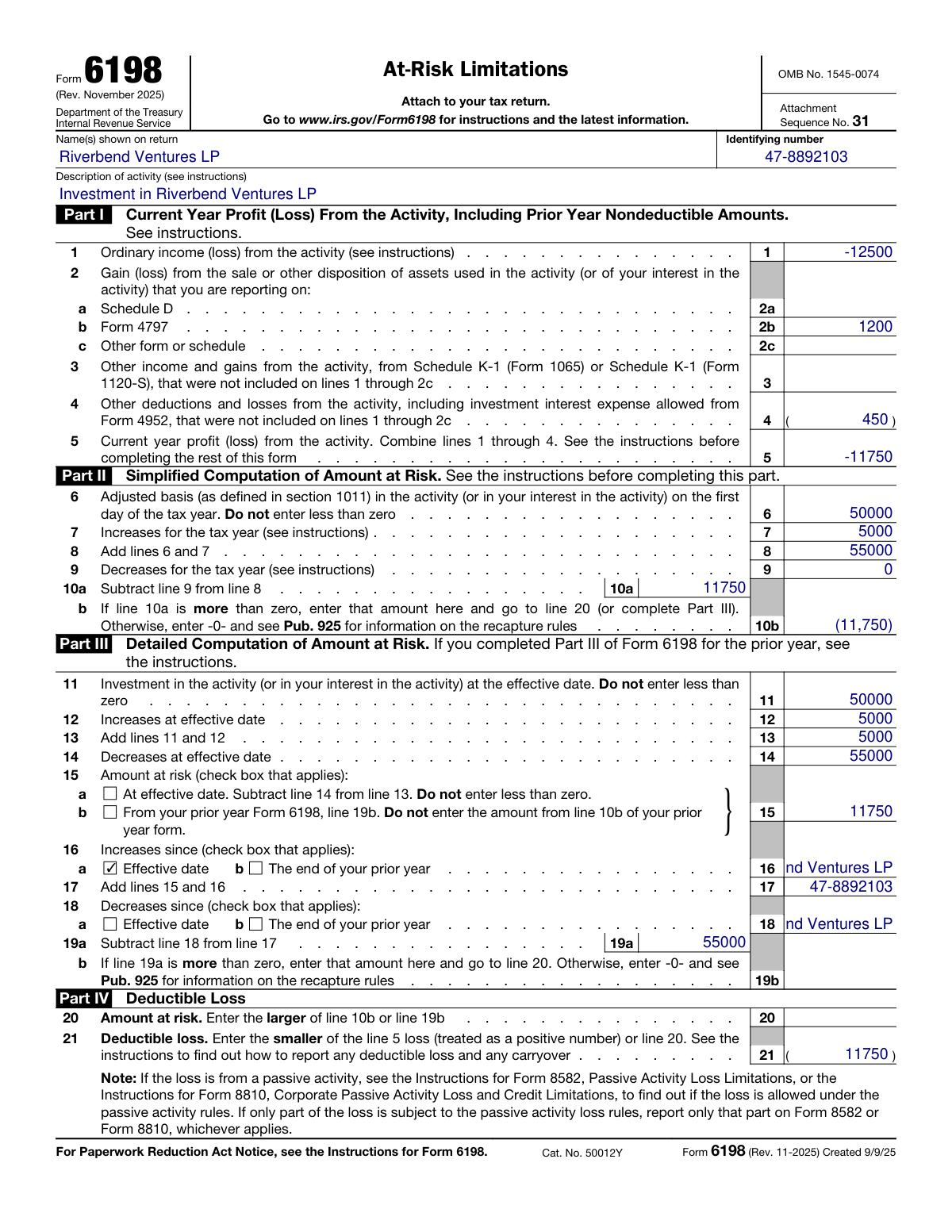
Example: Filling Form 6198 for Partnership Investment Loss
How this form was filled:
This example demonstrates how an AI assistant can extract complex financial data from a tax accountant's year-end summary email to fill out IRS Form 6198. The AI intelligently identifies relevant figures for current year loss, adjusted basis, and at-risk adjustments while ignoring irrelevant professional correspondence, ensuring accurate tax reporting.
Source document used: Accountant's Year-End Tax Summary Email
Subject: Year-End Tax Summary for Riverbend Ventures LP - Tax Year 2026

Dear Marcus, I hope you’re doing well. I’ve finished reconciling your investment records for Riverbend Ventures LP (EIN: 47-8892103) for the 2026 tax year. As we discussed, since this is a non-recourse leveraged activity, we need to carefully document your at-risk basis using Form 6198.

Your K-1 indicates an ordinary loss of $12,500. Additionally, you had a small gain of $1,200 from the sale of equipment reported on Form 4797. You incurred $450 in investment interest expenses which we are deducting. Altogether, this brings your total net loss for the activity to $11,750 for this year.

Regarding your basis calculation, you started the year with an adjusted basis of $50,000. During the year, you made an additional capital contribution of $5,000 in June to cover the short-term operating deficit, bringing your total available investment to $55,000 before considering this year's losses. We had no formal distributions during this period. Therefore, your current basis calculation is straightforward: the $55,000 initial position minus zero decreases leaves you with a current year amount at risk of $55,000.

I’ve noted the effective date for the activity as January 1st, 2026. Since the partnership agreement hasn't changed, we will continue using the end of the prior year for tracking increases and decreases. Please review these figures before I finalize the filing for the partnership tax return. If everything looks correct, I’ll prepare the final PDF for your signature by Friday. Let me know if you have any questions regarding the deductible loss thresholds.
Information used to fill out the document:
- Taxpayer Information: Marcus Thorne, EIN 47-8892103
- Activity Description: Riverbend Ventures LP
- Current Year Loss: -$11,750 (Net)
- Adjusted Basis: $50,000
- Increases/Contributions: $5,000
- Effective Tracking Date: End of prior year
What this filled form sample shows:
- Intelligent extraction of financial figures from narrative text
- Distinction between Form 4797 gains and ordinary business losses
- Logical grouping of at-risk basis components
- Automatic mapping of tax year-specific date references to form line items
Form specifications and details:
| Form Name: | Form 6198, At-Risk Limitations |
| Target Audience: | Individual partners or investors in at-risk activities |
| Tax Year: | 2026 |
| Core Function: | Calculating deductible losses against at-risk investment amounts |
| Created: | March 25, 2026 06:14 AM |