Yes! You can use AI to fill out Form 843, Claim for Refund and Request for Abatement
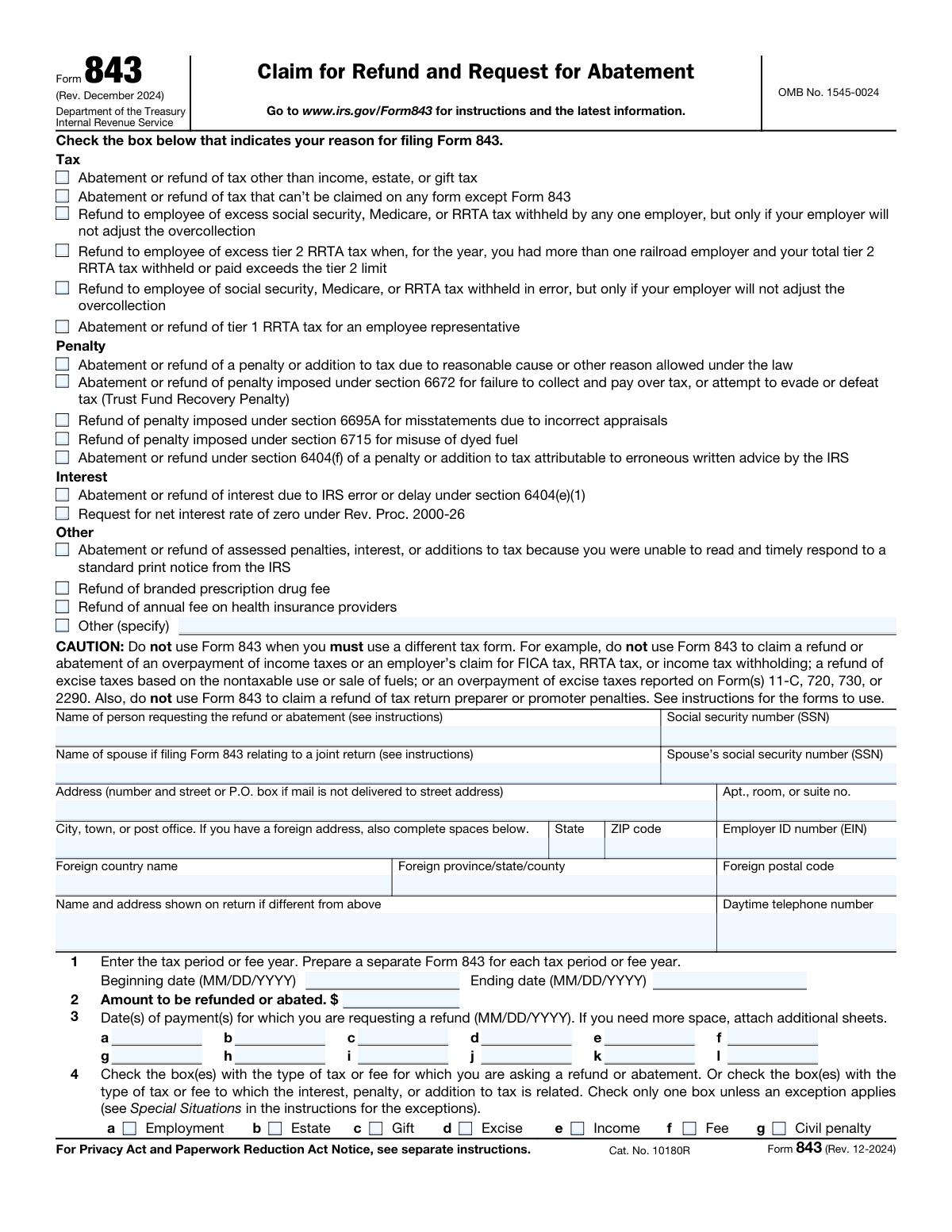
Form 843, Claim for Refund and Request for Abatement, is an Internal Revenue Service (IRS) document used by taxpayers to request a refund or abatement of specific taxes, interest, or penalties that cannot be claimed on another tax form. It is crucial for correcting overpayments or challenging assessments due to reasons like IRS errors, reasonable cause, or erroneous advice. Today, this form can be filled out quickly and accurately using AI-powered services like Instafill.ai, which can also convert non-fillable PDF versions into interactive fillable forms.
Our AI automatically handles information lookup, data retrieval, formatting, and form filling.
It takes less than a minute to fill out Form 843 using our AI form filling.
Securely upload your data. Information is encrypted in transit and deleted immediately after the form is filled out.
Form specifications
| Form name: | Form 843, Claim for Refund and Request for Abatement |
| Number of fields: | 85 |
| Number of pages: | 2 |
| Filled form examples: | Form Form 843 Examples |
| Language: | English |
More forms in ABA forms
Instafill Demo: How to fill out PDF forms in seconds with AI
How to Fill Out Form 843 Online for Free in 2026
Are you looking to fill out a FORM 843 form online quickly and accurately? Instafill.ai offers the #1 AI-powered PDF filling software of 2026, allowing you to complete your FORM 843 form in just 37 seconds or less.
Follow these steps to fill out your FORM 843 form online using Instafill.ai:
- 1 Navigate to Instafill.ai and upload your Form 843 or select it from the template library.
- 2 Provide your personal information, including your name, address, and Social Security Number (SSN) or Employer Identification Number (EIN).
- 3 Enter the details of your claim, such as the tax period, the amount you are requesting to be refunded or abated, and the type of tax or fee.
- 4 Select the appropriate boxes to indicate the reason for your claim, such as an IRS error, reasonable cause, or a specific penalty type.
- 5 Write a clear and detailed explanation for your request in the designated section, including how you calculated the refund or abatement amount.
- 6 Review the entire form after the AI has populated the fields to ensure all information is accurate and complete.
- 7 Electronically sign the form, download the completed document, and submit it to the IRS as per their instructions.
Our AI-powered system ensures each field is filled out correctly, reducing errors and saving you time.
Why Choose Instafill.ai for Your Fillable Form 843 Form?
Speed
Complete your Form 843 in as little as 37 seconds.
Up-to-Date
Always use the latest 2026 Form 843 form version.
Cost-effective
No need to hire expensive lawyers.
Accuracy
Our AI performs 10 compliance checks to ensure your form is error-free.
Security
Your personal information is protected with bank-level encryption.
Frequently Asked Questions About Form Form 843
Form 843, Claim for Refund and Request for Abatement, is used to claim a refund or request the reduction of certain taxes, interest, penalties, and fees that cannot be claimed on a more specific tax form.
No, you cannot use Form 843 to claim a refund of income taxes. For personal income tax refunds, you must file an amended return, such as Form 1040-X.
You should file Form 843 if you believe you overpaid certain taxes (other than income tax), were incorrectly charged a penalty or interest, and there isn't a different, specific form for your request.
Yes, if your employer will not adjust an overcollection of Social Security, Medicare, or RRTA tax, you can file Form 843 to claim a refund for the excess amount withheld.
On Line 8, you must provide a detailed explanation of why your claim should be allowed and show how you calculated the refund or abatement amount listed on Line 2. Attach additional sheets if you need more space.
Yes, the form instructions state that you must prepare and file a separate Form 843 for each individual tax period or fee year you are making a claim for.
You should attach copies of any documents that support your claim, such as relevant IRS notices, proof of payment, or any erroneous written advice you received from the IRS.
Check the box for 'Abatement or refund of a penalty...due to reasonable cause' and the box for 'Reasonable cause' on Line 7. Then, use Line 8 to provide a full, detailed explanation of your reasonable cause.
Yes, if you are filing Form 843 for a claim that relates to a joint tax return, both you and your spouse are required to sign the form.
The mailing address for Form 843 varies depending on the reason for your claim. You must refer to the official IRS instructions for Form 843 to find the correct address for your specific situation.
Yes, services like Instafill.ai use AI to auto-fill form fields accurately and save time. This can help you complete the form more efficiently and with fewer errors.
You can use a service like Instafill.ai to fill out the form online. Simply upload the form, and the platform will make it interactive, allowing you to type in your information, sign electronically, and download the completed PDF.
If you have a non-fillable PDF, you can use a tool like Instafill.ai. It can convert flat, non-fillable PDFs into interactive, fillable forms that you can easily complete on your computer.
Compliance Form 843
Validation Checks by Instafill.ai
1
Validates Social Security Number Format
This check ensures that the Social Security Numbers (SSN) for both the primary filer and spouse are entered in the standard nine-digit format (XXX-XX-XXXX). Correct formatting is crucial for the IRS to accurately identify the taxpayer and process the claim. An invalid format will lead to processing delays or rejection of the form.
2
Validates Employer Identification Number (EIN) Format
This validation verifies that any Employer Identification Number (EIN) entered on the form, including the filer's and the paid preparer's firm's, follows the correct nine-digit format (XX-XXXXXXX). An accurate EIN is essential for identifying business entities involved in the claim. Failure to provide a correctly formatted EIN can cause processing errors and misattribution of the claim.
3
Ensures Logical Tax Period Chronology
This check validates that the 'Ending date' for the tax period on line 1 is on or after the 'Beginning date.' A tax period cannot end before it begins, and this logical check prevents a common data entry error. An illogical date range would make the claim invalid and require correction before it can be processed.
4
Conditional Requirement for 'Other' Reason Specification
This validation ensures that if the filer selects the 'Other (specify)' checkbox as their reason for filing, they must provide a written explanation in the associated text field. This is necessary for the IRS to understand the basis of the claim when it doesn't fit into a standard category. If the explanation is missing, the claim is incomplete and cannot be evaluated, leading to rejection.
5
Verifies Presence of Claim Explanation
This check confirms that the explanation field (line 8) is not left blank. This section is critical as it contains the filer's justification for the refund or abatement and the calculation of the amount claimed. Without a detailed explanation, the IRS has no basis to approve the request, and the form will be considered incomplete.
6
Ensures Consistency of Spouse Information
This validation rule checks that if a spouse's name is entered, their Social Security Number (SSN) is also provided, and vice versa. This applies to claims related to a joint return and is essential for correctly identifying both taxpayers. Incomplete spousal information can lead to processing delays while the IRS seeks to verify the identity of the second taxpayer on the joint account.
7
Confirms Selection of a Filing Reason
This check ensures that the filer has selected at least one checkbox from the list of reasons for filing the claim at the top of the form. The selected reason is the fundamental basis for the claim and directs how the IRS will review the request. A form submitted without a selected reason is fundamentally incomplete and will be rejected.
8
Validates Standard Date Format (MM/DD/YYYY)
This check verifies that all date fields on the form, including the tax period and payment dates, are entered in the required MM/DD/YYYY format. Consistent and correct date formatting is essential for the system to parse the information accurately and avoid misinterpretation of the claim period. Incorrectly formatted dates will cause processing errors and may require the filer to resubmit the form.
9
Correlates Penalty Claim with IRC Section
This validation ensures that if the claim involves a penalty, the filer must specify the relevant Internal Revenue Code (IRC) section on line 6. This information is mandatory for the IRS to locate the specific penalty assessment and evaluate the request for abatement or refund. A missing IRC section on a penalty claim will render the request incomplete and likely cause it to be denied.
10
Validates Refund or Abatement Amount
This check ensures that the amount entered on line 2 is a valid, positive number, formatted as currency. The claim cannot be processed without a specific, quantifiable amount being requested for refund or abatement. Entering non-numeric characters or a zero/negative value would be an error and would halt the processing of the claim.
11
Enforces Mutually Exclusive Address Information
This validation checks that the filer has provided either a complete US address or a complete foreign address, but not both. A taxpayer can only have one primary mailing address for a given filing. Providing conflicting address information creates ambiguity and can lead to mail being sent to the wrong location, delaying communication and resolution of the claim.
12
Conditional Requirement for 'Other' Return Type Specification
This rule verifies that if the filer checks the 'Other (specify)' box in line 5, they must write in the specific form number or fee type. This detail is crucial for the IRS to cross-reference the claim with the correct original filing. A missing specification makes it impossible to process the claim accurately, as the context of the original tax or fee is unknown.
13
Validates Preparer Tax Identification Number (PTIN) Format
This check verifies that the PTIN entered in the 'Paid Preparer Use Only' section follows the correct format, which is a 'P' followed by eight digits. The PTIN is a required identifier for all paid tax preparers, and its validity is essential for compliance and accountability. An invalid PTIN can lead to rejection of the filing and potential penalties for the preparer.
14
Enforces Single Tax/Fee Type Selection
This validation checks that in most cases, only one box is selected in line 4 for the type of tax or fee. The form instructions state to check only one box unless a specific exception applies, as claims for different tax types usually require separate forms. Selecting multiple types without a valid exception can create processing confusion and may result in the form being returned for clarification.
Common Mistakes in Completing Form 843
Many filers mistakenly use Form 843 to claim a refund of overpaid income taxes, which should be done on Form 1040-X. This error occurs because filers see 'Claim for Refund' and don't read the detailed instructions or the 'CAUTION' notice on the form. Using the wrong form leads to an automatic rejection of the claim, significant processing delays, and a notice from the IRS instructing the filer to use the correct form, restarting the entire process.
The instructions for Line 1 clearly state to prepare a separate Form 843 for each tax period or fee year. Filers often try to consolidate claims for multiple years onto one form to save time, but this violates IRS processing rules. This results in the form being returned or the IRS only processing the claim for the first period listed, forcing the filer to resubmit for the other periods and causing major delays.
Line 8 requires a detailed explanation of the claim and a computation of the refund amount. A common mistake is providing a vague statement like 'I paid too much' without including specific facts, dates, legal arguments, and a clear mathematical breakdown of the amount on Line 2. An insufficient explanation is the most common reason for a claim to be denied, as the IRS examiner has no basis to approve the request.
If the claim for refund or abatement relates to a tax liability from a jointly filed return (e.g., Form 1040), both spouses must sign Form 843. Filers often overlook the second signature line, assuming only one signature is needed. An incomplete form with a missing signature cannot be processed and will be sent back, delaying any potential refund or abatement.
On Lines 4 and 5, filers must correctly identify the type of tax (e.g., Employment, Excise) and the related form number (e.g., 941, 720). People often guess or check the 'Income' box by default, even when the claim relates to a different type of tax. This mismatch confuses processing and can lead to the claim being misrouted or denied because the stated reason doesn't align with the tax type selected.
When requesting a penalty abatement on Line 6, filers are required to enter the specific IRC section on which the penalty is based. Many taxpayers do not know this information and leave the field blank. While not always fatal, omitting the IRC section weakens the claim and may require the IRS to spend extra time identifying the penalty, delaying the review process.
If the IRS has issued an IP PIN to the taxpayer or their spouse, it must be entered in the designated space in the signature section. Forgetting to include a required IP PIN is a frequent oversight that leads to the form being rejected for identity verification purposes. This requires the filer to resubmit the form correctly, causing unnecessary delays.
The dollar amount entered on Line 2 must be precisely supported by the detailed computation provided in the explanation on Line 8. Filers often enter a number on Line 2 without showing how they arrived at it, or the calculation in their explanation leads to a different total. This discrepancy immediately raises a red flag and will likely result in a request for more information or a denial of the claim.
Line 3 asks for the specific date(s) of the payment(s) for which a refund is being requested. A common error is leaving this section blank, writing 'various,' or providing only the year. The IRS needs the exact payment dates to verify the statute of limitations for a refund has not expired. Failure to provide this specific information will halt the processing of the claim until the dates are provided.
The extensive checklist at the top of the form details very specific reasons for filing, each with different documentation requirements. A filer might check the box for 'reasonable cause' when their situation is actually due to 'erroneous written advice from the IRS.' This mistake can lead to submitting the wrong type of supporting evidence, causing the claim to be denied on its merits. AI-powered tools like Instafill.ai can help prevent many of these data entry and formatting errors by guiding users through the form, validating data, and ensuring all required fields are completed correctly. If you only have a non-fillable PDF, Instafill.ai can also convert it into an interactive, fillable version.
Saved over 80 hours a year
“I was never sure if my IRS forms like W-9 were filled correctly. Now, I can complete the forms accurately without any external help.”
Kevin Martin Green
Your data stays secure with advanced protection from Instafill and our subprocessors

Robust compliance program
Transparent business model
You’re not the product. You always know where your data is and what it is processed for.
ISO 27001, HIPAA, and GDPR
Our subprocesses adhere to multiple compliance standards, including but not limited to ISO 27001, HIPAA, and GDPR.
Security & privacy by design
We consider security and privacy from the initial design phase of any new service or functionality. It’s not an afterthought, it’s built-in, including support for two-factor authentication (2FA) to further protect your account.
Fill out Form 843 with Instafill.ai
Worried about filling PDFs wrong? Instafill securely fills form-843-claim-for-refund-and-request-for-abatement forms, ensuring each field is accurate.



