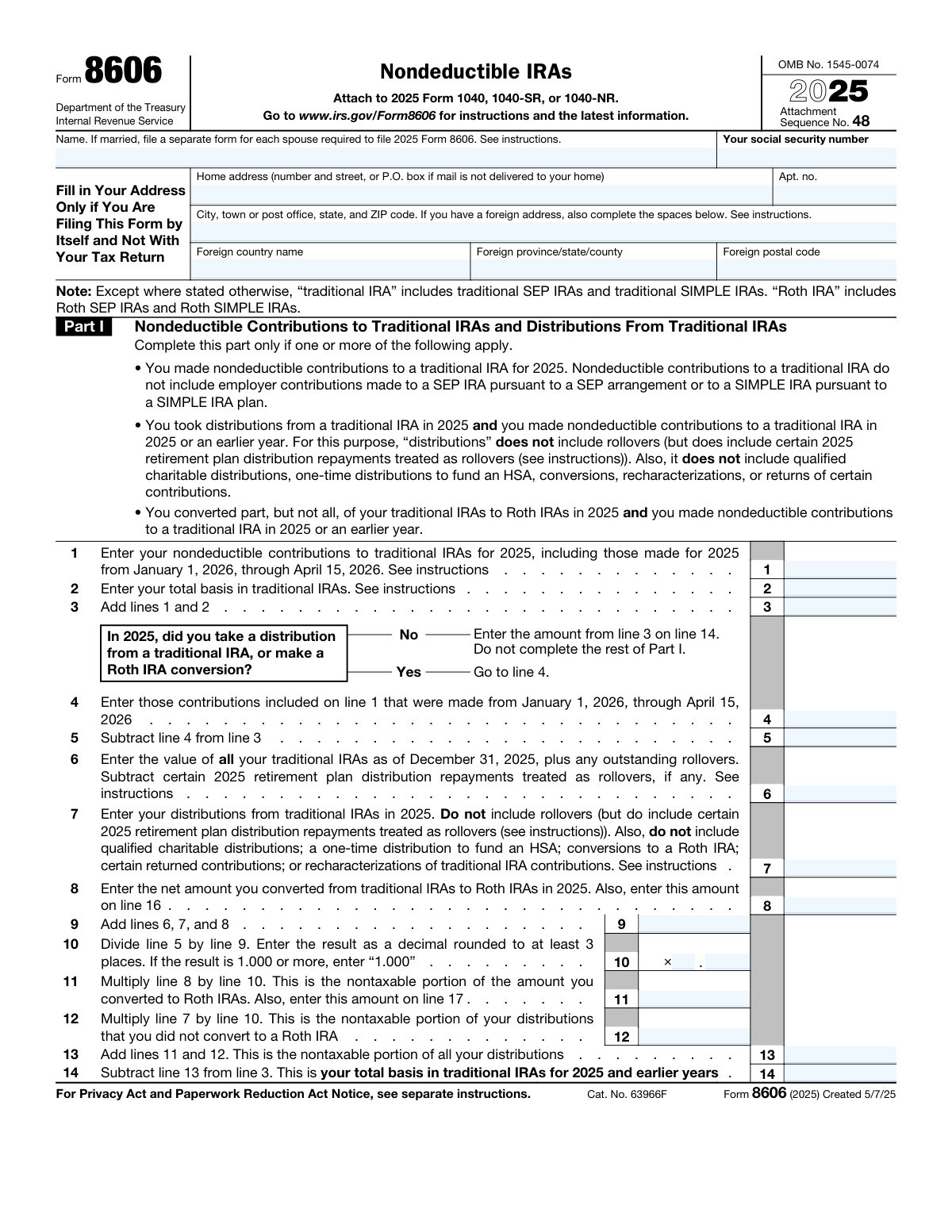
Yes! You can use AI to fill out Form 8606, Nondeductible IRAs

Form 8606, Nondeductible IRAs, is an Internal Revenue Service (IRS) tax form used by individuals to report nondeductible contributions to traditional IRAs and to figure the taxable portion of distributions from traditional, SEP, and SIMPLE IRAs. It is also used to report conversions from traditional IRAs to Roth IRAs and distributions from Roth IRAs, ensuring accurate tax reporting on retirement account activities. Today, this form can be filled out quickly and accurately using AI-powered services like Instafill.ai, which can also convert non-fillable PDF versions into interactive fillable forms.
Our AI automatically handles information lookup, data retrieval, formatting, and form filling.
It takes less than a minute to fill out Form 8606 using our AI form filling.
Securely upload your data. Information is encrypted in transit and deleted immediately after the form is filled out.

Form specifications

Form name: Form 8606, Nondeductible IRAs
Number of pages: 1
Language: English
Categories: IRA forms
main-image

Instafill Demo: How to fill out PDF forms in seconds with AI

How to Fill Out Form 8606 Online for Free in 2026

Are you looking to fill out a FORM 8606 form online quickly and accurately? Instafill.ai offers the #1 AI-powered PDF filling software of 2026, allowing you to complete your FORM 8606 form in just 37 seconds or less.
Follow these steps to fill out your FORM 8606 form online using Instafill.ai:
  1. 1 Navigate to Instafill.ai and upload or select Form 8606 from their library of official documents.
  2. 2 Provide your personal information, such as your name, Social Security number, and address if filing separately.
  3. 3 Complete Part I by entering details about your nondeductible contributions to and distributions from traditional IRAs.
  4. 4 Fill out Part II if you converted any traditional IRAs to Roth IRAs during the tax year, providing conversion amounts and basis information.
  5. 5 Complete Part III if you took distributions from a Roth IRA, detailing the amounts and your basis in contributions.
  6. 6 Review all the information populated by the AI for accuracy and make any necessary corrections before finalizing.
  7. 7 Securely sign and download the completed Form 8606, ready to be attached to your Form 1040, 1040-SR, or 1040-NR.

Our AI-powered system ensures each field is filled out correctly, reducing errors and saving you time.

Why Choose Instafill.ai for Your Fillable Form 8606 Form?

Speed

Complete your Form 8606 in as little as 37 seconds.

Up-to-Date

Always use the latest 2026 Form 8606 form version.

Cost-effective

No need to hire expensive lawyers.

Accuracy

Our AI performs 10 compliance checks to ensure your form is error-free.

Security

Your personal information is protected with bank-level encryption.

Frequently Asked Questions About Form Form 8606

Form 8606 is used to report nondeductible contributions to traditional IRAs, to figure the taxable portion of distributions from traditional, SEP, or SIMPLE IRAs, and to report conversions to or distributions from Roth IRAs.

You must file Form 8606 if you made nondeductible contributions to a traditional IRA, took distributions from a traditional IRA that has a basis, converted a traditional IRA to a Roth IRA, or took a distribution from a Roth IRA.

No, you cannot. If both you and your spouse are required to file Form 8606, you must each complete and file a separate form.

You will need your personal information, details about your IRA contributions and distributions from forms like Form 5498 and 1099-R, and records of any previous nondeductible contributions you've made.

You will need to complete Part I to calculate the nontaxable portion of the conversion and Part II to report the total conversion amount and determine the final taxable amount.

Your basis is the total amount of nondeductible, after-tax contributions you have made to your traditional IRAs over all years. This amount is not taxed again when you take distributions or make conversions.

Yes, if you took a distribution from a Roth IRA, you must complete Part III of Form 8606 to determine if any part of that distribution is taxable.

You should attach the completed Form 8606 to your annual tax return, which is typically Form 1040, 1040-SR, or 1040-NR. Only file it by itself if you are not required to file a tax return but still need to file Form 8606.

If you fail to file a required Form 8606, you may have to pay a penalty. More importantly, without a record of your nondeductible contributions, the entire amount of your future IRA distributions could be taxed, including the part that should be tax-free.

If you have a non-fillable PDF, you can use a service like Instafill.ai to convert it into an interactive, fillable form. This allows you to easily type your information directly into the fields online.

Yes, services like Instafill.ai use AI to help you complete forms accurately and quickly. The AI can auto-fill your personal information and guide you through the form, saving time and reducing potential errors.

To fill out your form online, simply upload the Form 8606 PDF to the Instafill.ai platform. The AI will make the document interactive, allowing you to easily enter all the required information before downloading the completed form.

A rollover is a non-taxable transfer of funds between similar retirement accounts, which is generally not reported on this form. A conversion is a transfer from a pre-tax traditional IRA to a post-tax Roth IRA, which is a taxable event that must be reported on Form 8606.

Compliance Form 8606
Validation Checks by Instafill.ai

1
Social Security Number Format
This check ensures the 'Your social security number' field is present and follows the standard 9-digit format (XXX-XX-XXXX or XXXXXXXXX). An invalid or missing SSN can lead to processing delays or rejection by the IRS. Failure to provide a valid SSN will prevent the form from being correctly associated with the taxpayer's account.
2
Conditional Address Requirement
Validates that the Home Address, City, State, and ZIP code fields are completed if the form is being filed by itself and not with a main tax return (Form 1040, etc.). This information is critical for the IRS to process the form and communicate with the taxpayer if it's a standalone submission. If the form is filed alone and the address is missing, it will be considered incomplete.
3
Part I, Line 3 Calculation Accuracy
Verifies that the value on Line 3 is the sum of the values on Line 1 and Line 2. This calculation is the first step in determining the total basis in traditional IRAs. An incorrect sum will cause all subsequent calculations in Part I to be wrong, leading to an incorrect tax assessment.
4
Part I Conditional Logic Path
Checks the 'Yes/No' question following Line 3. If 'No' is selected, it validates that the value from Line 3 is correctly entered on Line 14 and that the rest of Part I (lines 4-13) is left blank. This logic gate is crucial for guiding the user through the correct path and preventing unnecessary or incorrect entries.
5
Part I, Line 4 Value Constraint
Ensures that the amount entered on Line 4 (contributions made between Jan 1 and Apr 15 of the following year) is not greater than the total nondeductible contributions entered on Line 1. It is logically impossible to have made more contributions in that specific timeframe than for the entire year. An invalid entry here would lead to a negative basis calculation on Line 5.
6
Part I, Line 9 Calculation Accuracy
Validates that the value on Line 9 is the correct sum of the values from Line 6, Line 7, and Line 8. This total value of all traditional IRAs is the denominator for calculating the nontaxable portion of distributions. An error here will directly impact the decimal calculation on Line 10 and all subsequent taxability calculations.
7
Part I, Line 10 Decimal Format and Cap
Verifies that the value on Line 10 is the result of Line 5 divided by Line 9, is expressed as a decimal rounded to at least three places, and does not exceed 1.000. The form explicitly states to enter '1.000' if the result is 1.000 or more. This ratio is fundamental for determining the nontaxable percentage of IRA distributions and conversions.
8
Part I, Line 14 Calculation Accuracy
Checks that the value on Line 14 (total basis for 2025 and earlier years) is correctly calculated by subtracting Line 13 from Line 3. This final basis amount is a critical figure that will be carried forward to future years. An incorrect calculation will result in improper tax treatment in subsequent tax filings.
9
Part II, Line 16 Cross-Part Consistency
Ensures that if Part I was completed, the value entered on Line 16 is identical to the value from Line 8. This check maintains consistency across the form, as both lines represent the net amount converted from traditional to Roth IRAs. A mismatch indicates a data entry error and would make the form's calculations contradictory.
10
Part II, Line 17 Cross-Part Consistency
Validates that if Part I was completed, the value entered on Line 17 is identical to the value from Line 11. Line 11 calculates the nontaxable portion of the conversion, which is the basis that must be entered on Line 17. This validation prevents inconsistencies that would lead to an incorrect taxable amount on Line 18.
11
Part II, Line 18 Taxable Amount Calculation
Verifies that the taxable amount on Line 18 is the result of subtracting Line 17 from Line 16. This calculation determines the portion of the Roth conversion that is subject to income tax. The result should not be negative; if it is, it should be treated as zero.
12
Part III, Line 20 Maximum Value Constraint
Ensures the amount entered for qualified first-time homebuyer expenses on Line 20 does not exceed the lifetime limit of $10,000. While the system cannot check against prior years' distributions, it can enforce the absolute maximum per-form limit. This prevents the taxpayer from claiming an exemption amount greater than what is legally allowed.
13
Part III, Line 21 Non-Negative Result
Validates that the result of subtracting Line 20 from Line 19 is zero or greater, as instructed on the form. A negative value is not possible and would indicate an error in the amounts entered for total distributions or homebuyer expenses. The system should enforce a floor of zero for this field.
14
Part III, Line 25c Taxable Amount Calculation
Checks that the taxable amount on Line 25c is calculated by subtracting Line 25b from Line 25a and that the result is not negative. This final calculation in Part III determines the taxable portion of Roth IRA earnings. An incorrect value here would lead to an incorrect amount being reported on the taxpayer's Form 1040.

Common Mistakes in Completing Form 8606

Forgetting to Track and Report Prior-Year Basis

Taxpayers often fail to correctly enter their total basis from previous years on Line 2. This happens when they lose track of prior-year Form 8606 filings or don't understand that basis carries over. This error leads to the over-taxation of IRA distributions, as they are not getting credit for past nondeductible contributions. To avoid this, always save a copy of your filed Form 8606 and carry the amount from the prior year's Line 14 to the current year's Line 2.

Ignoring the IRA Aggregation Rule on Line 6

Line 6 requires the total year-end value of ALL traditional, SEP, and SIMPLE IRAs, not just the one from which a distribution was taken. A common mistake is to only list the value of a single IRA, which invalidates the pro-rata calculation. This error results in an incorrect taxable amount for distributions and conversions, likely leading to an IRS notice and tax adjustments. Always gather year-end statements for all relevant IRA accounts before filling out this line.

Incorrectly Including Rollovers as Distributions

Line 7 explicitly excludes rollovers, recharacterizations, and conversions from the distribution amount. People often see a gross distribution on their Form 1099-R and mistakenly enter the full amount, even if it was part of a non-taxable rollover. This inflates the distribution figure, which incorrectly increases the taxable portion of their withdrawals. Carefully review 1099-R codes and transaction history to isolate only the true, non-rollover distributions.

Failing to File Form 8606 to Establish Basis

A person must file Form 8606 for any year they make a nondeductible contribution, even if no distributions occur. Many taxpayers are unaware of this requirement and fail to file, meaning the IRS has no record of their after-tax basis. The consequence is severe: when they take distributions in future years, the entire amount is presumed to be taxable, causing them to pay tax twice on the same money.

Mathematical Errors in the Pro-Rata Calculation

The multi-step calculation from Line 9 to Line 13 is highly prone to error, especially the division on Line 10 which must be rounded to at least three decimal places. A simple arithmetic mistake can cascade through the form, causing an incorrect taxable income figure on Form 1040. This can trigger underpayment penalties and interest. AI-powered tools like Instafill.ai can prevent these mistakes by performing the complex calculations automatically and ensuring proper rounding.

Miscalculating the Taxable Amount of a Roth Conversion

When completing Part II for a Roth conversion, people often assume the transaction is entirely tax-free if they made a nondeductible contribution. However, if they hold any other pre-tax IRA funds, the pro-rata rule applies, making a portion of the conversion taxable. Incorrectly calculating the basis on Line 17 leads to underreporting taxable income on Line 18, which can result in a large tax bill, penalties, and interest from the IRS.

Combining Spouses' Information on a Single Form

The form instructions clearly state that IRAs are individual accounts and a separate Form 8606 must be filed for each spouse with reportable activity. A frequent error is for a married couple to file one form that combines their IRA balances, contributions, and distributions. The IRS will reject this, causing significant processing delays and requiring the couple to refile two correct, separate forms.

Confusing Roth Contribution Basis with Conversion Basis

Part III requires filers to separately track their basis from direct Roth IRA contributions (Line 22) and from conversions (Line 24). These two types of basis have different withdrawal ordering rules and tax implications. Mistakenly combining these figures or entering them on the wrong lines can lead to an incorrect calculation of the taxable amount of a Roth distribution, potentially causing you to pay tax on funds that should be tax-free.

Filing a Non-Fillable PDF by Hand

Many IRS forms are only available as flat, non-fillable PDFs, leading to manual data entry that is prone to illegibility and calculation errors. This can cause processing delays or incorrect tax assessments if the IRS cannot read the handwriting or if manual calculations are wrong. To avoid this, an AI tool like Instafill.ai can convert any flat PDF into an interactive, fillable form, ensuring all entries are clean, legible, and mathematically accurate.
Saved over 80 hours a year

“I was never sure if my IRS forms like W-9 were filled correctly. Now, I can complete the forms accurately without any external help.”

Kevin Martin Green

Your data stays secure with advanced protection from Instafill and our subprocessors

Robust compliance program

Transparent business model

You’re not the product. You always know where your data is and what it is processed for.

ISO 27001, HIPAA, and GDPR

Our subprocesses adhere to multiple compliance standards, including but not limited to ISO 27001, HIPAA, and GDPR.

Security & privacy by design

We consider security and privacy from the initial design phase of any new service or functionality. It’s not an afterthought, it’s built-in, including support for two-factor authentication (2FA) to further protect your account.

Fill out Form 8606 with Instafill.ai

Worried about filling PDFs wrong? Instafill securely fills form-8606-nondeductible-iras-1 forms, ensuring each field is accurate.