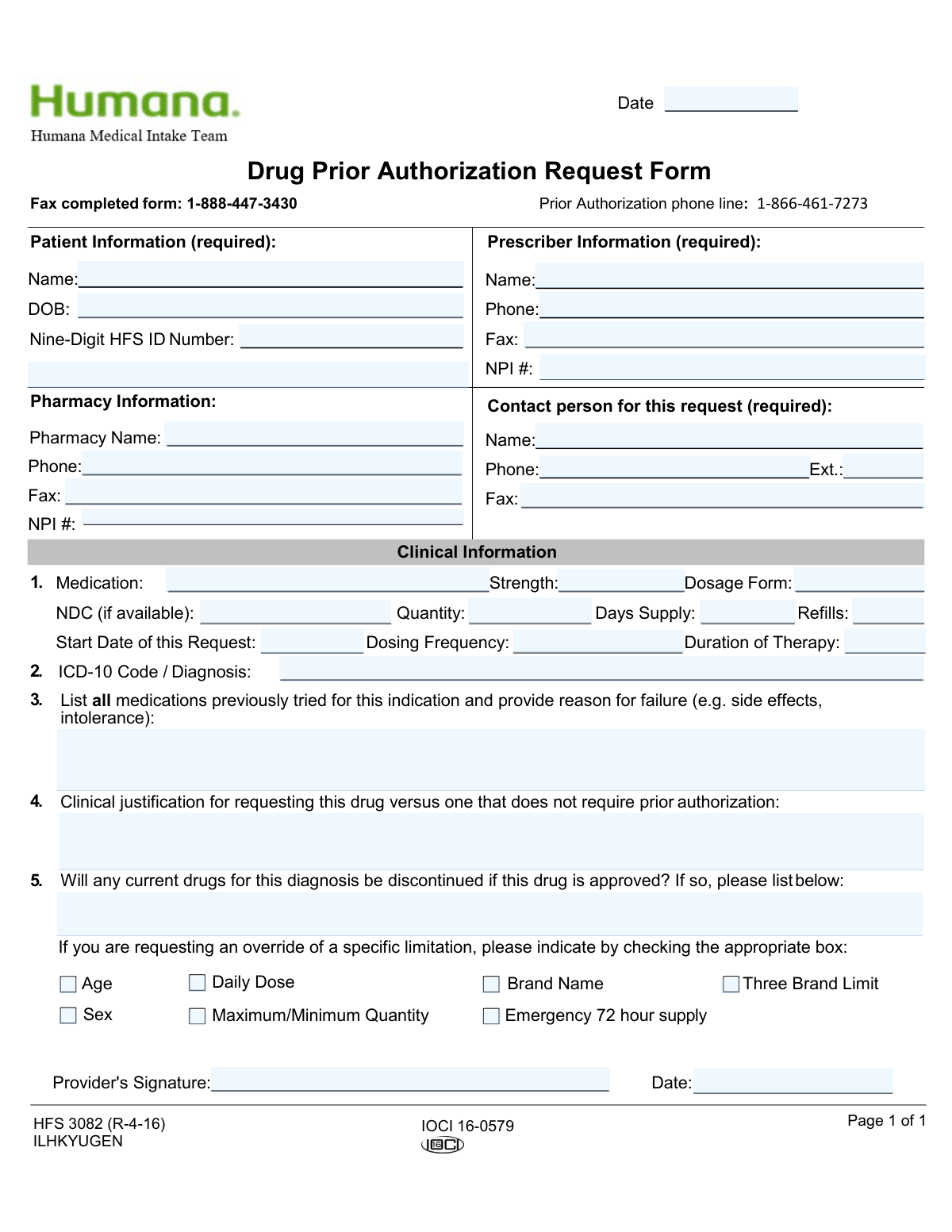
Yes! You can use AI to fill out Form HFS 3082, Drug Prior Authorization Request Form

The HFS 3082 Drug Prior Authorization Request Form is a medical document submitted by a prescriber to an insurance provider to justify the need for a specific medication that is not typically covered. It requires detailed patient information, prescriber details, and clinical justification, including diagnosis and treatment history, to demonstrate medical necessity. Today, this form can be filled out quickly and accurately using AI-powered services like Instafill.ai, which can also convert non-fillable PDF versions into interactive fillable forms.
Our AI automatically handles information lookup, data retrieval, formatting, and form filling.
It takes less than a minute to fill out HFS 3082 using our AI form filling.
Securely upload your data. Information is encrypted in transit and deleted immediately after the form is filled out.

Form specifications

Form name: Form HFS 3082, Drug Prior Authorization Request Form
Number of pages: 1
Language: English
Categories: prior authorization forms, authorization forms
main-image

Instafill Demo: How to fill out PDF forms in seconds with AI

How to Fill Out HFS 3082 Online for Free in 2026

Are you looking to fill out a HFS 3082 form online quickly and accurately? Instafill.ai offers the #1 AI-powered PDF filling software of 2026, allowing you to complete your HFS 3082 form in just 37 seconds or less.
Follow these steps to fill out your HFS 3082 form online using Instafill.ai:
  1. 1 Navigate to Instafill.ai and upload or select the HFS 3082 Drug Prior Authorization Request Form.
  2. 2 Provide the required Patient Information, including name, date of birth, and HFS ID number.
  3. 3 Enter the Prescriber, Pharmacy, and Contact Person details, such as names, NPI numbers, and contact information.
  4. 4 Fill in the complete Clinical Information for the medication being requested, including its name, strength, dosage, and quantity.
  5. 5 Provide the clinical justification, including the ICD-10 diagnosis code, a list of previously tried medications, and the reason for requesting the specific drug.
  6. 6 Indicate if you are requesting an override for any specific limitations by checking the appropriate boxes.
  7. 7 Review all the information auto-filled by the AI, make any necessary corrections, and then have the provider sign and date the form before faxing it.

Our AI-powered system ensures each field is filled out correctly, reducing errors and saving you time.

Why Choose Instafill.ai for Your Fillable HFS 3082 Form?

Speed

Complete your HFS 3082 in as little as 37 seconds.

Up-to-Date

Always use the latest 2026 HFS 3082 form version.

Cost-effective

No need to hire expensive lawyers.

Accuracy

Our AI performs 10 compliance checks to ensure your form is error-free.

Security

Your personal information is protected with bank-level encryption.

Frequently Asked Questions About Form HFS 3082

This form is used by a prescriber to request coverage for a medication that is not on the health plan's preferred drug list or has specific usage limitations. It helps demonstrate the medical necessity of the requested drug for the patient.

The patient's prescribing healthcare provider or their designated office staff is responsible for completing the clinical information and submitting the form. The patient provides their personal details, but the prescriber must sign the request.

You can submit the completed and signed form by faxing it to 1-888-447-3430. Ensure all required fields are filled out to avoid processing delays.

You must complete all sections marked as required, including patient details like the HFS ID number, prescriber information with NPI, and a designated contact person. Complete clinical justification is also critical for a successful review.

The patient's Nine-Digit HFS ID Number is their identification number for the Illinois Department of Healthcare and Family Services (HFS). This number is typically found on the patient's HFS medical card.

In this section, explain why the requested drug is medically necessary compared to drugs that don't require prior authorization. Include details on the patient's condition and why preferred alternatives are not appropriate.

Listing previously tried medications and why they failed (e.g., side effects, didn't work) shows that standard therapies have been attempted. This information is crucial for the insurer to approve the non-preferred drug.

If the need is urgent, you can check the 'Emergency 72 hour supply' box in the override section. This requests a temporary supply to be dispensed while the full prior authorization request is under review.

Processing times can vary, but you can check the status of your request by calling the Prior Authorization phone line at 1-866-461-7273. Submitting a complete and accurate form helps speed up the process.

This is for when you are requesting an exception to a specific coverage rule, such as an age restriction, dose limit, or quantity limit. Check the appropriate box to justify why the patient needs an exception.

The contact person should be someone in the prescriber's office, like a nurse or medical assistant, who can quickly answer any follow-up questions from the health plan. This helps prevent communication delays.

Yes, services like Instafill.ai use AI to help you accurately auto-fill form fields with patient, prescriber, and pharmacy details. This can save significant time and reduce manual data entry errors.

Simply upload the Drug Prior Authorization Request Form PDF to the Instafill.ai platform. The AI will make the fields fillable, and you can quickly enter the information or use saved profiles to auto-fill sections before downloading for submission.

If you have a non-fillable or 'flat' PDF, you can use a service like Instafill.ai. It can instantly convert the static document into an interactive, fillable form online, so you can easily type in all the required information.

Compliance HFS 3082
Validation Checks by Instafill.ai

1
Ensures HFS ID Number is Valid
This check verifies that the 'Nine-Digit HFS ID Number' field contains exactly nine numeric digits. This ID is critical for uniquely identifying the patient within the Healthcare and Family Services system for eligibility and benefits verification. If the ID is missing, incomplete, or contains non-numeric characters, the submission will be rejected as the patient cannot be correctly identified.
2
Completeness of Required Patient Information
This validation ensures that the 'Patient Name', 'DOB' (Date of Birth), and 'Nine-Digit HFS ID Number' fields are all populated. These fields are marked as required and are the minimum necessary data to identify the patient and begin processing the request. A failure to provide any of this information will result in an immediate rejection of the form for being incomplete.
3
Completeness of Required Prescriber Information
This check confirms that the 'Prescriber Name', 'Phone', and 'NPI #' fields are all filled out. This information is required to verify the identity and credentials of the prescribing provider and to enable contact for any necessary clarifications. A request submitted without this complete information cannot be authenticated and will be rejected.
4
Validates NPI Number Format
This check validates that the 'Prescriber NPI #' and 'Pharmacy NPI #' (if provided) are 10-digit numbers. The National Provider Identifier (NPI) is a standard, unique identifier, and an incorrect format indicates a data entry error. An invalid NPI prevents verification of the provider or pharmacy in the national registry, leading to rejection of the request.
5
Patient Date of Birth Validity
This validation ensures the 'Patient DOB' is a valid date formatted correctly (e.g., MM/DD/YYYY) and is in the past. It also checks that the resulting age is logical (e.g., less than 120 years). This is crucial for verifying patient identity and for applying age-based clinical rules, especially if an 'Age' limitation override is requested.
6
Validates Phone and Fax Number Formats
This check verifies that all phone and fax number fields across the form adhere to a standard format, such as containing 10 digits (excluding extensions). Correctly formatted contact numbers are essential for the reviewing entity to communicate with the prescriber, pharmacy, or contact person if questions arise. Incorrect formats can delay processing, even if they don't cause an immediate rejection.
7
Presence of Essential Medication Information
This validation ensures that the core medication details, including 'Medication' name, 'Strength', 'Quantity', and 'Days Supply', are all provided. Without this information, it is impossible for the reviewer to know what drug is being requested or to evaluate its appropriateness. A form missing any of these key details will be rejected as incomplete.
8
ICD-10 Code and Diagnosis Presence
This check verifies that the 'ICD-10 Code / Diagnosis' field is not empty. This information is fundamental to establishing medical necessity by linking the requested drug to a specific clinical condition. If a code is provided, it should also be validated for a proper ICD-10 format. A request without a diagnosis will be denied.
9
Logical Consistency of Medication Supply
This validation cross-references the 'Quantity', 'Days Supply', and 'Dosing Frequency' fields to ensure they are logically consistent. For example, the total quantity requested should be sufficient to last for the number of days supplied based on the dosing instructions. A discrepancy suggests a potential error in the prescription and will flag the request for manual review or clarification, causing delays.
10
Clinical Justification for Non-Preferred Drug
This check ensures that the 'Clinical justification for requesting this drug' field contains a detailed explanation. This justification is the primary rationale for the prior authorization and must explain why preferred alternatives are not appropriate for the patient. If this field is blank, the request will be denied for lacking evidence of medical necessity.
11
Verification of Previous Therapy Failure
This validation confirms that the field 'List all medications previously tried for this indication' is filled out. Many health plans require patients to try and fail one or more preferred medications (step therapy) before a non-preferred drug will be approved. An empty field will likely lead to a denial for not meeting this common requirement.
12
Start Date of Request is a Valid Date
This check ensures the 'Start Date of this Request' is a valid, properly formatted date that is not excessively far in the past or future. This date establishes the service period for the authorization and confirms the request is for a current therapeutic need. An invalid or illogical date may cause the request to be rejected or delayed for clarification.
13
Completeness of Required Contact Person Information
This validation verifies that the 'Name' and 'Phone' number fields under the 'Contact person for this request' section are populated. This section is marked as required to provide a direct point of contact for resolving issues quickly. Missing this information can significantly slow down the review process if the reviewer has questions.
14
Consistency of Form Dates
This check compares the 'Date' at the top of the form with the 'Date' next to the provider's signature. Both dates should be present, valid, and reasonably close to one another (e.g., within a few days). Mismatched or stale dates can raise questions about the request's timeliness and authenticity, potentially requiring a new submission.

Common Mistakes in Completing HFS 3082

Incorrect or Incomplete HFS ID Number

Entering an incorrect or incomplete Nine-Digit HFS ID Number is a frequent error that occurs due to typos or transcription mistakes. Since this ID is the primary patient identifier for the health plan, any error will lead to an immediate inability to process the request, causing significant delays. Always double-check the patient's ID card to ensure all nine digits are entered correctly and in the proper sequence.

Missing Prescriber or Pharmacy NPI Number

The National Provider Identifier (NPI) is crucial for verifying the prescriber and pharmacy, yet it's often omitted. This happens when the person filling the form doesn't have the information readily available and forgets to look it up. A missing NPI requires the processor to manually search for the provider or pharmacy, delaying the review, or may result in the form being returned as incomplete.

Vague Clinical Justification

Providing a weak or generic statement in the 'Clinical justification' section is a primary reason for denial. Phrases like 'patient needs this drug' or 'best for patient' are insufficient. A strong justification must explain why this specific drug is medically necessary over standard formulary options, referencing patient-specific conditions, contraindications to other drugs, or clinical guidelines. Lack of detail forces a denial or a time-consuming request for more information.

Insufficient Detail on Prior Failed Medications

When listing previously tried medications, simply stating 'failed' or 'intolerance' is not enough detail for reviewers. This lack of specificity often happens when the filer is in a hurry. To avoid rejection, you must specify the reason for failure, such as 'caused severe nausea after 3 days,' 'did not lower blood pressure after 90-day trial at max dose,' or 'allergic reaction (rash).'

Mismatched Medication Quantity and Days Supply

A common data entry error is a logical conflict between the 'Quantity' and 'Days Supply' fields, such as requesting a quantity of 30 tablets for a 90-day supply. This discrepancy acts as a red flag for reviewers, suggesting a mistake in the dosing frequency or overall request, and will halt the process until clarification is received. Ensure the quantity requested aligns logically with the dosing frequency and the days supply.

Using Non-Specific or Outdated Diagnosis Codes

The form requires a specific ICD-10 code, but filers sometimes use outdated ICD-9 codes or codes that are not specific enough to justify the requested medication. This leads to an automatic mismatch in the system and can result in denial. Always verify the most current and specific ICD-10 code that accurately reflects the patient's diagnosis for which the drug is being prescribed.

Omitting Required Contact Person Information

The 'Contact person for this request' section is marked as required but is frequently left blank or incomplete, especially the direct phone number and extension. If the reviewer has a simple question, they have no one to call, turning a 2-minute clarification into a multi-day delay via fax. Always designate a specific person, like a nurse or medical assistant, and provide their direct contact information.

Forgetting the Provider's Signature and Date

An unsigned or undated form is legally invalid and will be rejected immediately upon receipt. This simple oversight is a surprisingly common mistake, often happening when forms are filled out in batches and rushed. This error requires the entire submission process to be restarted, so always perform a final check for a valid signature and the current date before faxing. Since this is a non-fillable PDF, tools like Instafill.ai can convert it to a fillable version and help manage these final checks.

Ambiguous Dosing Frequency

Using vague terms like 'take as needed' or 'daily' in the 'Dosing Frequency' field causes ambiguity. Reviewers need precise instructions, such as 'one tablet by mouth twice daily' or 'one inhalation every 4-6 hours as needed for wheezing, not to exceed 6 inhalations in 24 hours.' Unclear instructions will always trigger a request for clarification, delaying patient access to the medication.

Incomplete Medication Details

Leaving fields like 'Strength,' 'Dosage Form,' or 'NDC' blank can create confusion, especially for drugs with multiple formulations. While the NDC is listed as optional, providing it ensures the exact product is reviewed and prevents potential dispensing errors or delays. AI-powered tools like Instafill.ai can help prevent these errors by auto-populating complete drug information from a simple name search, ensuring accuracy and completeness.
Saved over 80 hours a year

“I was never sure if my IRS forms like W-9 were filled correctly. Now, I can complete the forms accurately without any external help.”

Kevin Martin Green

Your data stays secure with advanced protection from Instafill and our subprocessors

Robust compliance program

Transparent business model

You’re not the product. You always know where your data is and what it is processed for.

ISO 27001, HIPAA, and GDPR

Our subprocesses adhere to multiple compliance standards, including but not limited to ISO 27001, HIPAA, and GDPR.

Security & privacy by design

We consider security and privacy from the initial design phase of any new service or functionality. It’s not an afterthought, it’s built-in, including support for two-factor authentication (2FA) to further protect your account.

Fill out HFS 3082 with Instafill.ai

Worried about filling PDFs wrong? Instafill securely fills form-hfs-3082-drug-prior-authorization-request-form forms, ensuring each field is accurate.