
Yes! You can use AI to fill out Form WH-384, Military Family Leave
Don't type 68 fields by hand. Tell our AI about yourself, or upload a document you already have, and it fills every field in seconds. You check it, then download, print or sign.
The AI does the filling. You just check it.
No typing into boxes, nothing to install.
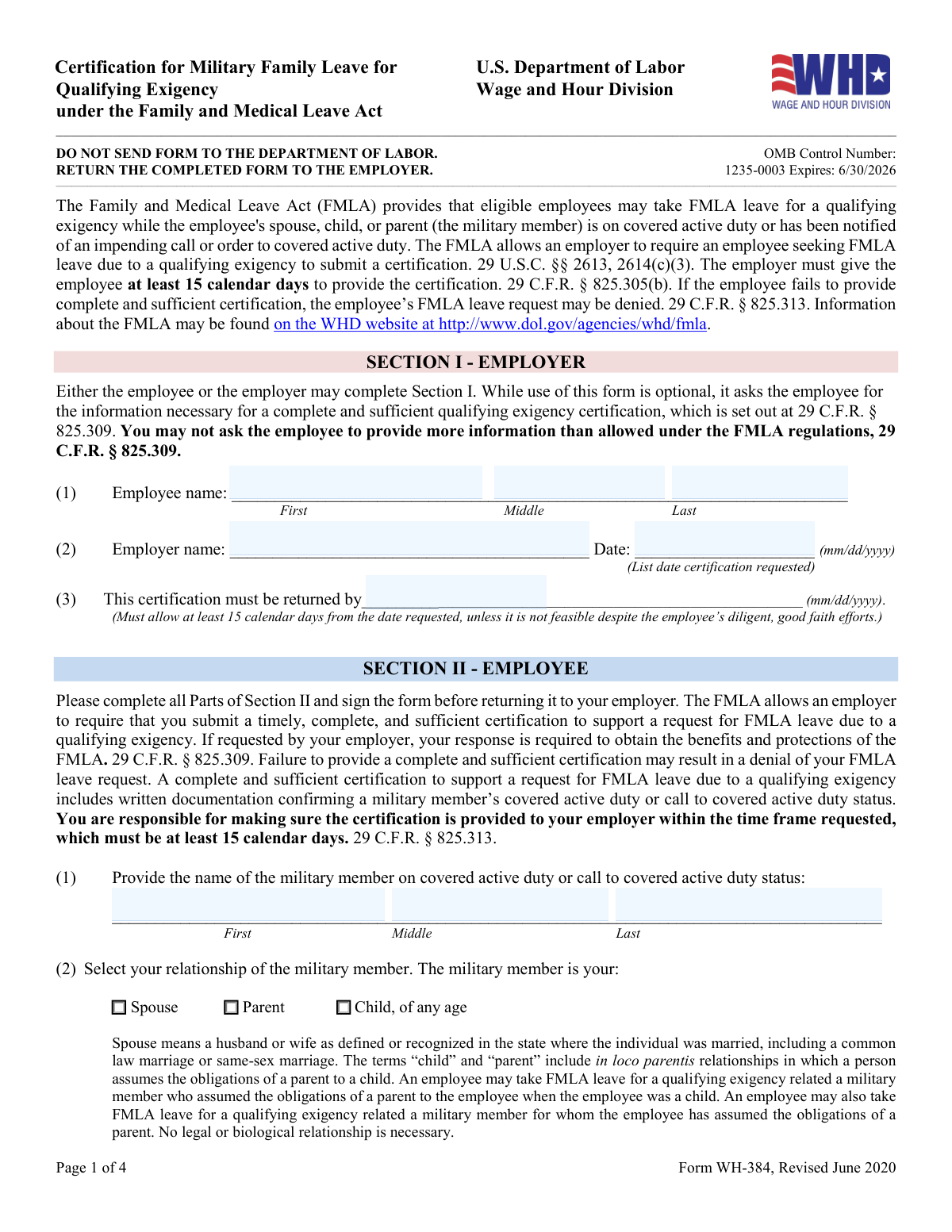
What this form asks for
The AI fills all of it, from your answers or your documents.
The AI checks your answers before you download
15 checks built for this form, so a wrong date or a missing answer is caught before anyone else sees it.
Ensures that the OMB Control Number 1235-0003 is accurately displayed on the form to comply with federal regulations. Additionally, it verifies that the form's expiration date is valid and falls on or after the specified date of 6/30/2026, ensuring the form's continued legitimacy and acceptance by the relevant authorities.
Confirms that the form bears the correct revision date, which should be June 2020. This check is crucial to ensure that the user is filling out the most current version of the form, as outdated forms may not be accepted and could contain obsolete information or requirements.
Verifies that the employee's full name, including first, middle, and last names, is properly entered in Section I of the form. This validation is essential for accurately identifying the individual requesting military family leave and for maintaining consistent records across all documentation.
Checks that the employer's name is correctly entered in Section I of the form, ensuring that the certification is associated with the correct entity. It also verifies that the date the certification was requested is entered in the correct format (mm/dd/yyyy), which is important for record-keeping and compliance with standard date formatting.
Confirms that the return date specified in Section I allows for at least 15 calendar days from the date the certification was requested. This validation ensures compliance with the minimum notice period required for military family leave, providing adequate time for the employer to make necessary arrangements.
The system ensures that the full name of the military member, including first, middle, and last names, is accurately entered in Section II of the form. It checks for completeness and proper formatting of the name fields to prevent any missing or incorrect information. The validation process includes cross-referencing the entered data with the provided documentation to ensure consistency. Any discrepancies or omissions trigger a prompt for the user to correct the information before submission.
And 9 more checks
- Ensures that the relationship to the military member is correctly indicated in Section II (Spouse, Parent, or Child).
- Checks for the inclusion of the military member’s covered active duty service dates in Part A.
- Confirms that appropriate documentation confirming the military member's status is attached in Part A.
- Verifies the selection of the appropriate Qualifying Exigency Category in Part B and checks for additional information if required.
- Ensures that the status of written documentation supporting the request for leave is indicated in Part B.
- Confirms the approximate date the exigency started or will start is listed in Part C (format mm/dd/yyyy).
- Verifies the estimated duration of the exigency, including start and end dates, in Part C (format mm/dd/yyyy).
- Checks for the estimated frequency and duration of each episode of intermittent absence in Part C.
- Ensures that the employee's signature and date are present at the bottom of page 4 and that the form is retained for three years as required by law.
Let AI fill out your Form WH-384
No typing. Every field filled in seconds, checked, ready to sign.
How to Fill Out Form WH-384 Online for Free in 2026
What the AI walks you through.
- Visit instafill.ai site and select Form WH-384.
- Enter employee and employer information.
- Provide military member's details and relationship.
- Complete sections on active duty status and leave needed.
- Sign and date the form electronically.
- Check for accuracy and submit the form.
Common Mistakes in Completing Form WH-384
The ones the AI is built to catch.
Incomplete or incorrect employee name in Section I
Incorrect or missing employer name in Section I
Failure to specify a valid return date in Section I
Incomplete or incorrect military member's name in Section II
Incorrect relationship status in Section II
Incorrect or Incomplete Covered Active Duty Service Dates in Part A
Failure to Attach Appropriate Documentation in Part A
Incomplete or Incorrect Qualifying Exigency Category in Part B
Failure to Indicate Documentation Status in Part B
Incomplete or Incorrect Leave Details in Part C
Failure to sign and date the form in the designated area on page 4
Retaining inadequate records for the required three years
Frequently Asked Questions About Form WH-384
Is it really free for 7 days?
Can I fill other forms too?
How do I cancel?
How does the AI fill out Form WH-384?
What happens to my information?
How complex is Form WH-384 to fill out?
What is the purpose of the Certification for Military Family Leave form?
Who should complete and return Section I of the Certification for Military Family Leave form?
What information is required in Section I of the Certification for Military Family Leave form?
What is the deadline for returning the completed Certification for Military Family Leave form to the employer?
What is a qualifying exigency under the Family and Medical Leave Act (FMLA)?
Who is considered a military member under the FMLA?
What documentation is required to support a request for FMLA leave due to a qualifying exigency?
What is covered active duty or call to covered active duty status under the FMLA?
What is the process for providing written documentation confirming a military member's covered active duty or call to covered active duty status?
What are the different categories of qualifying exigencies under the FMLA?
What is the process for requesting leave due to a qualifying exigency?
What information is required in Part B of the Certification for Military Family Leave form?
What is the process for estimating the amount of leave needed due to a qualifying exigency?
What is the process for requesting intermittent leave due to a qualifying exigency?
What is the purpose of Part D of the Certification for Military Family Leave form?
What information is required in Part D of the Certification for Military Family Leave form?
What is the Paperwork Reduction Act Notice and Public Burden Statement?
What is the estimated time it takes to complete the Certification for Military Family Leave form?
Get your Form WH-384 filled out by AI
$0 today. Cancel before Nov 1 and you pay nothing.
Other forms like this one
Military forms: Standard Form 180 (SF 180), Request Pertaining to Military Records (REV. 3/2024), Consent to Stepparent Adoption by Parent in Military, Standard Form 180, Request Pertaining to Military Records
leave forms: ADP Leave Management Application for Leave of Absence, Form 8994, Employer Credit for Paid Family and Medical Leave, Petition for Leave to Proceed In Forma Pauperis (Court of Common Pleas of Lehigh County, Pennsylvania, Civil Division), Leave of Absence Application (LOA), Vanguard University Leave of Absence Form, Michaels Leave of Absence (LOA) Request Form, Scheduled Medical Leave of Absence (MLOA) - BLET 13, Long-Term Leave of Absence (LOA) Request for an Extended Unpaid Leave, JPMorgan Chase As You Leave Guide, WCBOE Request for Approved Leave of Absence, Employee’s Frequently Asked Questions: Leave of Absence, Merakey Personal Leave of Absence Request Form, Sodexo Leave of Absence Request Packet, Application for Special Leave of Absence without Pay, Application for Sabbatical Leave, Leave of Absence Request Form - ESI PEO, OPM Form 71, Request for Leave or Approved Absence, Form WH-380-E, Certification of Health Care Provider
Let AI fill out your Form WH-384
Your trial starts once a card is added. You pay nothing before Nov 1.
Our AI already knows this form, all 68 fields of it. Skip the typing: tell it about yourself, or upload what you have, and it fills the whole form in seconds.
- AI fills every field on all 4 pages, checkboxes included
- No typing into boxes: answer a few questions, or upload a document you already have, an old copy of this form, a photo of a document
- The AI checks the answers; you review and change anything before you download
- Download the finished PDF, print it, or sign it online
- Encrypted, and never used to train AI
Cancel before Nov 1 and you pay nothing.
A card is needed to start the trial. Cancel in two clicks from your account.
Terms · Privacy