Fill out 403b forms
with AI.
403(b) forms are essential documents used to manage retirement savings plans for employees of public schools, churches, and certain tax-exempt organizations. Often referred to as tax-sheltered annuity plans, these forms facilitate everything from initial enrollment to the management of ongoing contributions. Because 403(b) plans are a primary retirement vehicle for educators and healthcare workers, ensuring these documents are completed accurately is vital for long-term financial security and adherence to IRS regulations.
By continuing, you acknowledge Instafill's Privacy Policy and agree to get occasional product update and promotional emails.
About 403b forms
These forms are typically required when an employee needs to make specific changes to their account or access funds. For example, a Salary Reduction Agreement is used to adjust how much is taken from a paycheck, while other forms handle loan applications or hardship withdrawals. Navigating these financial documents can be complex, especially during major life transitions or when planning for retirement. School administrators and non-profit staff often find themselves managing multiple versions of these forms to ensure they meet both employer requirements and provider standards.
Completing these documents manually can be tedious and prone to errors that might delay your financial requests. Modern tools like Instafill.ai use AI to fill these forms in under 30 seconds, ensuring data is handled accurately and securely. By automating the data entry process, you can focus on your financial planning rather than the administrative burden of repetitive paperwork.
Every form on this page can be completed without typing. Instafill is form filling software that reads a PDF and fills it for you — including flat and scanned documents that carry no fillable fields at all.
Forms in This Category
The forms in this category have a median Form Complexity Index of 48/100 (Moderate), measured across 2 forms by field count, input difficulty, length, conditional logic and structure. See how it is calculated.
| Form Name | Pages | FCI | |
|---|---|---|---|
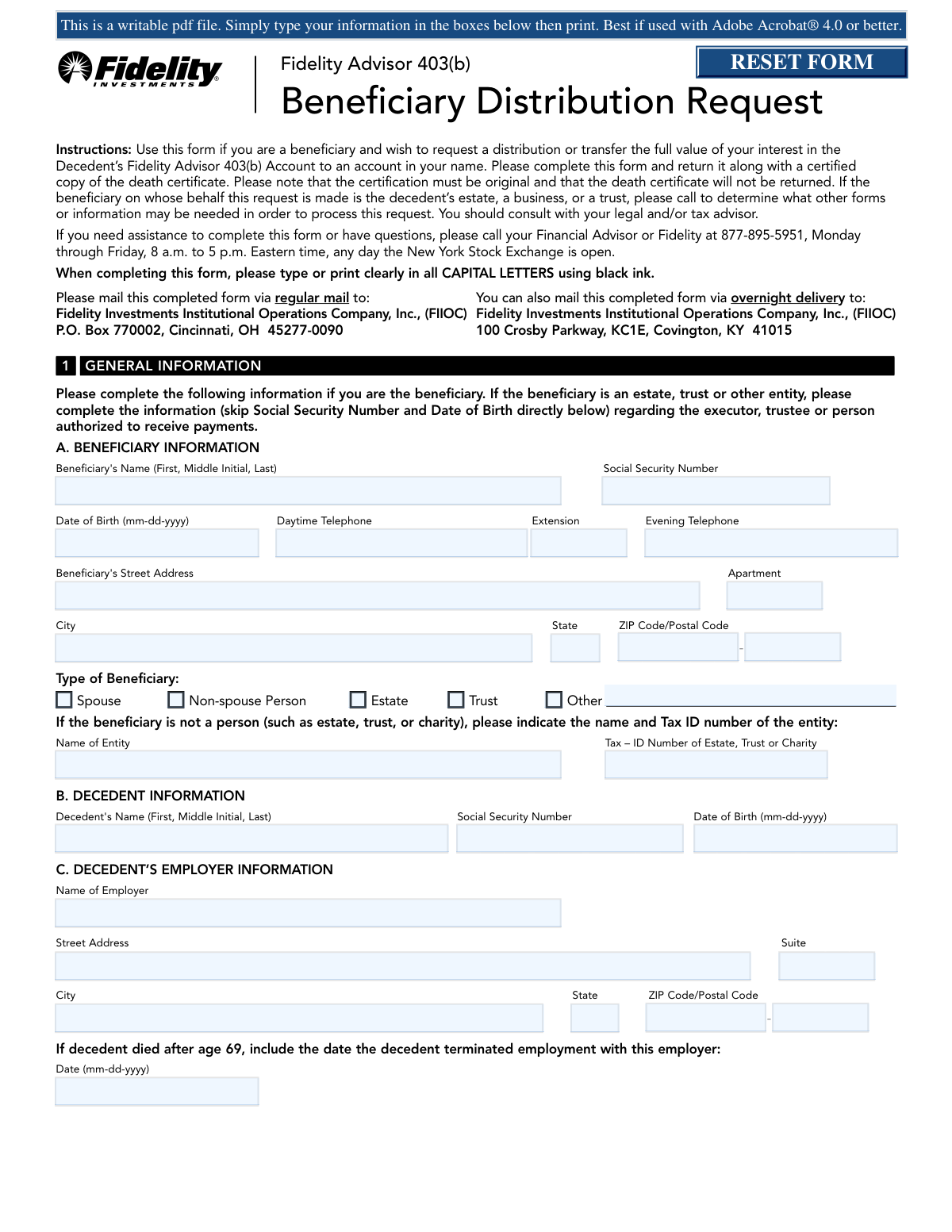
| 1. | Fidelity Advisor 403(b) Beneficiary Distribution Request | 1 | – |
| 2. | Fidelity Investments 403(b) Custodial Account Application | 1 | Moderate 48 |
- Enterprise-grade security & data encryption
- 99%+ accuracy powered by AI
- 1,000+ forms from all industries
- Complete forms in under 60 seconds
How to Choose the Right Form
Navigating 403(b) retirement plans can be complex, especially when dealing with the specific documentation required by educational institutions and non-profit organizations. To find the right form for your financial goals, consider your current objective and employment status.
Starting or Changing Contributions
If you are looking to begin participating in a plan or want to adjust the amount taken from your paycheck, you will need a Salary Reduction Agreement. This form authorizes your employer to withhold a specific portion of your pre-tax or Roth income and direct it into your retirement account. It is the primary document used for ongoing plan maintenance.
Accessing Your Funds
When you need to tap into your savings before retirement, the specific form depends on your financial situation:
- 403(b) Loan Application: Use this if you intend to borrow against your balance with the intent to pay it back over time via payroll deduction or manual payments.
- Hardship Distribution Request: This is required if you are facing an immediate and heavy financial need—such as medical expenses, funeral costs, or preventing eviction—and need a permanent withdrawal rather than a loan.
- Distribution Election Form: Use this if you have reached age 59½ or have separated from service and wish to begin taking regular payments or a lump sum.
Moving and Consolidating Assets
To move funds between different retirement accounts without incurring taxes or penalties, look for:
- 403(b) Rollover/Transfer Form: Use this to move funds from another qualified plan (like a 401k or another 403b) into your current plan.
- Direct Rollover Request: This is used when moving your current 403(b) balance into an IRA or a new employer’s plan after leaving your job.
Designating Beneficiaries
It is vital to keep your Designation of Beneficiary Form up to date. This legal document ensures that your assets are distributed according to your wishes in the event of your death, bypassing the lengthy probate process. Most advisors recommend reviewing this form annually or after major life events.
Form Comparison
| Form | Primary Purpose | Eligibility/Requirement | Typical Frequency |
|---|---|---|---|
| 403(b) Salary Reduction Agreement | Authorize or change elective deferral amounts from payroll | Must be an employee of a qualifying non-profit or school | Upon hire or when changing contribution amounts |
| 403(b) Loan Request Form | Borrow funds against the existing retirement account balance | Subject to plan limits and specific repayment terms | As needed, typically limited to one active loan |
| 403(b) Hardship Distribution Request | Request emergency access to funds for immediate financial needs | Requires documentation of a qualifying heavy financial burden | Only in rare, qualifying emergency situations |
| 403(b) Rollover/Distribution Form | Move funds to another plan or request a payout | Triggered by job termination, retirement, or age 59.5 | Once per account closure or rollover event |
| 403(b) Beneficiary Designation | Specify who receives account assets upon death | Requires valid witness or notary signature in some states | Upon account opening or after major life changes |
| 403(b) Transfer/Exchange Request | Move assets between different 403(b) investment providers | Requires authorization from both sending and receiving institutions | When consolidating accounts or changing investment providers |
Tips for 403b forms
Before starting your 403(b) paperwork, ensure you have the exact legal name of your employer and their Plan ID or EIN. Using outdated or slightly incorrect company information is a common reason for administrators to reject financial forms.
Many retirement forms, especially those involving loans or distributions, require a spouse's signature or a notary's seal. Review the signature page first to see if you need to arrange for a witness before you finish the rest of the document.
If you are filling out a loan application, verify your plan's specific vesting schedule and maximum loan limits. Applying for an amount exceeding your vested balance will result in a denied request and require you to resubmit the entire form.
When updating beneficiary designations, ensure the names and Social Security numbers match official records exactly. Discrepancies between your 403(b) forms and other estate documents can lead to complications during the asset transfer process.
Managing multiple retirement and financial forms can be time-consuming and repetitive. AI-powered tools like Instafill.ai can complete these forms in under 30 seconds with high accuracy, and your sensitive financial data stays secure during the entire process.
After submitting a form to change your contribution amounts, keep a digital copy to compare against your next two pay stubs. This ensures that your payroll department has correctly implemented the changes to your tax-deferred savings.
Frequently Asked Questions
403(b) forms are used to manage retirement savings accounts for employees of public schools and certain tax-exempt organizations. These forms allow participants to start contributions, change investment options, or request distributions and loans from their retirement funds.
These forms are completed by employees of 501(c)(3) non-profit organizations, public school systems, and some hospital or religious organizations. Both new hires setting up their accounts and existing employees making changes to their retirement strategy will need to use these documents.
If you need to borrow from your retirement savings, you should look for a 'Loan Application' or 'Loan Request' form specific to your plan provider. It is important to check with your plan administrator first to ensure your specific plan allows for loans, as not all 403(b) programs offer this feature.
Yes, AI tools like Instafill.ai can fill out 403(b) forms in under 30 seconds by accurately extracting data from your source documents and placing it in the correct fields. This reduces the manual effort required to complete complex financial paperwork while maintaining high accuracy.
Most 403(b) forms are submitted directly to your employer's human resources department or to the third-party administrator (TPA) managing the retirement plan. Some providers also allow for direct electronic submission through their proprietary portals once the form is filled out and signed.
This is one of the most common 403(b) forms, used to authorize your employer to withhold a specific portion of your paycheck to be deposited into your retirement account. You will need this form whenever you want to start, stop, or change the percentage or dollar amount of your contributions.
Using AI-powered platforms, you can complete most 403(b) forms in under 30 seconds. The AI quickly parses information from your identification or previous financial records and maps it to the PDF fields, significantly speeding up the process compared to manual entry.
While both serve similar retirement savings purposes, 403(b) forms are specific to non-profit and educational sectors, whereas 401(k) forms are used by for-profit corporations. The administrative requirements and specific tax regulations governing the forms may vary between the two plan types.
You should review and update your beneficiary forms whenever you experience a major life event, such as marriage, divorce, or the birth of a child. It is a good practice to check these forms annually to ensure your retirement assets are distributed according to your current wishes.
Hardship withdrawal forms typically require you to provide a specific reason for the request, such as medical expenses or preventing eviction, along with supporting documentation. You will also need to specify the exact amount needed and acknowledge the potential tax implications of an early distribution.
Glossary
- Form Complexity Index
- Instafill’s 0–100 measure of how much effort a form takes to complete, calculated deterministically from the form’s own structure rather than estimated. It combines the number of fillable fields (the largest factor), how difficult those fields are to complete based on their type, the number of pages that contain fields, the amount of conditional “fill-only-if” logic, and how many sections the form is divided into, then adds modifiers for tables and repeating lists, bundled instruction pages, and dense page layouts. A higher score means the form is harder to fill out by hand. The forms in this category have a median Form Complexity Index of 48/100 (Moderate). See exactly how it is calculated.
- 403(b) Plan
- A tax-advantaged retirement savings plan available for public school employees and certain tax-exempt 501(c)(3) nonprofit organizations.
- TSA (Tax-Sheltered Annuity)
- A common alternative name for a 403(b) plan, often used when the plan is funded through an annuity contract provided by an insurance company.
- Elective Deferral
- The portion of an employee's compensation that they choose to contribute to their 403(b) plan rather than receiving it as salary, typically done on a pre-tax basis.
- Hardship Withdrawal
- An emergency distribution of funds from a retirement account allowed by the IRS to meet an immediate and heavy financial need, such as medical expenses or preventing eviction.
- Catch-up Contribution
- A rule allowing employees aged 50 or older to contribute additional funds to their 403(b) beyond the standard annual IRS limit.
- QDRO (Qualified Domestic Relations Order)
- A legal judgment or order that recognizes the right of an 'alternate payee,' such as a former spouse, to receive a portion of a participant's retirement benefits.
- RMD (Required Minimum Distribution)
- The minimum amount that a retirement plan account owner must withdraw annually starting at a specific age, as mandated by IRS tax laws.
- Direct Rollover
- The transfer of retirement assets directly from one plan provider to another, avoiding tax withholding and the 10% early withdrawal penalty.