Fill out alternative investment forms
with AI.
Alternative investments—including private equity, real estate, hedge funds, and commodities—require a specialized set of documentation that differs significantly from traditional stock or bond paperwork. These forms serve as the official bridge between investors, brokerage firms, and fund managers, establishing the legal and financial parameters for non-traditional asset classes. They are essential for outlining the unique risks, liquidity constraints, and custodial responsibilities associated with assets that do not trade on public exchanges.
By continuing, you acknowledge Instafill's Privacy Policy and agree to get occasional product update and promotional emails.
About alternative investment forms
Typically, high-net-worth individuals, institutional investors, and financial advisors use these documents when diversifying portfolios or managing complex estates. For example, investors often need a Letter of Instruction (LOI) to authorize transaction requests like purchases or redemptions, or a Letter of Authorization to allow custodians such as Fidelity or Schwab to hold a specific asset. Completing these forms accurately is vital, as they frequently include indemnification clauses and suitability acknowledgments that protect both the investor and the institution during high-stakes financial movements.
Because these documents are often complex and require precise data entry, manual completion can be time-consuming and prone to errors. Tools like Instafill.ai use AI to fill these alternative investment forms in under 30 seconds, handling sensitive data accurately and securely to streamline your administrative workflow.
Every form on this page can be completed without typing. Instafill is form filling software that reads a PDF and fills it for you — including flat and scanned documents that carry no fillable fields at all.
Forms in This Category
The forms in this category have a median Form Complexity Index of 57/100 (Moderate), measured across 8 forms by field count, input difficulty, length, conditional logic and structure. See how it is calculated.
| Form Name | Pages | FCI | |
|---|---|---|---|
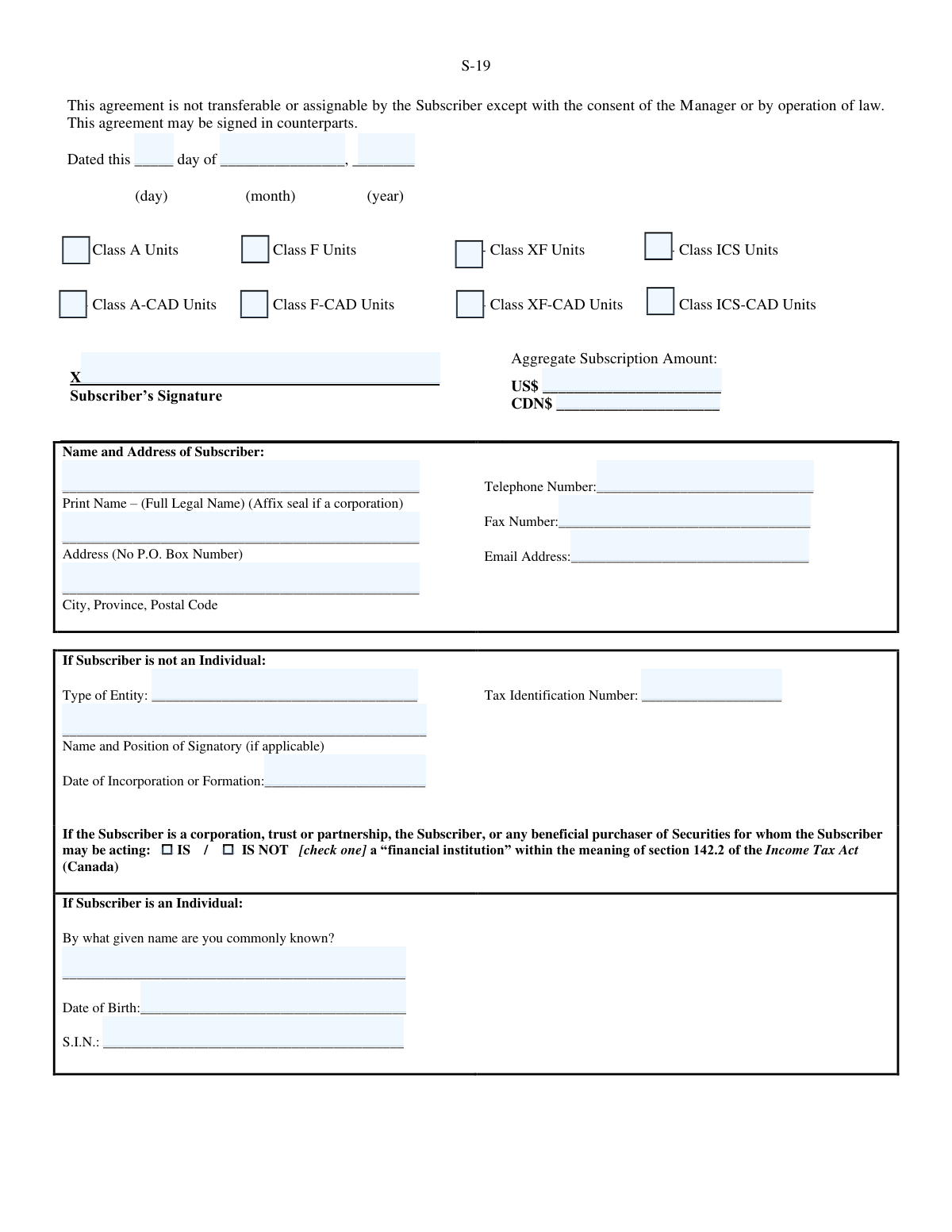
| 1. | Alpine SPRIM™ Private Markets Fund Subscription Agreement and Power of Attorney | 1 | Moderate 61 |
| 2. | Alternative Investment Letter of Authorization | 1 | Basic 45 |
| 3. | Alternative Investment Request for Transaction Letter of Instruction (LOI) | 2 | Basic 32 |
| 4. | BlackRock Private Investments Fund Subscription Agreement and Application | 1 | Complex 65 |
| 5. | Computershare Alternative Investment Product Transfer Request | 1 | Complex 65 |
| 6. | Pomona Investment Fund Investor Subsequent Application (Class A & Class I Shares) | 1 | Basic 41 |
| 7. | Protea International Hedge Fund Subscription Form (Individual) | 1 | Moderate 57 |
| 8. | The Entrust Group - Private Equity Buy Direction Letter | 1 | Basic 43 |
- Enterprise-grade security & data encryption
- 99%+ accuracy powered by AI
- 1,000+ forms from all industries
- Complete forms in under 60 seconds
How to Choose the Right Form
Choosing the right paperwork for alternative investments depends primarily on two factors: which brokerage firm you are using and whether you are initiating a new transaction or simply establishing custody of an existing asset.
If You Are Using Fidelity for Transactions
If you need to buy, redeem, or exchange an alternative asset (such as private equity, hedge funds, or non-traded REITs) within a Fidelity account, you should use the Fidelity Investments Request for Transaction Letter of Instruction (LOI) for Alternative Investments. This form is essential for authorizing Fidelity Brokerage Services to act on your behalf.
Keep in mind that for this specific form to be processed, you typically must also provide:
- A signed Fund Subscription Agreement.
- A completed Alternative Investments Addendum and Custody Agreement.
For general transaction requests where you need to confirm your responsibility for investment suitability and indemnify the broker, the Alternative Investment Request for Transaction Letter of Instruction (LOI) serves as the standard document to authorize purchases or redemptions.
If You Are Using Charles Schwab for Custody
For investors who use Charles Schwab & Co., the requirements differ slightly. You will likely need the Alternative Investment Letter of Authorization. Unlike a transaction-specific LOI, this document is a formal agreement that allows Schwab to hold an alternative investment in custody for you.
This form is necessary to:
- Detail the specific investment being held.
- Outline the responsibilities of your Investment Advisor (IA).
- Acknowledge that Schwab’s role is limited to that of a custodian and does not include investment advice for the specific asset.
Summary of Use Cases
- To buy or sell via Fidelity: Select the Fidelity Investments Request for Transaction Letter of Instruction (LOI) for Alternative Investments.
- To authorize custody via Schwab: Select the Alternative Investment Letter of Authorization.
- To authorize general transactions and acknowledge risk: Select the Alternative Investment Request for Transaction Letter of Instruction (LOI).
Form Comparison
| Form | Primary Purpose | Financial Institution | Key Transaction Types |
|---|---|---|---|
| Fidelity Investments Request for Transaction Letter of Instruction (LOI) for Alternative Investments | Authorizes Fidelity to execute alternative asset transactions on the owner's behalf. | Fidelity / National Financial Services | Purchases, redemptions, and exchanges of alternative investments. |
| Alternative Investment Letter of Authorization | Authorizes Schwab to hold alternative investments in a custodial account. | Charles Schwab & Co., Inc. | Establishing custody and defining investment advisor responsibilities. |
| Alternative Investment Request for Transaction Letter of Instruction (LOI) | Formally instructs a broker to execute specific alternative investment transactions. | Fidelity Investments | Execution of purchases or redemptions within brokerage accounts. |
Tips for alternative investment forms
Alternative investments often involve complex legal names and unique identification numbers that must match the fund's records exactly. A single typo in a CUSIP or fund name can lead to significant delays or the total rejection of your transaction request by the custodian.
Managing multiple alternative investment forms can be time-consuming, but AI-powered tools like Instafill.ai can complete these documents in under 30 seconds with high accuracy. These tools ensure your sensitive financial data remains secure while significantly reducing the manual effort required for repetitive data entry across different brokerage forms.
Most brokerage letters of instruction require you to attach the original fund subscription agreement or a specific custody addendum before they will process the trade. Ensure these documents are signed and ready to be uploaded alongside your LOI to prevent the brokerage from flagging your submission as incomplete.
By signing these forms, you are typically acknowledging that you—not the brokerage—are responsible for determining if the investment is suitable for your portfolio. Review the risk disclosure sections carefully, as these forms often indemnify the custodian from losses resulting from the investment's performance.
Some alternative investment transactions require physical 'wet' signatures or even a Medallion Signature Guarantee depending on the transaction size. Review the instructions for each specific custodian, such as Fidelity or Schwab, to see if electronic signatures are permitted for your specific account type.
If you are moving assets between custodians, ensure the account titles and tax ID numbers are identical on all forms involved. Discrepancies between the Letter of Authorization and the receiving institution's records are a common cause for administrative holds during the custody process.
Unlike standard stock trades, alternative investment transactions often involve manual review by the brokerage's alternative assets department. Submit your forms well in advance of fund deadlines to account for the additional time required for custody verification and capital call processing.
Frequently Asked Questions
Alternative investment forms are used to authorize brokerages or custodians to handle non-traditional assets like private equity, hedge funds, or real estate on behalf of an investor. These documents establish the legal framework for transactions, including purchases, redemptions, and exchanges, while clarifying the responsibilities of each party.
These forms are generally required by individual investors, institutional entities, or investment advisors who wish to hold or trade alternative assets within a brokerage account. Because alternative investments are often complex, the account holder must explicitly authorize the custodian to facilitate the transaction.
Brokerages require a Letter of Instruction (LOI) to confirm that the investor understands the risks associated with non-standard assets and to obtain formal authorization for a transaction. These forms clarify that the brokerage is acting solely as a custodian and is not responsible for the investment's suitability or performance.
Most forms require the account name and number, the specific name of the alternative investment fund, and the transaction type, such as a purchase or redemption. You will also likely need to provide the dollar amount or number of shares and sign various indemnity and risk acknowledgment clauses.
Yes, you can fill out alternative investment forms using AI tools. Services like Instafill.ai allow users to upload PDF forms and automatically populate the required fields by accurately extracting data from source documents, which helps ensure precision in complex financial paperwork.
Processing times vary depending on the brokerage and the specific investment fund, but it often takes several business days to verify the instructions and complete the transfer. It is important to submit these forms well in advance of any fund deadlines to account for administrative review and custody requirements.
Signing these authorizations typically means you acknowledge that alternative investments may be illiquid and carry higher risks than traditional stocks or bonds. You are also confirming that you have conducted your own due diligence and that the brokerage is not providing investment advice regarding the specific asset.
In many cases, a signed Fund Subscription Agreement is required to be submitted along with the Letter of Instruction or Letter of Authorization for new purchases. Always check the specific requirements of both your brokerage and the fund manager to ensure all necessary documentation is included for processing.
When using AI-powered tools, it typically takes under 30 seconds to fill out these forms. Platforms like Instafill.ai accurately extract data from your supporting documents and place it into the correct fields, significantly reducing the manual effort and time required for complex financial forms.
Completed forms are usually submitted directly to the custodian or brokerage firm, such as Fidelity or Charles Schwab, via their secure online portals, fax, or mail. Some forms may also need to be shared with your investment advisor or the fund manager to coordinate the transaction effectively.
Glossary
- Form Complexity Index
- Instafill’s 0–100 measure of how much effort a form takes to complete, calculated deterministically from the form’s own structure rather than estimated. It combines the number of fillable fields (the largest factor), how difficult those fields are to complete based on their type, the number of pages that contain fields, the amount of conditional “fill-only-if” logic, and how many sections the form is divided into, then adds modifiers for tables and repeating lists, bundled instruction pages, and dense page layouts. A higher score means the form is harder to fill out by hand. The forms in this category have a median Form Complexity Index of 57/100 (Moderate). See exactly how it is calculated.
- Letter of Instruction (LOI)
- A formal document provided by an account owner to a brokerage firm that gives specific directions to execute a transaction, such as a purchase, sale, or transfer of assets.
- Custodian
- A financial institution, such as Fidelity or Charles Schwab, that holds and safeguards an investor's assets but typically does not provide investment advice regarding alternative holdings.
- Subscription Agreement
- A primary legal contract between an investor and a fund manager that outlines the terms of the investment and the investor's commitment to purchase a specific number of shares.
- Indemnification
- A legal clause where the investor agrees to protect the brokerage firm from liability, losses, or legal claims that may arise from following the investor's instructions.
- Investment Suitability
- The legal and ethical requirement to ensure that a specific investment is appropriate for an investor's financial situation, risk tolerance, and long-term objectives.
- Redemption
- The process of an investor selling their interest in an alternative investment back to the fund or exiting the position to liquidate their capital.
- Alternative Investment Addendum
- A supplemental document added to a standard account agreement that provides specific disclosures and terms related to non-traditional assets like private equity or hedge funds.
- Letter of Authorization (LOA)
- A document that grants a third party, such as an Investment Advisor, the legal permission to perform specific actions or request transactions on the account owner's behalf.