Fill out certified payroll forms
with AI.
Certified payroll forms are specialized compliance documents required on federal and federally assisted construction projects subject to prevailing wage laws. Rooted in the Davis-Bacon and Related Acts (DBRA) and the Copeland Act, these forms exist to ensure that contractors and subcontractors pay workers at least the applicable prevailing wage rates and fringe benefits established by the U.S. Department of Labor. Submitting accurate certified payrolls is not optional — it is a contractual and legal obligation, and willful falsification can result in civil or criminal penalties and debarment from future federal contracts.
By continuing, you acknowledge Instafill's Privacy Policy and agree to get occasional product update and promotional emails.
About certified payroll forms
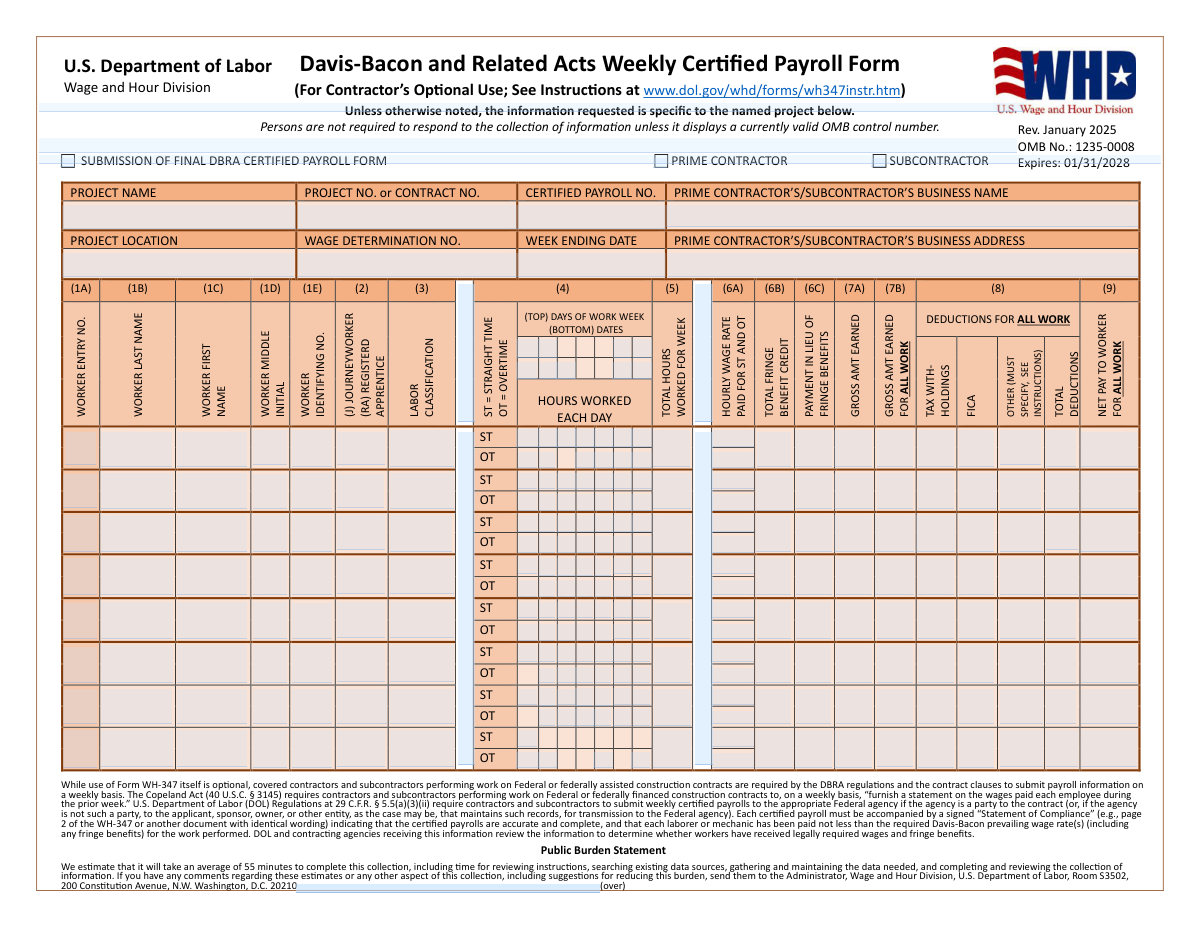
The most widely used form in this category is Form WH-347, the Department of Labor's standard weekly certified payroll reporting form. Contractors and subcontractors use it to document each worker's classification, hours worked, wage rates, fringe benefits, deductions, and net pay, along with a signed Statement of Compliance. These records are reviewed by contracting agencies to verify that wage protections are being upheld across covered projects. Anyone working on a federally funded construction contract — from general contractors to specialty subcontractors — will likely need to complete and submit these forms on a weekly basis throughout the life of the project.
Given the detailed, repetitive nature of certified payroll reporting, tools like Instafill.ai use AI to fill these forms in under 30 seconds, handling the data accurately and securely — a practical time-saver for contractors managing multiple workers and weekly submission deadlines.
Every form on this page can be completed without typing. Instafill is form filling software that reads a PDF and fills it for you — including flat and scanned documents that carry no fillable fields at all.
Forms in This Category
The forms in this category have a median Form Complexity Index of 73/100 (Complex), measured across 2 forms by field count, input difficulty, length, conditional logic and structure. See how it is calculated.
| Form Name | Pages | FCI | |
|---|---|---|---|
| 1. | Davis-Bacon and Related Acts Weekly Certified Payroll Form (Form WH-347) | 2 | Complex 73 |
| 2. | Form WH-347, Davis-Bacon and Related Acts Weekly Certified Payroll Form | 2 | Complex 68 |
- Enterprise-grade security & data encryption
- 99%+ accuracy powered by AI
- 1,000+ forms from all industries
- Complete forms in under 60 seconds
How to Choose the Right Form
Both forms in this category serve the same core purpose: weekly certified payroll reporting for contractors and subcontractors working on federal or federally assisted construction projects under the Davis-Bacon and Related Acts (DBRA).
Who Needs These Forms?
If you're a contractor or subcontractor on a covered federal construction project, you are required to submit weekly payroll records along with a signed Statement of Compliance. These forms are how you meet that obligation.
- Davis-Bacon and Related Acts Weekly Certified Payroll Form (Form WH-347) — Best if you want a concise overview of the form's purpose and compliance requirements before getting started.
- Form WH-347, Davis-Bacon and Related Acts Weekly Certified Payroll Form — Best if you need a more detailed breakdown of exactly what information the form captures, including hours worked, wage rates, fringe benefits, deductions, and net pay.
Which Version Should You Use?
Both listings refer to the same U.S. Department of Labor Wage and Hour Division form (WH-347) — there is only one official form. The two listings simply present it with different levels of detail.
- If you're new to certified payroll reporting and want to understand your obligations first, start with the first listing.
- If you're ready to fill out the form and want to know exactly what data you'll need to prepare, the second listing provides a more complete field-by-field description.
Key Things to Know Before You Fill Out WH-347
- Submission is required weekly for the duration of the covered project
- You must include a signed Statement of Compliance
- Workers must be paid at least the applicable prevailing wage and fringe benefits
- Willful falsification can result in criminal penalties and debarment from future federal contracts
Use Instafill.ai to fill out Form WH-347 accurately — even if you only have a non-fillable PDF version.
Form Comparison
| Form | Purpose | Who Files It | When to Use |
|---|---|---|---|
| Davis-Bacon and Related Acts Weekly Certified Payroll Form (Form WH-347) | Report weekly payroll and certify prevailing wage compliance | Contractors and subcontractors on federal construction projects | Weekly, for each payroll period on covered DBRA projects |
| Form WH-347, Davis-Bacon and Related Acts Weekly Certified Payroll Form | Capture worker hours, wages, fringe benefits, and sign compliance statement | Contractors and subcontractors under federal or federally assisted contracts | Weekly, to fulfill DBRA and Copeland Act reporting obligations |
Tips for certified payroll forms
Before filling out Form WH-347, look up the applicable prevailing wage determination for your specific project, trade, and locality on the Department of Labor's SAM.gov or Wage Determinations Online. Using outdated or incorrect wage rates is one of the most common compliance errors on certified payroll forms. The correct rates should be listed in your federal contract documents.
Certified payroll reports are required on a weekly basis for the duration of the covered project, and in some cases a 'no work performed' statement is required for weeks with no activity. Missing submissions can raise red flags during agency audits and may be treated as a compliance violation. Set a recurring weekly reminder to stay on schedule throughout the project.
Form WH-347 must be accompanied by a signed Statement of Compliance (found on the reverse of the form) certifying that workers were paid at least the applicable prevailing wages and fringe benefits. Submitting the payroll data without this signed statement renders the submission incomplete. Make sure the authorized company representative — not just any employee — signs and dates it each week.
Each worker must be listed under the correct labor classification that matches the work they actually performed, as defined in the prevailing wage determination. Misclassifying workers — for example, listing a skilled tradesperson as a laborer to show a lower wage rate — is a serious violation that can lead to back-wage liability and debarment. When in doubt, consult the wage determination or contact the contracting agency.
AI-powered tools like Instafill.ai can complete certified payroll forms like WH-347 quickly and accurately, saving significant time when you're managing multiple workers and weekly submissions. The platform can also convert non-fillable PDF versions into interactive forms, which is especially helpful for older document formats. Your data stays secure throughout the process, making it a practical choice for contractors handling sensitive payroll information.
Contractors are required to preserve payroll records for a set period after project completion, and agencies may request copies during audits or wage investigations. Maintain organized digital or physical copies of every weekly WH-347 submission along with supporting records such as timesheets and fringe benefit documentation. A consistent filing system by project and week number makes retrieval much easier.
Prevailing wage requirements include both the basic hourly rate and any required fringe benefits, which can be paid as cash in lieu of benefits or contributed to a bona fide benefit plan. Failing to properly document and report fringe benefits is a frequent compliance gap that can result in back-wage assessments. Clearly indicate on the form whether fringes are paid in cash or through a plan, and keep documentation of any benefit plan contributions.
Prime contractors are responsible for ensuring that all subcontractors on a covered project also submit their own weekly certified payroll reports. It is not sufficient for the prime contractor to include subcontractor workers on their own form. Establish a clear process for collecting and reviewing subcontractor payroll submissions before forwarding them to the contracting agency.
Frequently Asked Questions
Certified payroll forms are official documents that contractors and subcontractors use to report wage and hour information for workers on federally funded or federally assisted construction projects. They include detailed records of hours worked, pay rates, fringe benefits, and deductions, along with a signed Statement of Compliance confirming that workers received at least the applicable prevailing wages.
Contractors and subcontractors performing work on federal or federally assisted construction contracts covered by the Davis-Bacon and Related Acts (DBRA) are required to submit certified payroll reports. This applies to both prime contractors and any subcontractors working on the same covered project.
This category includes Form WH-347, the Davis-Bacon and Related Acts Weekly Certified Payroll Form, issued by the U.S. Department of Labor's Wage and Hour Division. While there are two listings for WH-347 here, they represent the same core form used to fulfill weekly certified payroll reporting obligations under the DBRA and the Copeland Act.
Certified payroll reports must be submitted on a weekly basis for each week that work is performed on a covered federal or federally assisted construction project. Reports are typically due within a short period after the end of each payroll week, as specified by the contracting agency.
Use of the WH-347 form itself is optional — contractors may use their own payroll format as long as it contains all the required information and is accompanied by a signed Statement of Compliance. However, many contractors and agencies prefer WH-347 because it is specifically designed to capture all DBRA-required data in an accepted format.
Certified payroll forms are typically submitted to the contracting or sponsoring agency overseeing the federal or federally assisted construction project, rather than directly to the Department of Labor. The specific submission process — whether electronic or paper — is usually outlined in the contract documents.
Willful falsification of certified payroll information can result in serious consequences, including civil or criminal prosecution and debarment from future federal contracts. Even unintentional errors can trigger compliance reviews, so accurate and complete reporting is essential.
The Statement of Compliance is a signed certification that must accompany each weekly certified payroll submission, attesting that all workers on the project were paid at least the applicable prevailing wage rates and fringe benefits. It is a legal declaration, and signing it falsely carries significant penalties under federal law.
Prevailing wages are the minimum wage rates and fringe benefits that must be paid to workers on covered federal construction projects, as determined by the U.S. Department of Labor under the Davis-Bacon Act. Certified payroll forms document that workers were paid at or above these rates, providing agencies with the data needed to verify compliance.
Yes — AI-powered tools like Instafill.ai can fill out certified payroll forms such as Form WH-347 in under 30 seconds by accurately extracting and placing data from your source documents. These tools can also convert non-fillable PDF versions of the form into interactive, fillable formats, making the weekly reporting process faster and less error-prone.
Manually completing Form WH-347 can be time-consuming, especially for projects with many workers and complex pay structures. Using AI-powered services like Instafill.ai, contractors can complete these forms in under 30 seconds by automatically extracting and populating the required data from existing payroll records.
Yes, subcontractors working on DBRA-covered projects have the same obligation to submit weekly certified payroll reports as prime contractors. Prime contractors are also generally responsible for ensuring that their subcontractors comply with prevailing wage and reporting requirements.
Glossary
- Form Complexity Index
- Instafill’s 0–100 measure of how much effort a form takes to complete, calculated deterministically from the form’s own structure rather than estimated. It combines the number of fillable fields (the largest factor), how difficult those fields are to complete based on their type, the number of pages that contain fields, the amount of conditional “fill-only-if” logic, and how many sections the form is divided into, then adds modifiers for tables and repeating lists, bundled instruction pages, and dense page layouts. A higher score means the form is harder to fill out by hand. The forms in this category have a median Form Complexity Index of 73/100 (Complex). See exactly how it is calculated.
- Prevailing Wage
- The minimum hourly wage rate and fringe benefits that contractors must pay workers on federally funded construction projects, as determined by the U.S. Department of Labor for each trade and locality.
- Davis-Bacon and Related Acts (DBRA)
- A set of federal laws requiring contractors and subcontractors on federal or federally assisted construction projects to pay workers no less than the locally prevailing wages and fringe benefits for corresponding work on similar projects in the area.
- Statement of Compliance
- A signed certification accompanying each weekly payroll submission in which the contractor or subcontractor swears that all workers were paid at least the applicable prevailing wage rates and fringe benefits; willful falsification of this statement can result in criminal prosecution.
- Certified Payroll
- A weekly payroll report submitted by contractors on covered federal construction projects that documents each worker's hours, wages, job classification, and deductions, and is accompanied by a signed Statement of Compliance.
- Fringe Benefits
- Non-wage compensation such as health insurance, pension contributions, vacation pay, or other benefits that count toward satisfying the prevailing wage requirement alongside the base hourly rate.
- Wage and Hour Division (WHD)
- The branch of the U.S. Department of Labor responsible for administering and enforcing federal labor laws related to wages, hours, and prevailing wage requirements, including overseeing certified payroll submissions.
- Copeland Act
- A federal law (40 U.S.C. § 3145) that prohibits contractors from improperly withholding workers' wages on federally funded projects and requires weekly certified payroll reporting to ensure compliance.
- Debarment
- A penalty that bars a contractor or subcontractor from being awarded future federal government contracts, often imposed for willful violations of prevailing wage laws or falsification of certified payroll records.
- Work Classification
- The specific job category or trade (e.g., carpenter, electrician, laborer) assigned to each worker on a certified payroll form, which determines the applicable prevailing wage rate they must be paid.