Fill out commercial lease forms
with AI.
Commercial lease forms are the essential legal building blocks for business real estate transactions, defining the financial and operational relationship between landlords and tenants. These documents, including standardized California real estate forms like those from C.A.R., cover critical deal points such as rent structures, maintenance responsibilities, insurance requirements, and dispute resolution. Because these agreements are legally binding and often involve significant financial commitments, ensuring every detail is documented correctly is vital for protecting the interests of both parties.
By continuing, you acknowledge Instafill's Privacy Policy and agree to get occasional product update and promotional emails.
About commercial lease forms
Property managers, real estate agents, and business owners typically utilize these forms when securing office spaces, retail storefronts, or industrial facilities. Whether you are drafting a comprehensive Commercial Lease Agreement or vetting a potential tenant with a Commercial and Lease Application, these documents provide the necessary framework to prevent future disputes over expenses and property usage. Having the right paperwork on hand ensures that the underwriting and leasing process moves forward professionally and efficiently.
Managing the administrative burden of these detailed forms can be a challenge, but modern technology offers a streamlined solution. Tools like Instafill.ai use AI to fill these forms in under 30 seconds, ensuring that your data is handled accurately and securely without the need for manual data entry.
Every form on this page can be completed without typing. Instafill is form filling software that reads a PDF and fills it for you — including flat and scanned documents that carry no fillable fields at all.
Forms in This Category
The forms in this category have a median Form Complexity Index of 79/100 (Complex), measured across 2 forms by field count, input difficulty, length, conditional logic and structure. See how it is calculated.
| Form Name | Pages | FCI | |
|---|---|---|---|
| 1. | Commercial and Lease Application (Commercial Credit Application) (Rev. 02/2023) | 2 | Complex 63 |
| 2. | Commercial Lease Agreement (C.A.R. Form CL, Revised 10/01) | 6 | Complex 79 |
- Enterprise-grade security & data encryption
- 99%+ accuracy powered by AI
- 1,000+ forms from all industries
- Complete forms in under 60 seconds
How to Choose the Right Form
Choosing the right commercial lease form depends on where you are in the leasing process. Whether you are screening a potential tenant or drafting the final binding contract, selecting the correct document ensures legal compliance and clear communication.
For Screening and Credit Checks
Before signing a lease, landlords and equipment lenders need to verify the financial stability of the business.
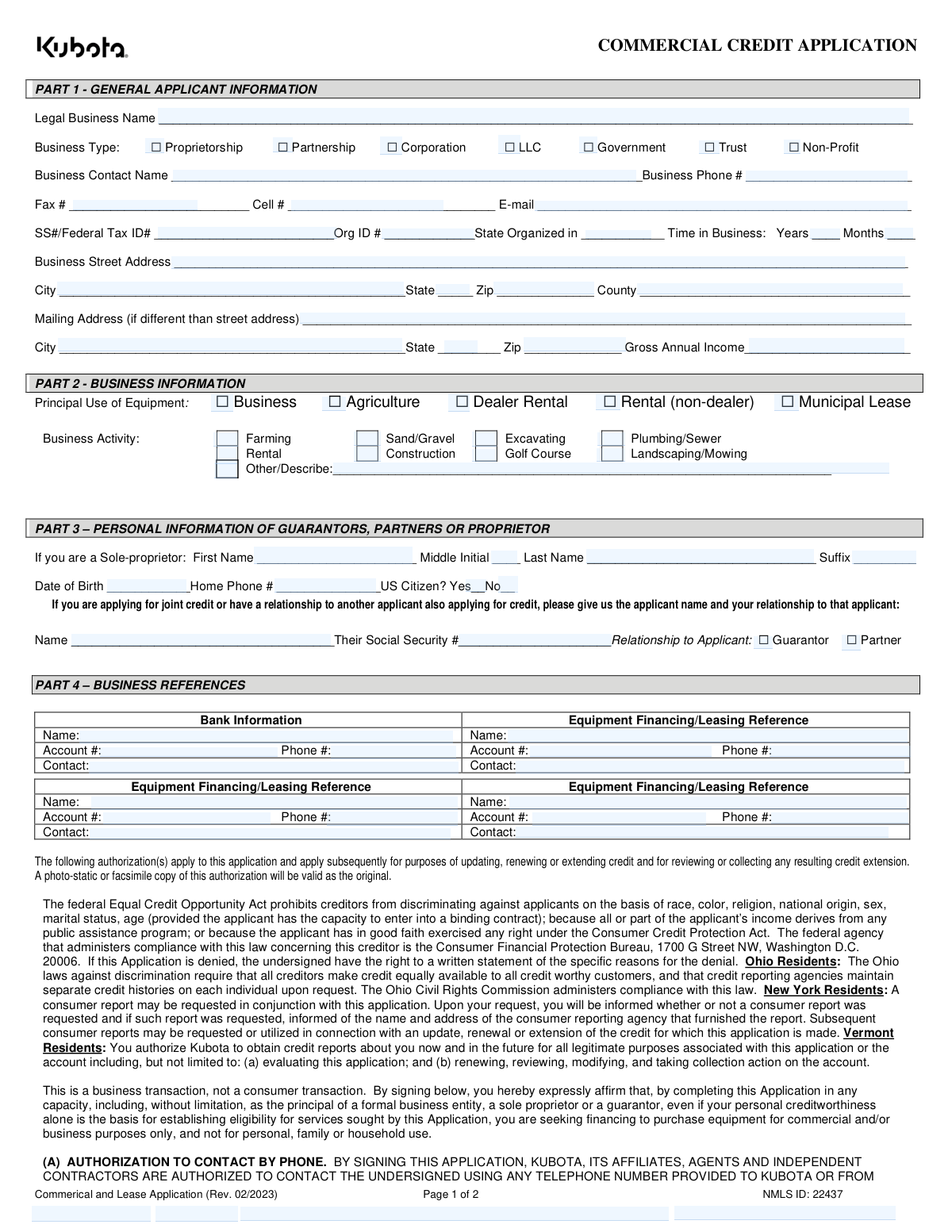
- Commercial and Lease Application (Commercial Credit Application) (Rev. 02/2023): Use this form if you are in the initial underwriting phase. It is designed to collect business details, proprietor information, and references. It also includes the necessary authorizations to pull credit reports and share data with affiliates, which is essential for risk assessment and underwriting decisions.
For Finalizing the Rental Agreement
Once a tenant is vetted and the terms are negotiated, you need a formal contract to govern the tenancy relationship.
- Commercial Lease Agreement (C.A.R. Form CL, Revised 10/01): This is the standard document for California real estate transactions. Choose this form to establish the specific legal and financial terms of the tenancy, including base rent, CPI adjustments, maintenance responsibilities, and dispute resolution. It is a comprehensive California Association of Realtors (C.A.R.) form suitable for various commercial property types.
Quick Summary
- If you are a Landlord or Property Manager: Start with the Commercial and Lease Application to vet applicants, then move to the Commercial Lease Agreement to finalize the legal deal.
- If you are a Business Owner or Applicant: You will likely be asked to fill out the Commercial and Lease Application first to prove your creditworthiness before the landlord prepares the Commercial Lease Agreement.
Form Comparison
| Form | Primary Purpose | Key Information Collected | Process Stage |
|---|---|---|---|
| Commercial Lease Agreement (C.A.R. Form CL, Revised 10/01) | Establishes binding legal and financial terms for renting commercial real property. | Rent structure, lease term, maintenance responsibilities, and dispute resolution procedures. | Used to finalize the agreement after a tenant has been approved. |
| Commercial and Lease Application (Commercial Credit Application) (Rev. 02/2023) | Screens potential tenants or borrowers to evaluate financial creditworthiness. | Business details, guarantor information, credit history authorizations, and trade references. | Used during the initial underwriting phase before a lease is signed. |
Tips for commercial lease forms
When filling out C.A.R. Form CL, ensure the description of the property includes specific suite numbers, square footage, and any included storage or parking areas. Vague descriptions can lead to disputes regarding maintenance responsibilities or exclusive use rights later in the tenancy.
Always use the exact legal name of your business as registered with the Secretary of State on both the lease agreement and credit application. Using a 'Doing Business As' (DBA) name without the underlying corporate entity can cause significant delays during the underwriting and approval process.
Commercial leases often feature complex rent structures, such as CPI-adjusted or tiered schedules. Carefully review the base rent section to ensure the math aligns with your negotiated terms to avoid overpayment or breach of contract notifications.
The Commercial Credit Application requires detailed information regarding business references and guarantors. Gathering your bank contact details and trade references beforehand allows you to move through the two-page application smoothly without stopping to look up records.
Using AI-powered tools like Instafill.ai can complete these complex commercial forms in under 30 seconds with high accuracy. Your data stays secure during the process, providing a reliable and efficient way to manage multiple real estate documents simultaneously.
Ensure that the individual signing the lease or credit application has the documented authority to bind the business entity. For corporations or LLCs, this typically requires an authorized officer or managing member to sign to ensure the agreement is legally enforceable.
Standardized commercial forms often mandate specific insurance coverage levels for tenants. Before submitting your form, verify that your current policy meets the landlord’s requirements to prevent last-minute hurdles during the possession phase.
Frequently Asked Questions
Commercial lease forms are standardized legal documents used to establish the terms of a business rental agreement between a landlord and a tenant. They cover essential details like rent amounts, property maintenance, and the duration of the lease for commercial spaces such as offices, retail units, or industrial warehouses.
Typically, the process begins with the Commercial and Lease Application, which allows the landlord or financier to vet the business's creditworthiness and references. Once the applicant is approved, the parties move forward to sign the Commercial Lease Agreement to finalize the legal tenancy.
Yes, forms produced by the California Association of REALTORS® (C.A.R.) are specifically designed to comply with California state laws and regulations. While they are standard in California, users in other states should ensure they are using forms that meet their specific local legal requirements.
Yes, modern AI tools like Instafill.ai can automatically complete commercial lease forms by extracting relevant data from your source documents and placing it into the correct fields. This technology ensures that complex legal forms are filled out accurately without the need for manual data entry.
Using AI-powered platforms such as Instafill.ai, you can fill out these forms in under 30 seconds. The system accurately identifies required fields and maps information from your business records or previous applications directly onto the PDF.
This form is used to collect business details and financial history to support underwriting decisions for commercial leases or equipment financing. It often requires information about the business entity, its proprietors, and business references to determine the risk level of the applicant.
A guarantor is often required if the business is new or does not have a strong enough credit history to secure the lease on its own. The application form includes sections for guarantor information so that an individual can legally commit to covering the lease obligations if the business fails to do so.
The agreement usually specifies which party is responsible for repairs to the roof, HVAC systems, plumbing, and common areas. These terms vary depending on whether the lease is a 'gross lease' or a 'net lease,' where the tenant might take on more of the operating expenses.
While the Commercial Lease Agreement is focused on real property, the Commercial and Lease Application is often used for both property and commercial equipment financing. It documents the applicant's certifications and authorizations needed to process credit for various types of business assets.
Standardized forms provide a clear framework that covers common legal disputes and ensures that essential deal points, such as dispute resolution and default remedies, are not overlooked. Using a recognized form helps both landlords and tenants understand their rights and obligations under a consistent set of rules.
Glossary
- Form Complexity Index
- Instafill’s 0–100 measure of how much effort a form takes to complete, calculated deterministically from the form’s own structure rather than estimated. It combines the number of fillable fields (the largest factor), how difficult those fields are to complete based on their type, the number of pages that contain fields, the amount of conditional “fill-only-if” logic, and how many sections the form is divided into, then adds modifiers for tables and repeating lists, bundled instruction pages, and dense page layouts. A higher score means the form is harder to fill out by hand. The forms in this category have a median Form Complexity Index of 79/100 (Complex). See exactly how it is calculated.
- C.A.R. (California Association of REALTORS®)
- The professional trade association that develops and maintains standardized legal forms, such as Form CL, used for real estate transactions in California.
- Base Rent
- The fixed monthly amount a tenant pays to occupy a commercial property, which does not include additional costs like utilities, maintenance, or taxes.
- CPI Adjustment
- A provision that allows the landlord to increase rent periodically based on changes in the Consumer Price Index, which measures inflation.
- Guarantor
- An individual or business entity that signs the lease application and agrees to be legally responsible for rent payments if the tenant fails to pay.
- Premises
- The specific physical area being leased, which may include the interior square footage, designated parking spots, and shared common areas.
- Underwriting
- The process used by landlords or financial institutions to evaluate an applicant's creditworthiness and financial history before approving a lease or credit application.
- Default Remedies
- The specific legal actions a landlord is entitled to take, such as termination of the lease or eviction, if the tenant violates the terms of the agreement.
- NMLS ID
- A unique identification number assigned through the Nationwide Multistate Licensing System to financial professionals and companies involved in commercial financing.