Fill out Emory forms
with AI.
Managing your employee benefits and retirement accounts at Emory University requires precise documentation to ensure your long-term financial goals are met. This category of Emory forms covers essential administrative tasks related to your retirement plan, such as transferring assets between providers or updating your beneficiary information. These documents are vital for maintaining control over your 403(b) accounts and ensuring that your retirement strategy remains aligned with your current financial situation.
By continuing, you acknowledge Instafill's Privacy Policy and agree to get occasional product update and promotional emails.
About Emory forms
Faculty and staff members typically encounter these forms during significant career milestones or major life events. For instance, if you are consolidating retirement funds into a single provider like Vanguard, the Asset Transfer Authorization form is necessary to facilitate a smooth transition. Similarly, keeping your beneficiary designations up to date is a critical step after a marriage, the birth of a child, or other family changes. Having quick access to these forms allows Emory employees to manage their benefits efficiently without navigating complex administrative hurdles.
While traditional PDF paperwork can be tedious to complete by hand, modern tools like Instafill.ai use AI to fill these forms in under 30 seconds while maintaining high standards for data accuracy and security. This approach helps you finalize your retirement paperwork quickly so you can focus on your work and personal life.
Every form on this page can be completed without typing. Instafill is form filling software that reads a PDF and fills it for you — including flat and scanned documents that carry no fillable fields at all.
Forms in This Category
- Enterprise-grade security & data encryption
- 99%+ accuracy powered by AI
- 1,000+ forms from all industries
- Complete forms in under 60 seconds
How to Choose the Right Form
Choosing the Right Emory Retirement Document
Navigating employee benefits can be complex, especially when managing long-term retirement savings. For Emory University employees, selecting the correct document depends on whether you are moving money between providers or updating the legal recipients of your funds.
Consolidating Your Retirement Savings
If your goal is to simplify your financial portfolio by moving your 403(b) account assets from a different investment company to Vanguard, you should select the Vanguard Asset Transfer Authorization Form for the Emory University Retirement Plan.
This form is essential for:
- Consolidating multiple retirement accounts into a single plan.
- Directing the transfer of assets from a current provider to The Vanguard Group's investment options.
- Streamlining your retirement management under the Emory University umbrella.
Updating Your Beneficiary Designations
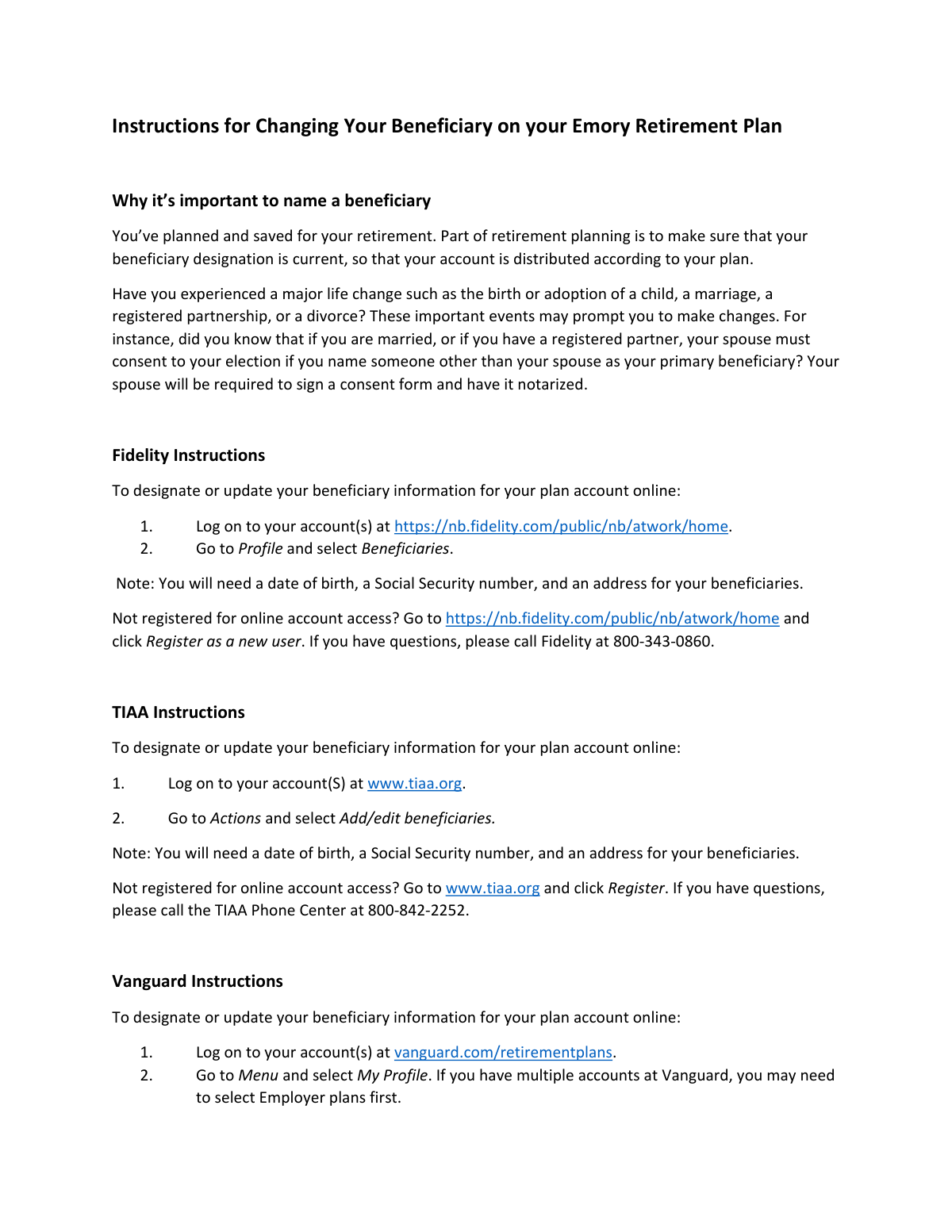
If you have experienced a major life event—such as marriage, divorce, or the birth of a child—you likely need to update who will inherit your retirement assets. In this case, refer to the Instructions for Changing Your Beneficiary on your Emory Retirement Plan.
This guide is the correct choice if you need to:
- Navigate the specific online update processes for financial providers like Fidelity, TIAA, or Vanguard.
- Ensure your retirement assets are distributed according to your current wishes after a life change.
- Understand the administrative steps required by each financial institution linked to the Emory plan.
Quick Comparison
- Use the Asset Transfer Form when you are moving actual money or "rolling over" funds from an outside provider into your Vanguard plan.
- Use the Beneficiary Instructions when you are updating names and legal designations for who receives your funds in the future.
Both documents can be processed more efficiently using Instafill.ai’s tools, which help you complete these critical financial forms accurately and quickly.
Form Comparison
| Form | Primary Purpose | Key Action | Associated Providers |
|---|---|---|---|
| Vanguard Asset Transfer Authorization Form for the Emory University Retirement Plan | Transfer 403(b) assets from current investment companies to Vanguard. | Authorize the consolidation and movement of retirement funds. | Exclusively for asset transfers into Vanguard accounts. |
| Instructions for Changing Your Beneficiary on your Emory Retirement Plan | Provide guidance on updating designated beneficiaries for retirement assets. | Follow online steps to change legal beneficiary information. | Includes Fidelity, TIAA, and Vanguard retirement plan providers. |
Tips for Emory forms
Managing retirement paperwork can be tedious, but AI-powered tools like Instafill.ai can complete these Emory forms in under 30 seconds with high accuracy. Your data stays secure throughout the process, providing a fast and reliable way to handle multiple benefit updates at once.
When completing the Vanguard Asset Transfer form, double-check that your current provider's account number and the plan name match your statements exactly. Even minor typos in account information can cause financial institutions to reject the transfer request, leading to significant processing delays.
Emory University works with multiple providers including Fidelity, TIAA, and Vanguard. Ensure you submit beneficiary change forms for every account you hold, as updating your designation with one provider does not automatically update your status with the others.
It is a best practice to revisit your Emory retirement forms after major life changes such as marriage, divorce, or the birth of a child. Keeping these forms current ensures that your assets are distributed according to your latest wishes without unnecessary legal hurdles for your heirs.
If you have multiple 403(b) accounts from previous employers, using the Asset Transfer Authorization form to consolidate them into your Emory Vanguard account can simplify your financial tracking. Having a single point of management reduces the number of forms you need to monitor and update annually.
Always save a finalized, time-stamped PDF copy of your submitted beneficiary or transfer forms. These digital records serve as essential proof of your intent should there be any administrative discrepancies between Emory HR and your financial investment providers.
Frequently Asked Questions
These forms are intended for current and former Emory University employees who participate in the university's retirement plans. They are used for administrative tasks such as consolidating retirement savings from different providers or updating who will inherit account assets.
It is recommended to review and update your beneficiary designations after major life events like marriage, divorce, the birth of a child, or a death in the family. Keeping this information current ensures your retirement assets are distributed according to your current wishes without administrative delays.
To move funds from a different investment company into the Emory University Retirement Plan at Vanguard, you must complete the Vanguard Asset Transfer Authorization Form. This document provides the legal authorization for your current provider to release the funds and for Vanguard to accept them into your 403(b) account.
Emory University partners with several major financial institutions, primarily Vanguard, Fidelity, and TIAA. Depending on which provider holds your accounts, you may need to use specific forms or online portals to manage your investments and beneficiary designations.
Yes, AI tools like Instafill.ai can be used to fill out Emory retirement and beneficiary forms in under 30 seconds. The AI accurately extracts data from your source documents and places it into the correct fields, which helps prevent manual entry errors on important financial documents.
You will generally need your current account numbers, the name of the financial institution you are moving money from, and your Emory employee identification details. Having a recent statement from your current provider handy will help ensure all account details are entered correctly.
Depending on the specific retirement plan and legal requirements, if you are married, your spouse may have a legal right to be your primary beneficiary. If you wish to name someone else, you may be required to obtain a signed waiver or additional documentation from your spouse.
Submission methods vary depending on the provider; some forms are submitted directly to Vanguard or Fidelity via their secure online portals, while others may require mailing to a specific processing center. Always refer to the instructions provided with the specific form to ensure it is sent to the correct location.
While manually typing in financial and personal data can take 10 to 15 minutes, using AI-powered services like Instafill.ai can reduce this time to less than 30 seconds. These services can also convert static PDF versions of Emory forms into interactive versions that are easier to complete.
Consolidating your retirement funds into a single provider like Vanguard can make it easier to track your investment performance and manage your asset allocation. Using the official transfer authorization forms ensures that the rollover is handled as a direct transfer, preserving the tax-deferred status of your savings.
Glossary
- 403(b) Plan
- A tax-advantaged retirement savings plan available for employees of public schools and certain tax-exempt organizations, such as Emory University.
- Beneficiary
- A person or legal entity designated by the account holder to receive the assets in a retirement plan upon the holder's death.
- Asset Transfer
- The process of moving retirement funds directly from one investment company or financial institution to another without the account holder taking a taxable distribution.
- Primary Beneficiary
- The first individual or organization in line to receive retirement account benefits; if they are still living or active, they receive 100% of the designated assets.
- Contingent Beneficiary
- A secondary person or entity who will receive retirement assets only if the primary beneficiary is deceased or unable to accept the funds.
- Investment Provider
- A financial institution, such as Vanguard, Fidelity, or TIAA, that manages the investment options and administrative tasks for the Emory University Retirement Plan.
- Qualified Plan
- A retirement plan that meets specific Internal Revenue Code requirements, allowing for tax-deferred growth on contributions until they are withdrawn.
- Medallion Signature Guarantee
- A special certification stamp often required for the transfer of securities that confirms a signature is genuine and the signer has legal capacity.