Fill out employee expense forms
with AI.
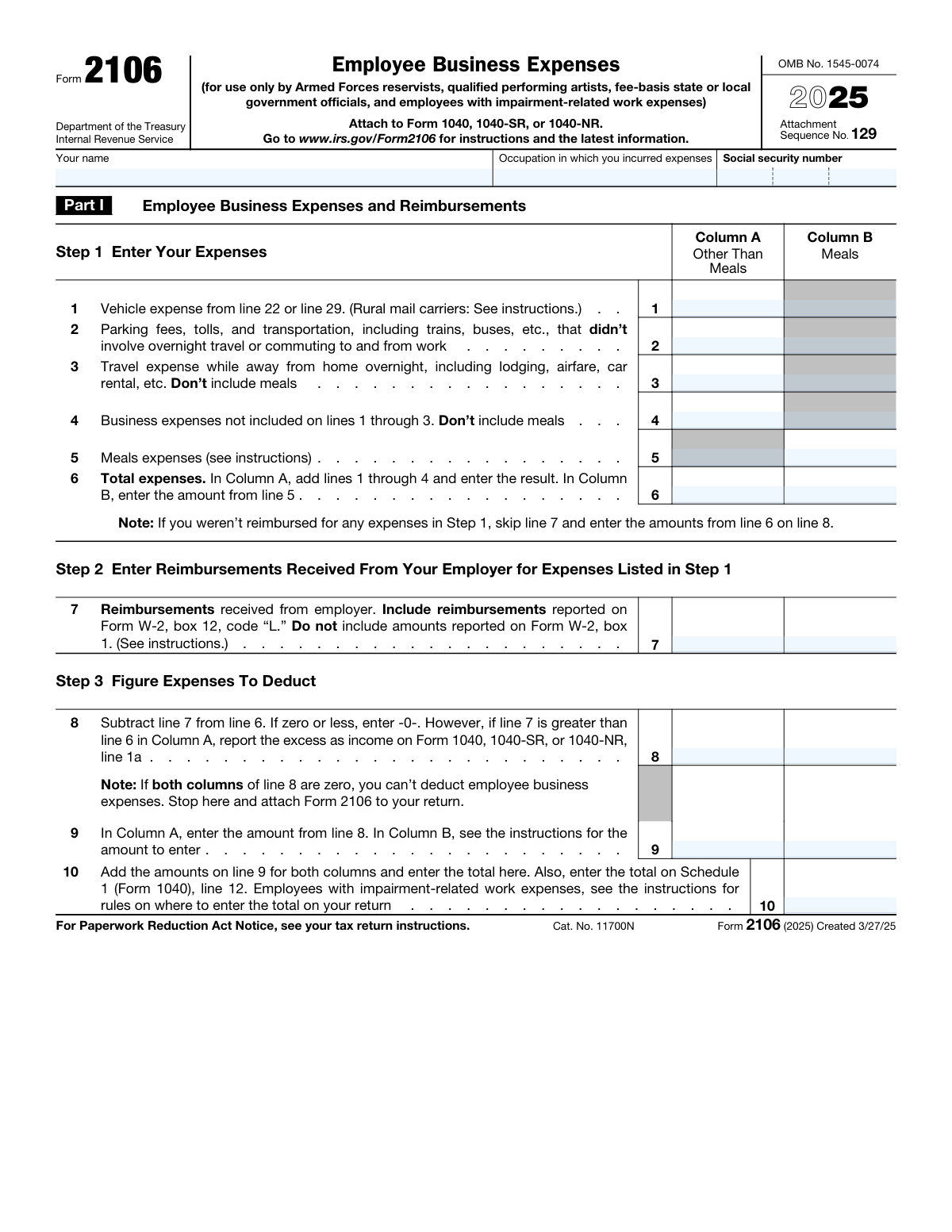
Employee expense forms are tax documents that allow workers to report and deduct business-related costs they've paid out of pocket while performing their job duties. These forms matter because unreimbursed work expenses — from travel and meals to vehicle use and professional equipment — can meaningfully reduce your taxable income when properly documented and claimed. The most prominent form in this category is IRS Form 2106, Employee Business Expenses, which is used to calculate deductions for ordinary and necessary costs incurred as part of employment.
By continuing, you acknowledge Instafill's Privacy Policy and agree to get occasional product update and promotional emails.
About employee expense forms
Not every employee qualifies to use these forms. Since the Tax Cuts and Jobs Act of 2017, Form 2106 is available only to specific groups: Armed Forces reservists, qualified performing artists, fee-basis state or local government officials, and employees with impairment-related work expenses. If you fall into one of these categories, completing Form 2106 accurately is an important part of filing your federal return, as the resulting deduction flows directly to Schedule 1 of Form 1040.
These forms can involve detailed calculations across multiple expense categories, which makes accuracy critical. Tools like Instafill.ai use AI to fill out these forms in under 30 seconds, handling the data accurately and securely — a practical time-saver during tax season.
Every form on this page can be completed without typing. Instafill is form filling software that reads a PDF and fills it for you — including flat and scanned documents that carry no fillable fields at all.
Forms in This Category
The forms in this category have a median Form Complexity Index of 63/100 (Complex), measured across 2 forms by field count, input difficulty, length, conditional logic and structure. See how it is calculated.
| Form Name | Pages | FCI | |
|---|---|---|---|
| 1. | Form 2106, Employee Business Expenses (2023) | 2 | Moderate 57 |
| 2. | Form 2106, Employee Business Expenses (2025) | 2 | Complex 63 |
- Enterprise-grade security & data encryption
- 99%+ accuracy powered by AI
- 1,000+ forms from all industries
- Complete forms in under 60 seconds
How to Choose the Right Form
Both forms in this category are versions of Form 2106, Employee Business Expenses — an IRS tax form used to deduct work-related expenses from your taxable income. Here's how to determine which listing fits your needs:
Who Should Use Form 2106?
Not all employees qualify for this deduction. The IRS restricts Form 2106 to specific groups:
- Armed Forces reservists
- Qualified performing artists
- Fee-basis state or local government officials
- Employees with impairment-related work expenses
If you don't fall into one of these categories, you are not eligible to claim employee business expense deductions using this form.
Which Listing Should You Choose?
- First listing (Form 2106, Employee Business Expenses) — Best if you want a straightforward overview and quick access to start filling out the form. Ideal for users who already know they qualify and simply need to report vehicle expenses, travel, meals, or other business costs.
- Second listing (Form 2106, Employee Business Expenses — detailed version) — Best if you want more context before you begin. This version explains eligibility requirements in detail, clarifies how the deduction flows to Schedule 1 (Form 1040), and notes that the completed form must be attached to your Form 1040, 1040-SR, or 1040-NR.
Quick Tips
- Both forms ultimately produce the same output — a deduction reported on Schedule 1.
- If you have a non-fillable PDF version of Form 2106, Instafill.ai can convert it into an interactive form you can complete online.
- When in doubt, review your eligibility first using the detailed listing, then use either version to complete your filing.
Form Comparison
| Form | Purpose | Who Files It | When to Use |
|---|---|---|---|
| Form 2106, Employee Business Expenses | Report and deduct ordinary business expenses as an employee | Employees with qualifying unreimbursed business expenses | When claiming deductions to reduce federal taxable income |
| Form 2106, Employee Business Expenses | Calculate deductions for travel, meals, vehicle, and work costs | Reservists, performing artists, fee-basis officials, disabled employees | Filed with Form 1040, 1040-SR, or 1040-NR at tax time |
Tips for employee expense forms
Form 2106 is no longer available to all employees — it's restricted to Armed Forces reservists, qualified performing artists, fee-basis government officials, and employees with impairment-related work expenses. Filing without meeting one of these criteria can trigger IRS scrutiny, so confirm your eligibility before you begin.
The IRS requires substantiation for business expense deductions, meaning you'll need receipts, invoices, or logs to back up every claim. Start tracking expenses and mileage as they occur rather than reconstructing records at tax time — it's far more accurate and saves significant stress.
Only 'ordinary and necessary' business expenses are deductible on Form 2106, covering categories like vehicle use, travel, meals, and work-related costs. Personal expenses mixed in with business ones are a common audit red flag, so carefully separate the two before entering any figures.
Meal expenses claimed on Form 2106 are generally only 50% deductible, not the full amount. Many first-time filers enter the total meal cost rather than applying this limitation, which results in an overstated deduction that may need to be corrected later.
AI-powered tools like Instafill.ai can fill out employee expense forms like Form 2106 in under 30 seconds with high accuracy, making it a real time-saver when you're juggling multiple tax forms. Your data stays secure throughout the process, and the tool can even convert non-fillable PDF versions into interactive forms you can complete online.
Form 2106 must be attached to your Form 1040, 1040-SR, or 1040-NR, and the resulting deduction flows through Schedule 1. Submitting it as a standalone document or forgetting to transfer the deduction to Schedule 1 means your expenses won't actually reduce your taxable income.
For vehicle expenses, you must choose between the IRS standard mileage rate or tracking your actual vehicle costs — you cannot combine the two methods for the same vehicle. Decide which method benefits you most before you start filling out the vehicle section of Form 2106.
Frequently Asked Questions
Employee expense forms, such as IRS Form 2106, are used to report and calculate deductions for ordinary and necessary business expenses incurred while performing your job. These forms help reduce your taxable income by accounting for eligible costs like travel, meals, vehicle use, and other work-related expenses.
Since the Tax Cuts and Jobs Act of 2017, Form 2106 is only available to a limited group of taxpayers. Eligible filers include Armed Forces reservists, qualified performing artists, fee-basis state or local government officials, and employees with impairment-related work expenses.
For most employees, the deduction for unreimbursed employee business expenses was suspended under federal tax law changes that took effect in 2018. Only the specific eligible groups listed on Form 2106 can currently claim these deductions on their federal tax return.
Form 2106 covers a range of work-related expenses including vehicle expenses, travel costs, meals, and other ordinary and necessary business expenses. The form provides sections to calculate each category of expense separately before arriving at a total deductible amount.
Form 2106 is not filed on its own — it is attached to your federal income tax return, specifically Form 1040, 1040-SR, or 1040-NR. The resulting deduction from Form 2106 is then carried over and reported on Schedule 1 (Form 1040).
Form 2106 is filed as part of your annual federal income tax return, so it follows the same deadline as your tax filing — generally April 15 for most taxpayers, unless an extension is granted. It is important to gather all supporting documentation for your business expenses before completing the form.
Yes, the IRS generally requires you to maintain records and receipts that substantiate the business expenses you claim on Form 2106. Good recordkeeping throughout the year — including mileage logs, receipts, and expense reports — is essential to support your deductions in case of an audit.
Yes, AI-powered tools like Instafill.ai can fill out Form 2106 in under 30 seconds by accurately extracting and placing data from your source documents. Instafill.ai can also convert non-fillable PDF versions of the form into interactive, fillable forms, making the process faster and more accurate.
Manually completing Form 2106 can take anywhere from 15 minutes to over an hour depending on the complexity of your expenses. Using an AI-powered service like Instafill.ai, the form can be completed in under 30 seconds by automatically extracting and entering your information.
This category includes two listings of Form 2106, Employee Business Expenses, which represent the same IRS form. Both cover the calculation and reporting of employee business expense deductions, so you can select either listing to access and complete the form.
Form 2106 is an IRS tax form used to claim deductions on your federal tax return for unreimbursed business expenses, while employer expense reimbursement forms are internal company documents used to request repayment from your employer. If your employer fully reimburses all your business expenses, you generally would not need to file Form 2106.
Glossary
- Form Complexity Index
- Instafill’s 0–100 measure of how much effort a form takes to complete, calculated deterministically from the form’s own structure rather than estimated. It combines the number of fillable fields (the largest factor), how difficult those fields are to complete based on their type, the number of pages that contain fields, the amount of conditional “fill-only-if” logic, and how many sections the form is divided into, then adds modifiers for tables and repeating lists, bundled instruction pages, and dense page layouts. A higher score means the form is harder to fill out by hand. The forms in this category have a median Form Complexity Index of 63/100 (Complex). See exactly how it is calculated.
- Ordinary and Necessary Expenses
- A standard IRS requirement meaning the expense must be common in your trade or business (ordinary) and helpful and appropriate for your work (necessary). Both conditions must be met for a business expense to qualify as a deductible employee expense.
- Above-the-Line Deduction
- A deduction subtracted from your gross income before calculating your adjusted gross income (AGI), which can reduce your tax bill even if you don't itemize deductions. Form 2106 deductions for eligible groups are reported this way via Schedule 1.
- Schedule 1 (Form 1040)
- An IRS attachment to the main tax return where additional income and adjustments to income are reported. Employee business expense deductions from Form 2106 are carried over and entered on this schedule.
- Fee-Basis Government Official
- A state or local government employee who is compensated based on fees paid directly by the public rather than receiving a fixed government salary. This is one of the limited groups still eligible to use Form 2106.
- Impairment-Related Work Expenses
- Costs that a disabled employee pays for attendant care or other items that enable them to work, which are deductible as a business expense. Employees with qualifying disabilities are among the few groups still permitted to claim deductions on Form 2106.
- Armed Forces Reservist
- A member of a military reserve component (such as the Army Reserve or National Guard) who serves part-time while maintaining civilian employment. Reservists who travel more than 100 miles from home for reserve duty are eligible to claim certain unreimbursed expenses on Form 2106.
- Qualified Performing Artist (QPA)
- An entertainer who meets specific IRS criteria—including having at least two employers, earning under $16,000 in AGI before the deduction, and having business expenses exceeding 10% of performing income—allowing them to deduct work-related costs via Form 2106.
- Unreimbursed Employee Expenses
- Business-related costs paid out of pocket by an employee that their employer does not pay back. Since the Tax Cuts and Jobs Act of 2017, only a narrow group of eligible employees may still deduct these expenses using Form 2106.
- Standard Mileage Rate
- An IRS-set cents-per-mile figure used to calculate the deductible cost of using a personal vehicle for business purposes, as an alternative to tracking actual vehicle expenses. This rate is updated annually and can be used when completing the vehicle expense section of Form 2106.