Fill out freight forms
with AI.
Freight forms are the essential documentation that facilitates the movement of goods across global and domestic transportation networks. These documents provide the legal and operational framework for the relationship between shippers, carriers, and consignees, ensuring that every party understands their responsibilities regarding liability, routing, and payment terms. Without accurate documentation, shipments can face significant delays at customs, incorrect billing, or disputes over cargo handling, making these forms critical for maintaining a smooth and compliant supply chain.
By continuing, you acknowledge Instafill's Privacy Policy and agree to get occasional product update and promotional emails.
About freight forms
These forms are typically utilized by logistics managers, warehouse supervisors, and business owners who manage the daily complexities of outbound and inbound freight. Whether you are shipping via air or ground, specific documents such as a Bill of Lading or a Shipper’s Letter of Instruction (SLI) are required to define the contract of carriage and provide necessary export data. These documents ensure that hazardous materials are handled safely, tariffs are applied correctly, and that carriers have the specific instructions needed to report shipments to regulatory bodies.
Managing this paperwork manually can be a significant administrative burden that is prone to human error. Tools like Instafill.ai use AI to fill these complex freight forms in under 30 seconds, ensuring data accuracy and security while allowing logistics professionals to focus on operations rather than repetitive data entry. By automating the completion of these essential documents, businesses can reduce processing times and minimize the risk of compliance issues during transit.
Every form on this page can be completed without typing. Instafill is form filling software that reads a PDF and fills it for you — including flat and scanned documents that carry no fillable fields at all.
Forms in This Category
The forms in this category have a median Form Complexity Index of 69/100 (Complex), measured across 2 forms by field count, input difficulty, length, conditional logic and structure. See how it is calculated.
| Form Name | Pages | FCI | |
|---|---|---|---|
| 1. | FedEx Freight Uniform Straight Bill of Lading (Original—Not Negotiable) | 1 | Complex 69 |
| 2. | UPS Supply Chain Solutions Shipper’s Letter of Instruction / Air Waybill (Air Freight Services) | 2 | Complex 67 |
- Enterprise-grade security & data encryption
- 99%+ accuracy powered by AI
- 1,000+ forms from all industries
- Complete forms in under 60 seconds
How to Choose the Right Form
Selecting the correct freight documentation is essential for ensuring your cargo moves through the supply chain without delays, billing errors, or compliance issues. The choice primarily depends on your chosen carrier and the mode of transportation (air versus ground).
For Air Freight and International Export
If you are coordinating an international shipment or using air transport via UPS, the UPS Supply Chain Solutions Shipper’s Letter of Instruction / Air Waybill (Air Freight Services) is the appropriate choice. This form functions as a comprehensive instruction set for the carrier. Use this form when:
- Customs Filing is Required: You need to provide export-control data such as Schedule B/HTS, ECCN, or EAR99 details.
- Power of Attorney: You are authorizing UPS to file Electronic Export Information (EEI) in the Automated Export System (AES) on your behalf.
- Detailed Routing: Your shipment requires specific service level designations and insurance declarations for high-value air cargo.
For Domestic Ground and LTL Shipping
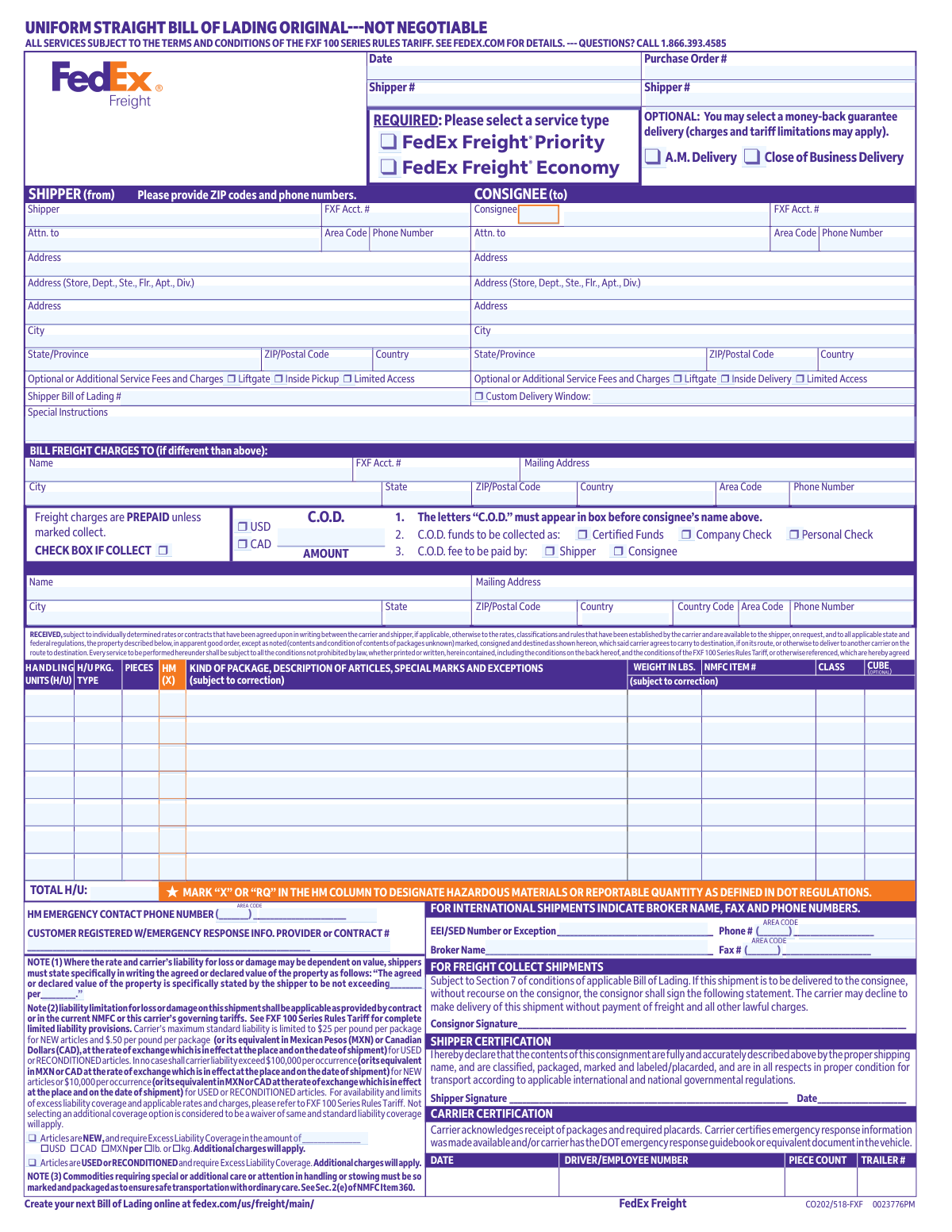
When moving freight via truck within North America using FedEx, you should use the FedEx Freight Uniform Straight Bill of Lading (Original—Not Negotiable). This is a standard contract of carriage for Less-Than-Truckload (LTL) shipments. Choose this form for:
- Standard Rating: You need to specify the NMFC class, weight, and freight description to ensure accurate billing.
- Hazardous Materials: You are transporting regulated materials that require official certification and emergency contact information.
- Standard Logistics: You need to define billing terms (Prepaid vs. Collect) or specify C.O.D. (Cash on Delivery) requirements.
Quick Selection Tips
- Check the Carrier: These forms are carrier-specific. Use the UPS form for UPS Supply Chain Solutions and the FedEx form for FedEx Freight to avoid processing friction.
- Identify the Mode: Choose the Air Waybill for speed-sensitive air transit and the Bill of Lading for traditional ground transportation.
- Compliance Needs: If your shipment involves complex export licenses, the UPS Shipper’s Letter of Instruction provides the necessary fields for regulatory compliance that a standard Bill of Lading may lack.
Form Comparison
| Form | Primary Purpose | Transport Mode | Key Information Included |
|---|---|---|---|
| UPS Supply Chain Solutions Shipper’s Letter of Instruction / Air Waybill (Air Freight Services) | Authorizes carrier to create waybills and file electronic export information. | Air Freight Services. | Export control data, Schedule B/HTS codes, and declared insurance value. |
| FedEx Freight Uniform Straight Bill of Lading (Original—Not Negotiable) | Acts as a legal contract of carriage and receipt for goods. | Ground and Less-Than-Truckload (LTL) Freight. | NMFC class, hazardous materials certification, and specific billing terms. |
Tips for freight forms
AI-powered tools like Instafill.ai can complete these complex freight forms in under 30 seconds with high accuracy by extracting data from your existing invoices. Your logistics data stays secure during the process, providing a massive time-saving advantage for businesses handling daily shipments.
Incorrect NMFC classes or estimated weights are common mistakes that lead to significant re-billing charges after the carrier weighs the shipment. Always use a certified scale and verify the current freight class to avoid unexpected rate adjustments on your final invoice.
If shipping regulated goods, you must provide the precise UN number, proper shipping name, and emergency contact information on the Bill of Lading. Failure to certify these details accurately can result in shipment rejections, delays, or legal penalties for non-compliance.
When filling out a Shipper’s Letter of Instruction (SLI), ensure the Schedule B or HTS numbers are precise for every commodity. This allows the carrier to file Electronic Export Information correctly, preventing customs holds and ensuring your international shipments remain compliant.
Carrier liability is often limited by weight or tariff rules unless a higher value is explicitly declared on the form. If your cargo is high-value, make sure the declared value section is completed to ensure you have the proper financial protection in the event of loss or damage.
Clearly mark whether the shipment is 'Prepaid' or 'Collect' to avoid billing disputes between the shipper and the consignee. Inconsistent billing terms across multiple forms can lead to shipments being held at the terminal until payment responsibility is manually clarified.
Since the Bill of Lading acts as a receipt for goods in 'apparent good order,' you must note any visible damage or piece-count discrepancies on the form before the driver signs. This documentation is the most critical piece of evidence if you need to file a freight claim later.
Frequently Asked Questions
Freight forms serve as legal contracts and instructional documents between shippers, carriers, and consignees. They ensure that cargo is handled correctly, billed accurately, and complies with transportation regulations. These documents also act as receipts and provide evidence of the condition of goods at the time of pickup.
A Bill of Lading (BOL) is typically used for domestic ground freight and serves as the contract of carriage and receipt of goods. A Shipper’s Letter of Instruction (SLI) is often used for international air or ocean freight to provide specific routing and export details to a freight forwarder. If you are shipping internationally, you may need both or a combined document depending on the carrier's requirements.
Generally, the shipper or the party initiating the shipment is responsible for providing accurate information on these forms. This ensures that the carrier has the correct delivery address, weight, and classification to move the goods safely. In some cases, a third-party logistics provider (3PL) may assist in preparing the documentation on behalf of the shipper.
Errors on freight forms can lead to delayed shipments, incorrect billing, and potential fines from regulatory bodies, especially for international cargo. Inaccurate weight or freight class can result in re-weighing fees or service failures. Furthermore, incorrect hazardous materials information can create significant safety risks and legal liability.
The National Motor Freight Classification (NMFC) code helps carriers determine the shipping rate based on the density, stowability, handling, and liability of the items. Including the correct code ensures you are billed the appropriate amount for the specific type of goods being transported. Omitting this information often results in the carrier applying a default, often more expensive, classification.
Yes, you can use AI tools like Instafill.ai to automate the completion of complex shipping and logistics forms. These tools can accurately extract data from your commercial invoices or packing lists and place it into the correct fields on forms like the FedEx Bill of Lading or UPS SLI. This significantly reduces manual entry errors and ensures consistency across your shipping documentation.
When using traditional manual methods, these forms can take several minutes to complete accurately; however, using AI-powered tools like Instafill.ai can reduce this time to under 30 seconds. The AI quickly parses your source documents and populates the required fields automatically. This speed is especially beneficial for high-volume shippers who need to process multiple documents daily.
International forms like the UPS SLI/Air Waybill require detailed commodity descriptions, export-control data such as Schedule B or HTS numbers, and ECCN details. You must also specify the service level, payment terms, and whether you are authorizing the carrier to file Electronic Export Information (EEI) on your behalf. These details are critical for customs clearance and international trade compliance.
Yes, a Bill of Lading is a legally binding contract between the shipper and the carrier that outlines the terms and conditions of transportation. It serves three main functions: a receipt for the goods, a document of title, and a contract of carriage. Once signed, both parties are bound by the terms specified, including liability limits and payment obligations.
Most freight forms are handed to the driver at the time of pickup or submitted electronically through the carrier's online portal. For international shipments, copies are also provided to customs brokers or freight forwarders to facilitate the clearance process. It is standard practice to keep a signed copy for your own records to prove the shipment was tendered to the carrier.
Glossary
- Form Complexity Index
- Instafill’s 0–100 measure of how much effort a form takes to complete, calculated deterministically from the form’s own structure rather than estimated. It combines the number of fillable fields (the largest factor), how difficult those fields are to complete based on their type, the number of pages that contain fields, the amount of conditional “fill-only-if” logic, and how many sections the form is divided into, then adds modifiers for tables and repeating lists, bundled instruction pages, and dense page layouts. A higher score means the form is harder to fill out by hand. The forms in this category have a median Form Complexity Index of 69/100 (Complex). See exactly how it is calculated.
- Bill of Lading (BOL)
- A legal document between a shipper and a carrier that serves as a contract of carriage and a receipt for the goods being transported.
- Consignee
- The individual or company designated as the recipient of the shipment at the final destination.
- Shipper’s Letter of Instruction (SLI)
- A formal document provided by an exporter to a freight forwarder containing detailed instructions on how the shipment should be handled and documented.
- NMFC Class
- A numeric classification assigned to freight based on its density, ease of handling, and value, which carriers use to determine shipping costs.
- Air Waybill (AWB)
- A non-negotiable document used specifically for air freight that acts as a receipt for the goods and a contract between the shipper and the airline.
- Electronic Export Information (EEI)
- The digital data filed in the Automated Export System (AES) used by the government to track export statistics and ensure compliance with trade regulations.
- Schedule B / HTS Code
- Standardized numerical codes used to classify physical goods for export and import to ensure they are taxed and regulated correctly.
- ECCN (Export Control Classification Number)
- An alphanumeric code used to categorize items for export control purposes, determining if a special license is required to ship the goods internationally.