Fill out gambling forms
with AI.
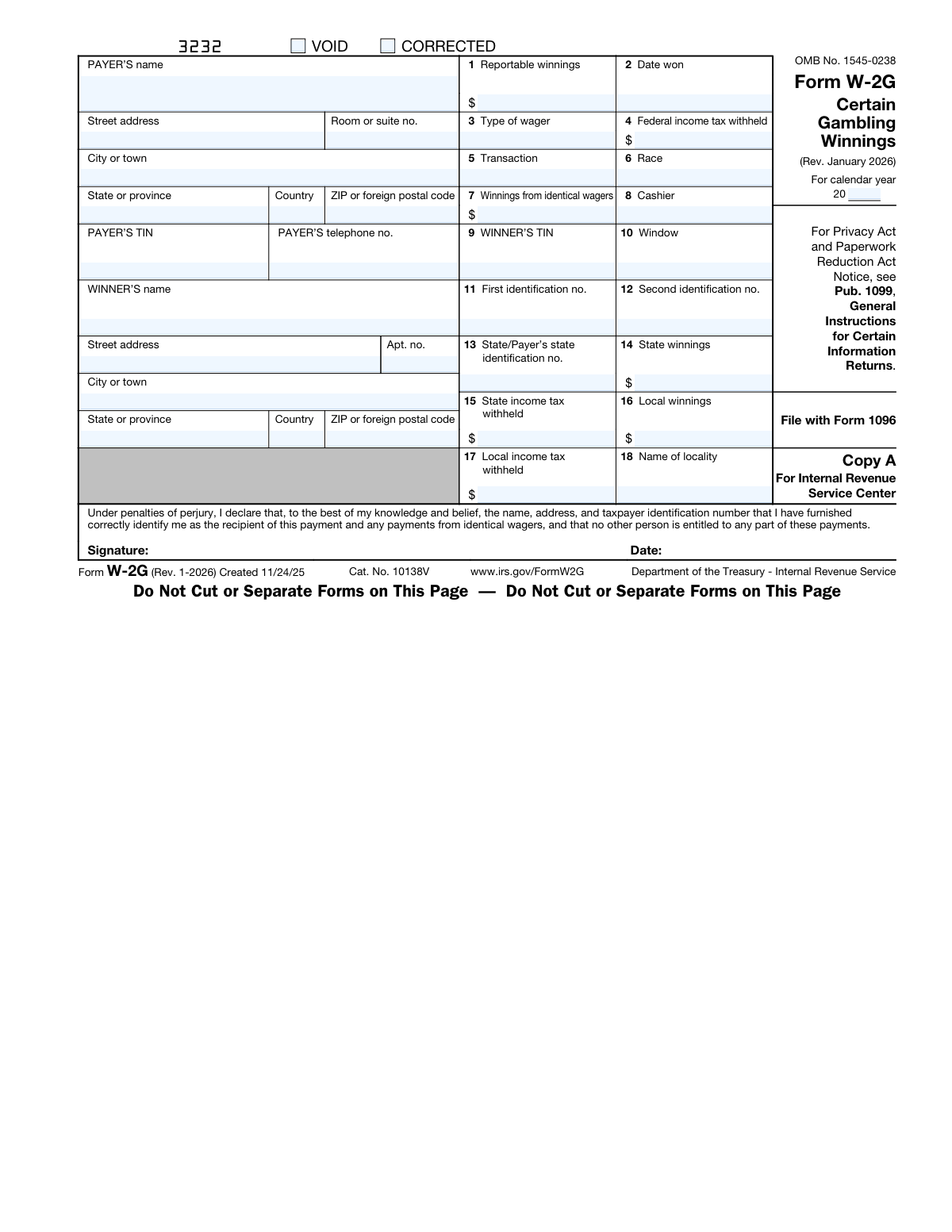
Gambling forms are a specific category of IRS tax documents used to report gambling winnings and any associated federal, state, or local tax withholding. These forms serve an important role in the U.S. tax system by ensuring that income earned through casinos, lotteries, racetracks, and other wagering activities is properly documented and reported to the IRS. The most prominent form in this category is Form W-2G, Certain Gambling Winnings, which payers are required to issue when a winner's winnings meet certain reporting thresholds.
By continuing, you acknowledge Instafill's Privacy Policy and agree to get occasional product update and promotional emails.
About gambling forms
These forms are relevant to two main groups of people: payers — such as casinos, lottery organizations, and racetracks — who must file and distribute the forms when reportable winnings are paid out, and winners themselves, who need their copies to accurately report gambling income and claim any withheld taxes on their federal and state tax returns. Whether you hit a jackpot on a slot machine, won big at a horse race, or received a substantial lottery prize, understanding and correctly completing these forms is essential to staying compliant with IRS requirements.
Because gambling tax forms involve precise details like taxpayer identification numbers, withholding amounts, and wager descriptions, accuracy is critical. Tools like Instafill.ai use AI to fill these forms in under 30 seconds, handling the data accurately and securely — a practical time-saver for both individual winners and tax professionals managing multiple filings.
Every form on this page can be completed without typing. Instafill is form filling software that reads a PDF and fills it for you — including flat and scanned documents that carry no fillable fields at all.
Forms in This Category
The forms in this category have a median Form Complexity Index of 69/100 (Complex), measured across 2 forms by field count, input difficulty, length, conditional logic and structure. See how it is calculated.
| Form Name | Pages | FCI | |
|---|---|---|---|
| 1. | Form W-2G, Certain Gambling Winnings (Rev. January 2026) | 7 | Complex 66 |
| 2. | Form W-2G (Rev. January 2026), Certain Gambling Winnings | 7 | Complex 69 |
- Enterprise-grade security & data encryption
- 99%+ accuracy powered by AI
- 1,000+ forms from all industries
- Complete forms in under 60 seconds
How to Choose the Right Form
Both forms in this category serve the same core purpose — reporting gambling winnings to the IRS — so choosing between them is straightforward once you understand the distinction.
Who Needs Form W-2G?
Both listings are versions of Form W-2G, Certain Gambling Winnings (Rev. January 2026), the standard IRS information return for reporting qualifying gambling income. This form applies to:
- Payers (casinos, racetracks, lotteries, poker tournament sponsors) who must report winnings that meet IRS thresholds to the winner and the IRS
- Winners who receive a W-2G and need to report gambling income and any federal/state tax withheld on their personal tax return
Which Listing Should You Use?
The two forms listed here are essentially the same IRS form, offered in slightly different formats:
- Form W-2G (Rev. January 2026), Certain Gambling Winnings — Use this if you need a standard fillable version to complete online, whether you're a payer filling out the form for a winner or a winner reviewing your copy
- Form W-2G, Certain Gambling Winnings (Rev. January 2026) — This version may be useful if you have a non-fillable PDF copy and need AI assistance to convert and complete it via Instafill.ai
Quick Tips
- Payers: Select either version to enter winner details, wager type, winnings amount, and withholding information before distributing copies
- Winners: Use your W-2G copy to accurately transfer gambling income and withholding onto your Form 1040
- If you're unsure which format works for your PDF, Instafill.ai can convert non-interactive versions into fillable forms automatically
In short, both options get you to the same form — pick based on whether you have an existing PDF to convert or prefer to start fresh.
Form Comparison
| Form | Purpose | Who Files It | When to Use |
|---|---|---|---|
| Form W-2G, Certain Gambling Winnings (Rev. January 2026) | Report gambling winnings and federal/state tax withheld | Casinos, racetracks, lotteries, and other gambling payers | When reportable gambling winnings are paid to a winner |
| Form W-2G (Rev. January 2026), Certain Gambling Winnings | Report qualifying gambling winnings and withholding to IRS | Gambling payers; winners use copies for their tax returns | When payer issues winnings meeting IRS reporting thresholds |
Tips for gambling forms
The IRS requires gambling winnings to be reported on your tax return regardless of whether you receive a W-2G. Payers issue a W-2G only when winnings meet certain thresholds, but you are still responsible for reporting smaller amounts. Don't assume that no form means no tax obligation.
An incorrect Social Security Number or TIN on a W-2G can cause mismatches between the form and your tax return, potentially triggering IRS notices. Always verify your TIN matches exactly what's on your Social Security card before signing or submitting. Even a single transposed digit can create headaches down the road.
The W-2G you receive from the payer is your official record of reported winnings and any federal or state tax withheld — treat it like a W-2 from an employer. You'll need it when preparing your tax return to accurately report income and claim withholding credits. Store it with your other tax documents until after you've filed and any applicable audit period has passed.
Box 4 of the W-2G shows federal income tax withheld, and this amount should be entered on your tax return as a payment toward your tax bill. If you receive multiple W-2Gs in a year, add up all withholding amounts carefully so you don't under- or over-claim. Errors here can result in a balance due or a delayed refund.
AI-powered tools like Instafill.ai can complete gambling tax forms like the W-2G in under 30 seconds with high accuracy, reducing the risk of manual entry errors. Your data stays secure throughout the process, making it a reliable option whether you're a payer filling out multiple forms or a winner reviewing your copy. It's a real time-saver during busy tax season when dealing with several forms at once.
The W-2G has multiple copies — one for the IRS, one for the winner, and copies for state and local tax agencies. If you're a payer (casino, lottery, etc.), make sure you file the correct copy with the IRS and provide the winner's copy promptly. If you're a winner, only use your designated copy when preparing your personal tax return.
While the W-2G only documents winnings, you may be able to deduct gambling losses up to the amount of your reported winnings if you itemize deductions. Keep a detailed log of losses throughout the year — dates, locations, amounts — along with supporting receipts or records. Without documentation, the IRS may disallow any loss deductions you claim.
Many states require separate reporting of gambling winnings, and some have their own withholding requirements reflected in boxes on the W-2G. Don't assume that satisfying your federal obligation covers your state filing as well — check your state's rules. The W-2G includes fields for state and local withholding specifically to help you file accurately at every level.
Frequently Asked Questions
Gambling forms are IRS tax documents used to report gambling winnings and any associated federal, state, or local tax withholding. They ensure that gambling income is properly documented for both the winner and tax authorities, supporting accurate tax return filing.
Form W-2G, 'Certain Gambling Winnings,' is an IRS information return issued by payers such as casinos, racetracks, and lotteries when a winner receives reportable gambling winnings. Winners receive copies of this form to use when reporting gambling income on their federal and state tax returns.
The payer — such as a casino, lottery organization, racetrack, or other gambling establishment — is responsible for completing and issuing Form W-2G to the winner. The winner does not fill out this form themselves but uses the copy they receive to report income on their tax return.
Generally, gambling winnings above certain IRS thresholds — which vary by type of wager, such as slot machines, bingo, keno, poker tournaments, lotteries, or horse racing — trigger the requirement to issue a W-2G. The specific thresholds and rules depend on the type of gambling activity involved.
Yes. The IRS requires taxpayers to report all gambling winnings as income on their tax return, regardless of whether a W-2G was issued. A W-2G is only required when winnings meet certain thresholds, but smaller winnings are still taxable and must be reported.
When gambling winnings exceed certain IRS thresholds, the payer may be required to withhold a percentage of the winnings for federal income tax. This withheld amount is reported on Form W-2G, and winners can claim it as taxes already paid when filing their federal tax return.
Form W-2G is a multi-copy document: one copy is filed with the IRS by the payer, one or more copies go to the winner for their records and tax return, and additional copies may be submitted to state and local tax agencies where applicable.
Yes. AI-powered tools like Instafill.ai can fill out gambling forms such as Form W-2G in under 30 seconds by accurately extracting and placing data from source documents. Instafill.ai can also convert non-fillable PDF versions of these forms into interactive, fillable formats.
Using AI-powered services like Instafill.ai, gambling forms like Form W-2G can be completed in under 30 seconds, with data accurately extracted and placed into the correct fields. This is significantly faster than manual entry and reduces the risk of errors.
Form W-2G generally requires identifying information for both the payer and the winner (names, addresses, and taxpayer identification numbers), along with details about the winnings such as the amount won, date won, type of wager, and any federal or state taxes withheld.
Yes, many states tax gambling winnings, and Form W-2G may include fields for state and local withholding amounts. Winners should check their specific state's tax rules, as some states require separate state tax filings for gambling income.
If you believe there is an error on a W-2G you received, you should contact the payer — such as the casino or lottery — to request a corrected form. Keeping accurate records of your winnings and losses can also help you reconcile discrepancies when filing your tax return.
Glossary
- Form Complexity Index
- Instafill’s 0–100 measure of how much effort a form takes to complete, calculated deterministically from the form’s own structure rather than estimated. It combines the number of fillable fields (the largest factor), how difficult those fields are to complete based on their type, the number of pages that contain fields, the amount of conditional “fill-only-if” logic, and how many sections the form is divided into, then adds modifiers for tables and repeating lists, bundled instruction pages, and dense page layouts. A higher score means the form is harder to fill out by hand. The forms in this category have a median Form Complexity Index of 69/100 (Complex). See exactly how it is calculated.
- W-2G
- An IRS information return that casinos, lotteries, racetracks, and other gambling payers must issue to report qualifying gambling winnings and any taxes withheld. Winners use this form to accurately report gambling income on their federal (and sometimes state) tax returns.
- Reportable Gambling Winnings
- Gambling winnings that meet IRS thresholds requiring the payer to issue a W-2G form — for example, $1,200 or more from slot machines or bingo, $1,500 or more from keno, or $5,000 or more from poker tournaments. Different thresholds apply depending on the type of wager.
- Backup Withholding
- A flat-rate federal tax (currently 24%) that a payer must withhold from gambling winnings when a winner fails to provide a valid Taxpayer Identification Number (TIN) or has been notified by the IRS of under-reporting. This withheld amount is reported on the W-2G and can be claimed as a credit on the winner's tax return.
- Regular Gambling Withholding
- The mandatory federal income tax withholding (currently 24%) applied to certain gambling winnings that exceed specific IRS thresholds, distinct from backup withholding. The withheld amount is reported in Box 4 of Form W-2G.
- Payer
- In the context of gambling forms, the payer is the business or organization (such as a casino, racetrack, lottery commission, or poker room) that awards the winnings and is responsible for issuing Form W-2G and remitting any withheld taxes to the IRS.
- TIN (Taxpayer Identification Number)
- A unique number — either a Social Security Number (SSN), Employer Identification Number (EIN), or Individual Taxpayer Identification Number (ITIN) — used by the IRS to identify a taxpayer. Winners must provide their TIN to the payer; missing or incorrect TINs can trigger backup withholding.
- Information Return
- A tax form filed with the IRS to report certain types of income paid to individuals, such as gambling winnings, rather than a form used to calculate taxes owed. Form W-2G is an information return that helps the IRS match reported income to a winner's tax return.
- Type of Wager
- A field on Form W-2G that identifies the specific gambling activity that produced the winnings (e.g., slot machine, keno, bingo, poker tournament, horse racing). The type of wager determines which IRS reporting threshold applies.
- State/Local Withholding
- Taxes withheld from gambling winnings for state or local tax authorities, reported in the state and local boxes of Form W-2G. Requirements vary by jurisdiction, and winners may need to file separate state returns to claim or reconcile these amounts.