Fill out listing agreement forms
with AI.
Listing agreement forms serve as the foundational legal contract between a property owner and a real estate brokerage. These documents grant a broker the authority to act as the seller's agent, outlining the essential terms of the sale such as the listing price, the duration of the agreement, and the agreed-upon commission rates. By formalizing this relationship, these forms protect both the seller and the broker, ensuring that marketing permissions, representation disclosures, and professional responsibilities are clearly defined before a property hits the market.
By continuing, you acknowledge Instafill's Privacy Policy and agree to get occasional product update and promotional emails.
About listing agreement forms
These real estate forms are typically required by homeowners and licensed agents during the initial stages of a property listing. For example, the C.A.R. Form RLA is a staple for California real estate transactions, while OREA Form 200 is used extensively throughout Ontario to establish exclusive or MLS® listing authority. Whether you are navigating complex holdover provisions or documenting multiple representation rules, having the correct paperwork is vital for a smooth and legally compliant transaction. Tools like Instafill.ai use AI to fill these forms in under 30 seconds, handling the data accurately and securely to save you time during the listing process.
Every form on this page can be completed without typing. Instafill is form filling software that reads a PDF and fills it for you — including flat and scanned documents that carry no fillable fields at all.
Forms in This Category
The forms in this category have a median Form Complexity Index of 57/100 (Moderate), measured across 7 forms by field count, input difficulty, length, conditional logic and structure. See how it is calculated.
- Enterprise-grade security & data encryption
- 99%+ accuracy powered by AI
- 1,000+ forms from all industries
- Complete forms in under 60 seconds
How to Choose the Right Form
Selecting the right listing agreement is the first step in formalizing the relationship between a property seller and a real estate brokerage. Because real estate laws vary significantly by jurisdiction, your choice will primarily depend on the location of the property and the specific type of representation you require.
Location-Based Selection
The forms in this category are region-specific. Choosing the wrong one could lead to legal complications or an invalid contract. Identify your location first:
- For Properties in Ontario, Canada: Use the OREA Form 200 (Revised 2025). This is the standard Seller Representation Agreement / Authority to Offer for Sale used by the Ontario Real Estate Association. It is designed for both MLS® and exclusive listings. Use this form to document commission obligations, holdover provisions, and the brokerage’s authority to act as your agent.
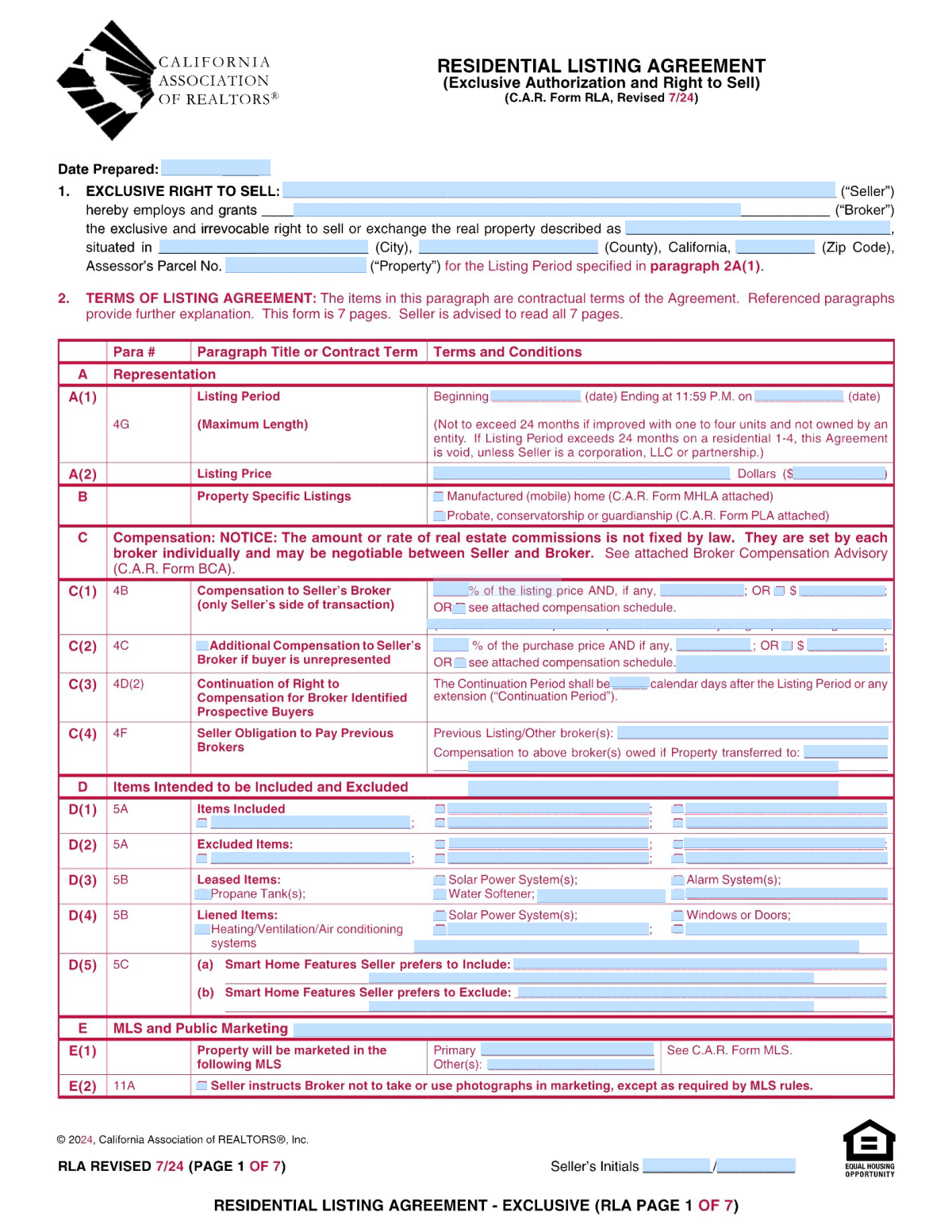
- For Properties in California, USA: Select the C.A.R. Form RLA (Residential Listing Agreement). This is the standard "Exclusive Authorization and Right to Sell" used across California. It is essential for defining the listing price, the length of the listing period, and broker compensation for residential sales.
Key Considerations for Your Agreement
Regardless of the jurisdiction, when you use Instafill.ai to complete these forms, ensure you have the following details ready:
- Listing Period: Both the C.A.R. Form RLA and OREA Form 200 require a definitive start and end date for the broker's authority.
- Commission Structure: Clearly state the percentage or flat fee. Note that OREA Form 200 includes specific sections for Schedule A, which allows for additional terms regarding services and confidentiality.
- Representation Type: Determine if the agreement is "Exclusive," meaning the broker is the only one authorized to sell the property, or if it allows for other marketing avenues.
Using our AI-powered tools, you can quickly convert these standard PDF agreements into interactive, fillable documents to get your property on the market faster while ensuring all mandatory disclosures are addressed.
Form Comparison
| Form | Jurisdiction | Type of Authority | Key Components |
|---|---|---|---|
| OREA Form 200 (Revised 2025) — Listing Agreement / Seller Representation Agreement / Authority to Offer for Sale (Ontario) | Ontario, Canada | Exclusive and irrevocable authority for a defined listing period | Commission holdover provisions, representation disclosures, and Schedule A |
| C.A.R. Form RLA, Residential Listing Agreement (Exclusive Authorization and Right to Sell) | California, USA | Exclusive right to sell and marketing authorization | Detailed broker compensation, listing duration, and marketing permissions |
Tips for listing agreement forms
Listing agreements are time-sensitive contracts that grant authority for a specific window. Ensure both the commencement and expiration dates are filled out correctly to avoid disputes over the brokerage's marketing window or commission eligibility.
Both Ontario and California forms often include a holdover period where commission may still be due if the property sells to a lead introduced during the listing. Review this timeframe carefully to ensure you understand your financial obligations even after the agreement officially expires.
Using a simple street address might not be sufficient for legal enforceability in all jurisdictions. Cross-reference the property's legal description, such as lot and plan numbers, with your deed or tax records to ensure the form is legally binding and accurate.
Avoid closing-day conflicts by explicitly listing which items stay with the property and which you intend to take. Use the additional space or schedules provided in forms like the OREA 200 to clarify the status of appliances, light fixtures, and window treatments.
Managing complex real estate paperwork can be overwhelming, but AI-powered tools like Instafill.ai can complete these forms in under 30 seconds with high accuracy. Your data stays secure during the process, providing a massive time-saving advantage for professionals dealing with multiple listing agreements.
Forms like the C.A.R. RLA require specific acknowledgments regarding dual agency or multiple representation. Make sure you understand and correctly mark how the broker will handle scenarios where they represent both the buyer and the seller before finalizing the document.
Standard forms often require supplemental documents, such as Schedule A for OREA forms, to outline specific services or terms. Ensure all referenced schedules are properly labeled and attached to the main agreement to prevent the contract from being considered incomplete or invalid.
Frequently Asked Questions
A listing agreement is a legally binding contract between a property owner and a real estate brokerage. It grants the agent the authority to act on the seller's behalf to find a buyer and outlines the terms of the sale, including commission rates and the listing duration.
All legal owners of the property must sign the listing agreement for it to be valid. Additionally, the broker or an authorized representative of the real estate agency must sign to acknowledge the terms of representation and compensation.
The correct form depends primarily on the jurisdiction where the property is located and the type of listing you want. For example, if you are selling property in Ontario, you would likely use OREA Form 200, whereas California sellers would use the C.A.R. Form RLA.
An exclusive authorization gives one specific broker the right to sell the property, while an MLS listing allows the property to be shared across a network of agents. Many standard forms, like OREA Form 200, can be used for both exclusive and MLS purposes depending on the specific boxes checked.
Yes, AI tools like Instafill.ai can fill out listing agreement forms in under 30 seconds by accurately extracting data from your source documents and placing it into the correct fields. This technology helps reduce manual entry errors and ensures that complex sections, like property descriptions and commission terms, are handled efficiently.
Most listing agreements include the listing price, the expiration date of the agreement, the broker's commission percentage, and marketing permissions. They also typically address how 'holdover' periods work, which protect the broker if a buyer introduced during the listing period purchases the home after the agreement expires.
Completing these forms manually can take quite some time due to the technical language and detailed property information required. However, using AI-powered platforms can reduce the time to less than 30 seconds, as the system can automatically populate the fields from your existing records or property data.
Once signed by all parties, the original document is typically kept by the real estate brokerage for their records. In many cases, the agent will then upload the data from the form to local real estate boards or the MLS database to begin the marketing process.
While some listing agreements are versatile, the forms in this category are specifically designed for residential transactions. Commercial sales often require different documentation that addresses specific business concerns like zoning, environmental reports, and complex lease structures.
A holdover provision is a clause found in forms like OREA Form 200 that entitles the broker to a commission if the property is sold to a buyer who was introduced to the property during the listing period, even if the sale occurs after the agreement has expired.
Generally, no. Listing agreement forms are specifically designed to establish a relationship between a seller and a professional real estate agent or brokerage. If you are selling a home on your own without an agent, you would typically use a different set of disclosure and purchase agreement forms.
Glossary
- Form Complexity Index
- Instafill’s 0–100 measure of how much effort a form takes to complete, calculated deterministically from the form’s own structure rather than estimated. It combines the number of fillable fields (the largest factor), how difficult those fields are to complete based on their type, the number of pages that contain fields, the amount of conditional “fill-only-if” logic, and how many sections the form is divided into, then adds modifiers for tables and repeating lists, bundled instruction pages, and dense page layouts. A higher score means the form is harder to fill out by hand. The forms in this category have a median Form Complexity Index of 57/100 (Moderate). See exactly how it is calculated.
- MLS® (Multiple Listing Service)
- A collaborative database used by real estate professionals to share property listings, allowing for wide exposure to potential buyers and other agents.
- Exclusive Authorization and Right to Sell
- A legal agreement giving a single broker the sole right to market and sell a property, ensuring they receive a commission even if the seller finds the buyer independently.
- Holdover Period
- A provision specifying that the broker is still entitled to a commission if the property is sold to a buyer introduced during the listing term, even after the agreement has expired.
- Multiple Representation
- A situation, common in OREA forms, where a single brokerage represents both the buyer and the seller in the same transaction, requiring written consent from both parties.
- Dual Agency
- The California legal term for when one agent or brokerage represents both sides of a real estate transaction, necessitating specific disclosures under C.A.R. guidelines.
- Cooperating Broker
- An outside real estate agent who represents a buyer and works with the listing broker to complete a sale, typically sharing in the total commission paid by the seller.
- Irrevocable Authority
- A binding clause stating that the seller cannot unilaterally cancel the listing agreement or the broker's right to act on their behalf during the specified term.
- Schedule A
- An additional document attached to standard OREA forms used to detail specific services, custom commission structures, or extra terms not found in the pre-printed agreement.