Fill out policy change forms
with AI.
Policy change forms are essential administrative tools used to update existing legal and financial agreements, such as life insurance policies or annuities. These documents ensure that the issuer—whether it's a private insurance company or a financial institution—maintains accurate records regarding ownership, beneficiaries, and contact details. Keeping this information current is vital for the proper administration of benefits and ensures that legal notices and financial statements reach the correct parties without delay.
By continuing, you acknowledge Instafill's Privacy Policy and agree to get occasional product update and promotional emails.
About policy change forms
These forms are typically required by policyholders or legal representatives during significant life events, such as a change in marital status, the establishment of a trust, or a simple move to a new residence. For instance, a Term Owner and Policy Change Form might be used to transfer ownership of a life insurance policy, while an Annuity Policy Change Form is necessary for adjusting beneficiary designations. In many cases, failing to file these updates promptly can lead to complications in claims processing or unintended tax consequences for the beneficiaries.
Navigating these documents often involves dealing with complex layouts and repetitive data entry. Tools like Instafill.ai use AI to fill these forms in under 30 seconds, handling the data accurately and securely to save you time. This technology simplifies the administrative burden, allowing you to finalize your updates quickly and move on with your day.
Every form on this page can be completed without typing. Instafill is form filling software that reads a PDF and fills it for you — including flat and scanned documents that carry no fillable fields at all.
Forms in This Category
The forms in this category have a median Form Complexity Index of 62/100 (Moderate), measured across 4 forms by field count, input difficulty, length, conditional logic and structure. See how it is calculated.
| Form Name | Pages | FCI | |
|---|---|---|---|
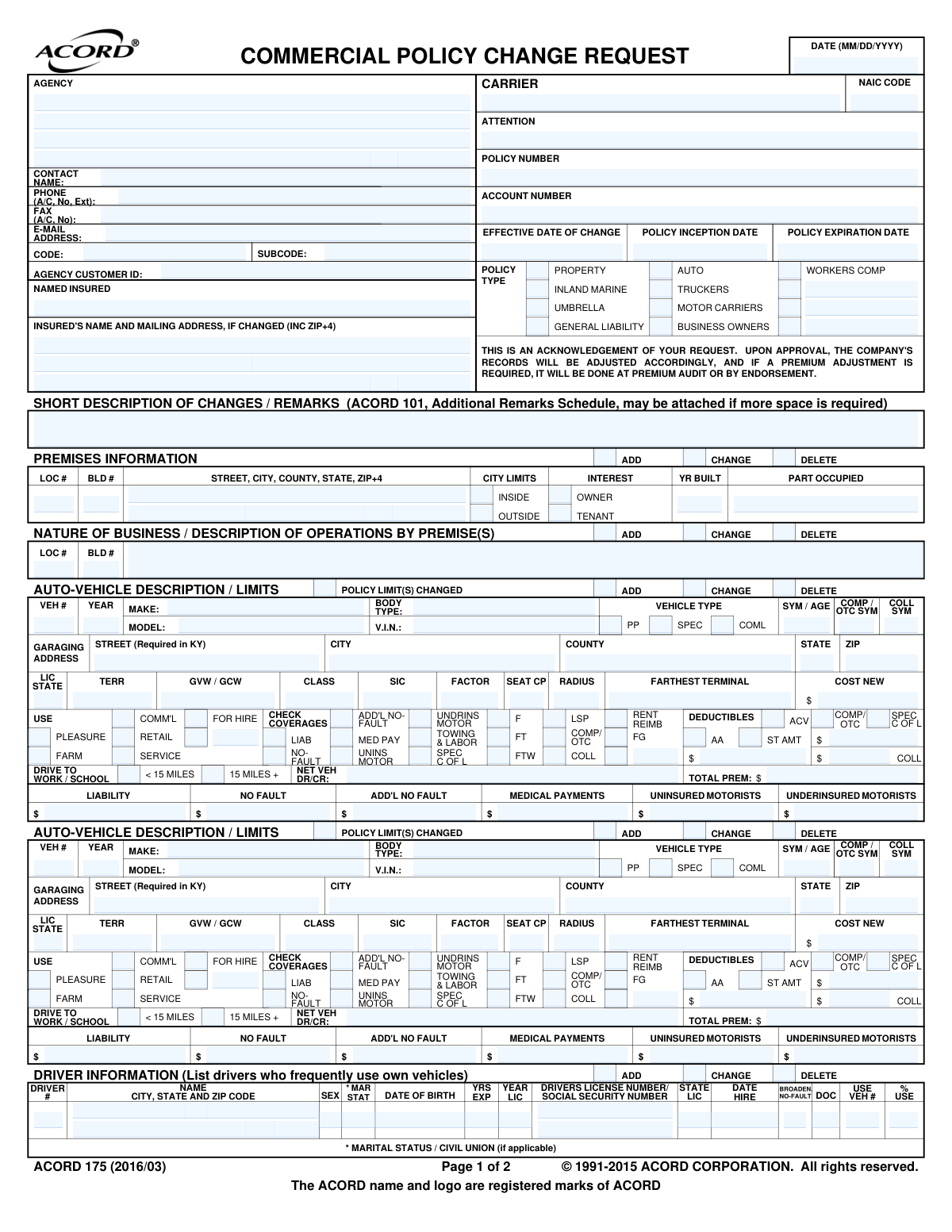
| 1. | ACORD 175, Commercial Policy Change Request | 2 | Moderate 62 |
| 2. | ACORD 36, Agent/Broker of Record Change | 1 | Moderate 60 |
| 3. | Term Owner and Policy Change Form | 1 | – |
| 4. | Transamerica Annuity Policy Change Form | 1 | – |
- Enterprise-grade security & data encryption
- 99%+ accuracy powered by AI
- 1,000+ forms from all industries
- Complete forms in under 60 seconds
How to Choose the Right Form
Selecting the correct policy change form is essential to ensure your updates are legally binding and processed without delay. These forms serve as official records for insurance companies and financial institutions, and the right choice depends primarily on the type of asset you are managing.
By Product Category
To find the right document, identify whether your policy is a standard life insurance plan or a specialized investment product:
- For Life Insurance Policies: If you need to update administrative details for a term life policy, use the Term Owner and Policy Change Form. This document is specifically designed for policyholders who need to update their mailing address, record a legal name change (such as after marriage), or transfer the entire ownership of the policy to another individual, a trust, or a corporation.
- For Annuities: If you hold an annuity contract specifically with Transamerica or its affiliates, you must use the Transamerica Annuity Policy Change Form. Annuities have different regulatory and tax requirements than standard life insurance, and this form is tailored to those specific financial structures.
By the Specific Action Required
Sometimes the nature of the change dictates which form you should prioritize:
- Beneficiary Designations: If your goal is to modify who will receive the proceeds of an annuity, the Transamerica Annuity Policy Change Form provides the necessary sections for designating both primary and contingent beneficiaries.
- Ownership Transfers: Both the Term Owner and Policy Change Form and the Transamerica Annuity Policy Change Form allow for ownership transfers. However, you must select the one that matches your specific provider or policy type to ensure the transfer is recognized by the carrier's legal department.
Using Instafill.ai to complete these forms helps you navigate complex fields accurately, ensuring that critical information regarding tax implications and legal ownership is presented clearly for the insurance provider.
Form Comparison
| Form | Policy Type | Common Changes | Key Focus |
|---|---|---|---|
| Term Owner and Policy Change Form | Term life insurance policies | Updates to mailing address, legal names, or ownership transfers | Maintaining accurate records for policy administration and communication |
| Transamerica Annuity Policy Change Form | Transamerica annuity policies | Modifying beneficiaries, transferring ownership, or updating personal details | Ensuring correct financial distributions and managing tax implications |
Tips for policy change forms
Ensure that all policy identifiers and personal identification numbers match your current records exactly. A single digit error in a policy number can result in the insurance company rejecting the form or applying changes to the wrong account.
If you are transferring a policy to a trust, corporation, or estate, provide the full legal name and tax identification number of the entity. Including the official entity documents alongside the change form helps the insurer verify the new owner without unnecessary delays.
When updating primary or contingent beneficiaries, verify that the assigned percentages add up to exactly 100%. Ambiguous or incomplete beneficiary designations can lead to legal complications and delays in the distribution of policy benefits.
Policy changes often require signatures from both the current owner and the proposed new owner. Check the instructions to see if signatures must be witnessed or notarized, as missing or improper signatures are the leading cause of processing failures.
AI-powered tools like Instafill.ai can complete these complex forms in under 30 seconds with high accuracy. This technology ensures your data stays secure during the process, making it a reliable time-saver for those managing multiple insurance or annuity updates.
Modifying ownership or beneficiary status on annuity and life insurance policies can trigger significant tax events. It is a best practice to consult with a tax professional before submitting these forms to understand how the changes affect your financial obligations.
Always save a digital or physical copy of the finalized form for your own records before submission. Having a timestamped copy allows you to easily follow up with the insurance provider if the changes are not updated in your account profile as expected.
Frequently Asked Questions
Policy change forms are legal documents used to update the official records of an insurance or annuity contract. They allow policyholders to modify essential details such as contact information, ownership status, or beneficiary designations to ensure the policy remains accurate and legally binding.
You should file these forms whenever there is a significant life event or administrative change affecting your policy. Common reasons include moving to a new address, legally changing your name, transferring policy ownership to a trust, or updating who will receive benefits.
Generally, only the current policy owner or a legally authorized representative, such as a Power of Attorney or a trustee, can sign these forms. If the policy is owned by a corporation or a trust, specific documentation proving the signer's authority may be required alongside the form.
The choice depends on the type of financial product you hold. Use a Term Owner form for term life insurance policies, whereas an Annuity policy change form is specifically designed for annuity contracts, which often have different tax structures and beneficiary requirements.
When requesting a legal name change on a policy, insurance companies typically require a copy of a supporting legal document. This often includes a marriage certificate, divorce decree, or a court order officially granting the name change.
Yes, most policy change forms include a section for transferring ownership to an individual, a trust, or a corporation. When transferring to a trust, you will likely need to provide the full legal name of the trust, the date it was established, and the names of the current trustees.
Some changes, particularly those involving ownership transfers or beneficiary adjustments in annuity contracts, can have significant tax consequences. It is advisable to consult with a financial advisor or tax professional before finalizing these changes to understand how they might affect your estate or tax liability.
Yes, AI tools like Instafill.ai can be used to fill out policy change forms by automatically extracting data from your existing documents and placing it into the correct fields. This technology can also handle non-fillable PDF versions by converting them into interactive, fillable formats.
Using AI-powered services can significantly reduce the time spent on paperwork, often allowing users to complete complex policy change forms in under 30 seconds. This process ensures high accuracy by pulling data directly from source documents, minimizing the risk of manual entry errors.
Once the form is filled and signed, it should be submitted directly to the insurance company's administrative office or through their secure online portal. Submission instructions, including mailing addresses or fax numbers, are usually found on the last page of the form or the company's official website.
In many cases, if you hold multiple policies with the same insurance provider, you can list all applicable policy numbers on one change form. However, if the policies are of different types, such as one life insurance and one annuity, the company may require separate forms for each.
Glossary
- Form Complexity Index
- Instafill’s 0–100 measure of how much effort a form takes to complete, calculated deterministically from the form’s own structure rather than estimated. It combines the number of fillable fields (the largest factor), how difficult those fields are to complete based on their type, the number of pages that contain fields, the amount of conditional “fill-only-if” logic, and how many sections the form is divided into, then adds modifiers for tables and repeating lists, bundled instruction pages, and dense page layouts. A higher score means the form is harder to fill out by hand. The forms in this category have a median Form Complexity Index of 62/100 (Moderate). See exactly how it is calculated.
- Policyowner
- The individual or entity who holds the legal rights to the insurance or annuity contract and has the authority to request changes.
- Primary Beneficiary
- The first person or entity designated to receive the policy's death benefit or payout upon the death of the insured or annuitant.
- Contingent Beneficiary
- A secondary person or entity who receives the policy benefits only if the primary beneficiary is deceased at the time the claim is made.
- Annuitant
- The person whose life expectancy is used to determine the timing and amount of payments in an annuity contract.
- Ownership Transfer
- The legal process of assigning the rights, title, and interest of a policy from the current owner to a new individual, trust, or corporation.
- Insured
- The specific person whose life is covered by the insurance policy; their death is the event that triggers the payment of benefits.
- Trustee
- A person or entity legally appointed to manage assets held in a trust, often required when a trust is named as a policy owner or beneficiary.