Fill out self-employed forms
with AI.
Navigating tax obligations as a self-employed professional requires specific documentation that differs significantly from standard employee filings. Self-employed forms cover a range of critical tax-related tasks, from reporting income to claiming business-specific deductions. These forms are vital for ensuring you are not paying more in taxes than necessary while maintaining full compliance with IRS guidelines. By properly documenting expenses like business-related health insurance, independent workers can significantly lower their taxable income and protect their bottom line.
By continuing, you acknowledge Instafill's Privacy Policy and agree to get occasional product update and promotional emails.
About self-employed forms
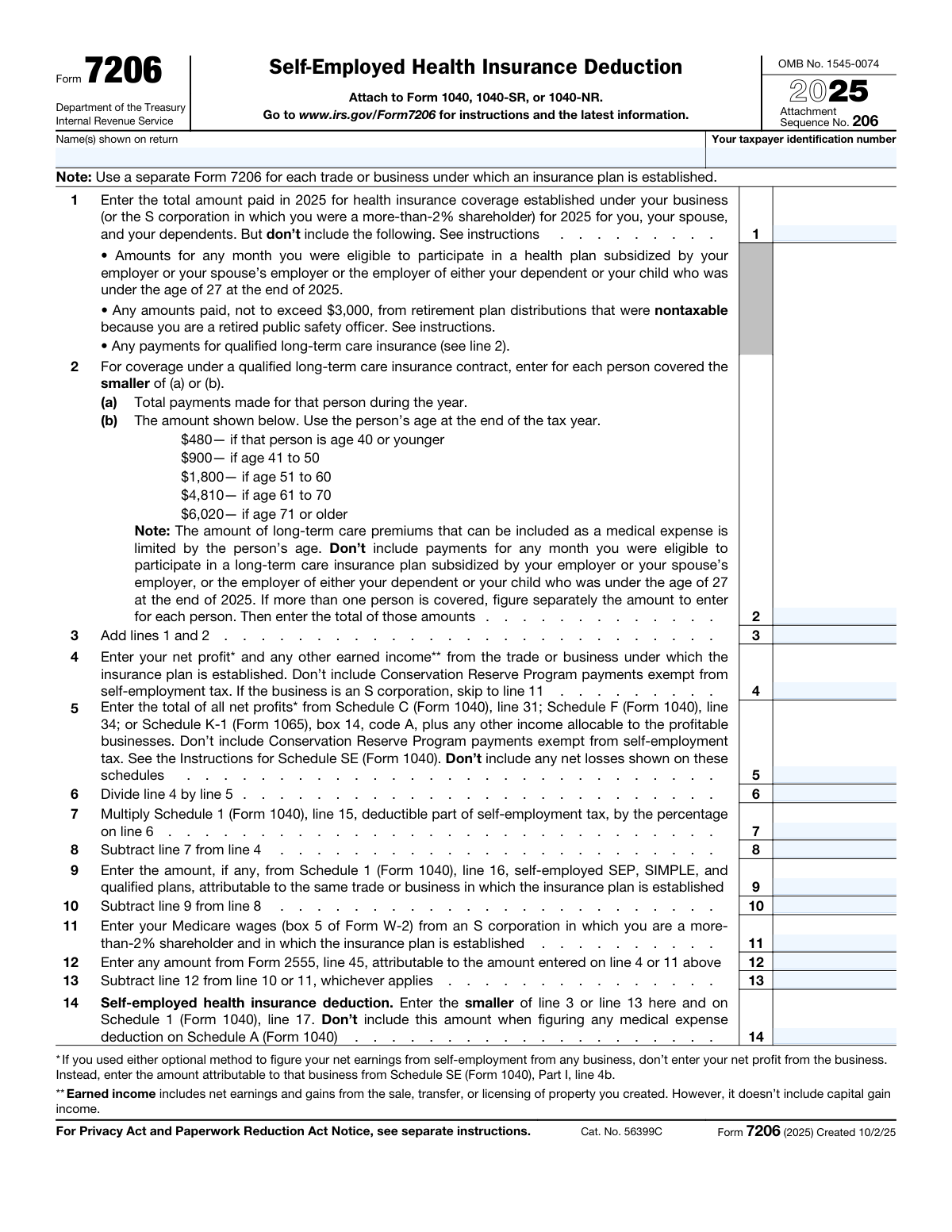
This collection is designed for freelancers, independent contractors, sole proprietors, and small business owners who manage their own tax filings. You will typically need these forms during the annual tax season or when calculating quarterly estimated tax payments. For example, if you are deducting health insurance premiums paid for yourself or your family, you will need to utilize documents like Form 7206 to accurately calculate the deductible amount based on your business earnings. Because separate filings may be required for each trade or business you operate, staying organized is key to avoiding errors and overstating deductions.
Managing complex tax paperwork can be a distraction from your core business work, but tools like Instafill.ai use AI to fill these forms in under 30 seconds with high accuracy and security. This automation helps ensure that your calculations are consistent across multiple documents, providing a practical way to streamline your administrative tasks and focus on growing your business.
Every form on this page can be completed without typing. Instafill is form filling software that reads a PDF and fills it for you — including flat and scanned documents that carry no fillable fields at all.
Forms in This Category
The forms in this category have a median Form Complexity Index of 94/100 (Very Complex), measured across 4 forms by field count, input difficulty, length, conditional logic and structure. See how it is calculated.
- Enterprise-grade security & data encryption
- 99%+ accuracy powered by AI
- 1,000+ forms from all industries
- Complete forms in under 60 seconds
How to Choose the Right Form
Navigating tax deductions as a self-employed professional can be complex, especially when it comes to healthcare costs. The forms in this category are specifically designed to help you calculate and claim the Self-Employed Health Insurance Deduction, which can significantly reduce your taxable income.
Choosing the Correct Tax Year
The most important factor in selecting a form from this list is the specific tax year for which you are filing. Tax laws and income limits often change annually, so choosing the version that matches your filing period is essential for compliance.
- Form 7206 (2025), Self-Employed Health Insurance Deduction: Select this version if you are preparing your taxes or estimating payments for the 2025 tax year. It contains the specific calculations and income-based limits tied to that year's regulations.
- Form 7206, Self-Employed Health Ins. Ded.: This is the standard version of the form. Use this for the most recent standard filing period or if you are catching up on previous years' filings that require this specific IRS attachment.
Who Should Use These Forms?
Both forms are intended for individuals who fall into specific professional categories. You likely need one of these if you are:
- Sole Proprietors and Freelancers: If you are a contractor or small business owner, use these forms to deduct premiums paid for yourself, your spouse, and your dependents.
- S Corporation Shareholders: If you own more than 2% of an S Corp, you must use Form 7206 to compute the deductible amount of premiums paid under a plan established by the business.
- Multiple Business Owners: Note that if you operate more than one trade or business, the IRS requires a separate Form 7206 for each business under which an insurance plan is established.
Filing Tip
Remember that the deduction calculated on these forms is limited by the earned income from your business. Once you have completed the worksheet, the final amount is typically reported on Schedule 1 (Form 1040).
Form Comparison
| Form | Purpose | Tax Year | Key Requirements | Reporting Location |
|---|---|---|---|---|
| Form 7206, Self-Employed Health Ins. Ded. | Calculate health insurance premium deductions for self-employed individuals and their dependents. | General version for recent standard tax filing years prior to 2025. | Requires net profit from business and a qualifying business-established health plan. | The final calculated deduction is reported on Schedule 1 (Form 1040). |
| Form 7206 (2025), Self-Employed Health Insurance Deduction | Determine deductible health insurance and long-term care premiums for 2025 income. | Specifically designated for the 2025 tax year calculation and reporting. | Deduction is limited by net earned income from the specific trade or business. | Reported on Schedule 1 (Form 1040) for the 2025 tax period. |
Tips for self-employed forms
Ensure the health insurance deduction does not exceed the net profit of the specific trade or business for which the plan was established. If you have multiple businesses, you must calculate the deduction separately for each to stay within IRS income limits.
You can generally deduct premiums paid for yourself, your spouse, your dependents, and children under age 27. However, you cannot claim the deduction for any month you were eligible to participate in a subsidized health plan maintained by your employer or your spouse's employer.
While qualified long-term care insurance premiums are deductible on Form 7206, they are subject to specific annual dollar limits based on your age. Double-check the current age-based thresholds to ensure you are only claiming the allowed portion of those premiums.
Managing multiple self-employment forms can be tedious and prone to manual entry errors. AI-powered tools like Instafill.ai can complete these forms in under 30 seconds with high accuracy, ensuring your data stays secure while saving you significant time during tax season.
Keep all digital or physical receipts, invoices, and proof of payment for your health insurance premiums organized by month. Having these records ready makes it much easier to verify the net amount paid after any subsidies or premium tax credits are applied.
If you operate more than one business and have separate insurance plans established under each, you must fill out a separate Form 7206 for each trade or business. Do not aggregate all insurance costs onto a single form if they are tied to different business entities.
If you received a premium tax credit through the Marketplace, you must subtract that credit from the total premiums paid before calculating your deduction. Only the actual out-of-pocket amount you paid is eligible for the self-employed health insurance deduction.
Frequently Asked Questions
These forms are primarily used by sole proprietors, partners in a partnership, and more-than-2% shareholders in an S corporation. They allow these individuals to calculate and claim deductions for health insurance premiums paid for themselves, their spouses, and their dependents.
Yes, AI tools like Instafill.ai can fill out these forms in under 30 seconds by accurately extracting data from your source documents and placing it directly into the PDF. This technology helps reduce manual entry errors and ensures that complex figures are transcribed correctly.
Using an AI-powered platform, the process of filling out self-employed forms typically takes less than 30 seconds. The system automatically identifies the required fields and populates them with information from your uploaded files, significantly speeding up the filing process.
Generally, the deduction is limited to the net earned income from the specific trade or business that established the insurance plan. You cannot use the deduction to create a business loss, so the amount claimed must be balanced against your business's profitability.
Yes, if you own multiple businesses and each has a separate insurance plan, you are required to complete a separate Form 7206 for each trade or business. This ensures the deduction is properly calculated against the respective earned income of each entity.
Once you have calculated the deductible amount on the self-employed health insurance forms, the total is usually reported on Schedule 1 (Form 1040). This amount then flows through to your main tax return to reduce your overall adjusted gross income.
Qualifying premiums include those paid for medical, dental, and vision insurance for yourself and your family. Additionally, some qualified long-term care insurance premiums may be eligible, though these are often subject to specific age-based limits.
Typically, you cannot claim the self-employed health insurance deduction for any month in which you were eligible to participate in a subsidized health plan maintained by an employer, including a spouse's employer. The deduction is intended for those who do not have access to other group health coverage.
If your business did not generate a profit, you might not be able to claim the self-employed health insurance deduction on these specific forms. Because the deduction is tied to earned income, a net loss usually means you cannot use this adjustment to further reduce your taxable income.
Yes, the IRS generally allows self-employed individuals to include premiums paid for children who are under age 27 at the end of the tax year. This applies even if the child does not qualify as your dependent for other tax purposes.
Glossary
- Form Complexity Index
- Instafill’s 0–100 measure of how much effort a form takes to complete, calculated deterministically from the form’s own structure rather than estimated. It combines the number of fillable fields (the largest factor), how difficult those fields are to complete based on their type, the number of pages that contain fields, the amount of conditional “fill-only-if” logic, and how many sections the form is divided into, then adds modifiers for tables and repeating lists, bundled instruction pages, and dense page layouts. A higher score means the form is harder to fill out by hand. The forms in this category have a median Form Complexity Index of 94/100 (Very Complex). See exactly how it is calculated.
- Earned Income
- The net profit from the specific trade or business that established the health insurance plan, which serves as the maximum limit for the health insurance deduction.
- Schedule 1 (Form 1040)
- A supplementary tax form used to report 'above-the-line' adjustments to income, where the final deduction amount from Form 7206 is recorded.
- Business-Established Plan
- A health insurance policy that is officially set up in the name of the business or the individual business owner for the purpose of providing coverage.
- 2% Shareholder
- An individual who owns more than 2% of an S corporation's stock and is eligible to claim this deduction if the corporation pays or reimburses the insurance premiums.
- Qualified Long-Term Care (LTC) Premiums
- Payments for insurance policies covering chronic illness or disability care that can be included in the deduction, subject to specific annual dollar limits based on age.
- Trade or Business
- Any activity carried on for a livelihood or profit; a separate Form 7206 must be completed for each distinct business that provides its own insurance plan.