Fill out taxpayer identification forms
with AI.
Taxpayer identification forms are the foundation of federal tax reporting in the United States. These documents are used by the IRS to track income and ensure that taxes are correctly withheld or reported. They serve as a formal bridge between payers—such as businesses or financial institutions—and the individuals or entities they compensate. Providing accurate identification through these forms is essential for compliance and helps prevent issues like backup withholding, where a portion of your earnings is automatically sent to the IRS because your tax status could not be verified.
By continuing, you acknowledge Instafill's Privacy Policy and agree to get occasional product update and promotional emails.
About taxpayer identification forms
These forms are most commonly required when starting a new professional relationship or financial arrangement. Freelancers, independent contractors, and vendors typically need to provide a W-9 to their clients before receiving payment. Similarly, individuals who do not qualify for a Social Security Number but have U.S. tax filing obligations must use these forms, such as the W-7, to apply for an Individual Taxpayer Identification Number (ITIN). Whether you are opening a bank account, setting up a brokerage account, or beginning a consulting gig, having these documents correctly filled is a standard part of the administrative onboarding process.
Managing these documents can be tedious, but modern tools like Instafill.ai use AI to fill these forms in under 30 seconds, handling the data accurately and securely to save you time. This automation ensures that your Taxpayer Identification Number (TIN) and certification details are placed correctly, reducing the risk of clerical errors that could delay your payments or complicate your annual tax filings.
Every form on this page can be completed without typing. Instafill is form filling software that reads a PDF and fills it for you — including flat and scanned documents that carry no fillable fields at all.
Forms in This Category
The forms in this category have a median Form Complexity Index of 38/100 (Basic), measured across 6 forms by field count, input difficulty, length, conditional logic and structure. See how it is calculated.
| Form Name | Pages | FCI | |
|---|---|---|---|
| 1. | Form W-7, Application for IRS Individual Taxpayer Identification Number | 1 | – |
| 2. | Form W-9, Request for Taxpayer Identification Number and Certification | 1 | Basic 38 |
| 3. | Form W-9, Request for Taxpayer Identification Number and Certification | 6 | Basic 34 |
| 4. | Form W-9, Request for Taxpayer Identification Number and Certification | 1 | Basic 31 |
| 5. | Form W-9, Request for Taxpayer Identification Number and Certification | 11 | Complex 66 |
| 6. | W-9, Request for Taxpayer Identification Number and Certification | 6 | Basic 39 |
- Enterprise-grade security & data encryption
- 99%+ accuracy powered by AI
- 1,000+ forms from all industries
- Complete forms in under 60 seconds
How to Choose the Right Form
Selecting the correct taxpayer identification form depends on whether you are applying for a new identification number from the government or providing an existing number to a business for payment reporting.
If You Need to Obtain a Taxpayer ID
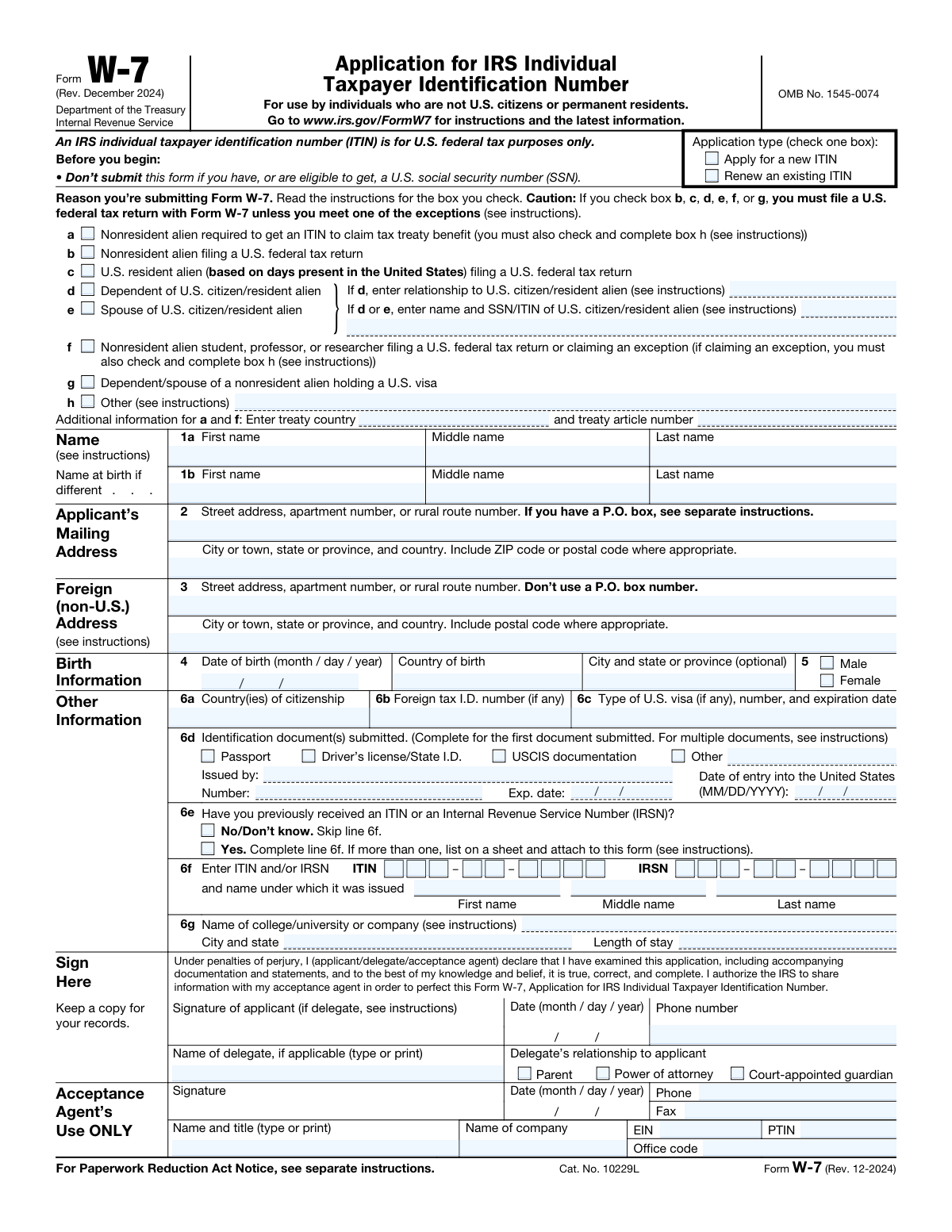
If you do not have a Social Security Number (SSN) and are not eligible to get one, but you are required to file a U.S. tax return, you need Form W-7, Application for IRS Individual Taxpayer Identification Number. This form is the official application to receive an ITIN. It is most commonly used by:
- Non-resident aliens who need to claim a tax treaty benefit.
- Resident aliens filing a U.S. tax return who are ineligible for an SSN.
- Dependents or spouses of U.S. citizens or resident aliens.
If You Are Providing Your ID to a Payer or Client
The most frequently used document in this category is Form W-9, Request for Taxpayer Identification Number and Certification. Unlike the W-7, you do not send this form to the IRS; instead, you provide it to the entity that is paying you. You should choose this form if:
- You are a Freelancer or Independent Contractor: A client needs your SSN, ITIN, or EIN to report your income on a Form 1099.
- You are a Business Vendor: You need to certify your business’s Employer Identification Number (EIN) to a customer for their accounting records.
- You are Opening a Bank Account: Financial institutions use the W-9 to confirm your tax ID for reporting interest or dividends.
Quick Selection Summary
- Choose Form W-7 if you are a foreign national or resident alien who needs to *request* a tax ID number from the IRS for the first time.
- Choose Form W-9 if you *already have* a tax ID (SSN, EIN, or ITIN) and need to certify it for a business, client, or financial institution to ensure accurate tax reporting and avoid backup withholding.
Both forms can be completed quickly and accurately on Instafill.ai, where our AI helps you navigate the technical fields to ensure your documentation is compliant.
Form Comparison
| Form | Purpose | Who Files It | Key Identification Number |
|---|---|---|---|
| Form W-7, Application for IRS Individual Taxpayer Identification Number | Request a tax processing number for individuals ineligible for a Social Security Number. | Individuals who must provide a U.S. tax ID but lack SSN eligibility. | Individual Taxpayer Identification Number (ITIN). |
| Form W-9, Request for Taxpayer Identification Number and Certification | Certify a Taxpayer Identification Number (TIN) and U.S. person status to payers. | Independent contractors, freelancers, and vendors receiving reportable income from businesses. | Social Security Number (SSN) or Employer Identification Number (EIN). |
Tips for taxpayer identification forms
Ensure the name entered on the form exactly matches the one on your Social Security card or previous tax filings. Discrepancies between the name and the Taxpayer Identification Number can lead to processing delays or backup withholding issues.
On Form W-9, carefully select your tax classification, such as Individual/Sole Proprietor or LLC. Choosing the wrong box can lead to incorrect reporting and may require you to resubmit the form to your payer later.
Verify every digit of your Social Security Number (SSN) or Employer Identification Number (EIN) before submitting. A single transposed digit can trigger an IRS mismatch notice, causing administrative headaches for both you and the requester.
AI-powered tools like Instafill.ai can complete these taxpayer identification forms in under 30 seconds with high accuracy. This is a massive time-saver for freelancers or businesses handling multiple forms, and your data stays secure during the process.
Always save a digital copy of every W-9 or W-7 you submit to various entities. This helps you track which businesses have your sensitive information and ensures you can quickly provide the same data if requested again.
When filling out Form W-7 for an ITIN, you must clearly mark the reason you are applying, such as being a non-resident alien required to file a tax return. Selecting the correct category is essential for the IRS to process your application without requesting further clarification.
Since these forms contain highly sensitive information like your SSN or EIN, avoid sending them via unencrypted email. Use secure portals or encrypted file-sharing services to protect your identity and prevent unauthorized access to your tax data.
Frequently Asked Questions
These forms are used by the IRS and businesses to collect necessary information for tax reporting and verification. They ensure that income paid to individuals or entities is correctly tracked and reported under a specific Taxpayer Identification Number, such as a Social Security Number, Employer Identification Number, or Individual Taxpayer Identification Number.
You use Form W-9 if you already have a Taxpayer Identification Number and need to provide it to a payer, such as a client or bank, to certify your status. Form W-7 is an application used specifically to request an Individual Taxpayer Identification Number from the IRS if you are not eligible for a Social Security Number.
Freelancers, independent contractors, and vendors are usually asked to fill out this form by the businesses hiring them. It allows the payer to accurately report payments exceeding a certain threshold to the IRS, ensuring the contractor's income is properly documented for tax purposes.
If you fail to provide a correct TIN to a requester, you may be subject to backup withholding. This means the payer is legally required to withhold a percentage of your payment, currently 24%, and send it directly to the IRS to ensure taxes are covered.
Unlike many other tax documents, Form W-9 is generally not sent to the IRS. Instead, you should provide the completed and signed form directly to the person or business that requested it from you so they can maintain it in their financial records.
Yes, you can use AI tools to streamline the process of completing these documents. AI platforms like Instafill.ai can accurately extract data from your source documents and place it into the correct fields on forms like the W-9 and W-7, significantly reducing the risk of manual entry errors.
Using modern AI technology, you can complete these forms in under 30 seconds. Services like Instafill.ai automate the data entry process by pulling information from your existing records, allowing you to generate a ready-to-sign PDF almost instantly.
Yes, if your legal name, business name, address, or tax identification number changes, you should provide an updated form to any entity that pays you. This ensures that your year-end tax documents, such as Form 1099, reflect your current and accurate information for the current tax year.
An Individual Taxpayer Identification Number is a tax processing number issued by the IRS for individuals who must have a U.S. taxpayer identification number but are not eligible for a Social Security Number. This typically includes nonresident aliens, their spouses, or dependents who have a federal tax filing or reporting requirement.
Taxpayer identification forms in this category are generally intended for independent contractors, freelancers, and vendors. Full-time employees typically fill out Form W-4 for payroll withholding, whereas the W-9 is used for entities not subject to standard payroll tax withholding.
Glossary
- Form Complexity Index
- Instafill’s 0–100 measure of how much effort a form takes to complete, calculated deterministically from the form’s own structure rather than estimated. It combines the number of fillable fields (the largest factor), how difficult those fields are to complete based on their type, the number of pages that contain fields, the amount of conditional “fill-only-if” logic, and how many sections the form is divided into, then adds modifiers for tables and repeating lists, bundled instruction pages, and dense page layouts. A higher score means the form is harder to fill out by hand. The forms in this category have a median Form Complexity Index of 38/100 (Basic). See exactly how it is calculated.
- TIN (Taxpayer Identification Number)
- A unique identification number used by the IRS for tax administration, which includes Social Security Numbers (SSN), Employer Identification Numbers (EIN), and Individual Taxpayer Identification Numbers (ITIN).
- ITIN (Individual Taxpayer Identification Number)
- A tax processing number issued by the IRS to individuals who are required to have a U.S. taxpayer identification number but are not eligible to obtain a Social Security Number.
- EIN (Employer Identification Number)
- Also known as a Federal Tax Identification Number, this nine-digit number is used to identify business entities, estates, and trusts for tax purposes.
- Backup Withholding
- A tax requirement where a payer must deduct a flat percentage of a payment (currently 24%) and send it to the IRS if the payee has not provided a valid TIN.
- U.S. Person
- A status used on tax forms that includes U.S. citizens, resident aliens, and domestic entities like corporations, partnerships, or trusts.
- Information Return
- A document, such as Form 1099, that a business or person must file with the IRS to report specific types of payments made to others during the year.
- Certification
- The legal act of signing a tax form under penalty of perjury to confirm that the information provided, such as your TIN and tax status, is correct.
- Acceptance Agent
- An individual or entity authorized by the IRS to assist applicants in the ITIN application process by reviewing and verifying their identity documentation.