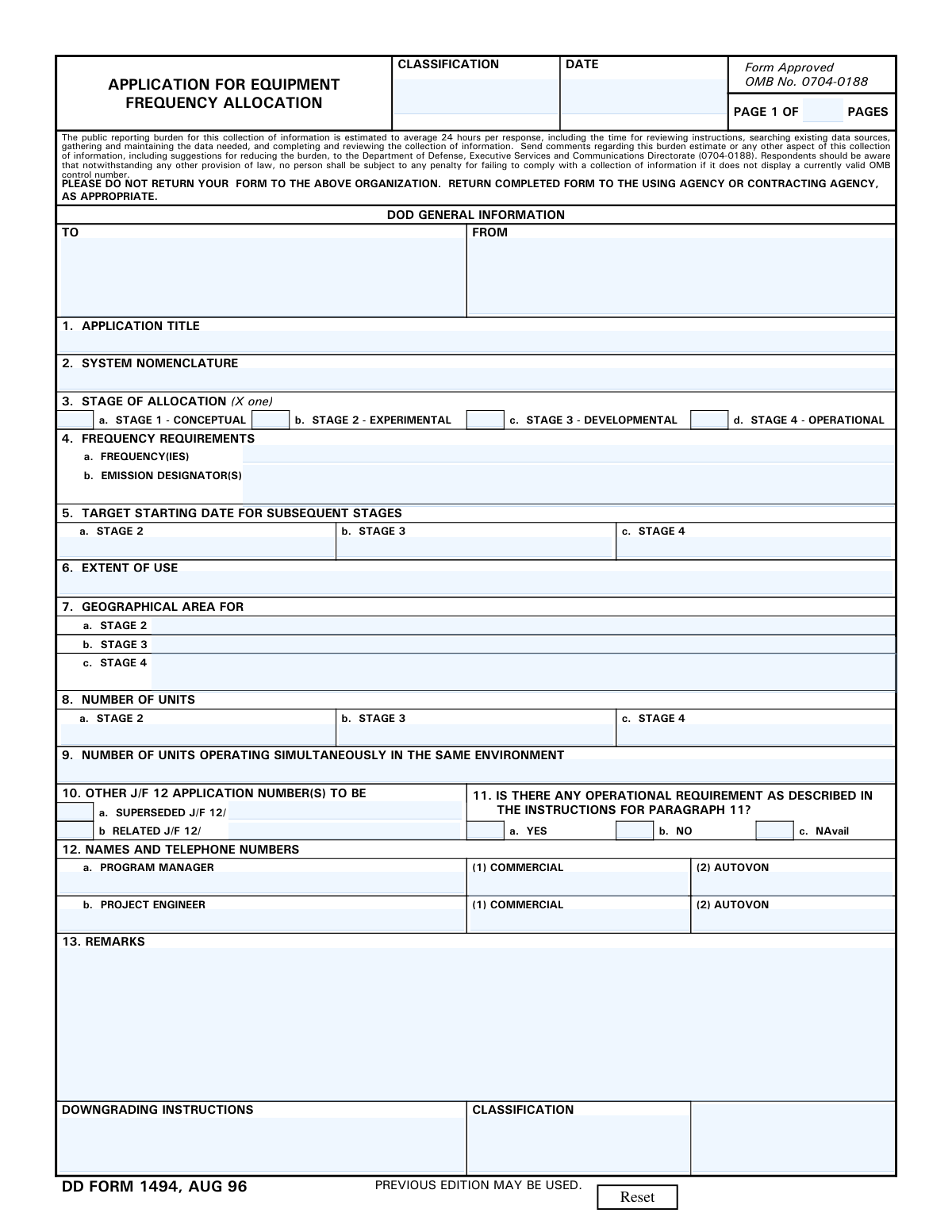
Yes! You can use AI to fill out DD Form 1494, Application for Equipment Frequency Allocation
DD Form 1494, Application for Equipment Frequency Allocation, is a multi-page Department of Defense form required before funds can be obligated for the development or procurement of any equipment that emits radio frequency (RF) energy. It captures detailed technical characteristics of transmitters, receivers, and antennas, as well as general program information for both DoD and NTIA review, covering all four stages from conceptual through operational. The form ensures that proposed RF equipment is evaluated for electromagnetic compatibility (EMC) against DoD, national, and international standards before spectrum use is authorized. Today, this complex multi-section form can be filled out quickly and accurately using AI-powered services like Instafill.ai, which can also convert non-fillable PDF versions into interactive fillable forms.
Our AI automatically handles information lookup, data retrieval, formatting, and form filling.
It takes less than a minute to fill out DD 1494 using our AI form filling.
Securely upload your data. Information is encrypted in transit and deleted immediately after the form is filled out.
Form specifications
| Form name: | DD Form 1494, Application for Equipment Frequency Allocation |
| Number of pages: | 12 |
| Language: | English |
Instafill Demo: filling out a legal form in seconds
How to Fill Out DD 1494 Online for Free in 2026
Are you looking to fill out a DD 1494 form online quickly and accurately? Instafill.ai offers the #1 AI-powered PDF filling software of 2026, allowing you to complete your DD 1494 form in just 37 seconds or less.
Follow these steps to fill out your DD 1494 form online using Instafill.ai:
- 1 Navigate to Instafill.ai and upload or select the DD Form 1494 (Application for Equipment Frequency Allocation) to begin filling it out online.
- 2 Complete the DoD General Information page by entering the application title, system nomenclature, stage of allocation, frequency requirements, target starting dates, extent of use, geographical areas, number of units, and contact information for the program manager and project engineer.
- 3 Fill out the Transmitter Equipment Characteristics page with the transmitter nomenclature, manufacturer details, installation type, tuning range, emission designators, bandwidth measurements, power levels, harmonic and spurious levels, and any applicable pulse characteristics.
- 4 Complete the Receiver Equipment Characteristics page by providing the receiver nomenclature, type, tuning range, IF and RF selectivity bandwidths, IF frequencies, sensitivity, image rejection, spurious rejection, and oscillator tuning information.
- 5 Fill in the Antenna Equipment Characteristics page with the antenna function, nomenclature, frequency range, type, polarization, scan characteristics, gain, and beamwidth details.
- 6 Complete the NTIA General Information page with the system purpose, information transfer requirements, estimated costs, target dates, system relationship and essentiality, replacement information, and applicable service and station class designations.
- 7 Review all pages for accuracy and completeness, attach any required line diagrams or space systems data, apply the appropriate classification markings and downgrading instructions, and submit the completed form to the using or contracting agency as directed.
Our AI-powered system ensures each field is filled out correctly, reducing errors and saving you time.
Why Choose Instafill.ai for Your Fillable DD 1494 Form?
Speed
Complete your DD 1494 in as little as 37 seconds.
Up-to-Date
Always use the latest 2026 DD 1494 form version.
Cost-effective
No need to hire expensive lawyers.
Accuracy
Our AI performs 10 compliance checks to ensure your form is error-free.
Security
Your personal information is protected with bank-level encryption.
Frequently Asked Questions About Form DD 1494
DD Form 1494 is the Application for Equipment Frequency Allocation, used by the Department of Defense to request frequency spectrum allocation for equipment with RF (radio frequency) emitters. It is an application for the development or procurement of RF-emitting equipment — not a request to operate RF emitters. Funds must not be obligated prior to approval of this application.
This form must be completed by DoD program managers, project engineers, or contractors who are developing or procuring equipment that emits radio frequency signals. It applies to any stage of development, from initial concept through full operational deployment, and is required before funds can be obligated for such equipment.
The four stages are: Stage 1 (Conceptual) — initial planning with proposed frequency bands; Stage 2 (Experimental) — preliminary design completed, radiation using test equipment may be required; Stage 3 (Developmental) — major design completed, radiation may occur during testing; and Stage 4 (Operational) — development essentially completed and final operating constraints need to be identified.
The complete form package includes: DoD General Information, Transmitter Equipment Characteristics, Receiver Equipment Characteristics, Antenna Equipment Characteristics, NTIA General Information, Line Diagram(s), and Space Systems Data (if applicable). For US coordination, these sections must be assembled in that specific order.
The transmitter page requires information such as nomenclature and manufacturer's model number, transmitter type and installation, tuning range and method, emission designators, frequency tolerance, emission bandwidth at -3/-20/-40/-60 dB levels, modulation techniques, pulse characteristics, mean and peak envelope power (PEP), harmonic levels, spurious emission levels, and FCC Type Acceptance number if applicable.
The receiver page requires the nomenclature and manufacturer's model number, receiver type and installation, tuning range and method, emission designators, frequency tolerance, IF and RF selectivity bandwidths, IF frequencies, sensitivity (in dBm), image rejection, spurious rejection, oscillator tuning information, and de-emphasis capability for FM/PM receivers.
The NTIA page requires additional information including a detailed description of the system's purpose and operational concepts (including whether it has a wartime function), information transfer requirements, estimated initial system cost, target dates for application approval and system activation/termination, system relationship and essentiality, replacement information for existing systems, related EMC analysis and test data, and the type of service and station class for Stage 4 operations.
For Stages 1 and 2, estimated values or ranges may be submitted when calculated or measured values are not yet available, and these must be annotated with '(EST).' For Stages 3 and 4, values should be measured. On the emission bandwidth section, you must mark whether values are 'Calculated' or 'Measured' by checking the appropriate box.
If foreign coordination is not required, approximately one year must be allowed for application approval. If foreign coordination is required, approximately two years must be allowed. Funds must not be obligated prior to the approval of the application, so planning ahead is critical.
The completed form should be returned to the using agency or contracting agency, as appropriate — not to the OMB address listed on the form. The form header includes 'To' and 'From' routing fields to identify the correct recipient and originating office.
The form must be classified in accordance with appropriate agency security directions, and downgrading instructions must be indicated. For classified applications, the highest classification for each item or sub-item must be marked with (U) for Unclassified, (C) for Confidential, or (S) for Secret alongside the item title. Each page has a classification field at the top and bottom.
An emission designator is a standardized code that describes the characteristics of a radio emission, including necessary bandwidth, as described in Chapter 9 of the NTIA Manual (e.g., 40M0PON or 16K0F3E). For systems with both frequency hopping and non-hopping modes, designators for each mode must be entered separately and identified as 'hopping' or 'non-hopping.'
Yes — services like Instafill.ai use AI to auto-fill form fields accurately, which can save significant time given that the public reporting burden for DD Form 1494 is estimated at an average of 24 hours per response. Instafill.ai can help populate technical fields, routing information, and stage-specific data across the multiple pages of this complex form.
You can upload the DD Form 1494 PDF to Instafill.ai, and the AI will guide you through completing each section — including DoD General Information, Transmitter, Receiver, Antenna, and NTIA pages — by auto-filling fields based on your equipment data. If your PDF is a flat, non-fillable version, Instafill.ai can convert it into an interactive fillable form so you can complete and save it digitally.
The antenna page requires the antenna's function (transmitting, receiving, or both), nomenclature and manufacturer's model number, frequency range, antenna type (e.g., Whip, Phased Array), polarization, scan characteristics (type, elevation angles, scan rates, sector blanking capability), maximum gain in dBi, first major side lobe gain and angular displacement, and 3 dB beamwidth in both horizontal and vertical planes.
Compliance DD 1494
Validation Checks by Instafill.ai
1
Exactly One Stage of Allocation Selected
Validates that one and only one Stage of Allocation checkbox (Stage 1 through Stage 4) is selected on both the DoD General Information page and the NTIA General Information page. The instructions specify 'X one,' meaning multiple selections or no selection are invalid. If no stage is selected or more than one is checked, the application cannot be properly routed or evaluated, as the stage determines which data fields are required and what review process applies.
2
Frequency Value Format and Units Validation
Validates that all frequency entries (Items 4a, 5a–c Tuning Range, Receiver Tuning Range, Antenna Frequency Range, and NTIA Item 4a) include explicit units such as Hz, kHz, MHz, or GHz as required by the instructions. Frequency values must be numeric and, where a range is specified, the lower bound must be less than the upper bound. Missing or ambiguous units make it impossible to assess spectrum compatibility and may result in rejection by the frequency allocation authority.
3
Emission Designator Format Compliance
Validates that all emission designator entries (Transmitter Item 8, Receiver Item 8, DoD General Item 4b, NTIA Item 4b) conform to the standard ITU/NTIA format as described in Chapter 9 of the NTIA Manual (e.g., '16K0F3E' or '40M0PON'). For systems with both hopping and non-hopping modes, each mode must have its own designator with the mode explicitly labeled. Incorrectly formatted designators prevent accurate spectrum analysis and may cause the application to be returned without action.
4
Stage-Conditional Fields Completed for Subsequent Stages
Validates that when a stage earlier than Stage 4 is selected, the corresponding target start dates (Item 5), geographical areas (Item 7), and number of units (Item 8) are provided for all subsequent stages. For example, a Stage 1 application must include projected data for Stages 2, 3, and 4. Omitting these fields violates the instruction that 'all applicable data items shall be submitted for all stages' and prevents reviewers from assessing the full lifecycle spectrum impact.
5
Manufacturer's Name Required When Model Number Is Provided
Validates that whenever a manufacturer's model number is entered in Item 1 of the Transmitter, Receiver, or Antenna pages, the corresponding Manufacturer's Name field (Item 2 or Item 3) is also completed. The instructions explicitly state 'If a manufacturer's model number is listed in Item 1, this item must be completed.' Leaving the manufacturer's name blank when a model number is present creates an incomplete equipment record that cannot be verified against FCC or DoD equipment databases.
6
Frequency Tolerance Units Correct for Emission Type
Validates that frequency tolerance values for transmitters (Item 9) and receivers (Item 9) are expressed in parts per million (ppm) for all emission types except single sideband (SSB), which must be expressed in Hertz (Hz). The instructions explicitly specify this distinction. Applying ppm to SSB emissions or Hz to non-SSB emissions produces technically incorrect tolerance specifications that could lead to improper interference assessments.
7
Emission Bandwidth Calculation or Measurement Method Indicated
Validates that for Transmitter Item 12 (Emission Bandwidth) and Receiver Item 11 (RF Selectivity), exactly one of the 'Calculated' or 'Measured' checkboxes is marked to indicate how the bandwidth values were determined. The instructions require this indication for all bandwidth entries. Without knowing whether values are calculated or measured, reviewers cannot properly weight the data, particularly since Stage 1 and 2 values may be estimated while Stage 3 and 4 values should be measured.
8
Pulse Radar Transmitter Requires -40 dB Bandwidth Entry
Validates that when the transmitter type (Item 4) indicates a pulse radar system, the emission bandwidth at the -40 dB level (Item 12c) is completed in addition to the standard -3, -20, and -60 dB entries. The instructions specifically state that the -40 dB bandwidth 'shall also be entered for pulse radar transmitters.' Omitting this value for pulse radar applications leaves a critical spectral occupancy data point missing that is required for radar interference analysis.
9
Operational Requirement (Item 11) Consistency with Remarks
Validates that when 'YES' is selected for Item 11 (Operational Requirement), the Remarks field (Item 13) contains a description specifying the US Military Services, DoD Components, US Government Agencies, or Allied Nations with which the equipment will operate. The instructions explicitly require this detail in Remarks when 'Yes' is selected. A 'YES' answer without supporting detail in Remarks is incomplete and prevents coordination with the identified organizations.
10
Program Manager and Project Engineer Contact Information Completeness
Validates that Item 12 contains at least a name and one telephone number (either commercial or AUTOVON) for both the Program Manager (12a) and the Project Engineer (12b). These contacts are essential for the reviewing authority to request clarifications or additional data. An application with missing contact information cannot be processed efficiently and may be returned, delaying frequency allocation approval and potentially causing funds to be obligated prematurely.
11
Antenna Function Checkbox — Exactly One Selection Required
Validates that exactly one of the three antenna function options (Transmitting, Receiving, or Transmitting and Receiving) is selected in Antenna Item 1, and that a separate antenna page is submitted for each antenna in a multi-antenna system. The instructions state 'For multi-antenna system, use one page for each antenna.' Selecting multiple function types on a single page or failing to provide separate pages for each antenna results in ambiguous or incomplete antenna characterization.
12
Antenna Gain and Beamwidth Values Include Correct Units
Validates that antenna gain values (Item 8a and 8b) are expressed in dBi and that beamwidth values (Item 9a and 9b) are expressed in degrees, as required by the instructions. Item 8b must also include the angular displacement of the first major side lobe from the main beam in degrees. Missing units or omitting the angular displacement value prevents accurate assessment of antenna radiation patterns and potential interference to adjacent systems.
13
NTIA Target Dates Reflect Required Approval Lead Times
Validates that the NTIA Item 8 target dates for application approval (8a) are set at least one year in the future from the submission date when no foreign coordination is required, or at least two years in the future when foreign coordination is required. The instructions explicitly state these minimum lead times and warn that 'Funds must not be obligated prior to the approval of this application.' Target dates that do not allow sufficient review time indicate a planning error that could result in premature fund obligation.
14
Spread Spectrum Modulation Detail Required in Remarks
Validates that when Spread Spectrum is marked 'YES' in Transmitter Item 11, the Remarks field (Item 24) contains a detailed description of the spread spectrum technique employed (e.g., direct sequence, frequency hopping, frequency agile), and that Item 13 (Maximum Bit Rate) reflects the bit rate after encoding rather than before. The instructions specifically require full details in Remarks for complex modulation schemes. Omitting this detail prevents proper EMC evaluation of spread spectrum systems.
15
Receiver Sensitivity Criteria and Noise Figure/Temperature Mutual Exclusivity
Validates that Receiver Item 17b (Sensitivity Criteria) is completed whenever Item 17a (Sensitivity in dBm) is provided, and that either Item 17c (Noise Figure in dB) or Item 17d (Noise Temperature in Kelvin) is completed based on the receiver's application — terrestrial systems must use noise figure (dB) and space/satellite earth station systems must use noise temperature (Kelvin), but not both. Mixing these metrics or omitting the criteria makes the sensitivity specification unverifiable and technically ambiguous.
16
Classification and Downgrading Instructions Consistency
Validates that the Classification field is completed on every page of the form and that when a classification other than Unclassified is indicated, the Downgrading Instructions field is also completed with specific conditions, timeframes, or actions required for downgrading. The instructions state the form 'must be classified in accordance with appropriate agency security directions' and that 'downgrading instructions must be indicated.' A classified form without downgrading instructions is non-compliant with security handling requirements and cannot be properly managed over its lifecycle.
Common Mistakes in Completing DD 1494
Applicants frequently enter frequency values in Items 4a (Frequency Requirements) and 5 (Tuning Range) without specifying the unit (Hz, kHz, MHz, or GHz), or they use inconsistent abbreviations. This can cause reviewers to misinterpret the requested band by orders of magnitude, potentially leading to rejection or misallocation. The form explicitly requires units to be indicated alongside every frequency entry. Always append the correct unit abbreviation (e.g., '225–400 MHz' not just '225–400'), and use only the standard abbreviations listed in the form's abbreviation table. Tools like Instafill.ai can automatically validate frequency entries and flag missing or inconsistent units before submission.
Emission designators (Items 4b on both the DoD and NTIA General Information pages, and Item 8 on the Transmitter and Receiver pages) must follow the precise format described in Chapter 9 of the NTIA Manual (e.g., '40M0PON' or '16K0F3E'). Applicants commonly omit the necessary bandwidth prefix, use incorrect character sequences, or fail to identify each mode as 'hopping' or 'non-hopping' for frequency-hopping systems. An incorrectly formatted designator can result in the application being returned for correction or cause spectrum conflicts. Always cross-reference the NTIA Manual Chapter 9 format and explicitly label each mode; AI-assisted form tools like Instafill.ai can help validate designator syntax automatically.
The instructions clearly state that estimated values submitted for Stage 1 and Stage 2 must be annotated with '(EST)' to distinguish them from calculated or measured values. Applicants often enter estimated figures without this annotation, which can mislead reviewers into treating rough estimates as confirmed technical data. For Stages 3 and 4, measured values are expected, and submitting estimates without annotation may trigger requests for clarification or cause compliance issues. Always append '(EST)' to any value that is an estimate, and ensure Stage 3/4 entries are based on actual measurements.
Applicants sometimes mark the incorrect stage (Items 3 on both the DoD and NTIA pages) because they misunderstand the NTIA definitions. For example, they may mark Stage 3 (Developmental) when the design is still preliminary and radiation using test equipment is only beginning, which actually corresponds to Stage 2 (Experimental). Selecting the wrong stage affects the type of data required, the review timeline, and the approval process. Carefully review the NTIA stage definitions provided in the instructions before marking a stage, and note that funds must not be obligated prior to application approval.
Item 5 (Target Starting Dates for Subsequent Stages) requires the proposed date of application submission for each subsequent stage — not the date the equipment will begin operating. Applicants frequently either leave these fields blank or enter projected operational start dates, which are different from submission dates. Missing or incorrect dates can delay the review process and cause scheduling conflicts for subsequent stage approvals. Enter the anticipated date you plan to submit the application for each subsequent stage, and ensure all relevant stage date fields are completed even if they are estimates.
Items 7 and 13 (Geographical Area) require specific location names and, where available, geographical coordinates in degrees, minutes, and seconds. Applicants commonly enter overly broad descriptions such as 'worldwide' or 'CONUS' without further detail, or omit coordinates entirely when they are available. Vague geographical entries make it difficult for reviewers to assess potential interference with other spectrum users in specific regions. Provide named locations (e.g., 'White Sands Missile Range, New Mexico'), use standard abbreviations like 'US&P' or 'NATO Countries' as appropriate, and include coordinates when known.
Item 11 asks whether the equipment will operate with the same or similar equipment used by other US Military Services, DoD Components, US Government Agencies, or Allied Nations. Applicants often leave this item blank, mark 'NAvail' when the information is actually known, or mark 'Yes' without providing the required details in Item 13 (Remarks). Failing to properly complete this item can result in missed coordination opportunities and potential electromagnetic compatibility conflicts. If 'Yes' is marked, always specify in the Remarks section the specific services, agencies, or countries involved, including each country's services.
Items 21 (Harmonic Level) and 22 (Spurious Level) on the Transmitter page require values expressed in dB relative to the fundamental. Applicants frequently enter absolute power levels (e.g., in dBm or watts) instead of relative dB values, or omit the negative sign that indicates attenuation below the fundamental. This makes it impossible for reviewers to assess EMC compliance. Always express harmonic and spurious levels as negative dB values relative to the fundamental (e.g., '-60 dB'), and ensure Item 21c captures the highest-powered harmonic above the 3rd. AI-powered tools like Instafill.ai can help enforce correct units and sign conventions for these technical fields.
The DD Form 1494 requires two separate general information sections — one for DoD and one for NTIA — each with overlapping but distinct fields. Applicants often complete only the DoD page and submit the form without the NTIA General Information page, or they copy entries verbatim without addressing NTIA-specific fields such as Items 5 (Purpose of System/Wartime Use), 9 (System Relationship and Essentiality), and 16–17 (Type of Service and Station Classes). Omitting the NTIA page will result in an incomplete submission. Ensure both pages are fully completed and assembled in the correct order as specified in the 'How to Assemble the Form' instructions.
Item 9 (Frequency Tolerance) on both the Transmitter and Receiver pages requires the tolerance to be expressed in parts per million (ppm) for all emission types except single sideband (SSB), which must be expressed in Hertz (Hz). Applicants commonly use ppm for SSB systems, use percentage instead of ppm, or omit units entirely. Incorrect units make the tolerance value meaningless for EMC evaluation. Always verify the emission type before selecting the unit, and double-check that SSB entries are in Hz while all other types are in ppm.
Item 14 on the NTIA General Information page requires applicants to enter the page number of the attached line diagram, which must show links, direction of transmissions, frequency bands, and associated equipment with J/F 12 numbers. Applicants frequently forget to attach the line diagram altogether, enter an incorrect page number, or attach a diagram that omits required elements such as J/F 12 numbers or frequency band labels. A missing or incomplete line diagram is a common cause of application rejection. Prepare the line diagram before completing the form, verify it contains all required elements, and enter the correct page reference in Item 14.
Both the DoD General Information instructions and the NTIA General Information instructions explicitly state that funds must not be obligated prior to the approval of the frequency allocation application. Program managers and contracting officers sometimes initiate procurement or development contracts before receiving approval, assuming the allocation will be granted. This can result in significant financial and legal complications if the application is denied or requires modification. Establish internal controls to prevent fund obligation until written approval is received, and note that foreign coordination can extend the approval timeline to approximately two years.
Saved over 80 hours a year
“I was never sure if my IRS forms like W-9 were filled correctly. Now, I can complete the forms accurately without any external help.”
Kevin Martin Green
Your data stays secure with advanced protection from Instafill and our subprocessors
Robust compliance program
Transparent business model
You’re not the product. You always know where your data is and what it is processed for.
ISO 27001, HIPAA, and GDPR
Our subprocesses adhere to multiple compliance standards, including but not limited to ISO 27001, HIPAA, and GDPR.
Security & privacy by design
We consider security and privacy from the initial design phase of any new service or functionality. It’s not an afterthought, it’s built-in, including support for two-factor authentication (2FA) to further protect your account.
Fill out DD 1494 with Instafill.ai
Worried about filling PDFs wrong? Instafill securely fills dd-form-1494-application-for-equipment-frequency-allocation forms, ensuring each field is accurate.