Fill out frequency allocation forms
with AI.
Frequency allocation forms are official documents used to request, document, and authorize the use of specific radio frequency (RF) spectrum for electronic equipment and systems. These forms are a critical part of the regulatory process that ensures different devices and systems can operate without causing harmful interference to one another. Before any RF-emitting equipment can be developed, procured, or deployed — particularly within government and military contexts — it must go through a formal spectrum management review process governed by agencies like the Department of Defense and the National Telecommunications and Information Administration (NTIA).
By continuing, you acknowledge Instafill's Privacy Policy and agree to get occasional product update and promotional emails.
About frequency allocation forms
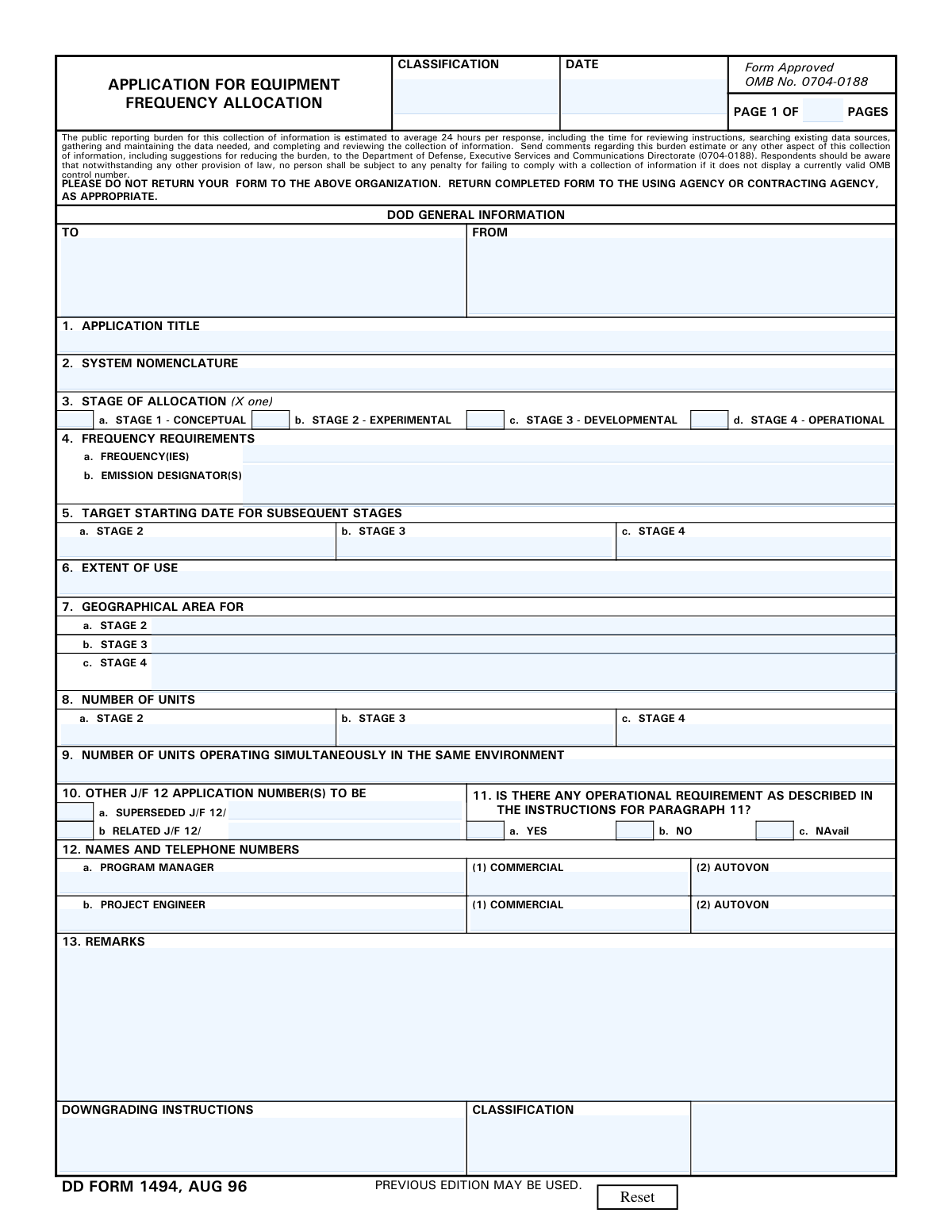
The primary users of these forms are defense contractors, military program managers, systems engineers, and federal acquisition personnel who are working on projects involving transmitters, receivers, antennas, or any equipment that radiates electromagnetic energy. A key example in this category is DD Form 1494, the Application for Equipment Frequency Allocation, which must be submitted at each stage of a program's lifecycle — from early concept through full operational deployment — to demonstrate electromagnetic compatibility (EMC) with existing spectrum users and international standards.
These forms are technically detailed and multi-sectioned, often requiring precise input about antenna gain, frequency ranges, modulation types, and power levels. Tools like Instafill.ai use AI to fill these forms accurately in under 30 seconds, making it significantly easier to handle even the most complex sections without errors or omissions.
Every form on this page can be completed without typing. Instafill is form filling software that reads a PDF and fills it for you — including flat and scanned documents that carry no fillable fields at all.
Forms in This Category
The forms in this category have a median Form Complexity Index of 73/100 (Complex), measured across 1 forms by field count, input difficulty, length, conditional logic and structure. See how it is calculated.
| Form Name | Pages | FCI | |
|---|---|---|---|
| 1. | DD Form 1494, Application for Equipment Frequency Allocation | 12 | Complex 73 |
- Enterprise-grade security & data encryption
- 99%+ accuracy powered by AI
- 1,000+ forms from all industries
- Complete forms in under 60 seconds
How to Choose the Right Form
If you've landed on this page, you're likely dealing with Department of Defense radio frequency (RF) equipment and need to secure spectrum authorization before moving forward with development or procurement.
There's One Form — But It Covers a Lot
This category currently features a single, comprehensive form:
- DD Form 1494, Application for Equipment Frequency Allocation — This is the required form for *any* DoD equipment that emits RF energy. It applies across all four lifecycle stages: conceptual, developmental, experimental, and operational.
Is DD Form 1494 the Right Form for You?
You need this form if:
- You are developing, procuring, or modifying equipment that transmits or receives radio frequency signals
- You need DoD or NTIA spectrum authorization before funds can be obligated
- Your project involves transmitters, receivers, or antennas at any stage — from early concept through full operational deployment
You may not need this form if your equipment is purely passive and emits no RF energy, or if spectrum authorization has already been granted for an identical, unchanged system.
What to Have Ready Before You Start
DD Form 1494 is detailed and technical. Before filling it out, gather:
- Transmitter and receiver technical specifications (frequency range, power output, modulation type)
- Antenna characteristics and gain data
- Program timeline and acquisition stage information
- Electromagnetic compatibility (EMC) assessment data
Tip: Use AI to Simplify the Process
DD Form 1494 is a complex, multi-section document. Using an AI-powered tool like Instafill.ai can help you complete it accurately and efficiently — especially useful if you're working with a non-fillable PDF version that needs to be converted into an interactive form first.
Form Comparison
| Form | Purpose | Who Files It | When to Use |
|---|---|---|---|
| DD Form 1494, Application for Equipment Frequency Allocation | Request spectrum authorization for RF-emitting equipment | DoD program managers and equipment developers | Before obligating funds for RF equipment development or procurement |
Tips for frequency allocation forms
DD Form 1494 must be submitted at each of the four stages of equipment development — from conceptual through operational. Submitting only once or skipping a stage can delay spectrum authorization and hold up procurement funding. Identify your current stage before you begin filling out the form to ensure you're providing the right level of technical detail.
The form requires precise technical data for transmitters, receivers, and antennas, including frequency ranges, power levels, emission designators, and modulation types. Attempting to fill it out without this information on hand often leads to incomplete submissions and review delays. Collect all equipment specification sheets and engineering documentation before you begin.
Emission designators follow a specific ITU format that many first-time filers get wrong, leading to rejections or requests for clarification from reviewers. Double-check the designator against ITU Radio Regulations Appendix 1 to ensure it accurately reflects your signal's bandwidth, modulation, and information type. Errors here are one of the most common causes of form resubmission.
The antenna data fields — including gain, polarization, and radiation patterns — are frequently left incomplete, but they are critical for electromagnetic compatibility (EMC) analysis. Reviewers at both DoD and NTIA need this data to assess potential interference with existing spectrum users. Attach antenna pattern charts or supporting documentation when values cannot be fully captured in the form fields.
AI-powered tools like Instafill.ai can complete complex forms like the DD 1494 in under 30 seconds with high accuracy, reducing the risk of transcription errors across its many technical fields. Your data stays secure throughout the process, making it a reliable option even for sensitive program information. This is especially useful when managing submissions across multiple development stages.
Your organization's spectrum or frequency manager should be involved before you submit, not after. They can verify that your technical entries align with DoD spectrum policy and catch issues that could cause rejection at the NTIA or international review level. Early coordination can significantly shorten the overall approval timeline.
Since the form is submitted at multiple development stages, maintaining a well-organized archive of each version is essential for tracking changes in equipment characteristics over time. Reviewers may compare current and previous submissions, so discrepancies without explanation can raise flags. Label each saved copy clearly with the submission date and development stage.
Submitting the form does not guarantee spectrum authorization — it initiates a review process that evaluates EMC against DoD, national, and international standards. Plan your project timeline to account for potential back-and-forth with reviewers, especially for equipment operating in congested frequency bands. Budget adequate lead time before funds need to be obligated.
Frequently Asked Questions
Frequency allocation forms are used to request authorization for equipment that emits radio frequency (RF) energy to operate within designated spectrum bands. They ensure proposed RF equipment is evaluated for electromagnetic compatibility (EMC) before spectrum use is approved by relevant authorities such as the Department of Defense (DoD) or the National Telecommunications and Information Administration (NTIA).
DD Form 1494, Application for Equipment Frequency Allocation, is the standard DoD form for this purpose. It is required before funds can be obligated for the development or procurement of any equipment that emits RF energy, and it covers all four stages of a program from conceptual through operational.
Any DoD program office, contractor, or agency planning to develop, procure, or operate equipment that emits radio frequency energy must submit a frequency allocation application. This applies across all branches of the military and supporting organizations when RF-emitting equipment is involved at any stage of development or deployment.
Frequency allocation applications should be submitted early in the equipment development or procurement process — ideally at the conceptual stage — since spectrum authorization must be obtained before funds can be obligated. Submitting early allows time for DoD and NTIA review and helps avoid costly delays in program timelines.
These forms require detailed technical characteristics of the RF equipment, including specifications for transmitters, receivers, and antennas, as well as general program information such as intended use, operational environment, and program stage. The information is used to assess electromagnetic compatibility against DoD, national, and international standards.
Completed DD Form 1494 applications are submitted through the appropriate DoD spectrum management office, which then coordinates review with the NTIA and other relevant authorities as required. The specific submission path may vary depending on the military branch and the stage of the program.
The DD Form 1494 covers four stages of equipment development: conceptual, developmental, experimental, and operational. Each stage requires a separate submission or update to the form, ensuring that spectrum authorization keeps pace with the program's progression from initial design through full deployment.
EMC evaluation ensures that new RF-emitting equipment will not interfere with existing systems and will operate effectively within its intended electromagnetic environment. Without this evaluation, equipment could disrupt critical communications, navigation, or other RF-dependent systems used by the DoD or civilian agencies.
Yes, AI-powered tools like Instafill.ai can fill out complex forms such as DD Form 1494 in under 30 seconds by accurately extracting and placing data from your source documents. This is especially useful for multi-section technical forms that require precise and consistent information across multiple fields.
Manually completing a multi-section form like DD Form 1494 can take considerable time due to the volume of technical detail required. Using AI-powered services like Instafill.ai, the process can be completed in under 30 seconds, with data accurately extracted from existing documents and placed into the correct fields.
Some versions of frequency allocation forms, including DD Form 1494, may be available only as non-fillable PDFs. Services like Instafill.ai can convert these non-fillable PDFs into interactive fillable forms, making it easier to complete and submit them accurately without printing and handwriting the information.
While DD Form 1494 is specifically a Department of Defense form, spectrum allocation and frequency authorization requirements apply broadly to any entity operating RF-emitting equipment in the United States. Civilian agencies and commercial operators have their own processes through the FCC and NTIA, but DoD programs must follow the military-specific requirements outlined in DD Form 1494.
Glossary
- Form Complexity Index
- Instafill’s 0–100 measure of how much effort a form takes to complete, calculated deterministically from the form’s own structure rather than estimated. It combines the number of fillable fields (the largest factor), how difficult those fields are to complete based on their type, the number of pages that contain fields, the amount of conditional “fill-only-if” logic, and how many sections the form is divided into, then adds modifiers for tables and repeating lists, bundled instruction pages, and dense page layouts. A higher score means the form is harder to fill out by hand. The forms in this category have a median Form Complexity Index of 73/100 (Complex). See exactly how it is calculated.
- Frequency Allocation
- The official assignment of specific radio frequency bands to particular uses or users by a regulatory authority, ensuring different systems do not interfere with one another.
- Radio Frequency (RF) Energy
- Electromagnetic energy transmitted through the air at frequencies used for wireless communication, radar, and other electronic systems, typically ranging from 3 kHz to 300 GHz.
- Electromagnetic Compatibility (EMC)
- The ability of electronic equipment to operate correctly in its intended environment without causing or suffering from interference with other electronic devices or systems.
- NTIA (National Telecommunications and Information Administration)
- The U.S. federal agency within the Department of Commerce responsible for managing the federal government's use of the radio frequency spectrum and coordinating spectrum policy.
- Spectrum Authorization
- Official approval granted by a regulatory body permitting a device or system to transmit or receive signals within a designated radio frequency band.
- DD Form 1494
- The Department of Defense's official multi-section application form required to obtain frequency allocation approval before funds can be committed to developing or purchasing RF-emitting equipment.
- Conceptual Through Operational Stages
- The four lifecycle phases of DoD equipment development—conceptual, developmental, production, and operational—each requiring spectrum review and approval before proceeding.
- Transmitter / Receiver Characteristics
- Technical specifications describing how a device sends (transmitter) or receives (receiver) RF signals, including power output, frequency range, modulation type, and bandwidth, which must be documented on frequency allocation forms.
- Electromagnetic Interference (EMI)
- Unwanted disruption caused by RF energy from one device that degrades the performance of another nearby electronic system, a key concern evaluated during the frequency allocation review process.
- Spectrum Management
- The coordinated process of regulating, planning, and monitoring the use of radio frequency spectrum to prevent interference and ensure efficient use across military, government, and civilian users.