Fill out DD forms
with AI.
Department of Defense (DD) forms serve as the standardized administrative backbone for the United States military and its affiliated agencies. These documents are essential for maintaining rigorous records and ensuring compliance across a wide spectrum of activities, from personnel management and benefits to technical equipment authorizations. Because the DoD operates under strict federal regulations, accurately completing these forms is critical for the smooth execution of military operations and the protection of legal rights for those serving or working with the armed forces.
By continuing, you acknowledge Instafill's Privacy Policy and agree to get occasional product update and promotional emails.
About DD forms
Typically, these forms are required by active-duty service members, veterans, civilian contractors, and DoD employees. You may need to fill them out during significant career milestones, such as when updating beneficiary information via DD Form 638-28, or during specialized technical tasks like submitting a DD Form 1494 for frequency allocation. Regardless of the specific requirement, these forms ensure that vital information is communicated clearly and stored securely within the government’s records system. Tools like Instafill.ai use AI to fill these forms in under 30 seconds, handling your data accurately and securely to save you time on complex paperwork.
Every form on this page can be completed without typing. Instafill is form filling software that reads a PDF and fills it for you — including flat and scanned documents that carry no fillable fields at all.
Forms in This Category
The forms in this category have a median Form Complexity Index of 73/100 (Complex), measured across 2 forms by field count, input difficulty, length, conditional logic and structure. See how it is calculated.
| Form Name | Pages | FCI | |
|---|---|---|---|
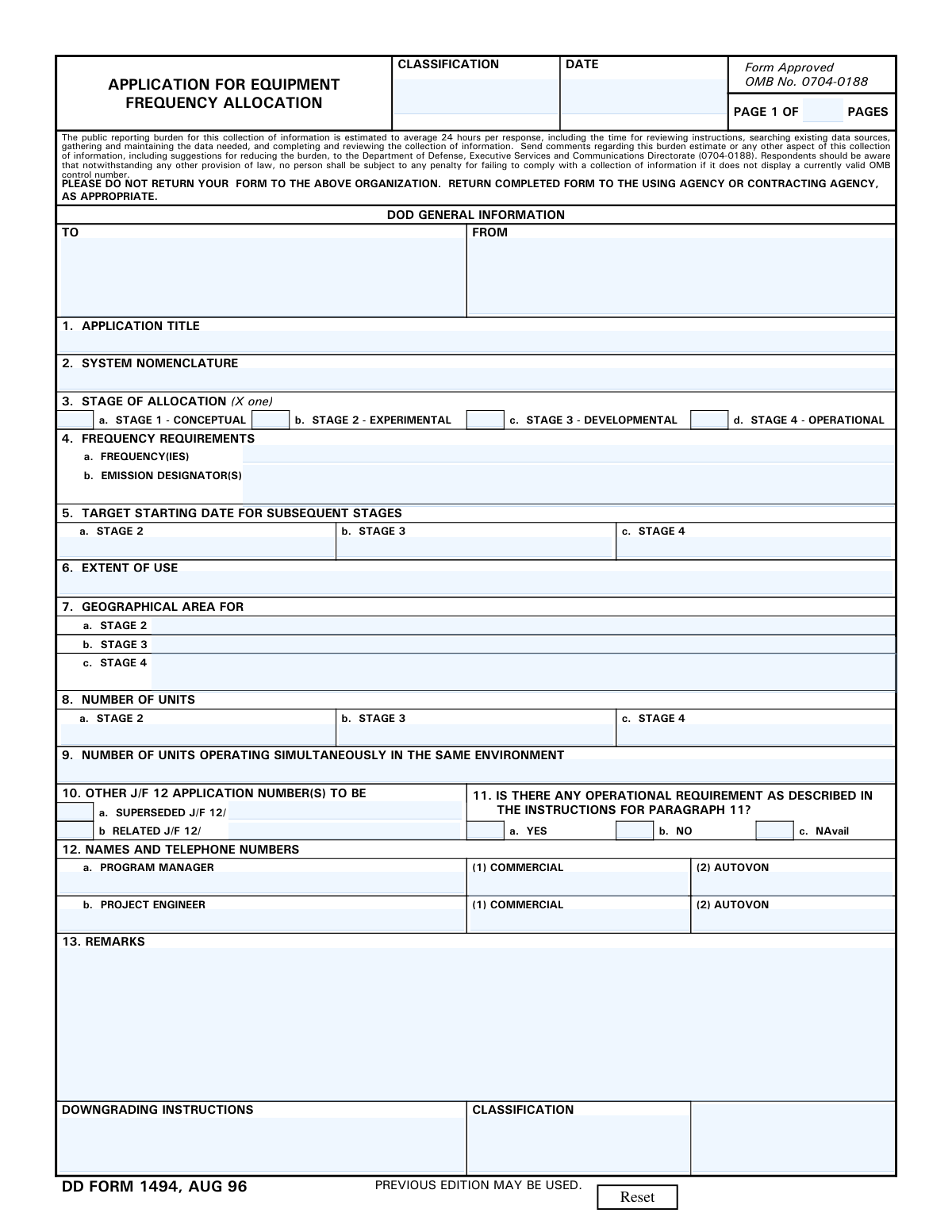
| 1. | DD Form 1494, Application for Equipment Frequency Allocation | 12 | Complex 73 |
| 2. | Form DD 638-28, Beneficiary Change | 1 | Moderate 61 |
- Enterprise-grade security & data encryption
- 99%+ accuracy powered by AI
- 1,000+ forms from all industries
- Complete forms in under 60 seconds
How to Choose the Right Form
Navigating Department of Defense (DD) forms can be complex, as they range from highly technical engineering applications to personal administrative updates. To find the correct document for your needs, first identify whether your task is related to equipment procurement or personal life insurance benefits.
Technical Frequency & Equipment Allocation
If you are involved in the development, procurement, or operation of equipment that emits radio frequency (RF) energy, you will likely need to complete technical documentation for Department of Defense and NTIA review.
Choose DD Form 1494, Application for Equipment Frequency Allocation if you need to:
- Obligate funds for the development or procurement of RF-emitting equipment.
- Provide detailed technical characteristics of transmitters, receivers, or antennas.
- Ensure proposed equipment is evaluated for electromagnetic compatibility (EMC) across any of the four stages of development (conceptual through operational).
Personal Records & Beneficiary Management
For service members or policy owners managing their personal affairs and financial legacy, the focus shifts to administrative legal documents. Keeping these records current is vital for ensuring your wishes are honored without legal delays.
Choose Form DD 638-28, Beneficiary Change if you need to:
- Designate or update the person(s), trust, or entity that will receive a policy's death benefit.
- Assign primary, contingent, or irrevocable beneficiaries to a policy.
- Update your records following a significant life event, such as marriage, divorce, or the birth of a child, to ensure assets are distributed correctly.
Both forms require high levels of precision. While DD Form 1494 is a multi-page technical document and Form DD 638-28 is a critical legal designation, using an AI-powered tool like Instafill.ai can help you navigate the fields quickly and ensure your submission is accurate and professional.
Form Comparison
| Form | Purpose | Primary Focus | Key Information Required |
|---|---|---|---|
| DD Form 1494, Application for Equipment Frequency Allocation | Requesting radio frequency spectrum allocation for military equipment development or procurement. | Technical electromagnetic compatibility and authorization for RF-emitting hardware. | Detailed technical specifications for transmitters, receivers, and antennas. |
| Form DD 638-28, Beneficiary Change | Designating or updating beneficiaries to receive policy death benefits. | Legal distribution of assets and personal beneficiary management. | Names and designations for primary, contingent, or irrevocable beneficiaries. |
Tips for DD forms
Ensure your DoD ID number or Social Security Number is entered correctly on every page. Military administrative systems are highly sensitive to these identifiers, and a single-digit error can lead to significant processing delays or the rejection of your submission.
For complex documents like the DD Form 1494, gather all technical RF data and antenna characteristics before you begin. Inaccurate technical specifications can lead to electromagnetic interference issues or the denial of frequency allocation during the critical review stages.
AI-powered tools like Instafill.ai can complete these complex DD forms in under 30 seconds with high accuracy. This is a real time-saver for people dealing with multiple forms, and you can rest assured that your data stays secure throughout the automated filling process.
Many Department of Defense forms require specific digital signatures or physical witness signatures to be legally binding. Always check the form instructions to see if a Common Access Card (CAC) is required for a digital signature or if a third party must be present to witness your beneficiary designations.
Always save a digital copy of your completed DD forms for your own records. Military paperwork can occasionally be misplaced during administrative transitions, and having a backup ensures you can provide proof of filing or update your information without starting the process from scratch.
For forms like the DD 638-28, it is best practice to review your designations after major life events such as marriage, divorce, or the birth of a child. Keeping these forms current ensures that benefits are distributed exactly according to your wishes without unnecessary legal complications for your heirs.
Frequently Asked Questions
DD forms are official Department of Defense documents used by military personnel, civilian employees, and defense contractors. They cover a wide range of administrative, technical, and personnel actions across the various branches of the U.S. military and related agencies.
Most DD forms are categorized by their specific purpose, such as personnel management, equipment allocation, or legal designations. You should consult your commanding officer, HR representative, or the specific DOD department guidelines to ensure you are using the correct form number for your requirement.
Yes, AI tools like Instafill.ai can process complex DD forms in under 30 seconds by accurately extracting data from source documents and placing it into the correct fields. This significantly reduces the manual effort and potential for errors when handling multi-page technical or legal forms.
Submission requirements vary depending on the specific form and your branch of service or department. Generally, forms are submitted to your local personnel office, a specific command authority, or an online portal designated for that specific administrative or technical task.
Keeping beneficiary forms current ensures that your assets and benefits are distributed exactly according to your wishes in the event of a claim. Failing to update these forms after major life events, like marriage or the birth of a child, can lead to legal complications or unintended distributions.
The DD Form 1494 is used to request frequency allocation for equipment that emits radio frequency energy. It is a critical step in ensuring that new technology does not interfere with existing military or civilian communications and complies with national and international electromagnetic standards.
While complex technical forms can take hours to complete manually, using AI-powered services like Instafill.ai allows you to finish them in less than 30 seconds. The AI handles the data entry and formatting, ensuring that technical details are captured accurately without the need for manual typing.
While some DD forms are designed for specific military-grade software, many are available as standard PDFs. Online platforms allow you to convert non-fillable versions into interactive forms that can be completed directly in your web browser without downloading additional software.
Yes, most DD forms are official legal records used by the Department of Defense for personnel and operational management. Providing inaccurate information or failing to follow the instructions on these forms can have legal or administrative consequences for service members and contractors.
Many modern DD forms accept digital signatures, especially when submitted through secure military networks. Always check the specific instructions on the form or with your department to see if an electronic signature is sufficient or if a physical 'wet' signature is required for that specific filing.
Yes, many DD forms are specifically designed for use by civilian contractors, particularly those related to equipment procurement, security clearances, or facility access. Forms like the DD 1494 are essential for contractors developing hardware that utilizes the radio frequency spectrum.
The Department of Defense does not charge a fee for the forms themselves, as they are public records intended for official use. However, there may be specific departmental requirements or administrative processes associated with the review of certain technical applications.
Glossary
- Form Complexity Index
- Instafill’s 0–100 measure of how much effort a form takes to complete, calculated deterministically from the form’s own structure rather than estimated. It combines the number of fillable fields (the largest factor), how difficult those fields are to complete based on their type, the number of pages that contain fields, the amount of conditional “fill-only-if” logic, and how many sections the form is divided into, then adds modifiers for tables and repeating lists, bundled instruction pages, and dense page layouts. A higher score means the form is harder to fill out by hand. The forms in this category have a median Form Complexity Index of 73/100 (Complex). See exactly how it is calculated.
- DD (Department of Defense)
- The executive department of the U.S. government responsible for national security and the United States Armed Forces, which issues these standardized forms.
- Beneficiary
- An individual, trust, or entity designated to receive assets or death benefits from a policy or account upon the owner's death.
- Contingent Beneficiary
- A secondary person or entity named to receive benefits only if the primary beneficiary is deceased or unable to accept them.
- NTIA (National Telecommunications and Information Administration)
- The federal agency that manages the use of the radio frequency spectrum for the U.S. government and reviews equipment frequency allocations.
- Frequency Allocation
- The official authorization to use a specific part of the radio frequency spectrum for a particular type of communication service or equipment.
- EMC (Electromagnetic Compatibility)
- The ability of electronic equipment to operate in its environment without causing or suffering from interference with other devices.
- Irrevocable Beneficiary
- A beneficiary designation that cannot be changed or canceled by the policy owner without the express written consent of that beneficiary.
- Obligation of Funds
- A legal commitment by the government to pay for goods or services, which in technical projects often requires approved frequency allocation forms.