
Yes! You can use AI to fill out Fidelity Automatic Withdrawals — Nonretirement
Don't type 75 fields by hand. Tell our AI about yourself, or upload a document you already have, and it fills every field in seconds. You check it, then download, print or sign.
The AI does the filling. You just check it.
No typing into boxes, nothing to install.
What this form asks for
The AI fills all of it, from your answers or your documents.
The AI checks your answers before you download
14 checks built for this form, so a wrong date or a missing answer is caught before anyone else sees it.
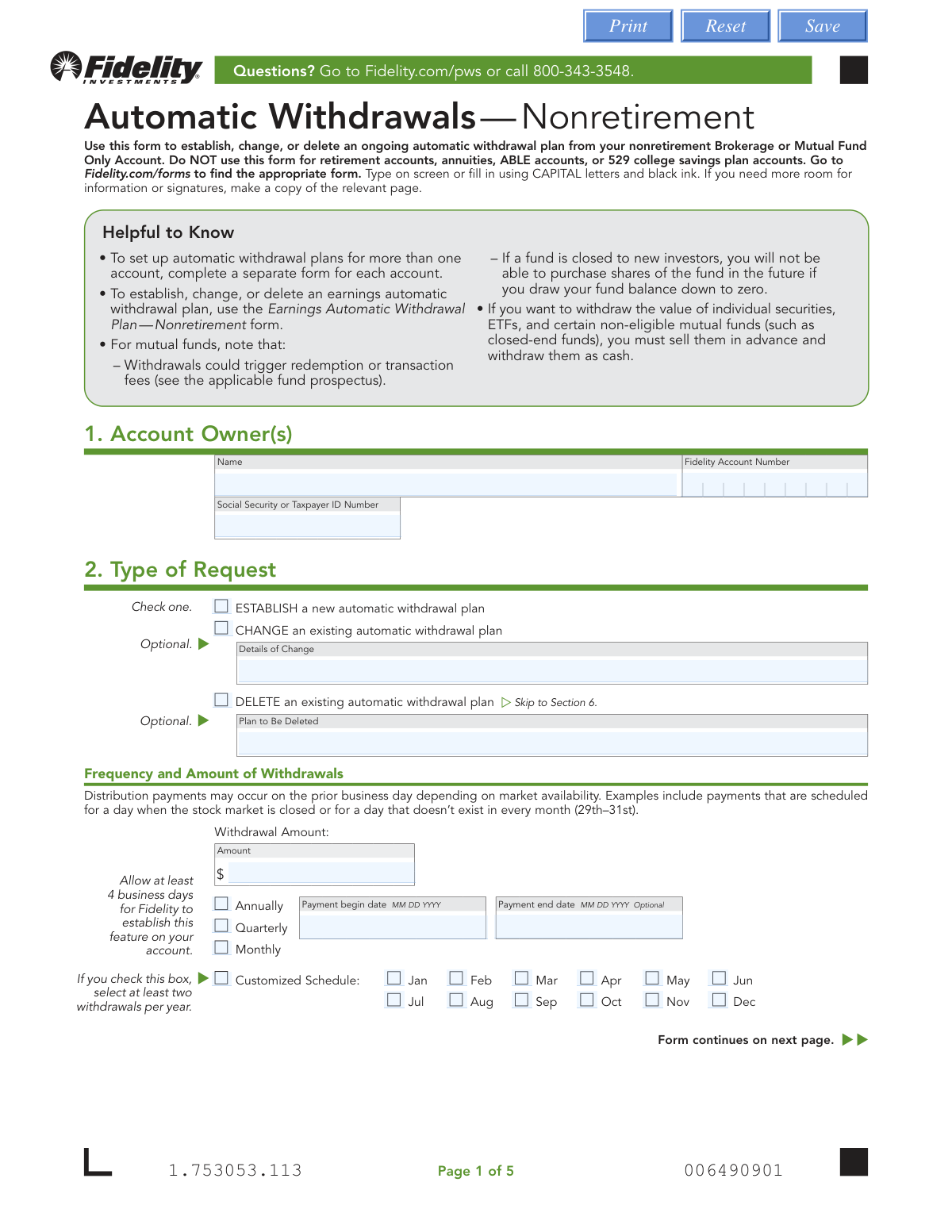
This check verifies that the Fidelity Account Number provided in Section 1 corresponds to an active, valid nonretirement Brokerage or Mutual Fund Only Account. It is crucial because the form's instructions are specific to these account types and invalid for retirement, ABLE, or 529 accounts. If the account number is invalid, for the wrong account type, or does not exist, the form will be rejected as the requested action cannot be performed.
This validation ensures the Social Security or Taxpayer ID Number in Section 1 is in a valid format (XXX-XX-XXXX or XX-XXXXXXX) and matches the information on file for the owner of the specified Fidelity account. This is a critical security measure to verify the identity of the person making the request and prevent fraud. A mismatch or invalid format will halt processing until the identity can be confirmed, protecting the account holder's assets.
This check ensures that exactly one option among 'ESTABLISH', 'CHANGE', or 'DELETE' is selected in Section 2. Selecting multiple options or none at all creates ambiguity about the account owner's intent. If this validation fails, the form is considered incomplete and will be returned to the user for clarification.
If the user selects 'ESTABLISH' or 'CHANGE' in Section 2, this validation confirms that the 'Withdrawal Amount' and a 'Frequency' (e.g., Monthly, Quarterly) have been specified. These details are the core of the withdrawal instruction and are mandatory for setting up or modifying a plan. A failure means the instructions are incomplete and the plan cannot be created or updated.
This check validates that the 'Payment begin date' in Section 2 is a valid calendar date, is not in the past, and adheres to the 'Allow at least 4 business days' rule mentioned on the form. This ensures there is sufficient time for processing and prevents attempts to schedule payments for impossible dates. An invalid or past date would cause an immediate processing error and rejection of the plan setup.
If the optional 'Payment end date' is filled out, this validation ensures it is a valid date that occurs chronologically after the 'Payment begin date'. A plan cannot end before it begins, so this logical check prevents nonsensical instructions. If the end date is before the begin date, the form will be rejected for correction.
And 8 more checks
- Custom Schedule Minimum Requirement
- Fixed Percentage Distribution Sum
- Bank Routing Number Validity
- EFT Information Completeness
- Medallion Signature Guarantee Cross-Check
- Signature and Date Presence
- Mutual Fund Account All-Owner Signature
- Conditional Logic for DELETE Request
Let AI fill out your Fidelity Automatic Withdrawals Nonretirement
No typing. Every field filled in seconds, checked, ready to sign.
How to Fill Out Fidelity Automatic Withdrawals Nonretirement Online for Free in 2026
What the AI walks you through.
- Navigate to Instafill.ai and upload the Fidelity Automatic Withdrawals — Nonretirement form or select it from the template library.
- Enter your account owner details in Section 1, including your name, Fidelity account number, and Social Security or Taxpayer ID Number.
- In Section 2, specify the type of request: establish, change, or delete a plan. If establishing or changing, detail the withdrawal amount, frequency, and payment dates.
- Complete Section 3 to instruct Fidelity on how to fund the withdrawal, whether from the core position, specific funds, or proportionally across eligible positions.
- Select your desired withdrawal method in Section 4, such as direct deposit to another account, Electronic Funds Transfer (EFT) to a bank, or a mailed check.
- Carefully review all sections for accuracy, then proceed to Section 6 to provide your signature and the date. A Medallion signature guarantee may be required for certain requests.
- Download the completed form and submit the entire document to Fidelity via the regular or overnight mail addresses provided on the form.
Common Mistakes in Completing Fidelity Automatic Withdrawals Nonretirement
The ones the AI is built to catch.
Using the Form for an Ineligible Account Type
Missing or Incorrect Account Owner Information
Setting an Unrealistic Payment Begin Date
Incomplete or Ambiguous Change/Deletion Request
Incorrectly Specifying Funding Sources
Forgetting to Attach Required EFT Documentation
Missing a Required Medallion Signature Guarantee
Providing an Insufficient Number of Signatures
Submitting Only a Portion of the Form
Illegible Handwriting or Using Non-Black Ink
Frequently Asked Questions About Fidelity Automatic Withdrawals Nonretirement
Is it really free for 7 days?
Can I fill other forms too?
How do I cancel?
How does the AI fill out Fidelity Automatic Withdrawals Nonretirement?
What happens to my information?
How complex is Fidelity Automatic Withdrawals Nonretirement to fill out?
What is the purpose of the Automatic Withdrawals — Nonretirement form?
Can I use this form for my IRA or 529 college savings plan?
How long will it take for my new withdrawal plan to start?
How do I choose which investments to sell for my withdrawal?
What happens if my scheduled withdrawal date falls on a weekend or holiday?
What is a Medallion signature guarantee and when is it required?
What documents do I need to set up electronic funds transfer (EFT) to my bank?
How do I stop an existing automatic withdrawal plan?
I want to set up withdrawals from two different accounts. Can I use one form?
Where do I send the completed form?
Can AI tools help me fill out this Fidelity form?
How can I fill out this form online?
The PDF I downloaded is not fillable. What should I do?
Get your Fidelity Automatic Withdrawals Nonretirement filled out by AI
$0 today. Cancel before Nov 3 and you pay nothing.
Other forms like this one
retirement forms: Form SSA-1-BK, Application for Retirement Benefits, Form 8880, Credit for Qualified Retirement Savings Contributions, Nationwide Retirement Solutions Participant Distribution Request Form (PNF-0875M9, TRAC Version, 01/2025), Nationwide Retirement Solutions Participant Distribution Request Form (PNF-0875M9, TRAC Version, 01/2025), Momentum Wealth Retirement Income Option Application (WIS060E), Fidelity Investment-Only (Non-Prototype) Retirement Account Application, One-Time Withdrawal — Defined Contribution Retirement Plan, Fidelity One-Time Withdrawal Form — Nonretirement, One-Time Withdrawal – Investment-Only (Non-Prototype) Retirement Account, Automatic Withdrawals—Defined Contribution Retirement Plan, Beneficiaries — Nonretirement Transfer on Death, The Church of the Nazarene 403(b) Retirement Savings Plan Beneficiary Designation Form, Beneficiaries – Defined Contribution Retirement Plan, Transfer Shares as a Gift — Nonretirement, Schwab Personal Choice Retirement Account® (PCRA) Limited Power of Attorney (LPOA) Form For a Participant, Vanguard Asset Transfer Authorization Form for the Emory University Retirement Plan, Retirement Transfer Between Existing Vanguard Accounts, Gift of Nonretirement Assets to Existing Vanguard Account Form, Vanguard Taking a Loan from Your Retirement Plan, Vanguard 403(b)(7) ERISA Retirement Plan Distribution Request (Retirement / Severance from Employment / Disability)
withdrawal forms: Empower Disability Withdrawal Request Form, One-Time Withdrawal – IRA, Fidelity Investments, One-Time Withdrawal — Defined Contribution Retirement Plan, Fidelity One-Time Withdrawal Form — Nonretirement, One-Time Withdrawal – Investment-Only (Non-Prototype) Retirement Account, Fidelity Investments Withdrawal — One-Time, Automatic Withdrawals—Defined Contribution Retirement Plan, Fidelity Investments Withdrawals—529 College Savings Plan, Fidelity Growth and Guaranteed Income Partial Withdrawal/Full Surrender Form, Fidelity Investments Earnings Automatic Withdrawal Plan — IRA, The Vanguard 529 College Savings Plan: Withdrawal Request Form, Vanguard Personal Investor Withdrawal form, Empower Retirement Plan Withdrawal Request Form, Hardship Withdrawal Request - Empower, Hardship Withdrawal Request 401(a) Plan, Separation from Employment Withdrawal Form, MassMutual Application for Hardship Withdrawal, Beneficiary Account Withdrawal Request Governmental 457(b) Plan, Separation from Employment Withdrawal Form for East Bay Regional Park District 457(b) Deferred Compensation Plan, Separation from Employment Withdrawal Kit
Fidelity forms: Fidelity Funds Account Transfer of Assets Form, Fidelity Stock Plan Services (SPS) Transfer Request Form, How to Transfer Assets from Morgan Stanley to Fidelity Investments (Fidelity Stock Plan Services Guide), Fidelity Investments Transfer/Rollover/Exchange Form, Fidelity Investments Standing Transfer Instructions Form, Fidelity Charitable 144/145 Contribution Form, One-Time Withdrawal – IRA, Fidelity Investments, Fidelity Investments Transfer/Rollover Form, Fidelity Advisor 403(b) Distribution Request Form, Fidelity Advisor IRA Distribution Request for Automatic Rollover Accounts, Special Tax Notice: Your Rollover Options - Fidelity Investments, Fidelity Charitable Letter of Authorization, Fidelity Advisor Trading Authorization and Indemnification, Fidelity Investment-Only (Non-Prototype) Retirement Account Application, Fidelity NetBenefits Send a Document Form, Fidelity NetBenefits Auditor's Guide: An Overview of Fidelity's 2024 Plan Year Reporting Package, Fidelity NetBenefits Distribution - Recurring Payments, Fidelity Investments® Beneficiary Distribution Form, Fidelity Investments Distribution Form, Fidelity One-Time Withdrawal Form — Nonretirement
retirement withdrawal forms: Fidelity Automatic Withdrawals — RMD/Life Expectancy, One-Time Withdrawal — Defined Contribution Retirement Plan, Fidelity One-Time Withdrawal Form — Nonretirement, One-Time Withdrawal – Investment-Only (Non-Prototype) Retirement Account, Automatic Withdrawals—Defined Contribution Retirement Plan, Empower Retirement Plan Withdrawal Request Form, Form F11323, Cash Withdrawal From Your Retirement Investments, Form F11610, Cash Withdrawal from your Retirement Investments for Plans Not Subject to QJSA
Let AI fill out your Fidelity Automatic Withdrawals Nonretirement
Your trial starts once a card is added. You pay nothing before Nov 3.
Our AI already knows this form, all 75 fields of it. Skip the typing: tell it about yourself, or upload what you have, and it fills the whole form in seconds.
- AI fills every field on all 5 pages, checkboxes included
- No typing into boxes: answer a few questions, or upload a document you already have, an old copy of this form, a photo of a document
- The AI checks the answers; you review and change anything before you download
- Download the finished PDF, print it, or sign it online
- Encrypted, and never used to train AI
Cancel before Nov 3 and you pay nothing.
A card is needed to start the trial. Cancel in two clicks from your account.
Terms · Privacy