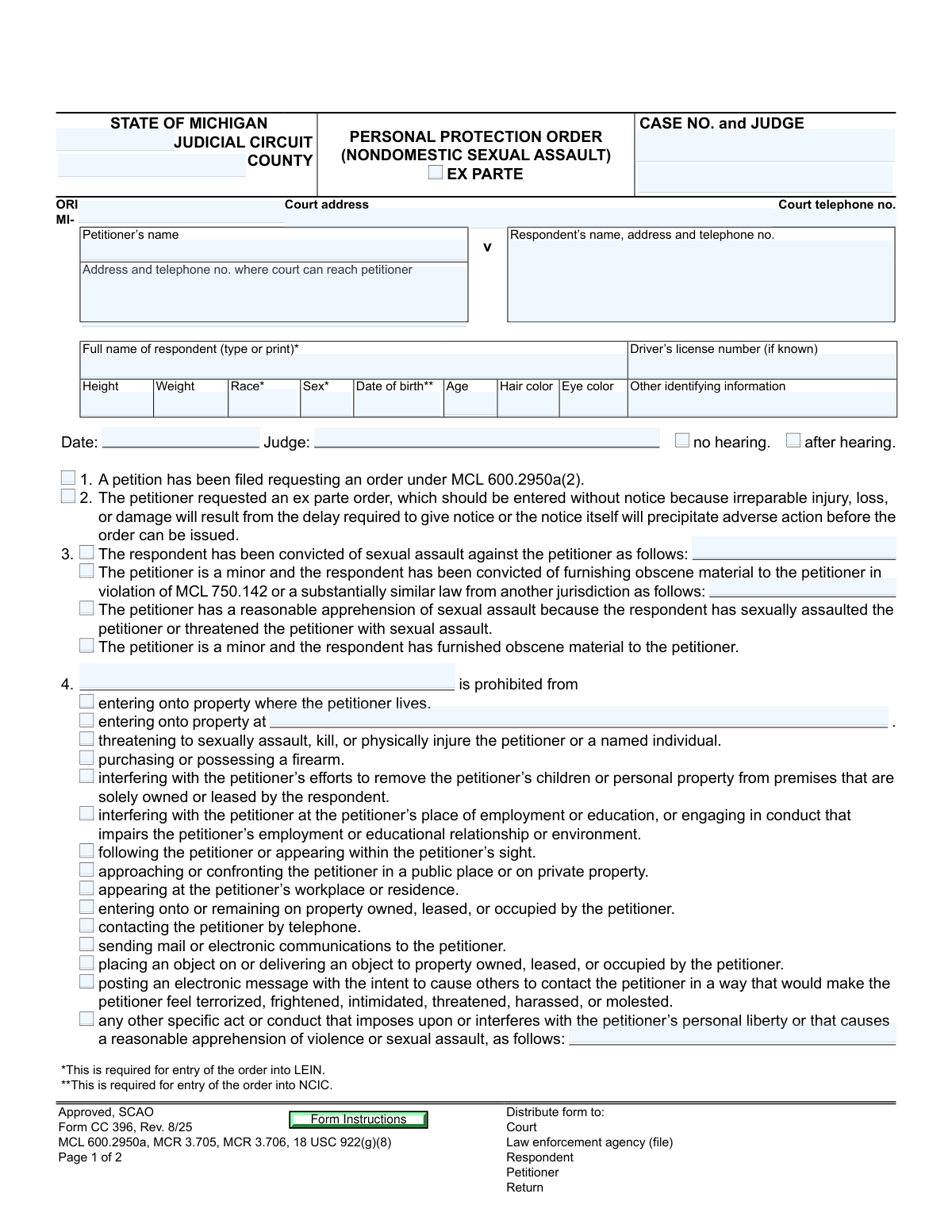
Yes! You can use AI to fill out Form CC 396, Personal Protection Order (Nondomestic Sexual Assault) Ex Parte

Form CC 396 is an official Michigan judicial form used to obtain a Personal Protection Order (PPO) in nondomestic sexual assault situations, authorized under MCL 600.2950a, MCR 3.705, MCR 3.706, and 18 USC 922(g)(8). It allows a petitioner to seek an ex parte order — meaning the court can issue the order without prior notice to the respondent — when there is a reasonable apprehension of sexual assault or a prior conviction for sexual assault. The order can prohibit the respondent from contacting, approaching, or threatening the petitioner, and violations can result in immediate arrest, up to 93 days imprisonment, and fines up to $500. Today, this form can be filled out quickly and accurately using AI-powered services like Instafill.ai, which can also convert non-fillable PDF versions into interactive fillable forms.
Our AI automatically handles information lookup, data retrieval, formatting, and form filling.
It takes less than a minute to fill out CC 396 using our AI form filling.
Securely upload your data. Information is encrypted in transit and deleted immediately after the form is filled out.

Form specifications

Form name: Form CC 396, Personal Protection Order (Nondomestic Sexual Assault) Ex Parte
Number of pages: 3
Language: English
Categories: restraining order forms, domestic violence forms
main-image

Instafill Demo: filling out a legal form in seconds

How to Fill Out CC 396 Online for Free in 2026

Are you looking to fill out a CC 396 form online quickly and accurately? Instafill.ai offers the #1 AI-powered PDF filling software of 2026, allowing you to complete your CC 396 form in just 37 seconds or less.
Follow these steps to fill out your CC 396 form online using Instafill.ai:
  1. 1 Navigate to Instafill.ai and upload or select Michigan Form CC 396 (Personal Protection Order – Nondomestic Sexual Assault) to begin filling it out online.
  2. 2 Enter the court and case information, including the judicial circuit, county, case number, judge's name, ORI code, court address, and telephone number.
  3. 3 Provide the petitioner's full legal name and contact information, as well as the respondent's full name, address, telephone number, and all required identifying details such as date of birth, height, weight, race, sex, hair color, and eye color.
  4. 4 Select the applicable grounds for the protection order in Paragraph 3, such as a prior sexual assault conviction, furnishing obscene material to a minor, or the petitioner's reasonable apprehension of sexual assault, and provide any required conviction details.
  5. 5 Check all applicable prohibited acts in Paragraph 4 that the respondent should be barred from, such as entering the petitioner's property, contacting the petitioner, possessing firearms, or any other specific conduct, and provide details where required.
  6. 6 Review and confirm the order's effective date and expiration date, the agency responsible for LEIN entry, and whether the order is being issued ex parte or after a hearing.
  7. 7 Complete the Proof of Service section with the process server's information, service method, date, time, place of service, and any applicable fees, then submit or print the completed form for filing with the court.

Our AI-powered system ensures each field is filled out correctly, reducing errors and saving you time.

Why Choose Instafill.ai for Your Fillable CC 396 Form?

Speed

Complete your CC 396 in as little as 37 seconds.

Up-to-Date

Always use the latest 2026 CC 396 form version.

Cost-effective

No need to hire expensive lawyers.

Accuracy

Our AI performs 10 compliance checks to ensure your form is error-free.

Security

Your personal information is protected with bank-level encryption.

Frequently Asked Questions About Form CC 396

Form CC 396 is a Michigan Personal Protection Order (Nondomestic Sexual Assault) form. It is used to request a court order protecting a petitioner from a respondent who has sexually assaulted them, threatened sexual assault, or engaged in related harmful conduct, in situations where the parties do not have a domestic relationship.

This form is filled out by the petitioner — the person seeking protection — or their legal representative. It is used when the petitioner wants to obtain a personal protection order against someone who has sexually assaulted them or threatened them with sexual assault, and the respondent is not a domestic partner or household member.

An ex parte order is a temporary protection order issued without notifying the respondent beforehand. You should request one if you believe that waiting to give notice would result in irreparable injury, loss, or damage, or if giving notice might cause the respondent to take adverse action against you before the order can be issued.

There are four qualifying grounds: (1) the respondent has been convicted of sexual assault against the petitioner, (2) the petitioner is a minor and the respondent was convicted of furnishing obscene material to them, (3) the petitioner has a reasonable apprehension of sexual assault due to the respondent's actions or threats, or (4) the petitioner is a minor and the respondent has furnished obscene material to them.

You must provide the respondent's full name, address, and telephone number. For law enforcement database entry purposes, you should also include their race, sex, date of birth, and as much additional identifying information as possible, such as height, weight, hair color, eye color, driver's license number, and any other distinguishing features like scars or tattoos.

The order can prohibit a wide range of behaviors, including entering the petitioner's property, threatening or physically injuring the petitioner, purchasing or possessing firearms, contacting the petitioner by phone or electronic communications, following or approaching the petitioner, appearing at their workplace or residence, interfering with their employment or education, and posting electronic messages intended to cause others to harass the petitioner.

The order is effective as soon as it is signed by a judge and remains in effect until the expiration date entered in item 6 of the form. To extend the order, a motion must be filed at least 3 days before the expiration date, or a new petition must be filed.

Violating the order subjects the respondent to immediate arrest and to civil and criminal contempt of court. If found guilty, the respondent can be imprisoned for up to 93 days and fined up to $500.00.

Yes. The order is enforceable anywhere in Michigan by any law enforcement agency once signed by a judge. Upon service, it may also be enforced by another state, an Indian tribe, or a U.S. territory. If the respondent violates the order outside Michigan, they are subject to the penalties of the jurisdiction where the violation occurred.

Yes. For an ex parte order, the respondent may file a motion to modify or terminate the order within 14 days after being served with or receiving actual notice of the order. Forms and instructions for doing so are available from the court clerk.

The process server must serve the protection order on the respondent either personally or by registered or certified mail with return receipt requested and delivery restricted to the respondent. The process server must then file proof of service with the court clerk. If service cannot be completed, the original and all copies must be returned to the court clerk.

LEIN stands for Law Enforcement Information Network, which is Michigan's statewide database used by law enforcement agencies. Once the order is signed, the court clerk files it with the designated agency to enter it into LEIN, making it accessible to law enforcement officers across the state so they can enforce the order.

Yes, AI-powered services like Instafill.ai can help you accurately auto-fill the fields on Form CC 396, saving you time and reducing errors. If you have a flat, non-fillable PDF version of the form, Instafill.ai can also convert it into an interactive fillable form so you can complete it digitally.

To fill out Form CC 396 online, visit Instafill.ai and upload the form PDF. The AI will guide you through each field — including petitioner and respondent information, grounds for the order, and prohibited conduct — and auto-fill the form based on your responses. Once complete, you can download and print the finished form for submission to the court.

The completed form should be submitted to the appropriate Michigan judicial circuit court in the county where you are filing. The form indicates it should be distributed to the court, a law enforcement agency (for filing), the respondent, and the petitioner, so you should prepare multiple copies accordingly. Check with your local court clerk for specific submission instructions.

Compliance CC 396
Validation Checks by Instafill.ai

1
Ensures Petitioner's Full Legal Name is Provided and Not Left Blank
This check verifies that the Petitioner's name field contains a complete legal name (first, middle if applicable, and last name) and is not empty or filled with placeholder text. The petitioner's identity is foundational to the protection order and must be unambiguous for law enforcement and court records. If this field is blank or incomplete, the order cannot be properly issued, served, or enforced.
2
Ensures Respondent's Full Legal Name is Provided in Both Name Fields
This check confirms that both the 'Respondent: name, address and telephone' field and the 'Full name of respondent (type or print)' field are populated with the respondent's complete legal name and that the two entries are consistent with each other. The respondent's full name is marked as required for LEIN entry and is critical for law enforcement identification. Inconsistencies or omissions between these two fields could result in the order being unenforceable or incorrectly entered into LEIN.
3
Validates Respondent's Date of Birth Format and Logical Consistency with Age
This check ensures the respondent's date of birth is entered in a valid date format (MM/DD/YYYY) and that the calculated age derived from the date of birth matches the separately entered Age field within a reasonable tolerance. The date of birth is flagged as required for NCIC entry, making accuracy essential for national law enforcement database records. A mismatch between the date of birth and the stated age, or an invalid date format, could cause the order to be rejected during NCIC entry or lead to misidentification of the respondent.
4
Ensures Race and Sex Fields Are Populated as Required for LEIN Entry
This check verifies that both the Race and Sex fields for the respondent are completed, as both are explicitly marked with an asterisk indicating they are required for entry of the order into LEIN. These fields must contain recognized, standardized values consistent with LEIN data entry requirements. If either field is left blank or contains an unrecognized value, the order cannot be entered into the Law Enforcement Information Network, rendering it unenforceable statewide.
5
Ensures At Least One Ground for Protection in Paragraph 3 is Selected
This check confirms that at least one of the four checkboxes in Paragraph 3 (sexual assault conviction, obscene material conviction involving a minor, reasonable apprehension of sexual assault, or furnishing obscene material to a minor) has been selected. Paragraph 3 establishes the legal basis for issuing the protection order under MCL 600.2950a, and without a stated ground the order lacks statutory justification. Failure to select at least one ground renders the order legally deficient and subject to dismissal.
6
Ensures Conviction Details Are Provided When a Conviction-Based Ground is Selected
This check verifies that when Paragraph 3.1 (respondent convicted of sexual assault) or Paragraph 3.2 (respondent convicted of furnishing obscene material to a minor) is selected, the corresponding conviction details field is also completed with specific information such as charge, court, and date. These detail fields are conditionally required and provide the evidentiary basis for the conviction-based grounds. Leaving the details blank when a conviction checkbox is selected creates an incomplete legal record and may cause the order to be challenged or invalidated.
7
Ensures Minor-Related Grounds Are Only Selected When Petitioner Is a Minor
This check validates that Paragraph 3.2 (petitioner is a minor and respondent convicted of furnishing obscene material) and Paragraph 3.4 (petitioner is a minor and respondent furnished obscene material) are only selected when the petitioner's age or date of birth indicates they are under 18 years of age. These grounds are legally applicable only to minors under MCL 750.142, and selecting them for an adult petitioner would constitute a legally invalid basis for the order. If a minor-specific ground is selected but the petitioner's age does not confirm minor status, a warning should be flagged for review.
8
Ensures At Least One Prohibited Act in Paragraph 4 is Selected
This check confirms that at least one of the prohibited act checkboxes in Paragraph 4 has been selected to define the specific restrictions imposed on the respondent. A protection order must specify what conduct is prohibited in order to be enforceable and to provide clear notice to the respondent of the restrictions. An order with no prohibited acts checked is legally meaningless and cannot be enforced by law enforcement or the courts.
9
Ensures Specific Property Address is Provided When 'Entering onto property at (specified location)' is Selected
This check verifies that when the checkbox for prohibiting the respondent from entering a specific property location is selected, the corresponding address or location description field is also completed. Without a specific address or description, law enforcement cannot determine the boundaries of the restriction or enforce it. If the checkbox is selected but the location field is left blank, the prohibition is unenforceable and the order is incomplete.
10
Ensures 'Other Prohibited Acts' Description is Provided When That Checkbox is Selected
This check confirms that when the 'Any other specific act or conduct that imposes on petitioner's liberty or causes apprehension' checkbox is selected, the corresponding description field ('Paragraph 4 - Other prohibited acts (details)') is also filled in with a clear description of the prohibited behavior. A vague or blank description for a catch-all prohibition fails to give the respondent adequate notice and may be unenforceable. If the checkbox is checked but the details field is empty, the form should be flagged as incomplete.
11
Validates the Order Expiration Date is a Future Date and Properly Formatted
This check ensures that the 'Order Effective Until' expiration date in Paragraph 6 is entered in a valid date format (MM/DD/YYYY) and represents a date in the future relative to the order's signing date. A protection order without a valid future expiration date creates ambiguity about its duration and may complicate enforcement or extension proceedings. If the expiration date is missing, improperly formatted, or set to a past date, the order's enforceability and LEIN/NCIC entry may be compromised.
12
Ensures the LEIN Filing Agency is Identified in Paragraph 7
This check verifies that the 'Agency or Office to File With (LEIN entry)' field in Paragraph 7 is completed with the name of the agency or office responsible for entering the order into the Law Enforcement Information Network. LEIN entry is mandatory for statewide enforceability of the protection order, and without identifying the responsible agency the clerk has no direction for filing. A blank field here creates an administrative gap that could delay or prevent the order from being entered into LEIN.
13
Ensures the Hearing Selection Checkbox (No Hearing vs. After Hearing) is Completed and Not Contradictory
This check confirms that exactly one of the two hearing selection checkboxes — 'No hearing' or 'After hearing' — is selected, and that the selection is logically consistent with whether the Ex Parte checkbox is also checked. If the Ex Parte box is checked, the 'No hearing' option should be selected, as ex parte orders are issued without the respondent present. Selecting both checkboxes simultaneously or selecting 'After hearing' alongside the Ex Parte designation creates a logical contradiction that must be resolved before the order is issued.
14
Validates Court Telephone Number Format
This check ensures that the Court Telephone Number field contains a properly formatted U.S. phone number, including a 10-digit number with area code (e.g., (XXX) XXX-XXXX or XXX-XXX-XXXX). An incorrectly formatted or incomplete phone number prevents parties, law enforcement, and process servers from contacting the court for clarification or follow-up. If the field is blank or contains fewer than 10 digits, the form should be flagged for correction.
15
Ensures ORI Code Follows the Required State Prefix Format
This check verifies that the ORI (Originating Agency Identifier) field begins with the state prefix 'MI-' as indicated on the form, followed by additional alphanumeric characters consistent with a valid Michigan ORI code. The ORI is used to identify the originating jurisdiction for LEIN and NCIC purposes, and an incorrectly formatted ORI will cause errors during database entry. If the ORI field is blank or does not begin with 'MI-', the form should be flagged before submission to the law enforcement agency.
16
Ensures Proof of Service Fields Are Complete When Service is Indicated
This check verifies that when the 'I served' checkbox is selected on the Proof of Service section, the required fields — Respondent's name, Date and time of service, Place or address of service, and the server's Name and Signature — are all completed. Incomplete proof of service documentation prevents the court from confirming that the respondent received proper notice of the order, which is required for the order to be enforceable against the respondent. If any of these fields are blank while the 'I served' box is checked, the proof of service is legally deficient.

Common Mistakes in Completing CC 396

Omitting required LEIN fields: Race, Sex, and Date of Birth

Petitioners frequently leave the respondent's Race, Sex, and/or Date of Birth blank, not realizing these fields are legally required for entry into the Law Enforcement Information Network (LEIN) and NCIC. Without this information, law enforcement cannot properly identify the respondent, which can delay or prevent enforcement of the order. The form explicitly marks Race and Sex with an asterisk (*) as required for LEIN entry and Date of Birth with a double asterisk (**) as required for NCIC entry. Always provide all asterisked fields, even if you must estimate or note the information as approximate. AI-powered tools like Instafill.ai can flag these required fields and prompt you to complete them before submission.

Failing to select the correct hearing status (no hearing vs. after hearing)

Many petitioners forget to check either the 'no hearing' or 'after hearing' box, or they check the wrong one, which creates confusion about how the court should proceed. For an ex parte order, 'no hearing' is typically the appropriate selection, while 'after hearing' applies when a hearing has already taken place. Leaving both unchecked can cause the clerk to return the form for correction, delaying issuance of the order. Carefully read both options and select only the one that matches the procedural posture of your case.

Not checking Paragraph 1 and Paragraph 2 boxes for ex parte requests

When seeking an ex parte order, petitioners must check both the Paragraph 1 box (confirming a petition has been filed under MCL 600.2950a(2)) and the Paragraph 2 box (confirming the basis for entering the order without notice). Petitioners often check only one or neither, which leaves the legal basis for the ex parte order incomplete. An incomplete legal basis can result in the judge declining to sign the order. Review both paragraphs carefully and check all applicable boxes that reflect the facts of your situation.

Providing vague or incomplete conviction details in Paragraph 3

When checking Paragraph 3.1 (sexual assault conviction) or Paragraph 3.2 (furnishing obscene material to a minor), petitioners often leave the accompanying detail lines blank or write only a general description like 'sexual assault.' The court needs specific information such as the charge, court name, case number, and conviction date to verify the legal basis for the order. Incomplete details can cause the judge to request additional documentation or deny the order. Always include the full charge name, the court where the conviction occurred, the case number, and the date of conviction.

Selecting an insufficient or overly narrow set of prohibited acts in Paragraph 4

Petitioners frequently check only one or two prohibited acts in Paragraph 4 when their situation warrants broader protections, or they check acts that do not match the specific threat they face. For example, someone being harassed electronically should also check 'sending mail or electronic communications' and 'posting an electronic message,' not just 'contacting the petitioner by telephone.' Failing to select all relevant prohibitions leaves gaps in the order that the respondent may exploit. Carefully review every listed prohibition and check all that apply to your circumstances.

Leaving the specific property address blank when checking the location-based prohibition

When petitioners check the box prohibiting the respondent from 'entering onto property at [specified location],' they often forget to fill in the actual address on the accompanying line. Without a specific address, the prohibition is unenforceable because law enforcement cannot determine which property is covered. This mistake often happens because petitioners assume the general prohibition covers all relevant locations. Always write the complete street address, including unit number if applicable, whenever you select a location-specific restriction.

Failing to enter the order's expiration date in Item 6

Item 6 requires the petitioner or court to specify the date until which the protection order remains in effect, but this field is frequently left blank. Without an expiration date, the order's enforceability is ambiguous, and it may not be properly entered into LEIN or NCIC. Law enforcement agencies rely on this date to determine whether an order is still active. Confirm with the court clerk what expiration date should be entered, and ensure it is filled in before the order is signed. Tools like Instafill.ai can remind users to complete date fields before finalizing the form.

Omitting or incorrectly entering the ORI (Originating Agency Identifier)

The ORI field, which must begin with the state prefix (e.g., 'MI-'), is often left blank or filled in with an incorrect code. The ORI is essential for routing the order into the correct law enforcement database and ensuring it is enforceable statewide. Petitioners unfamiliar with this field may not know where to find the correct ORI code, leading them to skip it entirely. Contact the court clerk or the local law enforcement agency to obtain the correct ORI code for your jurisdiction before submitting the form.

Using a nickname or informal name instead of the respondent's full legal name

Petitioners sometimes enter a nickname, maiden name, or partial name for the respondent rather than their full legal name (first, middle, and last). The form explicitly instructs that the full name must be typed or printed, as it is required for LEIN entry and accurate identification. Using an informal name can prevent the order from being properly matched to the respondent in law enforcement databases, undermining enforcement. Always use the respondent's complete legal name as it appears on government-issued identification.

Providing an incomplete or inaccessible contact address for the petitioner

Petitioners sometimes list a P.O. box, an old address, or no address at all in the field for where the court can reach them, making it impossible for the court to send notices or updates about the case. In sensitive cases, petitioners may also inadvertently list their home address when they wish to keep it confidential, potentially exposing their location to the respondent. Use a safe, reliable address where you can receive mail—such as a trusted friend's address, a legal aid office, or a P.O. box—and ensure the telephone number provided is current and monitored.

Incorrectly completing or skipping the Proof of Service section

The Proof of Service section at the end of the form is often left entirely blank or filled out incorrectly by the process server, including missing the date and time of service, the place of service, or the server's signature. Without a properly completed Proof of Service, the court cannot confirm that the respondent was served, which affects the enforceability of the order and the respondent's ability to file a motion to modify within the 14-day window. The process server must complete all required fields, sign the certificate, and return the form to the court clerk promptly after service.

Failing to identify the agency responsible for LEIN entry in Item 7

Item 7 requires the petitioner or court to specify the agency or office with whom the court clerk will file the order for LEIN entry, but this field is frequently left blank. Without this information, the order may not be entered into LEIN in a timely manner, leaving law enforcement unaware of the active order and unable to enforce it. Petitioners may not know which agency to list, but the court clerk can provide this information. Always confirm the correct agency name with the clerk and ensure it is entered before the order is finalized. AI-powered form tools like Instafill.ai can help ensure no required fields are overlooked.
Saved over 80 hours a year

“I was never sure if my IRS forms like W-9 were filled correctly. Now, I can complete the forms accurately without any external help.”

Kevin Martin Green

Your data stays secure with advanced protection from Instafill and our subprocessors

Robust compliance program

Transparent business model

You’re not the product. You always know where your data is and what it is processed for.

ISO 27001, HIPAA, and GDPR

Our subprocesses adhere to multiple compliance standards, including but not limited to ISO 27001, HIPAA, and GDPR.

Security & privacy by design

We consider security and privacy from the initial design phase of any new service or functionality. It’s not an afterthought, it’s built-in, including support for two-factor authentication (2FA) to further protect your account.

Fill out CC 396 with Instafill.ai

Worried about filling PDFs wrong? Instafill securely fills form-cc-396-personal-protection-order-nondomestic-sexual-assault-ex-parte forms, ensuring each field is accurate.