Fill out personal protection order forms
with AI.
Personal protection order (PPO) forms are legal documents used to request court-ordered protection from harassment, threats, stalking, or assault. In Michigan, these forms are part of the official court system and carry serious legal weight — violations can result in arrest, fines, and imprisonment. Whether you're seeking protection from a stranger, an acquaintance, or someone who has committed sexual assault, the right forms must be completed accurately and filed correctly for the court to act.
By continuing, you acknowledge Instafill's Privacy Policy and agree to get occasional product update and promotional emails.
About personal protection order forms
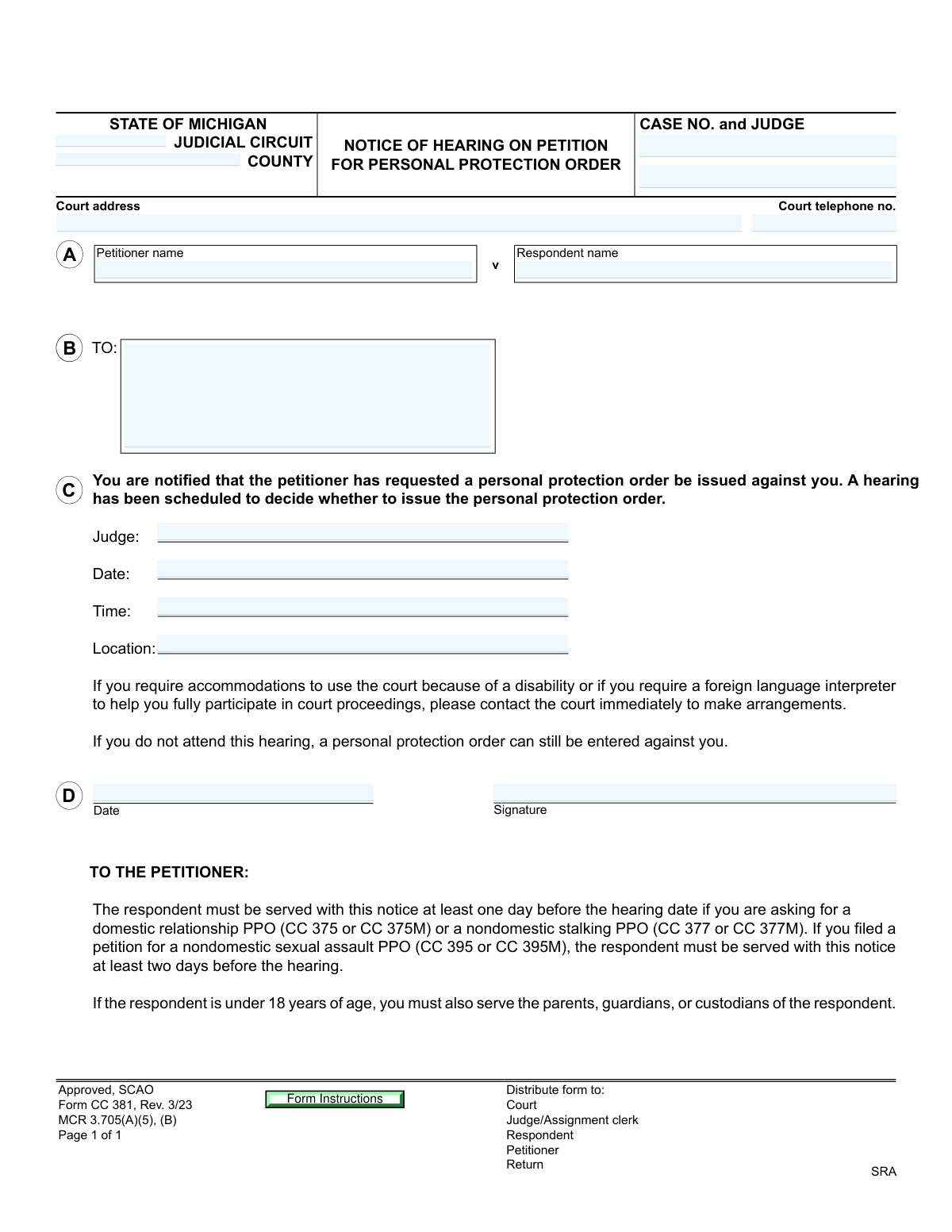
These forms are typically needed by individuals who feel unsafe and are seeking legal protection through the court system. For example, Form CC 396 allows a petitioner to request an emergency ex parte order in nondomestic sexual assault situations, meaning a judge can grant protection without the respondent being present. Form CC 381, on the other hand, is used when a hearing is scheduled, formally notifying the respondent and documenting proof of service. Both forms are governed by specific Michigan court rules and must be filled out precisely to ensure due process is upheld.
Because errors or omissions can delay or jeopardize a protection order, accuracy is critical when completing these documents. Tools like Instafill.ai use AI to fill these forms in under 30 seconds, helping petitioners and legal professionals handle the paperwork quickly, accurately, and securely.
Every form on this page can be completed without typing. Instafill is form filling software that reads a PDF and fills it for you — including flat and scanned documents that carry no fillable fields at all.
Forms in This Category
The forms in this category have a median Form Complexity Index of 49/100 (Moderate), measured across 2 forms by field count, input difficulty, length, conditional logic and structure. See how it is calculated.
| Form Name | Pages | FCI | |
|---|---|---|---|
| 1. | Form CC 381, Notice of Hearing on Petition for Personal Protection Order | 3 | Moderate 49 |
| 2. | Form CC 396, Personal Protection Order (Nondomestic Sexual Assault) Ex Parte | 3 | Moderate 46 |
- Enterprise-grade security & data encryption
- 99%+ accuracy powered by AI
- 1,000+ forms from all industries
- Complete forms in under 60 seconds
How to Choose the Right Form
These two Michigan court forms serve different stages of the personal protection order process. Here's how to determine which one you need:
Seeking Protection from Sexual Assault
If you are a petitioner trying to obtain a Personal Protection Order against someone who has sexually assaulted you or poses a credible threat of sexual assault — and the respondent is not a domestic partner or household member — start with:
- Form CC 396, Personal Protection Order (Nondomestic Sexual Assault) Ex Parte — This is the primary form to file when requesting a PPO. Because it is an *ex parte* order, the court can grant it without notifying the respondent first, making it appropriate in urgent situations. It can prohibit the respondent from contacting, approaching, or threatening you, and violations carry serious legal consequences.
Scheduling or Responding to a PPO Hearing
If the court has not granted an ex parte order and instead scheduled a hearing, or if you need to formally notify the respondent that a hearing is taking place, you will need:
- Form CC 381, Notice of Hearing on Petition for Personal Protection Order — This form is used to notify the respondent of the scheduled court hearing and to document proof of service. It is a procedural form, not a request for protection itself, and is typically completed after the initial petition has been filed.
Quick Decision Summary
- Filing for protection? → Use Form CC 396
- Notifying a respondent of a hearing or documenting service? → Use Form CC 381
In many cases, you may need both forms — CC 396 to request the order and CC 381 if the court schedules a hearing rather than granting the order immediately. If you're unsure, consult your local Michigan circuit court clerk for guidance.
Form Comparison
| Form | Purpose | Who Files It | When to Use |
|---|---|---|---|
| Form CC 396, Personal Protection Order (Nondomestic Sexual Assault) Ex Parte | Obtain a court order prohibiting respondent from contact or threats | Petitioner seeking protection from sexual assault | When petitioner fears sexual assault and needs immediate protection |
| Form CC 381, Notice of Hearing on Petition for Personal Protection Order | Notify respondent of scheduled PPO hearing and document service | Court or petitioner's attorney serving the respondent | After PPO petition filed, when hearing is scheduled for respondent notice |
Tips for personal protection order forms
Michigan has different Personal Protection Order forms depending on the nature of the relationship and type of threat involved. Form CC 396 is specifically for nondomestic sexual assault situations, so make sure you're selecting the correct form before you begin — using the wrong form can delay your case or result in a dismissal.
When describing the incidents or threats that led you to seek a PPO, include dates, locations, and specific behaviors whenever possible. Vague or general statements are less persuasive to a judge — concrete details help establish the reasonable apprehension required for the court to grant an ex parte order without prior notice to the respondent.
Form CC 381 includes proof of service sections that must be completed accurately to confirm the respondent was properly notified of the hearing. Incomplete or missing service documentation can jeopardize due process requirements and potentially delay or invalidate your PPO proceedings.
Timing is critical in PPO cases — the notice of hearing must be served on the respondent before the scheduled court date to satisfy due process rules under MCR 3.705 and MCR 2.105. Check with your local Michigan court clerk for specific deadlines and accepted methods of service in your jurisdiction.
AI-powered tools like Instafill.ai can complete Michigan PPO forms like CC 396 and CC 381 in under 30 seconds with high accuracy, reducing the risk of errors that could slow down your case. Your data stays secure throughout the process, making it a practical and safe time-saver — especially if you're managing multiple court forms at once.
Once your PPO forms are filed, make sure to retain certified copies for your personal records and keep one accessible at all times. If a violation occurs, having immediate access to your order is essential for law enforcement to take action quickly.
A Personal Protection Order can prohibit a respondent from contacting, approaching, or threatening you, and violations can result in immediate arrest. However, a PPO is a civil order — understanding its scope and limitations will help you take the right additional safety steps, such as notifying local law enforcement of the order.
PPO forms involve legal terminology and procedural requirements that can be confusing for first-time filers. Many Michigan counties offer free legal aid services, courthouse self-help centers, or victim advocacy programs that can guide you through the process without the cost of hiring a private attorney.
Frequently Asked Questions
Personal protection order (PPO) forms are official court documents used to request legal protection from harassment, threats, stalking, or assault. In Michigan, these forms allow a petitioner to ask a court to prohibit a respondent from making contact, approaching, or threatening them. The forms in this category are specifically used in nondomestic sexual assault situations.
Form CC 396 is the actual petition used to request a Personal Protection Order in a nondomestic sexual assault case, and it can be issued ex parte — meaning without the respondent being present or notified in advance. Form CC 381, on the other hand, is used when a hearing is scheduled to decide whether a PPO will be issued, formally notifying the respondent of that hearing. Together, these forms cover different stages of the PPO process.
Any individual who has a reasonable apprehension of sexual assault, or where the respondent has a prior conviction for sexual assault, may be eligible to petition for a nondomestic PPO in Michigan using Form CC 396. The petitioner and respondent do not need to have a domestic or familial relationship for this type of order. It is advisable to consult with an attorney or a court clerk to confirm eligibility before filing.
An ex parte order is one that a court can issue without prior notice to or participation from the respondent. In PPO cases, this allows the court to grant immediate protection to a petitioner when waiting for a full hearing could put them at risk. Form CC 396 is designed specifically for requesting this type of expedited, ex parte relief.
Form CC 381 is required when a court schedules a hearing to decide whether a Personal Protection Order should be issued, rather than granting an ex parte order immediately. It serves as the official notice to the respondent that a hearing has been set, and it must be properly served on the respondent in accordance with Michigan court rules. Accurate completion and timely service of this form are essential to ensure due process.
Personal protection order forms in Michigan are filed with the circuit court in the county where the petitioner resides or where the respondent resides. Court clerks at the circuit court can guide you on local filing procedures and any associated fees. Some Michigan courts also offer self-help centers or resources for individuals filing without an attorney.
Once a PPO is issued, the respondent must be formally served with the order before it can be enforced. Violating a PPO in Michigan can result in immediate arrest, up to 93 days in jail, and fines up to $500. The petitioner should keep a copy of the order accessible and contact law enforcement immediately if the order is violated.
Yes, AI-powered tools like Instafill.ai can fill out Michigan personal protection order forms such as CC 396 and CC 381 in under 30 seconds by accurately extracting and placing your information from source documents. These tools can also convert non-fillable PDF versions of court forms into interactive, fillable formats. This can save time and reduce errors when preparing your paperwork before filing with the court.
Using AI-powered services like Instafill.ai, these forms can typically be completed in under 30 seconds, as the AI extracts and accurately places relevant data from your source documents. Filling them out manually may take longer depending on your familiarity with legal terminology and the details required. Either way, it is important to review all completed forms carefully before submitting them to the court.
You are not required to have an attorney to file a personal protection order in Michigan, and many petitioners file on their own. However, consulting with a family law attorney can be helpful, especially if your situation is complex or if the respondent is likely to contest the order at a hearing. Many Michigan courts also have self-help resources available for individuals navigating the PPO process without legal representation.
Michigan judicial forms like CC 396 and CC 381 are official state court forms and are generally available at no cost through the Michigan courts website or your local circuit court clerk's office. While the forms themselves are free, there may be court filing fees associated with submitting a PPO petition, which can vary by county. Some petitioners may qualify for fee waivers based on financial need.
Glossary
- Form Complexity Index
- Instafill’s 0–100 measure of how much effort a form takes to complete, calculated deterministically from the form’s own structure rather than estimated. It combines the number of fillable fields (the largest factor), how difficult those fields are to complete based on their type, the number of pages that contain fields, the amount of conditional “fill-only-if” logic, and how many sections the form is divided into, then adds modifiers for tables and repeating lists, bundled instruction pages, and dense page layouts. A higher score means the form is harder to fill out by hand. The forms in this category have a median Form Complexity Index of 49/100 (Moderate). See exactly how it is calculated.
- Personal Protection Order (PPO)
- A court order that legally prohibits a person (the respondent) from contacting, approaching, or threatening another person (the petitioner). Violations of a PPO can result in immediate arrest and criminal penalties.
- Ex Parte Order
- A court order issued without prior notice to or participation from the other party (the respondent). Courts grant ex parte PPOs when immediate protection is needed and notifying the respondent in advance could put the petitioner at risk.
- Petitioner
- The person who files a request (petition) asking the court to issue a Personal Protection Order for their protection.
- Respondent
- The person against whom a Personal Protection Order is requested or issued. The respondent is the individual whose behavior or contact the order seeks to restrict.
- Nondomestic PPO
- A Personal Protection Order involving parties who do not share a domestic relationship (such as a spouse, former spouse, or household member). A nondomestic sexual assault PPO applies when the respondent has committed or there is reasonable apprehension of sexual assault.
- Proof of Service
- A section of a court form used to document how, when, and by whom legal documents were officially delivered to the respondent. Proper proof of service is required to confirm the respondent received notice of the PPO proceedings.
- SCAO
- State Court Administrative Office — the Michigan agency that approves and standardizes official court forms used across the state, including PPO forms.
- MCL (Michigan Compiled Laws)
- The official collection of Michigan state statutes. References like 'MCL 600.2950a' on PPO forms indicate the specific law that authorizes or governs the form's use.
- MCR (Michigan Court Rules)
- The procedural rules that govern how cases are handled in Michigan courts. MCR citations on PPO forms specify the exact procedures that must be followed when filing, serving, or hearing a PPO petition.
- Due Process
- A constitutional requirement that all parties in a legal proceeding receive fair notice and an opportunity to be heard. In PPO cases, this means the respondent must be properly notified of any hearing before a final order is issued.