Fill out CC forms
with AI.
CC forms are official Michigan court documents used in civil case proceedings, covering a range of legal matters from family law to personal protection. Among the most critical in this category are forms related to personal protection orders (PPOs) — legal tools that courts can issue to protect individuals from harassment, threats, stalking, or assault. These forms carry real legal weight: once granted, violations can lead to immediate arrest and criminal penalties, making accuracy and completeness in filling them out especially important.
By continuing, you acknowledge Instafill's Privacy Policy and agree to get occasional product update and promotional emails.
About CC forms
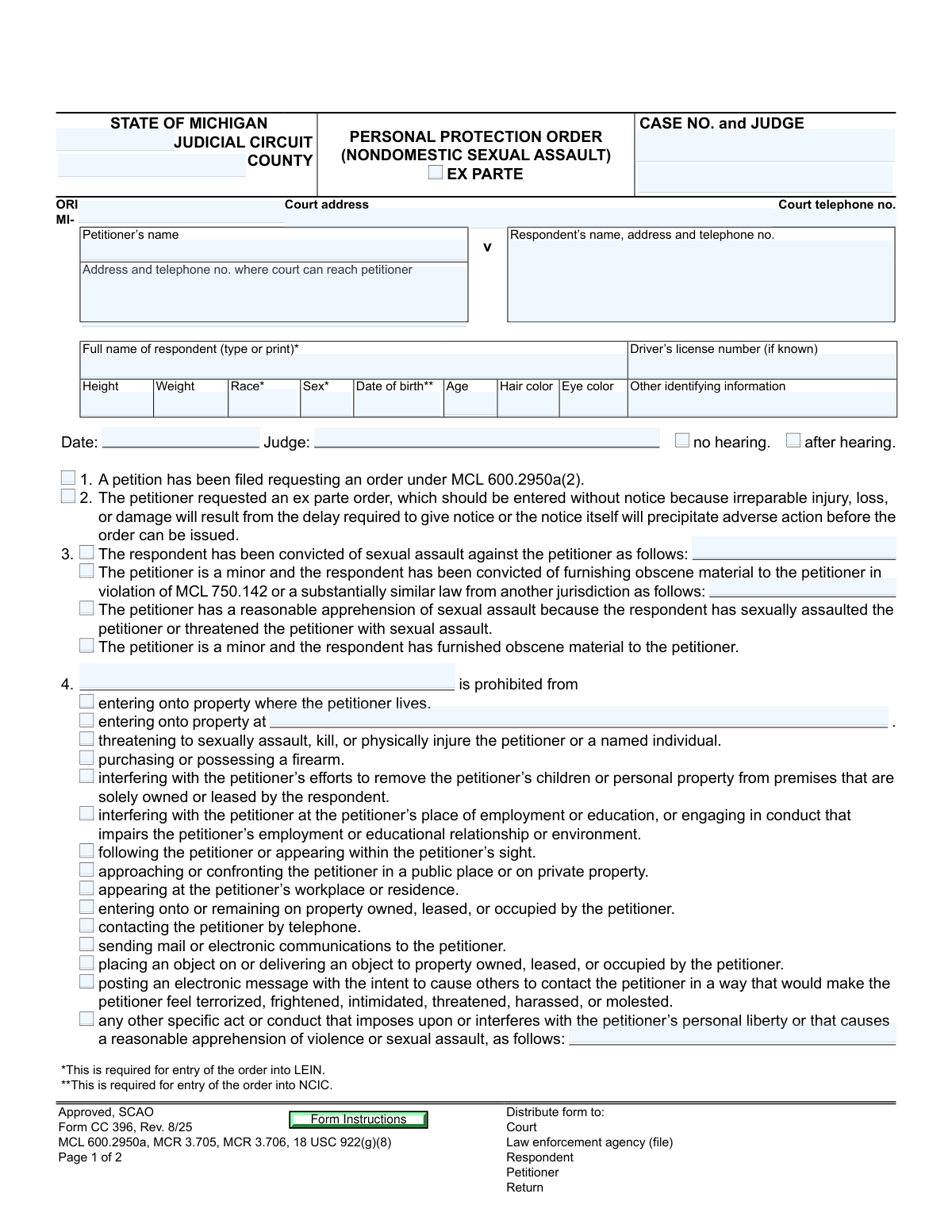
People who need CC forms are often navigating difficult and urgent circumstances. Survivors of sexual assault, individuals facing harassment, or those seeking protection from someone outside their household may need to file a form like CC 396, which requests an ex parte Personal Protection Order in nondomestic sexual assault situations. Because ex parte orders can be issued without notifying the respondent in advance, the petition itself must clearly and correctly present the facts — leaving little room for errors or omissions on the form.
Filling out these forms correctly under stressful conditions can be challenging, especially when dealing with legal terminology or non-fillable PDF versions. Tools like Instafill.ai use AI to help complete these forms accurately in under 30 seconds, making it easier for petitioners to focus on their situation rather than paperwork logistics.
Every form on this page can be completed without typing. Instafill is form filling software that reads a PDF and fills it for you — including flat and scanned documents that carry no fillable fields at all.
Forms in This Category
The forms in this category have a median Form Complexity Index of 46/100 (Moderate), measured across 1 forms by field count, input difficulty, length, conditional logic and structure. See how it is calculated.
| Form Name | Pages | FCI | |
|---|---|---|---|
| 1. | Form CC 396, Personal Protection Order (Nondomestic Sexual Assault) Ex Parte | 3 | Moderate 46 |
- Enterprise-grade security & data encryption
- 99%+ accuracy powered by AI
- 1,000+ forms from all industries
- Complete forms in under 60 seconds
How to Choose the Right Form
If you've landed on this page, you're likely looking for a Michigan court form related to personal protection or restraining orders. Here's what you need to know to confirm you have the right form.
Who Should Use Form CC 396
Form CC 396, Personal Protection Order (Nondomestic Sexual Assault) Ex Parte is specifically designed for situations involving sexual assault outside of a domestic relationship. This means the respondent is not a current or former spouse, dating partner, or household member — but rather someone such as a neighbor, coworker, acquaintance, or stranger.
This form is the right choice if:
- You have experienced or have a reasonable fear of sexual assault by someone you do not share a domestic relationship with
- The respondent has a prior conviction for sexual assault
- You need the court to act immediately and without notifying the respondent (ex parte relief)
- You want to legally prohibit the respondent from contacting, approaching, or threatening you
When You May Need a Different Form
CC 396 is not the right form if:
- The person you need protection from is a spouse, former spouse, dating partner, or someone you share a child with — in that case, look for a domestic PPO form such as CC 375
- You are seeking protection from stalking or harassment unrelated to sexual assault — a different PPO form may apply
Quick Tip
Because this is a legal court document, accuracy matters. Using an AI-powered tool like Instafill.ai can help you complete Form CC 396 correctly and convert non-fillable PDF versions into an interactive format — reducing errors before you file with the court.
If you're unsure which form applies to your situation, consult a Michigan legal aid organization or family law attorney before filing.
Form Comparison
| Form | Purpose | Who Files It | When to Use |
|---|---|---|---|
| Form CC 396, Personal Protection Order (Nondomestic Sexual Assault) Ex Parte | Obtain court order prohibiting nondomestic sexual assault contact | Petitioner (victim) seeking protection from sexual assault | When fearing sexual assault from non-household member, no prior notice needed |
Tips for CC forms
An ex parte order means the court can grant your request without notifying the respondent first. This is designed to protect you quickly, but you must provide enough factual detail in your petition to justify why immediate action is necessary without the other party present.
When describing the conduct that led to your petition, include specific dates, locations, and descriptions of what occurred. Vague statements like 'they harassed me' are less effective than detailed accounts — courts need concrete facts to issue and uphold a Personal Protection Order.
Form CC 396 allows you to request specific prohibitions, such as restricting contact, proximity, or communication. Review each available restriction carefully and check all that apply to your situation — omitting a relevant protection could leave gaps in your safety plan.
Errors in the respondent's name, address, or identifying information can delay processing or make the order harder to enforce. Before submitting, verify all personal details are accurate and match official records — even a misspelled name can cause complications.
AI-powered tools like Instafill.ai can complete Form CC 396 in under 30 seconds with high accuracy, reducing the risk of errors that could slow down your case. Your data stays secure throughout the process, making it a practical time-saver when speed and accuracy both matter.
Always keep at least two copies of your completed form — one for your personal records and one to carry with you if the order is granted. A copy of an active PPO can be critical in an emergency if law enforcement needs to verify the order exists.
CC 396 must be filed with the appropriate Michigan circuit court, typically in the county where you live or where the respondent lives. Contact your local court clerk's office in advance to confirm filing procedures, fees (if any), and whether same-day processing is available for ex parte requests.
Once submitted, a judge will review your petition — often the same day for ex parte requests — and may grant, deny, or request more information. If granted, the order must be served on the respondent before it becomes enforceable, so ask the court about the service process right away.
Frequently Asked Questions
CC forms are official Michigan court forms used in civil and criminal proceedings across the state's circuit courts. In this category, the CC forms relate to Personal Protection Orders (PPOs), which are legal tools used to protect individuals from harassment, stalking, or assault. These forms are standardized by the Michigan Supreme Court and are required when petitioning for court-ordered protection.
A Personal Protection Order is a court-issued order that legally prohibits a respondent from contacting, approaching, or threatening the petitioner. Anyone who has experienced or reasonably fears sexual assault, stalking, or harassment may petition for a PPO. In Michigan, there are different types of PPOs depending on the relationship between the petitioner and respondent and the nature of the threat.
A domestic PPO applies when the petitioner and respondent share or have shared a domestic relationship, such as spouses, former partners, or household members. A nondomestic PPO — like Form CC 396 — covers situations involving individuals who do not share such a relationship, including cases of nondomestic sexual assault. Choosing the correct form is important, as the legal basis and protections offered may differ.
An ex parte order is one that the court can issue without notifying or hearing from the respondent beforehand. This is designed for urgent situations where waiting for a full hearing could put the petitioner at risk. The respondent is typically notified after the order is issued and may request a hearing to contest it.
Form CC 396 should be filed at the circuit court in the county where you reside or where the respondent resides. Michigan has circuit courts in each county, and court clerks can assist with the filing process. Some counties also offer self-help centers or domestic violence advocates who can guide petitioners through the process.
After filing, a judge reviews the petition and decides whether to grant the ex parte order, typically on the same day or within a short period. If granted, the order is served on the respondent, and the petitioner receives a copy. The respondent then has the right to request a hearing to contest the order, at which point both parties can present their case.
A nondomestic sexual assault PPO can prohibit the respondent from contacting, calling, messaging, approaching, or threatening the petitioner. Violations of the order can result in immediate arrest, criminal charges, jail time, and fines. The order may also affect the respondent's ability to possess firearms under federal law.
You are not legally required to have an attorney to file a PPO in Michigan, and many petitioners complete the process on their own. However, consulting with a legal aid organization or domestic violence advocate can be helpful, especially if your situation is complex. Michigan courts and nonprofits often provide free resources to help individuals navigate the PPO process.
Yes, AI-powered tools like Instafill.ai can fill out Michigan CC forms such as the CC 396 in under 30 seconds by accurately extracting and placing your information from source documents. This can reduce errors and save time, particularly for forms with multiple fields and legal references. Instafill.ai can also convert non-fillable PDF versions of these forms into interactive, fillable formats.
Filling out the CC 396 form manually can take 20–40 minutes depending on your familiarity with legal terminology and the details of your situation. Using an AI-assisted service like Instafill.ai, the form can be completed in under 30 seconds by automatically populating fields from your provided information. Reviewing the completed form for accuracy before filing is always recommended.
The CC 396 form is an official Michigan judicial form, but it may be distributed as a non-fillable PDF in some cases. Services like Instafill.ai can convert non-fillable versions into interactive fillable forms, making it easier to complete digitally. Always ensure you are using the most current version of the form, as Michigan courts may update forms periodically.
Before completing a PPO form, you should gather basic identifying information about yourself and the respondent, including full names, addresses, and dates of birth if known. You will also need to describe the incidents or threats that form the basis of your petition, including dates, locations, and any relevant evidence. Having this information organized in advance will make the filing process faster and more accurate.
Glossary
- Form Complexity Index
- Instafill’s 0–100 measure of how much effort a form takes to complete, calculated deterministically from the form’s own structure rather than estimated. It combines the number of fillable fields (the largest factor), how difficult those fields are to complete based on their type, the number of pages that contain fields, the amount of conditional “fill-only-if” logic, and how many sections the form is divided into, then adds modifiers for tables and repeating lists, bundled instruction pages, and dense page layouts. A higher score means the form is harder to fill out by hand. The forms in this category have a median Form Complexity Index of 46/100 (Moderate). See exactly how it is calculated.
- Personal Protection Order (PPO)
- A court order that legally prohibits a specific person from contacting, approaching, or threatening you. In Michigan, PPOs are civil orders enforced by law enforcement and violations can result in immediate arrest.
- Ex Parte
- A legal term meaning the court can issue an order based only on the petitioner's request, without notifying or hearing from the respondent first. This is used in urgent situations where immediate protection is needed.
- Nondomestic Sexual Assault PPO
- A type of Personal Protection Order specifically for situations involving sexual assault by someone who is not a current or former spouse, dating partner, or household member. It is governed by MCL 600.2950a in Michigan.
- Petitioner
- The person who files the court form and is requesting the Personal Protection Order for their own protection.
- Respondent
- The person named in the PPO petition — the individual whose behavior the petitioner is seeking protection from.
- MCL (Michigan Compiled Laws)
- The official collection of all Michigan state statutes. References like 'MCL 600.2950a' on court forms indicate the specific law authorizing or governing the form's use.
- MCR (Michigan Court Rules)
- The procedural rules that govern how cases are handled in Michigan courts. MCR citations on forms (e.g., MCR 3.705) specify the court procedures that apply to the PPO process.
- 18 USC 922(g)(8)
- A federal law that prohibits a person subject to a qualifying domestic or personal protection order from possessing firearms or ammunition. Its citation on PPO forms signals that the order may trigger a federal gun prohibition.
- Reasonable Apprehension
- A legal standard meaning the petitioner has a genuine, reasonable fear that sexual assault will occur. Courts use this standard to decide whether to grant an ex parte PPO without a full hearing.