Yes! You can use AI to fill out Form F11489, Request for Recurring Required Minimum Distributions From Your Retirement Investments
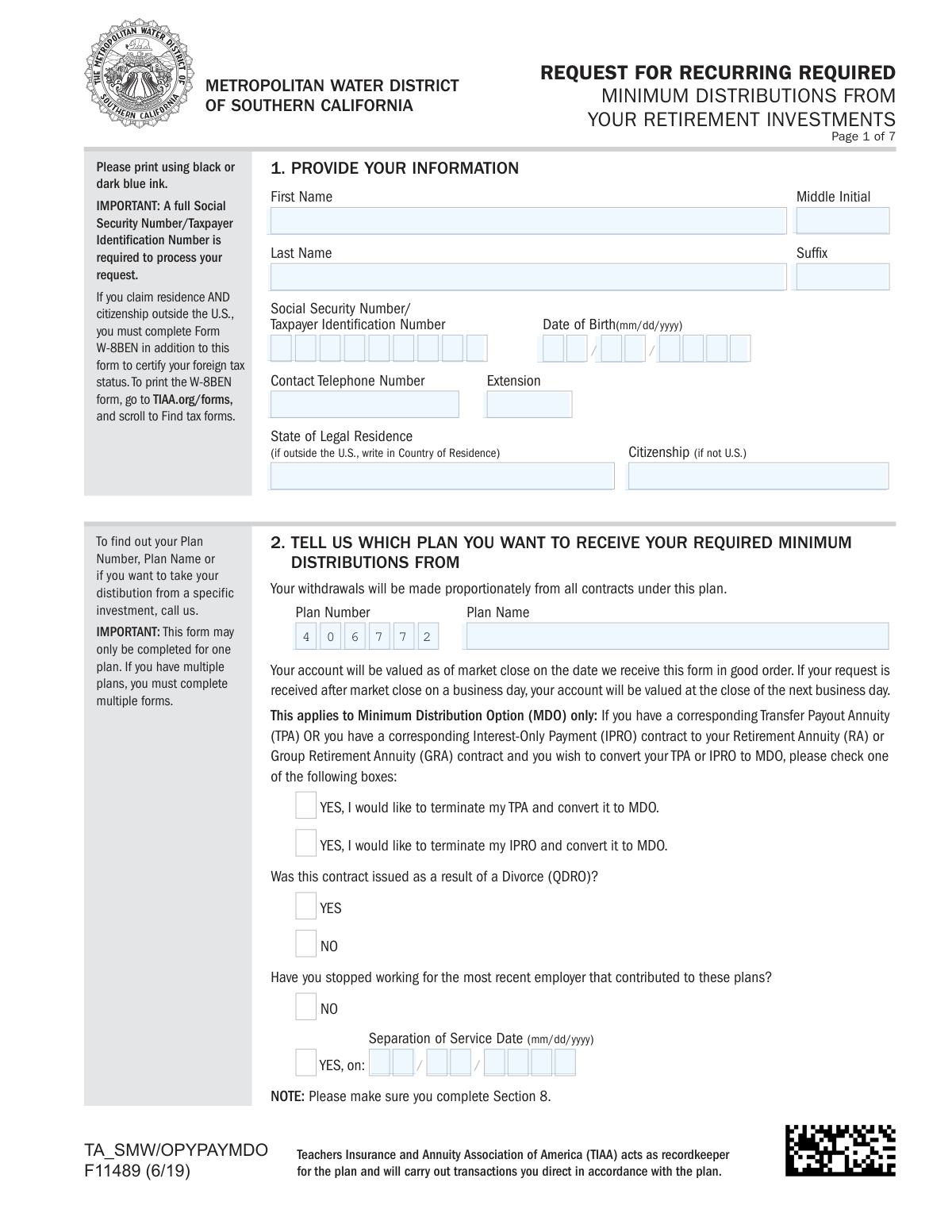
TIAA Form F11489, Request for Recurring Required Minimum Distributions, is used by retirement account holders to establish an automated payment plan that satisfies the IRS's annual Required Minimum Distribution (RMD) rules. By completing this form, you instruct TIAA to calculate and pay the minimum required amount each year, avoiding the need for manual withdrawal requests. Today, this form can be filled out quickly and accurately using AI-powered services like Instafill.ai, which can also convert non-fillable PDF versions into interactive fillable forms.
F11489 is part of the
retirement forms, investment forms, investment account forms, distribution forms, retirement distribution forms and required minimum distribution forms categories on Instafill.
Rather not fill this in by hand? Instafill is an online form filler that completes PDF forms automatically — upload the blank form, answer a few questions, and the AI fills every field.
Form specifications
| Form name: | Form F11489, Request for Recurring Required Minimum Distributions From Your Retirement Investments |
| Number of pages: | 1 |
| Language: | English |
Our AI automatically handles information lookup, data retrieval, formatting, and form filling.
It takes less than a minute to fill out F11489 using our AI form filling.
Securely upload your data. Information is encrypted in transit and deleted immediately after the form is filled out.
Instafill Demo: How to fill out PDF forms in seconds with AI
How to Fill Out F11489 Online for Free in 2026
Are you looking to fill out a F11489 form online quickly and accurately? Instafill.ai offers the #1 AI-powered PDF filling software of 2026, allowing you to complete your F11489 form in just 37 seconds or less.
Follow these steps to fill out your F11489 form online using Instafill.ai:
- 1 Navigate to Instafill.ai and upload or select the TIAA Form F11489.
- 2 Use the AI assistant to accurately fill in your personal details in Section 1, including your name, Social Security Number, and date of birth.
- 3 Specify which retirement plan you want to receive distributions from by providing the Plan Number and Name in Section 2.
- 4 In Section 3, select your desired payment frequency (e.g., monthly, annually) and the start date for your recurring distributions.
- 5 Complete the Federal Tax Withholding Election in Section 5 and provide your payment instructions in Section 7, choosing between direct deposit or a mailed check.
- 6 Review all the information pre-filled by the AI for accuracy, then securely e-sign and date the form in Section 8.
- 7 Download the completed, signed document and submit it to TIAA via upload, fax, or mail as instructed on the form.
Our AI-powered system ensures each field is filled out correctly, reducing errors and saving you time.
Why Choose Instafill.ai for Your Fillable F11489 Form?
Speed
Complete your F11489 in as little as 37 seconds.
Up-to-Date
Always use the latest 2026 F11489 form version.
Cost-effective
No need to hire expensive lawyers.
Accuracy
Our AI performs 10 compliance checks to ensure your form is error-free.
Security
Your personal information is protected with bank-level encryption.
Frequently Asked Questions About F11489
This form is used to request and set up automatic, recurring withdrawals from your TIAA retirement accounts to satisfy the IRS's Required Minimum Distribution (RMD) requirements.
You should complete this form if you are required by the IRS to take minimum distributions from your retirement accounts and you want TIAA to automatically calculate and pay them to you each year.
No, you must complete a separate form for each individual plan from which you wish to receive recurring required minimum distributions.
To set up a new direct deposit, you must provide an original voided check, a notarized letter from your bank, or a bank-generated setup form. You can upload a photo of a voided check or setup form through the TIAA mobile app or website.
Section 3 allows you to choose to receive your payments on a monthly, quarterly, semiannually, or annually basis. If you do not make a selection, the frequency will default to annual payments.
If you do not complete Section 5, federal income tax will be withheld from your distribution using the default rate for a person with a 'Married' status claiming three allowances.
Once your request is approved, direct deposits typically arrive within two business days. If you choose to receive a check by mail, it can take up to 8-10 business days to arrive.
An employer's signature may be required depending on your plan's rules. If it is required and the form is submitted without it, TIAA will need to obtain approval before processing your request, which may cause a delay.
This information helps determine how your RMD is calculated. If your spouse is your sole beneficiary and more than ten years younger, a different life expectancy table may be used, which could result in a smaller required withdrawal amount.
The quickest method is to upload your completed documents using the TIAA mobile app or by logging into your account on TIAA.org. Submitting via fax or mail is also an option but will take longer to process.
Yes, services like Instafill.ai use AI to help you accurately auto-fill form fields with your information. This can save you time and help prevent common errors.
If you have a non-fillable or 'flat' PDF, you can use a service like Instafill.ai to convert it into an interactive, fillable form. Simply upload the document to their platform to begin filling it out electronically.
To fill out this form online, you can upload the PDF to a platform like Instafill.ai. The service makes the document interactive, allowing you to type your answers directly into the fields before printing for submission.
Yes, if you are a non-U.S. citizen, you must also complete and submit Form W-8BEN to certify your foreign tax status. Your distributions may be subject to a 30% tax withholding unless a tax treaty allows for a reduced rate.
Compliance F11489
Validation Checks by Instafill.ai
1
SSN/TIN Format and Completeness
This check verifies that the Social Security Number or Taxpayer Identification Number in Section 1 is provided and contains exactly nine digits. This number is critical for tax reporting and identity verification. If the field is blank or contains an incorrectly formatted number, the form cannot be processed, and the request will be rejected pending correction.
2
Date of Birth Validity
Validates that the Date of Birth in Section 1 is a complete and logical date in MM/DD/YYYY format and is in the past. This is essential for determining eligibility for Required Minimum Distributions (RMDs), which are age-based. An invalid or future date would prevent the system from correctly calculating eligibility and distribution amounts, causing the request to be flagged for manual review.
3
Separation of Service Date Logic
This check ensures that if the user answers 'YES' to having stopped working in Section 2, a 'Separation of Service Date' is provided. The date must be a valid date in the past. This information is crucial as distribution rules can differ based on employment status. Failure to provide a date when required will halt processing until the information is supplied.
4
Payment Option Exclusivity
Verifies that in Section 3, the user has selected only one payment start option from Option A, B, or C. Selecting multiple options creates ambiguity in the payment instructions. If more than one option is checked, the form will be considered invalid and returned to the applicant for clarification.
5
Payment Start Day Constraint
This validation confirms that the chosen day for payments in Section 3 is a number between 1 and 28, as specified in the form's instructions. This constraint ensures payments are scheduled on valid processing days. If a date outside this range (e.g., the 31st) is selected, the system should reject it or default to a valid day as per business rules, potentially notifying the user of the change.
6
Signature Date vs. Payment Start Date Proximity
A critical check that cross-references the signature date in Section 8 with the payment start date in Section 3. The signature date must be within 180 days prior to the requested payment start date. This ensures the request is recent and reflects the applicant's current intent. If the signature is too old, the request is considered stale and will be rejected.
7
Spouse Age Difference Verification
This check is triggered if the user answers 'Yes' in Section 4, indicating their spouse is their sole beneficiary and more than ten years younger. It compares the applicant's Date of Birth (Section 1) with the Spouse's Birth Date (Section 4) to confirm the age difference is greater than ten years. This is vital for using the correct IRS life expectancy table for RMD calculation. An inconsistency will require correction to ensure the distribution amount is calculated correctly.
8
Spouse Information Completeness
Ensures that if the user checks 'Yes' in Section 4 (spouse is more than 10 years younger), then the 'Spouse’s Name' and 'Spouse’s Birth Date' fields are filled out. This information is mandatory for applying the Joint Life Expectancy calculation method. If these fields are left blank after checking 'Yes', the form is incomplete and cannot be processed correctly.
9
Federal Tax Withholding Method Exclusivity
Validates that in Section 5, the user has chosen only one method for federal tax withholding: either by allowances, by a specific percentage, or electing no withholding. Selecting both a percentage and allowances, for example, creates conflicting instructions. The form would be rejected for ambiguity, requiring the user to select a single, clear withholding option.
10
Payment Destination Exclusivity
This check ensures that payment instructions are provided in either Section 6 (Send to a TIAA Account) or Section 7 (Provide Payment Instructions), but not both. Funds can either be transferred internally or paid out externally, and selecting both creates a conflict. If both sections are completed, the form will be flagged for manual intervention to clarify the user's intent.
11
Signature and Date Completeness
Verifies that the applicant's signature and the 'Today’s Date' field in Section 8 are both present. The signature legally authorizes TIAA to perform the transaction, and the date establishes when the authorization was given. A missing signature or date renders the entire form invalid and legally non-binding, causing an immediate rejection of the request.
12
Foreign Citizenship and W-8BEN Requirement
This validation checks if the 'Citizenship' field in Section 1 is filled with a country other than the U.S. If the applicant is a non-U.S. citizen, the system flags the submission to ensure a completed Form W-8BEN is also included. This is crucial for applying the correct tax withholding rules based on international treaties. Without the W-8BEN, the request may be delayed or subject to a default higher withholding rate.
Common Mistakes in Completing F11489
Section 2 requires a specific Plan Number, and the form explicitly states it may only be used for one plan. Applicants with multiple TIAA retirement plans often try to list them all on one form to save time, but this will cause the request to be rejected or only processed for the first plan found. This error significantly delays distributions from the other accounts. To avoid this, a separate form must be completed for each plan; tools like Instafill.ai can streamline this by auto-filling personal information across multiple forms.
The signature block in Section 8 explicitly warns that non-TIAA digital signatures, such as those created with Adobe Acrobat, are not accepted. Many people are now accustomed to signing documents electronically and overlook this specific requirement. Submitting a form with an invalid signature type will lead to its immediate rejection, forcing the applicant to print, physically sign, and resubmit the entire package, delaying their first payment.
Section 9 requires a signature from the employer's plan representative if mandated by the plan's rules, but applicants often don't know if this applies to them. Skipping this section is a common gamble that frequently results in major processing delays. If the signature is required, TIAA must halt the request and contact the employer for approval, a process that can take weeks. Applicants should proactively confirm with their former employer if this authorization is needed before submission.
For new direct deposits, Section 7 requires very specific documentation, such as an original voided check or a notarized bank letter. Common mistakes include submitting photocopies, starter checks, or deposit slips, all of which are explicitly listed as unacceptable. This failure results in TIAA defaulting to mailing a paper check to the address on file, which is slower, less secure, and delays access to funds by up to 10 business days.
Section 3 presents three complex options (A, B, C) for when to begin distributions, based on age and retirement status. The descriptions are dense, leading people to choose an option that doesn't match their situation, such as accidentally triggering two distributions in one year by selecting Option B incorrectly. This can lead to unexpected tax consequences and processing delays while TIAA seeks clarification.
The form specifies that payment dates in Section 3 must be between the 1st and 28th of the month and that the signature date must be within 180 days of the requested start date. Applicants frequently overlook these constraints, entering a date like the 31st or signing the form too far in advance. Such errors force TIAA to default to a different payment date or reject the form, disrupting the applicant's financial schedule. AI-powered tools like Instafill.ai can validate date entries against form rules to prevent these mistakes.
Section 5 provides multiple ways to specify federal tax withholding, which can cause confusion. Applicants might select a marital status and number of allowances while also entering a specific percentage to withhold, creating a conflicting instruction. This ambiguity forces TIAA to either apply a default rate the user may not want or contact the applicant for clarification, delaying the first payment and causing incorrect taxes to be withheld.
In Section 3, applicants must choose a payment frequency (Monthly, Quarterly, etc.), but this checkbox is easily missed. The form states that if no selection is made, the frequency will default to 'Annually.' This oversight can result in the applicant receiving a single, large lump-sum payment for the year instead of the steady income stream they expected, which could have negative tax implications.
Section 4 asks a two-part question: is your spouse more than ten years younger AND your sole beneficiary? Answering 'Yes' changes the RMD calculation method. People often answer 'Yes' if their spouse is younger but forget the 'sole beneficiary' requirement, or they may not have updated their beneficiary records. This error leads to an incorrect RMD calculation, which can result in IRS penalties for taking too little or unnecessarily depleting the account by taking too much.
This form is a non-fillable PDF, often leading people to print and complete it by hand. Illegible handwriting in critical fields like Social Security Numbers, plan numbers, or bank account details is a primary cause of processing rejections and errors. A simple mistake can lead to significant delays or even misdirected funds. To avoid this, a service like Instafill.ai can convert the flat PDF into an interactive, fillable form, ensuring all data is typed, clear, and accurate.
Saved over 80 hours a year
“I was never sure if my IRS forms like W-9 were filled correctly. Now, I can complete the forms accurately without any external help.”
Kevin Martin Green
Your data stays secure with advanced protection from Instafill and our subprocessors




Robust compliance program
Transparent business model
You’re not the product. You always know where your data is and what it is processed for.
ISO 27001, HIPAA, and GDPR
Our subprocesses adhere to multiple compliance standards, including but not limited to ISO 27001, HIPAA, and GDPR.
Security & privacy by design
We consider security and privacy from the initial design phase of any new service or functionality. It’s not an afterthought, it’s built-in, including support for two-factor authentication (2FA) to further protect your account.
Fill out F11489 with Instafill.ai
Worried about filling PDFs wrong? Instafill securely fills form-f11489-request-for-recurring-required-minimum-distributions-from-your-retirement-investments-1 forms, ensuring each field is accurate.
