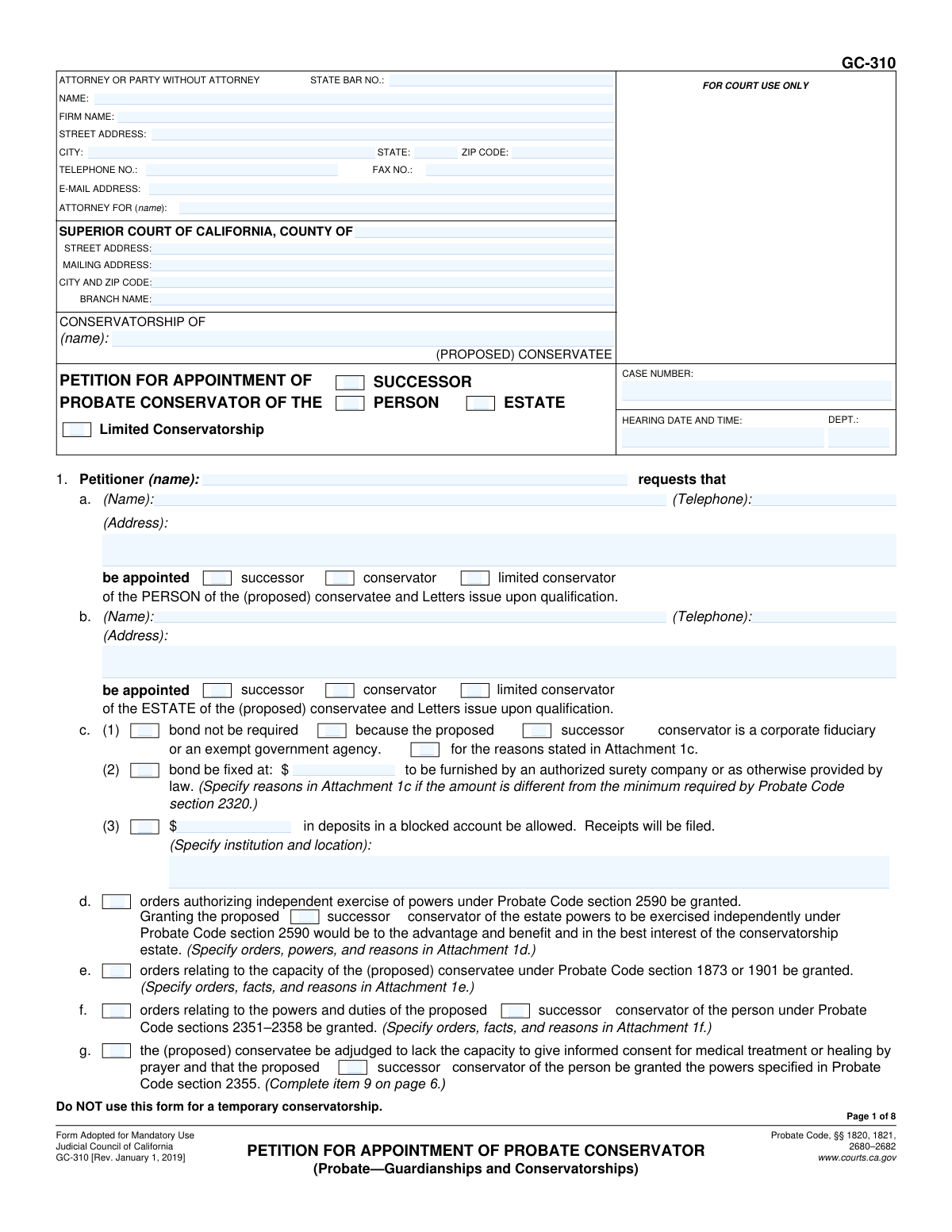
Yes! You can use AI to fill out Form GC-310, Petition for Appointment of Probate Conservator
The California Form GC-310, Petition for Appointment of Probate Conservator, is used to initiate a legal process to appoint a responsible person or entity (a conservator) to care for another adult (the conservatee) who cannot care for themselves or manage their finances. This is a critical step in ensuring the well-being and protection of a vulnerable individual's personal and financial affairs. Today, this form can be filled out quickly and accurately using AI-powered services like Instafill.ai, which can also convert non-fillable PDF versions into interactive fillable forms.
Our AI automatically handles information lookup, data retrieval, formatting, and form filling.
It takes less than a minute to fill out GC-310 using our AI form filling.
Securely upload your data. Information is encrypted in transit and deleted immediately after the form is filled out.
Form specifications
| Form name: | Form GC-310, Petition for Appointment of Probate Conservator |
| Number of fields: | 270 |
| Number of pages: | 8 |
| Language: | English |
More forms in ATO forms
Instafill Demo: How to fill out PDF forms in seconds with AI
How to Fill Out GC-310 Online for Free in 2026
Are you looking to fill out a GC-310 form online quickly and accurately? Instafill.ai offers the #1 AI-powered PDF filling software of 2026, allowing you to complete your GC-310 form in just 37 seconds or less.
Follow these steps to fill out your GC-310 form online using Instafill.ai:
- 1 Navigate to Instafill.ai and upload or select the GC-310 form.
- 2 Provide the personal information for the petitioner, the proposed conservatee, and the proposed conservator.
- 3 Specify the type of conservatorship being requested (e.g., of the person, of the estate, limited, or successor).
- 4 Detail the reasons for the conservatorship, including facts about the proposed conservatee's inability to manage personal or financial affairs.
- 5 Enter the required information about the proposed conservatee's relatives, assets, and any special circumstances.
- 6 Answer questions regarding bond requirements, medical treatment capacity, and any other special powers or orders being requested.
- 7 Review the completed form for accuracy, then download the document to be signed and filed with the appropriate California Superior Court.
Our AI-powered system ensures each field is filled out correctly, reducing errors and saving you time.
Why Choose Instafill.ai for Your Fillable GC-310 Form?
Speed
Complete your GC-310 in as little as 37 seconds.
Up-to-Date
Always use the latest 2026 GC-310 form version.
Cost-effective
No need to hire expensive lawyers.
Accuracy
Our AI performs 10 compliance checks to ensure your form is error-free.
Security
Your personal information is protected with bank-level encryption.
Frequently Asked Questions About Form GC-310
Form GC-310, Petition for Appointment of Probate Conservator, is used to ask a California court to appoint a legal conservator for an adult who can no longer manage their personal care or finances. It is used for permanent conservatorships, not temporary ones.
This form is typically filled out by the person seeking to be appointed as the conservator (the petitioner). However, the proposed conservatee, their spouse, a relative, or a friend can also file the petition.
A conservator of the person manages personal decisions like healthcare, food, and housing. A conservator of the estate manages financial matters, such as paying bills, managing investments, and protecting assets. You can petition for one or both roles on this form.
A limited conservatorship is specifically for an adult with a developmental disability. It grants the conservator only the specific powers that the person cannot manage on their own, allowing the conservatee to retain as much independence as possible.
You will also need to file a Confidential Conservator Screening Form (GC-314), Confidential Supplemental Information (GC-312), and a proposed Order Appointing Court Investigator (GC-330). Additional forms, like a Capacity Declaration (GC-335), may be required depending on the powers you are requesting.
No, this form is for a permanent conservatorship, which can take several weeks or months to establish. For urgent situations, you must also file a Petition for Appointment of Temporary Conservator (Form GC-111).
The court uses the information about the conservatee's assets and income to determine the appropriate amount for a bond. A bond is a form of insurance that protects the conservatee's estate from mismanagement by the conservator.
To gain medical authority, you must request it in Section 1g of the petition and submit a Capacity Declaration (Form GC-335). This separate form must be completed by a physician or psychologist, stating that the proposed conservatee cannot give informed consent for medical treatment.
You must list the proposed conservatee's spouse or domestic partner and their second-degree relatives, which includes parents, grandparents, children, grandchildren, and siblings. This ensures all close family members are legally notified of the proceedings.
You must file the completed Form GC-310 and all its attachments with the Superior Court in the county where the proposed conservatee lives.
Yes, services like Instafill.ai use AI to auto-fill form fields accurately and save time. This can be particularly helpful for a multi-page legal form like the GC-310, reducing the chance of errors.
Simply upload the GC-310 PDF to the Instafill.ai platform. The AI will make the form fillable online, allowing you to enter your information once and have it populated in all the correct fields before you download or print.
If you have a non-fillable or 'flat' PDF, you can use a service like Instafill.ai to convert it into an interactive, fillable form. This allows you to easily type your information directly into the fields on your computer.
Compliance GC-310
Validation Checks by Instafill.ai
1
Ensures Bond Request is Logically Complete
This check validates the logic within section 1c regarding the conservatorship bond. If the petitioner requests that a bond 'not be required' or that a specific 'bond be fixed', the corresponding reason or amount must be provided. This is crucial for ensuring the estate's assets are properly protected or that the reason for waiving protection is legally sound, preventing incomplete or legally insufficient petitions.
2
Verifies Jurisdictional Basis is Fully Specified
This validation ensures that in section 3a, a complete jurisdictional basis for the conservatorship is established. If the petitioner indicates the proposed conservatee is a 'Resident of California', they must then specify whether they reside in the filing county or not. Failing to provide a complete and valid jurisdictional reason can lead to the petition being rejected for being filed in the wrong court.
3
Validates Completeness of Blocked Account Information
This check confirms that if the petitioner requests to allow deposits in a blocked account in section 1c, they must also provide the dollar amount and specify the financial institution and its location. This information is mandatory for the court to issue an order that correctly identifies and restricts the account, safeguarding the conservatee's funds. An incomplete request cannot be processed.
4
Confirms Medical Incapacity Documentation Requirements
This validation cross-references section 1g with section 9. If the petitioner requests the power to make medical decisions (1g), it verifies that section 9 is completed to provide the necessary justification, such as indicating a Capacity Declaration (GC-335) is filed or will be filed. This ensures the request to remove a fundamental right from the conservatee is supported by required medical evidence, preventing unsubstantiated claims.
5
Validates Consistency for Successor vs. Initial Appointments
This check ensures that sections related to the type of appointment are filled out correctly. If the petition is for an 'initial appointment' (section 5a), then section 5b ('Vacancy in office of conservator') must be left blank, and vice-versa. This prevents logical contradictions in the petition's purpose and ensures the court is reviewing the correct type of request, avoiding procedural delays and confusion.
6
Ensures Spouse Conflict of Interest is Addressed
This validation targets section 6, which applies if the petitioner or proposed conservator is the conservatee's spouse. If the spouse is a party to a marital dissolution or similar legal action, the check ensures that an attachment is referenced explaining why their appointment is in the conservatee's best interest. This is a critical safeguard to prevent appointments where a clear conflict of interest exists, protecting the conservatee from potential harm.
7
Verifies Financial Asset and Income Calculation
This check validates the monetary values entered in section 3e, 'Character and estimated value of the property of the estate'. It ensures all income and property fields contain valid numerical data and that the 'Total' field accurately reflects the sum of the specified personal property and annual income sources. An accurate financial picture is essential for the court to set the appropriate bond amount and oversee the estate's management.
8
Confirms Professional Fiduciary Attachment Requirement
This validation ensures that if the petitioner or proposed conservator is identified as a 'professional fiduciary' in section 2 or 3c, the form indicates that the required Professional Fiduciary Attachment (GC-210(A-PF)/GC-310(A-PF)) is included. This attachment contains mandatory disclosures about licensure and relationships. Failure to include it results in an incomplete filing and non-compliance with state regulations for professional fiduciaries.
9
Validates Completeness of Relatives List
This check examines section 11 to ensure that for each relative listed, both the 'Name and relationship' and the 'Residence address' fields are completed. Alternatively, if no relatives are known, it verifies that the appropriate box is checked. This is vital for ensuring all legally required parties receive proper notice of the proceedings, which is a matter of due process.
10
Ensures Justification for Conservatee's Non-Attendance
This validation focuses on section 8, regarding the proposed conservatee's attendance at the hearing. If the conservatee 'is unable to attend the hearing because of medical inability', the check confirms that a Capacity Declaration (GC-335) is either filed or will be filed. This is a crucial due process check to ensure a person's right to appear in court is only waived with valid medical justification.
11
Validates Limited Conservatorship Selections
This check ensures that if 'Limited Conservatorship' is selected in the petition's header, the petitioner has appropriately considered and completed the specific sections for limited conservatorships (1h, 1i, 1j). Conversely, it ensures these sections are not filled out for a general conservatorship. This prevents incorrect powers from being requested and ensures the petition aligns with the specific legal requirements for conservatorships of developmentally disabled adults.
12
Verifies Date Format and Validity
This validation scans all date fields on the form, such as 'Hearing Date and Time', 'Date Proposed Conservatee Becomes Adult' (5a), and the order date in 9c. It ensures that all entries are in a valid date format (e.g., MM/DD/YYYY) and are logically sound (e.g., a hearing date cannot be in the past). Correct date formatting is essential for court scheduling, legal deadlines, and record-keeping.
13
Ensures Major Neurocognitive Disorder Documentation is Specified
This check validates section 1k, which pertains to special orders for major neurocognitive disorders like dementia. If the petitioner requests these special orders, the system must verify that one of the sub-options is selected, indicating whether the required forms (GC-335 and GC-335A) are filed, will be filed, or are not needed for a successor appointment. This ensures that requests for highly restrictive placements or treatments are supported by the necessary, specific medical declarations as required by law.
14
Validates Petitioner's Relationship Declaration
This check ensures that in section 2, the petitioner selects at least one checkbox to define their relationship to the proposed conservatee. The petition cannot proceed without establishing the petitioner's standing to file. This validation confirms that a relationship is declared, which is a fundamental requirement for the court to consider the petition.
Common Mistakes in Completing GC-310
Item 11 requires listing the proposed conservatee's spouse/domestic partner and second-degree relatives. A frequent mistake is omitting relatives, providing outdated addresses, or failing to conduct due diligence to locate them. This is a critical error because these relatives must be legally notified of the proceedings. Failure to provide a complete and accurate list can lead to a court continuance or even dismissal of the petition for violating jurisdictional notice requirements.
In Item 5c, petitioners must provide specific facts demonstrating why the proposed conservatee is 'unable to properly provide for his or her personal needs' or 'substantially unable to manage his or her financial resources.' A common mistake is using vague, conclusory statements instead of concrete examples of behavior, incidents, or financial mismanagement. The court needs detailed, factual evidence to justify removing an individual's rights, and a lack of specificity will result in the petition being questioned or denied.
This petition (GC-310) is almost always filed with other mandatory forms. Petitioners frequently forget to include the Confidential Supplemental Information (GC-312), the Confidential Conservator Screening Form (GC-314), and, when necessary, a Capacity Declaration (GC-335). Omitting these forms will result in an incomplete filing, causing the court clerk to reject the petition or the court to delay the hearing until all required documents are submitted.
In Item 1c, the petitioner must request a bond amount, which is calculated based on the estate's value and income detailed in Item 3e. Common errors include miscalculating the total value of personal property and annual income, leading to an incorrect bond amount. Additionally, if requesting the bond be waived, petitioners often fail to provide a sufficient legal reason or attach the required explanation. These errors cause delays as the court must issue an order to fix the bond amount before Letters of Conservatorship can be issued.
Throughout the form, checkboxes indicate that more information is provided in an attachment (e.g., 'Attachment 1d,' 'Attachment 5c(1)'). A very common clerical error is checking a box but failing to draft, label, and physically attach the corresponding document. This renders the petition incomplete, forcing the court to continue the hearing until the missing information is provided and reviewed. AI-powered tools like Instafill.ai can help by flagging fields that require an attachment, ensuring no information is missed.
The form distinguishes between conservatorship of the 'Person' (for personal and medical care) and the 'Estate' (for financial matters). Petitioners often misunderstand the distinction, requesting only one when both are needed, or failing to specify which requested powers apply to which type of conservatorship. This can result in a conservator who lacks the legal authority to perform necessary duties, requiring a new petition to be filed later to expand their powers.
On a complex form with hundreds of options, it is easy to make contradictory selections. For example, a petitioner might check a box in Item 8 indicating the conservatee is 'unable to attend the hearing because of medical inability' while also checking a box that they 'will attend the hearing.' These inconsistencies signal carelessness to the court and create ambiguity that must be resolved, leading to delays. Using a guided form-filling tool can prevent these logical errors by validating selections.
Item 3e requires a detailed breakdown of the proposed conservatee's property and income. Petitioners often make mistakes by estimating values inaccurately, omitting sources of income like pensions or public benefits, or incorrectly categorizing assets. These inaccuracies directly impact the bond calculation and can mislead the court about the scope of the estate, potentially causing significant legal and financial complications down the line. AI tools like Instafill.ai can help ensure all financial fields are completed and calculations are accurate.
The form is used for both initial appointments and for appointing a successor to an existing conservatorship. A common point of confusion is checking 'successor' boxes on an initial petition or, conversely, failing to provide required information for a successor, such as the reason for the vacancy (Item 5b). This creates procedural confusion for the court clerk and judge, delaying the processing of the petition. If the form is a non-fillable PDF, tools like Instafill.ai can convert it to an interactive, fillable version with clear guidance to prevent such errors.
Saved over 80 hours a year
“I was never sure if my IRS forms like W-9 were filled correctly. Now, I can complete the forms accurately without any external help.”
Kevin Martin Green
Your data stays secure with advanced protection from Instafill and our subprocessors

Robust compliance program
Transparent business model
You’re not the product. You always know where your data is and what it is processed for.
ISO 27001, HIPAA, and GDPR
Our subprocesses adhere to multiple compliance standards, including but not limited to ISO 27001, HIPAA, and GDPR.
Security & privacy by design
We consider security and privacy from the initial design phase of any new service or functionality. It’s not an afterthought, it’s built-in, including support for two-factor authentication (2FA) to further protect your account.
Fill out GC-310 with Instafill.ai
Worried about filling PDFs wrong? Instafill securely fills form-gc-310-petition-for-appointment-of-probate-conservator forms, ensuring each field is accurate.