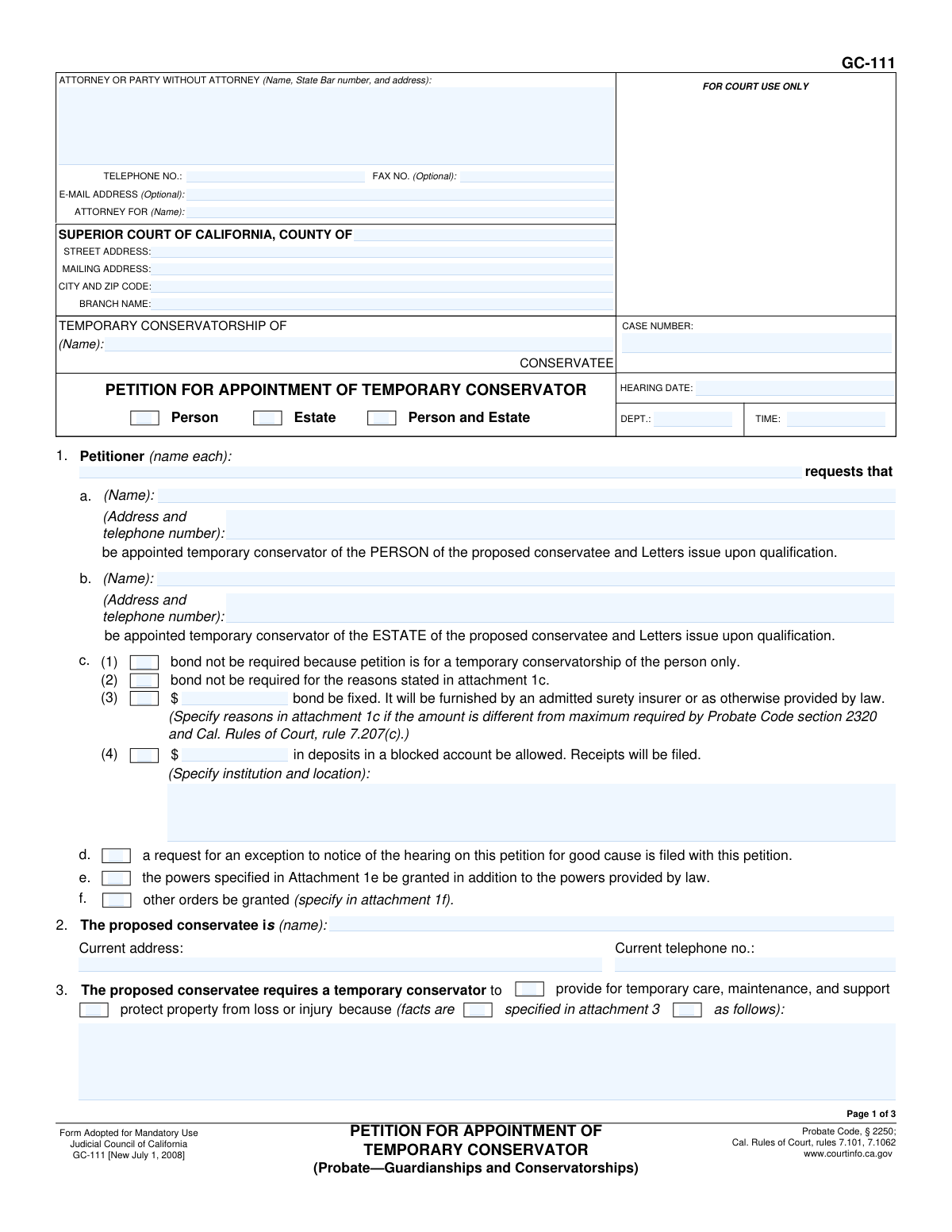
Yes! You can use AI to fill out Form GC-111, Petition for Appointment of Temporary Conservator (Probate—Guardianships and Conservatorships)

Form GC-111, Petition for Appointment of Temporary Conservator, is a legal document filed in the Superior Court of California to request the urgent appointment of a conservator for a limited time. This is typically done when an individual (the proposed conservatee) is unable to provide for their personal needs or manage their financial affairs, and immediate intervention is required to prevent harm or loss pending a hearing for a general conservatorship. Today, this form can be filled out quickly and accurately using AI-powered services like Instafill.ai, which can also convert non-fillable PDF versions into interactive fillable forms.
GC-111 is part of the guardianship forms, ATO forms and probate forms categories on Instafill.
Our AI automatically handles information lookup, data retrieval, formatting, and form filling.
It takes less than a minute to fill out GC-111 using our AI form filling.
Securely upload your data. Information is encrypted in transit and deleted immediately after the form is filled out.

Form specifications

Form name: Form GC-111, Petition for Appointment of Temporary Conservator (Probate—Guardianships and Conservatorships)
Number of fields: 92
Number of pages: 3
Language: English
main-image

Instafill Demo: How to fill out PDF forms in seconds with AI

How to Fill Out GC-111 Online for Free in 2026

Are you looking to fill out a GC-111 form online quickly and accurately? Instafill.ai offers the #1 AI-powered PDF filling software of 2026, allowing you to complete your GC-111 form in just 37 seconds or less.
Follow these steps to fill out your GC-111 form online using Instafill.ai:
  1. 1 Navigate to Instafill.ai and upload or select the Form GC-111.
  2. 2 Provide the court information, including the county, court address, and branch name.
  3. 3 Enter the personal details of the petitioner, the proposed conservatee, and the proposed temporary conservator.
  4. 4 Specify the type of temporary conservatorship requested (Person, Estate, or both) and provide financial details if an estate conservatorship is needed.
  5. 5 Detail the reasons why a temporary conservatorship is necessary and indicate any special powers or orders being requested.
  6. 6 Review all the information automatically populated by the AI for accuracy and completeness, making any necessary corrections.
  7. 7 Download, print, and sign the completed form before filing it with the appropriate California Superior Court, along with any required attachments.

Our AI-powered system ensures each field is filled out correctly, reducing errors and saving you time.

Why Choose Instafill.ai for Your Fillable GC-111 Form?

Speed

Complete your GC-111 in as little as 37 seconds.

Up-to-Date

Always use the latest 2026 GC-111 form version.

Cost-effective

No need to hire expensive lawyers.

Accuracy

Our AI performs 10 compliance checks to ensure your form is error-free.

Security

Your personal information is protected with bank-level encryption.

Frequently Asked Questions About Form GC-111

Form GC-111 is used to petition a California court for the urgent appointment of a temporary conservator. This is done to protect a person or their estate when there is an immediate need, typically while a petition for a general, long-term conservatorship is pending.

This form should be filed by someone (the petitioner) who believes an adult (the proposed conservatee) is unable to provide for their personal needs or manage their financial affairs and requires immediate protection.

A conservator of the person makes decisions about care, health, and residence. A conservator of the estate manages the person's finances, assets, and property. You can petition for one or both on this form.

A bond is usually required for a conservator of the estate to protect the conservatee's assets, and you must estimate the estate's value in Section 5. You can request that no bond be required if you are only petitioning for a conservatorship of the person.

If you are requesting a conservatorship of the estate, you must complete Section 5 with the estimated value of personal property and the annual gross income from all sources. This information helps the court set the correct bond amount.

To gain authority to change the proposed conservatee's residence, you must specifically request it in Section 6 of the form. You will need to provide the new address and explain why the move is necessary to prevent harm.

If you cannot find or contact all required persons, you must indicate this in Section 8b and attach a signed declaration detailing your efforts to locate them. This is a crucial step to show the court you have performed due diligence.

Not always. In Section 9, you must state whether the proposed conservatee will attend; if they are medically unable to, you must attach a doctor's declaration (Attachment 9c) to the petition.

This petition is typically filed alongside a Petition for Appointment of Probate Conservator (form GC-310). You must also file a proposed Order Appointing Court Investigator (form GC-330), as stated in Section 10.

A professional fiduciary is a person licensed by the State of California to act as a conservator. They are often appointed when there are no family members or friends able or willing to serve in that role.

Yes, services like Instafill.ai use AI to help you accurately auto-fill form fields, which can save significant time and reduce errors. This is especially helpful for complex legal forms like the GC-111.

You can use a service like Instafill.ai to fill out the form online. Simply upload the GC-111, and the platform will make it interactive, allowing you to type directly into the fields and save your progress.

If you have a flat, non-fillable PDF, you can use a tool like Instafill.ai to convert it into an interactive, fillable form. This allows you to easily complete and save the document electronically before printing and filing.

Compliance GC-111
Validation Checks by Instafill.ai

1
Estate Value Calculation Accuracy
This validation ensures that the 'Total' value in item 5d is the correct sum of the 'Personal property' (5a), 'Annual gross income' (5b), and 'Bond recovery cost' (5c). This is critical for determining the correct bond amount and ensuring financial accuracy in court filings. If the sum is incorrect, the form submission should be blocked, and the user prompted to correct the values.
2
Conditional Estate Valuation Requirement
This check verifies that if the conservatorship type is for the 'Estate' or 'Person and Estate', then all fields in Section 5 ('Character and estimated value of the property of the estate') are completed. This section is legally required to assess the need for and amount of a bond to protect the estate's assets. Failure to complete this section when required will result in an incomplete and likely rejected petition.
3
Bond Requirement Logic for Estate Conservatorship
This validation ensures that if the petition is for an 'Estate' or 'Person and Estate', the petitioner selects a valid bond option in section 1c (e.g., 1c(2), 1c(3), or 1c(4)). The option 'bond not be required because petition is for a temporary conservatorship of the person only' (1c(1)) should be disallowed. This prevents a logical contradiction and ensures compliance with probate rules that mandate financial protection for an estate.
4
Attachment Reference Integrity
This check cross-references all checkboxes that mention an attachment (e.g., 1c, 1e, 1f, 3, 6a, 6b, 7c, 7d, 8b, 8c, 9c) against the 'Attachment Page Count' field. If any attachment checkbox is selected, the page count must be a number greater than zero. This prevents petitioners from referencing non-existent documents, which would cause delays and potential rejection by the court clerk.
5
Mutually Exclusive Hearing Attendance Status
This validation ensures that only one option is selected in Section 9 regarding the proposed conservatee's attendance at the hearing. The options (will attend, able but unwilling, unable due to medical inability, out of state) are mutually exclusive. Allowing multiple selections would create ambiguity and confusion for the court, so the system should enforce a single choice.
6
Conditional Professional Fiduciary Details
This check validates that if the 'Petitioner is a professional fiduciary' box (Item 7) is checked, then the 'License number' and 'License issuance or renewal date' fields in 7a are mandatory and must be filled. This is crucial for court verification of the petitioner's credentials as required by law. An error should be displayed if the box is checked but the license details are missing.
7
Petitioner Identity and Contact Logic
This validation enforces the logic in Item 8. If 'Petitioner is not the proposed conservatee' is checked, the system must then require a selection from one of the two sub-options in 8b ('Have been found and contacted' or 'Have not been found'). This ensures the petition properly accounts for notice requirements for all relevant parties, a critical due process step.
8
Hearing Date and Time Format
This check ensures the 'Hearing Date' is a valid, future date and the 'Hearing Time' is in a proper time format (e.g., HH:MM AM/PM). Submitting a past date or an invalid format would lead to immediate scheduling conflicts and rejection. The system should use a date picker and formatted time input to minimize user error.
9
Case Number Consistency Across Pages
This validation verifies that the 'Case Number' entered in the header of Page 1 is identical to the 'Case Number' in the headers of Page 2 and Page 3. This ensures document integrity and correct case file association when the pages are processed or potentially separated. A mismatch could lead to filing errors or misidentification of the document.
10
Conditional Residence Change Details
This check ensures that if the petitioner checks the box in 6a to request authority to change the conservatee's residence, the 'Proposed new residence address' field becomes mandatory. Without a proposed address, the request is incomplete and cannot be evaluated by the court. The system should trigger a validation error if the request is made without specifying the new location.
11
Blocked Account Information Completeness
This validation ensures that if a dollar amount is entered into the 'deposits in a blocked account' field (1c(4)), then the corresponding 'Specify institution and location' field must also be completed. The court needs to know where the funds will be held to approve the request. An incomplete request will be denied, so the system should flag this dependency.
12
Conservatee Name Consistency
This check verifies that the 'Conservatee Name' entered in the top-level case identification section is identical to the name entered in Section 2 ('The proposed conservatee is (name)'). Inconsistent naming can create legal ambiguity and problems with record-keeping and official notices. The system should flag any discrepancy for correction before submission.
13
Valid State Bar Number
This validation checks that the 'State Bar number' provided for the attorney is a valid numerical value. While a simple check ensures it contains only digits, a more advanced check could validate it against the expected length or format for California Bar numbers. This helps ensure the attorney listed is legitimate and their information is recorded correctly.
14
Reason for Conservatorship Selection
This check ensures that at least one of the reasons for the temporary conservatorship is selected in Section 3 ('provide for temporary care...' or 'protect property from loss...'). The petition must state a valid legal reason for the court's intervention. If neither box is checked, the petition lacks a fundamental basis and should be considered incomplete.

Common Mistakes in Completing GC-111

Incorrect Court and Case Information

Filers often enter the wrong court branch name or address in the header, or leave the case number blank if it's a new filing. This happens due to confusion about which court location handles probate matters. An incorrect header can lead to the petition being rejected by the clerk or misfiled, causing critical delays in a time-sensitive process. To avoid this, always verify the specific court branch and address for probate filings in your county before you begin; the case number will be assigned upon filing.

Improper Bond Request or Calculation

Petitioners frequently make errors in Section 1c and Section 5 regarding the conservatorship bond. Common mistakes include miscalculating the required bond amount by omitting assets or failing to add the statutory cost of recovery (Item 5c). An incorrect bond calculation is a frequent reason for rejection by the court clerk or judge, halting the appointment process. It is crucial to accurately list all assets and income in Section 5 and follow the California Rules of Court for bond calculation to prevent delays.

Vague or Inadequate Factual Justification

In Item 3, petitioners must provide specific facts demonstrating why a temporary conservatorship is urgently needed. A common mistake is using conclusory statements like 'to protect property' without detailing the specific risks, events, or threats of loss. The court requires concrete, factual evidence of immediate harm or need, and failure to provide this can lead to the court denying the petition for lack of urgency.

Failure to Include Mandatory Attachments

This form requires numerous attachments for detailed explanations (e.g., Attachments 3, 6a, 8b, 8c, 9c). A critical error is checking a box indicating an attachment is provided but then failing to include it, or miscounting the total number of pages in Item 11. Forgetting the medical declaration for Item 9c, for example, means the court cannot excuse the proposed conservatee's attendance, leading to an incomplete filing and likely postponement of the hearing.

Inaccurate Estate Valuation in Section 5

When an estate conservatorship is requested, petitioners often make mathematical errors in Section 5. They may forget to add personal property (5a), annual income (5b), and the bond recovery cost (5c) to arrive at the correct total in 5d. Since this valuation directly determines the bond amount, courts scrutinize it closely, and any error will cause the filing to be rejected or delayed until a corrected accounting is submitted.

Incomplete Notice Declarations for Relatives

Item 8 requires a detailed accounting of efforts to notify all interested parties, which is a cornerstone of due process. Petitioners often fail to attach the required declaration (Attachment 8b) explaining why a relative could not be found or contacted. This is a serious procedural error that will cause the court to postpone the hearing until proper notice or diligent search efforts are documented and filed.

Missing Required Signatures

The law requires that all petitioners sign the form on the final page, in addition to their attorney. A surprisingly common mistake is for one of several petitioners to forget to sign, or for the petitioner to assume only the attorney's signature is needed. A petition with missing signatures is invalid and will be immediately rejected by the court clerk, stopping the entire process before it can be reviewed by a judge.

Inconsistency with General Conservatorship Petition

This temporary petition (GC-111) is almost always filed with a general Petition for Appointment of Probate Conservator (GC-310). Filers often make the mistake of providing information on this form that contradicts the general petition, such as listing different asset values or relatives. Courts review these documents together, and any inconsistencies can raise red flags, create confusion, and lead to delays while the court seeks clarification.

Neglecting to File the Court Investigator Order

Item 10 requires the petitioner to affirm that a proposed Order Appointing Court Investigator (form GC-330) is being filed concurrently. Many filers check this box but forget to actually prepare and submit the separate GC-330 form. The court investigator's report is a mandatory part of the process, and failing to submit the order for their appointment will bring the case to a complete stop until it is filed.

Confusion Between Conservator of Person vs. Estate

In Item 1, petitioners frequently select the wrong type of conservatorship, such as requesting only 'Person' when financial management ('Estate') is also urgently needed. This mistake stems from a misunderstanding of the legal distinction: 'Person' covers care and medical decisions, while 'Estate' covers financial matters. Requesting the wrong type can leave the conservatee's assets unprotected or their personal needs unaddressed, requiring an amended or new petition to correct. AI-powered tools like Instafill.ai can help prevent these errors by providing clear guidance and ensuring data is validated and formatted correctly, and can even convert non-fillable PDFs into fillable versions.
Saved over 80 hours a year

“I was never sure if my IRS forms like W-9 were filled correctly. Now, I can complete the forms accurately without any external help.”

Kevin Martin Green

Your data stays secure with advanced protection from Instafill and our subprocessors

Robust compliance program

Transparent business model

You’re not the product. You always know where your data is and what it is processed for.

ISO 27001, HIPAA, and GDPR

Our subprocesses adhere to multiple compliance standards, including but not limited to ISO 27001, HIPAA, and GDPR.

Security & privacy by design

We consider security and privacy from the initial design phase of any new service or functionality. It’s not an afterthought, it’s built-in, including support for two-factor authentication (2FA) to further protect your account.

Fill out GC-111 with Instafill.ai

Worried about filling PDFs wrong? Instafill securely fills form-gc-111-petition-for-appointment-of-temporary-conservator-probateguardianships-and-conservatorships forms, ensuring each field is accurate.