Yes! You can use AI to fill out Form GC-335, Confidential Capacity Assessment and Declaration—Probate Conservatorship
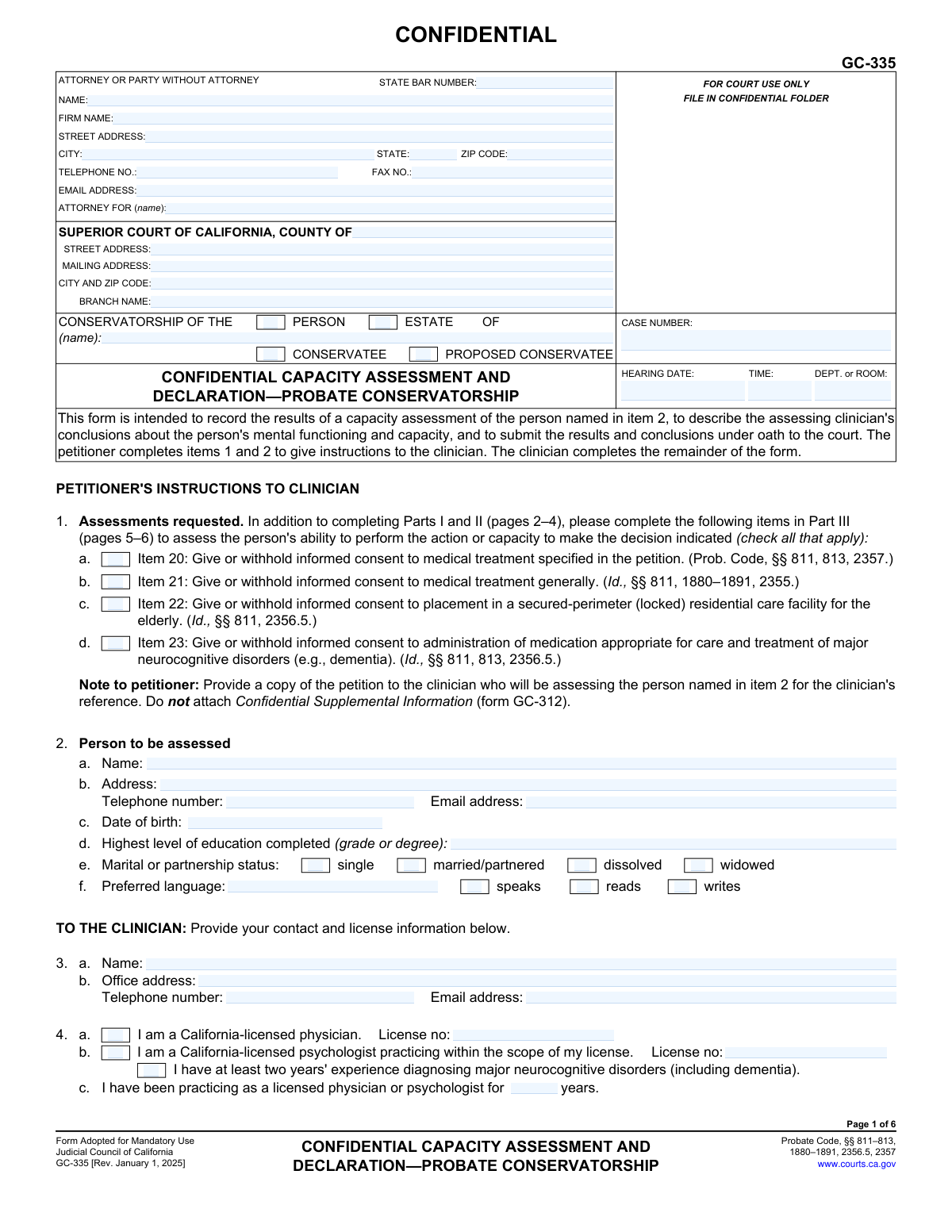
California Form GC-335, the Confidential Capacity Assessment and Declaration, is a crucial legal document used in probate conservatorship proceedings. A licensed physician or psychologist completes this form to provide the court with a detailed assessment of a proposed conservatee's mental functions and their capacity to make decisions regarding medical treatment, placement, and medication. This declaration helps the court make informed decisions about the necessity and scope of a conservatorship. Today, this form can be filled out quickly and accurately using AI-powered services like Instafill.ai, which can also convert non-fillable PDF versions into interactive fillable forms.
Our AI automatically handles information lookup, data retrieval, formatting, and form filling.
It takes less than a minute to fill out GC-335 using our AI form filling.
Securely upload your data. Information is encrypted in transit and deleted immediately after the form is filled out.
Form specifications
| Form name: | Form GC-335, Confidential Capacity Assessment and Declaration—Probate Conservatorship |
| Number of fields: | 338 |
| Number of pages: | 6 |
| Language: | English |
More forms in ATO forms
Instafill Demo: How to fill out PDF forms in seconds with AI
How to Fill Out GC-335 Online for Free in 2026
Are you looking to fill out a GC-335 form online quickly and accurately? Instafill.ai offers the #1 AI-powered PDF filling software of 2026, allowing you to complete your GC-335 form in just 37 seconds or less.
Follow these steps to fill out your GC-335 form online using Instafill.ai:
- 1 Navigate to Instafill.ai and upload or select Form GC-335.
- 2 The petitioner or their attorney uses the AI assistant to fill in their details, court information, and instructions for the clinician, specifying which capacities need to be assessed.
- 3 The designated clinician securely accesses the form to input their professional license information and details about the examination.
- 4 The clinician completes the detailed assessment sections (Parts I and II), documenting the person's general health and evaluating specific mental functions like alertness, memory, and thought processes.
- 5 In Part III, the clinician provides their professional opinion on the person's capacity to give informed consent for medical treatment, placement, or medication as requested.
- 6 The clinician reviews the entire form for accuracy, attaches any required supplemental pages, and then electronically signs and dates the declaration under penalty of perjury.
- 7 Download, print, or securely share the completed confidential form for filing with the court.
Our AI-powered system ensures each field is filled out correctly, reducing errors and saving you time.
Why Choose Instafill.ai for Your Fillable GC-335 Form?
Speed
Complete your GC-335 in as little as 37 seconds.
Up-to-Date
Always use the latest 2026 GC-335 form version.
Cost-effective
No need to hire expensive lawyers.
Accuracy
Our AI performs 10 compliance checks to ensure your form is error-free.
Security
Your personal information is protected with bank-level encryption.
Frequently Asked Questions About Form GC-335
Form GC-335 is a confidential court form used to document a professional clinician's assessment of a person's mental capacity in a probate conservatorship case. It helps the court determine if an individual can make their own decisions regarding medical treatment and personal care.
The petitioner (the person requesting the conservatorship) fills out the first two items to instruct the clinician. A qualified, California-licensed physician or psychologist then completes the remainder of the form based on their professional assessment of the proposed conservatee.
This form contains highly sensitive and private medical information about the person being assessed. It is marked confidential to protect their privacy and is filed separately from public court records.
The petitioner must provide the clinician with a copy of the conservatorship petition for their reference. You should not, however, provide the Confidential Supplemental Information (form GC-312).
The clinician evaluates mental functions like alertness, memory, thought processes, and mood. Based on these findings, they provide a professional opinion on the person's capacity to consent to medical treatment, placement in a secured facility, or administration of dementia medications.
These letters rate the level of deficit: 'a' means no deficit, 'b' is a mild deficit, 'c' is a moderate deficit, and 'd' indicates a major deficit or no function. The letter 'e' is used if the area was not applicable to the assessment or was not assessed.
The form includes options like 'I don't know' or 'I do not have enough information to form an opinion' for many items. The clinician should select this option if they cannot make a professional judgment based on the information they have.
The completed and signed form is typically filed with the court by the petitioner or their attorney. It must be submitted to be filed in the case's confidential folder to maintain the privacy of the assessed individual.
Yes, services like Instafill.ai use AI to help you accurately auto-fill your information into the form fields, which saves time and helps avoid errors. However, the medical evaluation and professional opinions must be completed by the qualified clinician.
You can upload the GC-335 form to the Instafill.ai platform. The service will make the document interactive, allowing you to type information directly into the fields, save your progress, and print the completed form for submission.
If you have a flat, non-fillable PDF, you can use a service like Instafill.ai. It can convert the document into an interactive, fillable form online, so you can easily type in all the required information.
This refers to conditions that might temporarily affect a person's mental state but could improve with treatment, such as medication side effects, infections, or severe emotional distress. The clinician must consider whether any such factors are impacting the person's current condition.
Compliance GC-335
Validation Checks by Instafill.ai
1
Clinician License and Type Consistency
This check ensures that if the clinician selects 'California-licensed physician' in item 4a, the 'Physician license number' field is filled. Likewise, if 'California-licensed psychologist' is selected, the 'Psychologist license number' field must be filled. This is critical for verifying the declarant's credentials with the appropriate state licensing board. A mismatch or missing license number could render the entire assessment invalid and cause significant delays in the legal proceedings.
2
Declaration Date vs. Examination Date
Validates that the 'Date' of the declaration in item 25 is on or after the 'Date of the examination' in item 6a. This is a logical consistency check to confirm the clinician is signing the declaration after having performed the assessment. A declaration dated before the examination would be logically impossible and would undermine the credibility and validity of the entire document.
3
Mandatory Assessment Selection
Verifies that the petitioner has checked at least one of the assessment request boxes (a, b, c, or d) in Item 1. This section provides the core instruction to the clinician about what capacity to evaluate. If no assessment is requested, the form has no purpose, and submission should be blocked to prevent an empty and unusable filing.
4
Cross-Validation of Requested vs. Completed Assessments
This validation ensures that for each assessment requested in Item 1, the corresponding section in Part III (Items 20-23) is completed by the clinician. For example, if Item 1a is checked, then an opinion must be provided in Item 20. This is crucial to ensure the clinician has fulfilled the petitioner's request and provided the court with the specific information it needs to make a ruling.
5
Date of Birth Validity
Confirms that the 'Date of birth' for the assessed person in item 2c is a complete and valid date that occurs in the past. This is a fundamental data integrity check to ensure the identity and age of the proposed conservatee are correctly recorded. An invalid, future, or missing date would indicate a critical data entry error and could halt the processing of the case.
6
Conditional Explanation for Lacked Capacity
Ensures that if the clinician opines that the person lacks capacity for a specific decision (e.g., Item 20b, 21b, 22c(2), or 23c(2) is checked), then a source for the explanation ('below' or 'in Attachment') must be selected and the corresponding text provided. This explanation is the evidentiary basis for the clinician's opinion. Without it, the court cannot properly evaluate the conclusion, making the declaration incomplete.
7
Attachment Count Consistency
Validates that if any checkbox indicating information is provided 'in Attachment' is checked throughout the form, the 'Number of pages attached' in item 25 must be a number greater than zero. This serves as a sanity check to ensure that referenced documents are actually included with the submission. A mismatch suggests that critical supporting documentation may be missing.
8
Medication Impairment Detail Requirement
If the clinician answers 'Yes' to Item 16a, indicating the person is on medications that may impair mental functioning, this check ensures that the medication details and an explanation of the impairment (Item 16b) are provided. This information is vital for the court to distinguish between deficits caused by an underlying condition and those caused by potentially reversible medication side effects. Failure to provide this detail leaves a critical question unanswered.
9
Conservatee Status Exclusivity
Ensures that for the person named as the subject of the conservatorship, exactly one status ('Conservatee' or 'Proposed Conservatee') is checked in the form's header sections. This clarifies the current legal status of the individual for the court. Selecting both or neither creates ambiguity that could lead to incorrect processing or application of legal standards.
10
Clinician Experience and Practice Years Correlation
Verifies that if the clinician checks the box in item 4a for having 'at least two years' experience diagnosing major neurocognitive disorders', the value entered for 'years' of practice in item 4c is a number greater than or equal to 2. This provides a basic logical check on the clinician's self-reported qualifications. An inconsistency could call the clinician's expertise into question.
11
Case Number Presence
Validates that the 'CASE NUMBER' field is not empty. The case number is the primary identifier used by the court to associate the document with the correct legal proceeding. A missing case number will prevent the document from being correctly filed, leading to rejection by the court clerk and delays.
12
Exclusive Selection for Deficit Ratings
For each mental function listed in Items 10 through 14, this validation ensures that exactly one rating ('a' through 'e') is selected. This is a fundamental completeness and data integrity check for the core assessment portion of the form. Submitting the form with multiple or no selections for a given function would make the assessment ambiguous and unusable by the court.
13
Conditional Text Field Population
This check applies to multiple items (e.g., 7c, 15, 16b, 17, 18). It validates that if a checkbox indicating details are provided 'below' is checked, the corresponding free-text field is not left empty. This prevents the user from indicating an explanation is present when it is not, which would result in an incomplete submission with missing critical information that the form claims to contain.
14
Prerequisite for Secured Placement Opinion
If an opinion on secured placement is provided in Item 22, this validates that the clinician has also checked box 22a (confirming a major neurocognitive disorder) and box 22b (confirming need for placement). These are foundational prerequisites for the capacity opinion in 22c, as established by the Probate Code. Missing these prerequisite findings invalidates the subsequent opinion on placement capacity.
Common Mistakes in Completing GC-335
Users, typically the petitioner or their attorney, often enter the wrong case number, hearing date, or misspell the name of the proposed conservatee. This happens due to simple typographical errors or referencing outdated case documents. Such mistakes can lead to the form being rejected by the court clerk, misfiled, or not being available to the judge for the scheduled hearing, causing significant delays. To avoid this, carefully cross-reference all information with the official court notice of hearing. AI-powered form filling tools like Instafill.ai can also help by auto-populating consistent case information across all related legal documents.
The petitioner is responsible for checking the boxes in Item 1 to instruct the clinician on which specific capacities need to be assessed. Petitioners sometimes forget to check any boxes, leaving the clinician without clear direction on the legal standards to apply. This can result in an assessment that doesn't address the specific powers being requested in the petition, rendering the report useless for the court. To prevent this, the petitioner or their attorney must review the goals of the conservatorship and check all corresponding boxes in Item 1 before sending the form to the clinician.
The assessing clinician must check the box indicating if they are a physician or psychologist and must enter their license number in Item 4. Forgetting this information or entering it incorrectly is a critical error. The court relies on these details to verify the declarant's qualifications and authority to make the assessment. An incomplete or unverified credential section can lead the court to disregard the entire declaration. Clinicians should double-check that their license number is entered correctly and that all relevant experience boxes are checked.
A legally sufficient assessment must explicitly link the mental function deficits identified in Part II (Items 10-14) to the specific lack of capacity concluded in Part III (Items 20-23). Clinicians often state a conclusion (e.g., 'lacks capacity') without explaining *how* a specific deficit, like poor short-term memory, prevents the person from understanding treatment risks. This omission weakens the legal basis for the court's decision. To avoid this, the clinician must use the narrative sections in Part III to clearly articulate the connection between the observed deficits and the resulting inability to make a specific decision.
In Part III, when a clinician determines a person lacks capacity (e.g., in Item 21b or 22c), the form requires a further explanation. It is a common mistake to check the 'lacks capacity' box but leave the corresponding narrative section blank. A conclusion without a documented rationale provides the court with no basis for its findings and may be rejected. To avoid this, always provide a detailed explanation for any conclusion of incapacity, referencing specific observations or assessment results. Smart tools like Instafill.ai can flag these required conditional fields to ensure they are not left empty.
Throughout the form, users can choose to provide details 'below' in a text box or 'in Attachment.' A frequent error is checking 'in Attachment' but failing to attach the referenced document, or checking 'below' and leaving the space empty. This results in incomplete information and forces the court to guess or issue an order for more information. To prevent this, ensure that for every 'Attachment' box checked, a corresponding, clearly labeled document is included, and for every 'below' box, the required information is typed directly into the form.
Item 17 asks if temporary or reversible causes of mental impairment (like infections, medication side effects, or depression) were considered. Clinicians sometimes check 'No' or 'I don't know' without providing any discussion. The law requires that these potential causes be evaluated, and failing to document this process can open the assessment to legal challenges. A thorough assessment includes describing which reversible causes were considered and why they were ruled out. This should be detailed in the space provided or in an attachment.
The declaration at the end of the form (Item 25) must be signed and dated by the clinician to be legally valid. Forgetting to sign or date the form is one of the most common and easily avoidable mistakes, yet it instantly invalidates the document. This often happens when a printed form is reviewed but not signed before being scanned and filed. To avoid this, make signing and dating the form the final step before submission. AI-powered tools like Instafill.ai can help by providing a clear workflow and reminders for electronic signatures.
Internal consistency is crucial for the credibility of the assessment. A common mistake is providing ratings that contradict each other, such as rating overall mental health as 'Good' in Item 9a while also indicating 'Major Deficits' in key areas like memory or thought processes in Part II. These inconsistencies can undermine the entire report and cause the judge to question the clinician's findings. To avoid this, clinicians should review all ratings and narrative sections together to ensure they present a coherent and logical picture of the person's condition.
The form's instructions note that the petitioner must provide a copy of the petition to the clinician. This step is often missed, leaving the clinician without essential context, especially for Item 20, which assesses capacity for treatment 'specified in the petition.' Without the petition, the clinician cannot properly conduct the requested assessment, leading to an incomplete or irrelevant report. The petitioner's attorney must ensure the clinician receives a copy of the petition (but not the Confidential Supplemental Information, form GC-312) before the assessment begins.
Saved over 80 hours a year
“I was never sure if my IRS forms like W-9 were filled correctly. Now, I can complete the forms accurately without any external help.”
Kevin Martin Green
Your data stays secure with advanced protection from Instafill and our subprocessors

Robust compliance program
Transparent business model
You’re not the product. You always know where your data is and what it is processed for.
ISO 27001, HIPAA, and GDPR
Our subprocesses adhere to multiple compliance standards, including but not limited to ISO 27001, HIPAA, and GDPR.
Security & privacy by design
We consider security and privacy from the initial design phase of any new service or functionality. It’s not an afterthought, it’s built-in, including support for two-factor authentication (2FA) to further protect your account.
Fill out GC-335 with Instafill.ai
Worried about filling PDFs wrong? Instafill securely fills form-gc-335-confidential-capacity-assessment-and-declarationprobate-conservatorship forms, ensuring each field is accurate.