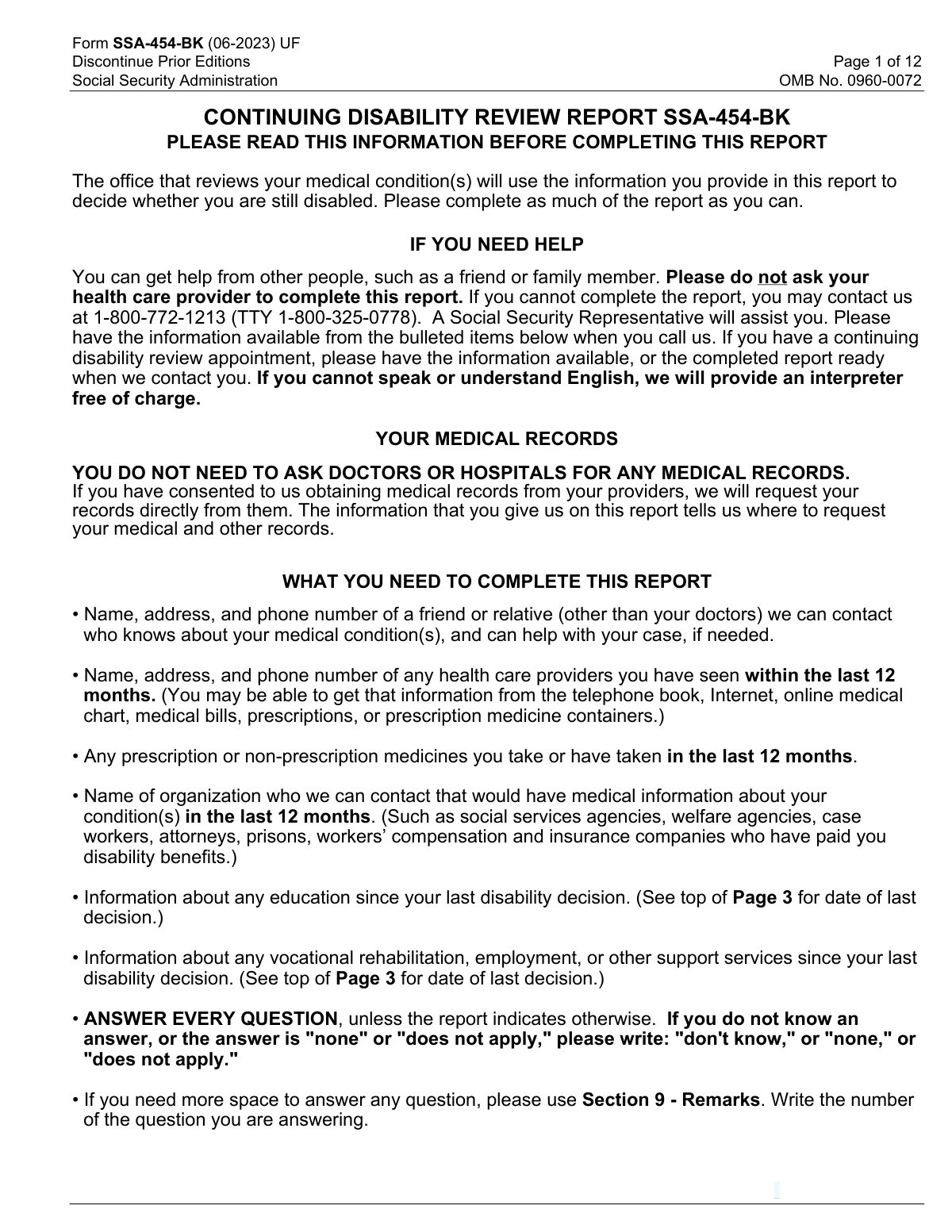
Yes! You can use AI to fill out Form SSA-454-BK, Continuing Disability Review Report
Form SSA-454-BK is the Social Security Administrationâs primary questionnaire for a Continuing Disability Review (CDR). It asks for updated details about your disabling conditions, recent medical treatment and tests, medications, assistive devices, work activity, education/training, support services, and how your conditions affect daily functioning. SSA uses the information to request records from providers and to decide whether you continue to meet the medical requirements for disability benefits. Completing it thoroughly and accurately helps avoid delays and supports a timely, correct decision.
Our AI automatically handles information lookup, data retrieval, formatting, and form filling.
It takes less than a minute to fill out SSA-454-BK using our AI form filling.
Securely upload your data. Information is encrypted in transit and deleted immediately after the form is filled out.
Form specifications
| Form name: | Form SSA-454-BK, Continuing Disability Review Report |
| Number of pages: | 12 |
| Filled form examples: | Form SSA-454-BK Examples |
| Language: | English |
| Categories: | disability forms |
Instafill Demo: filling out a legal form in seconds
How to Fill Out SSA-454-BK Online for Free in 2026
Are you looking to fill out a SSA-454-BK form online quickly and accurately? Instafill.ai offers the #1 AI-powered PDF filling software of 2026, allowing you to complete your SSA-454-BK form in just 37 seconds or less.
Follow these steps to fill out your SSA-454-BK form online using Instafill.ai:
- 1 Enter claimant identification details in Section 1 (name, SSN, addresses, phone/email) and note any other names used on medical/education records and English language abilities.
- 2 Add a reliable third-party contact in Section 2 (someone other than doctors) with relationship, address, phone, and language preference.
- 3 Complete Section 3 medical information: list all limiting physical/mental conditions, provide height/weight, list all providers seen in the last 12 months with dates/addresses, record any ordered tests, list medications taken in the last 12 months, and note any assistive devices used.
- 4 If age 14 or older, complete Section 4 work information about any work since the last medical disability decision (including current work and type of work such as wages or self-employment).
- 5 If age 18 or older, complete Sections 5–7: vocational rehabilitation/support services, other organizations holding medical information (e.g., case workers/insurance/attorneys), and any education or training since the last disability decision including literacy questions.
- 6 If age 18 or older, complete Section 8 daily activities by marking areas of difficulty and providing explanations of how conditions limit functioning.
- 7 Use Section 9 for extra details (e.g., medication side effects or overflow answers), then complete Section 10 to identify who filled out the report, provide contact information, and date the report for submission to SSA.
Our AI-powered system ensures each field is filled out correctly, reducing errors and saving you time.
Why Choose Instafill.ai for Your Fillable SSA-454-BK Form?
Speed
Complete your SSA-454-BK in as little as 37 seconds.
Up-to-Date
Always use the latest 2026 SSA-454-BK form version.
Cost-effective
No need to hire expensive lawyers.
Accuracy
Our AI performs 10 compliance checks to ensure your form is error-free.
Security
Your personal information is protected with bank-level encryption.
Frequently Asked Questions About Form SSA-454-BK
SSA uses this report during a Continuing Disability Review (CDR) to decide whether you are still medically disabled and should continue receiving disability benefits. The information you provide helps SSA request the right medical and other records.
The person receiving disability benefits should complete it, unless they need help. If someone else fills it out, they must complete Section 10 to identify themselves and their relationship to the beneficiary.
No. The form states you do not need to request medical records; if you have consented, SSA will request records directly from your providers using the information you list.
Have contact information for a friend/relative SSA can reach (not a doctor), your health care providers from the last 12 months, medications taken in the last 12 months, and any organizations that may have medical information (e.g., case workers, insurance, workersâ comp). Also gather details about any education or support services since your last disability decision.
SSA estimates it may take about 480 minutes to read instructions, gather information, and answer the questions. The time can vary depending on how many providers, medications, and services you need to list.
Send or bring it to your local SSA field office, or if you are outside the U.S., to the nearest U.S. Embassy or Consulate. You can call 1-800-772-1213 (TTY 1-800-325-0778) to find the correct address.
You may get help from a friend or family member, but the form asks you not to have your health care provider complete it. If you cannot speak or understand English, SSA will provide an interpreter free of charge, and you can call SSA for assistance.
Answer âNOâ to the question asking if they are the same, then complete the RESIDENT ADDRESS fields. This helps SSA know where you live versus where you receive mail.
In Section 1.C, answer âYESâ and list the other names (such as a maiden name, married name, nickname, or other name). This helps SSA match your records correctly.
SSA uses this contact to help reach you and to get general help with your case if you become unavailable. The form specifically says this person should be someone other than your doctors (for example, a family member, friend, or neighbor).
List each physical and/or mental health condition that limits your ability to work (or, for a child, limits their ability to do the same things as other children the same age). If you have more than the space provided, add the extra conditions in Section 9 (Remarks).
Provide as much as you can, even partial details (for example, a nearby landmark or cross street) and use your best estimate for dates if needed. The form notes you can use information from bills, online charts, prescriptions, or the internet.
YesâSection 3.F asks about prescription and non-prescription medicines taken in the last 12 months. The form instructs you to list side effects in Section 9 (Remarks).
The instructions say to answer every question unless told otherwise. If you donât know, or the answer is none/does not apply, write âdonât know,â ânone,â or âdoes not apply.â
Work Information (Section 4) is completed only if the person is age 14 or older. Several sectionsâSupport Services (Section 5), Other Medical Information (Section 6), Education/Training/Literacy (Section 7), and Daily Activities (Section 8)âare marked âComplete only if you are age 18 years or older,â so those are generally skipped for minors.
Compliance SSA-454-BK
Validation Checks by Instafill.ai
1
Validates claimant full name is present and structurally complete (Section 1.A)
Checks that the person receiving benefits has a non-empty first and last name, and that any suffix is in an allowed set (e.g., Jr., Sr., II, III) if provided. This is important for identity matching and to prevent misfiling under incomplete or malformed names. If validation fails, the submission should be flagged as incomplete and routed for correction before downstream identity matching.
2
Validates Social Security Number format and basic plausibility (Section 1.B)
Ensures the SSN is exactly 9 digits (optionally allowing hyphens) and rejects known invalid patterns (e.g., all zeros in any group, 000/666/9xx in the first three digits). This reduces the risk of associating the report with the wrong beneficiary record. If validation fails, block submission or require re-entry because SSA record retrieval depends on a valid SSN.
3
Validates last medical disability decision date is present and is a valid date (Page 3 header)
Checks that the 'Date of your last medical disability decision' is provided and conforms to a valid date format (month/day/year or system-defined format) and is not in the future. Many later questions reference this date for conditional logic (work, education, services since that date). If missing or invalid, the system should prevent completion of dependent sections or require the date to be corrected.
4
Validates mailing address completeness and postal rules (Section 1.D)
Ensures mailing address includes street/PO box, city, state/province (when applicable), ZIP/postal code, and country, with ZIP/postal code format validated based on country (e.g., US 5-digit or ZIP+4). Accurate mailing address is critical for notices and follow-up requests. If validation fails, prompt for missing components and do not allow final submission until a deliverable address is provided.
5
Validates residence address logic based on 'same as mailing' response (Section 1.E)
If the user answers 'YES' to residence same as mailing, the residence address fields should be empty or auto-copied and locked to prevent conflicting entries. If 'NO', the residence address must be fully completed with the same completeness rules as the mailing address. If validation fails (e.g., 'NO' but residence address missing), the system should require completion or correction to avoid inconsistent contact/location data.
6
Validates phone number formats for claimant and contact person (Sections 1.F, 2.D, 10 phone)
Checks that phone numbers contain valid digits and length for the declared context (US/Canada 10 digits; international numbers must include IDD/country code as instructed) and rejects alphabetic characters or too-short entries. Reliable phone numbers are essential for scheduling, clarifications, and interpreter coordination. If validation fails, require re-entry and optionally request an alternate number if the primary is invalid.
7
Validates email address format when provided (Section 1.G)
If an email is entered, validates it against a standard email pattern (local@domain) and rejects obvious invalid forms (missing '@', invalid domain, spaces). While email may be optional, incorrect emails can cause missed communications if the system uses electronic contact. If validation fails, prompt the user to correct the email or clear the field.
8
Validates English proficiency responses and required preferred language (Sections 1.H–1.J, 2.E)
Ensures each YES/NO question (speak/understand, read, write) has a selected value, and if 'Can you speak and understand English?' is 'NO', a preferred language must be provided. For the contact person, if they cannot speak/understand English, their preferred language must also be captured. If validation fails, require completion because interpreter needs and communication planning depend on these fields.
9
Validates alternate names list required when 'other names used' is YES (Section 1.C)
If the claimant indicates they used other names in the last 12 months, the form must include at least one alternate name entry and should reject placeholders like blank strings. This is important for locating medical/educational records that may be filed under different names. If validation fails, prompt for the names used or require changing the answer to 'NO' if none apply.
10
Validates 'Someone we can contact' is complete and not a medical provider (Section 2)
Requires contact name, relationship, address, and phone number to be present, and checks that the relationship is not blank and is plausible (e.g., family/friend/neighbor). Additionally, it should flag entries that appear to be a medical provider (e.g., relationship 'doctor' or organization names like 'clinic') because the form explicitly requests someone other than doctors. If validation fails, require a non-provider contact to ensure SSA has a reliable non-medical point of contact.
11
Validates height and weight entries are numeric and within reasonable ranges (Section 3.B–3.C)
Ensures height is provided in either feet/inches or centimeters (not both unless consistent) and weight is provided in either pounds or kilograms, with numeric-only values and reasonable bounds (e.g., adult height 36â96 inches; weight 30â800 lbs, configurable). This helps prevent data entry errors that can affect medical review context. If validation fails, prompt for correction and prevent submission of obviously impossible values.
12
Validates at least one limiting condition is listed (Section 3.A)
Checks that the claimant lists at least one physical and/or mental condition that limits ability to work (or for a child, limits age-appropriate functioning). This is core to the continuing disability review and drives what records and follow-up questions are needed. If validation fails, the system should require at least one condition or an explicit 'none/does not apply' only if allowed by business rules.
13
Validates provider/treatment section completeness when treatment is YES (Section 3.D)
If the claimant answers 'YES' to having seen a provider in the last 12 months, requires at least one provider entry with facility/office name or provider name, location (city/state/country at minimum), and the condition treated/evaluated; phone and street address should be required when available. Also validates 'Date last seen' as YYYY/MM and not in the future. If validation fails, prompt for missing provider details because SSA uses this to request records.
14
Validates medical tests section completeness when tests ordered is YES (Section 3.E)
If 'YES' is selected for tests ordered, requires at least one test type selection and the associated provider/facility name for each listed test entry. For tests requiring a body part (biopsy, MRI/CT, X-ray), the body part field must be non-empty when that option is selected. If validation fails, require completion to avoid ambiguous test references that hinder record retrieval.
15
Validates medications section completeness when medications is YES (Section 3.F)
If the claimant indicates they took/take medicines in the last 12 months, requires at least one medication name and, when provided, validates that doctor name and reason fields are not filled with invalid placeholders. This information supports medical evaluation and may explain symptoms/side effects referenced in remarks. If validation fails, prompt for at least one medication or require changing the answer to 'NO' if none were taken.
16
Validates age-gated section routing and prevents contradictory completion (Sections 3.H, 4, 5–8)
Enforces that work information (Section 4) is completed only when the beneficiary is age 14+ and that Sections 5â8 are completed only when age 18+ as stated, based on the formâs gating questions (under 14, under 18). It should also prevent users from skipping required sections when the gating indicates they apply, and prevent entering data in sections that should be skipped. If validation fails, the system should redirect the user to the correct next section and require missing age-appropriate content.
Common Mistakes in Completing SSA-454-BK
People often skip questions they think are irrelevant or they donât know the answer to, leaving fields empty. On SSA-454, blanks can look like an oversight and may trigger follow-up calls, delays, or an incomplete review. If you truly donât have the information, write ânone,â âdonât know,â or âdoes not applyâ exactly as the instructions say. This helps SSA distinguish missing information from a negative answer.
Many claimants list only their primary diagnosis and forget secondary conditions (e.g., depression/anxiety, pain, fatigue, side effects, or related physical limitations). This can lead to an incomplete picture of functional limitations and may affect the reviewerâs understanding of ongoing disability. Separately list each physical and mental condition that limits work, even if it seems âminorâ compared to the main condition. Use Section 9 (Remarks) to add more than the provided lines.
A common issue is listing âmy doctorâ or a clinic name without the provider name, phone number, or address, or omitting the date last seen. This makes it harder for SSA to request records and can slow the review or result in missing evidence. Use medical bills, online portals, prescription labels, or internet searches to capture the facility name, treating provider, phone, and as much address detail as possible. If you donât know the exact date, provide your best estimate in the requested YYYY/MM format.
The form repeatedly requests dates in a specific format (YYYYMM with a slash shown as YYYY/MM), but people often write â3/24,â âMarch 2024,â or leave out the year. Incorrect or ambiguous dates can cause confusion about timelines (last seen, attendance dates, start/stop dates) and may require SSA to contact you for clarification. Always write four-digit year and two-digit month (e.g., 2025/01). If youâre unsure, provide a best estimate rather than leaving it blank.
People frequently list only the medication name and omit why they take it, who prescribed it, or they forget over-the-counter medications. They also often write side effects in the medication table even though the form directs side effects to Section 9, or they forget side effects entirely. Missing medication context can weaken the record of ongoing treatment and functional impact. Use your medication containers or pharmacy list, include all prescription and non-prescription meds taken in the last 12 months, and document side effects clearly in Section 9 with the medication name.
Claimants often report only tests already completed and forget tests that were ordered but not yet done, or they list the test but not the facility/provider who ordered it. This can cause SSA to miss important upcoming evidence or delay development while trying to locate where records will be. Include both completed and scheduled tests, and name the healthcare provider or facility that ordered/scheduled them. If you donât know details like body part for imaging, provide your best estimate (e.g., âMRIâlower backâ).
People often answer âsometimesâ because they donât use a device at home, even though they rely on it whenever they leave the house. The form specifically notes that âalwaysâ may apply if you always use it outside your home, and incorrect frequency can understate limitations. This can affect how SSA evaluates mobility, safety, and functional capacity. Choose the frequency that reflects real-world need, and identify the prescribing provider if known.
The form uses two different timeframes: some questions are âwithin the last 12 months,â while others are âsince the date of your last medical disability decisionâ (shown at the top of Page 3). People commonly answer using the wrong timeframe, which can lead to missing work attempts, support services, education, or training that occurred earlier than 12 months but after the last decision. This can create inconsistencies and prompt follow-up. Before answering, check which timeframe the question uses and respond accordingly.
Some claimants omit short-term jobs, self-employment, gig work, or âhelping outâ because they donât consider it real work or they fear it will hurt their case. Incomplete work reporting can create credibility issues if SSA later finds earnings or work activity through records, and it may delay the review. Report any work since the last medical disability decision and indicate whether it was wages, self-employment, and whether you are currently working. If details are complex, clarify in Section 9 rather than leaving it out.
Section 2 requires someone other than your doctors who knows your condition and can help SSA reach you, but people sometimes list a provider, list someone who doesnât answer calls, or omit phone/address details. If SSA cannot reach you, the review can stall or deadlines can be missed. Choose a dependable friend/relative/neighbor, provide complete contact information, and confirm they are willing to be contacted. If the contact does not speak English, specify the preferred language so SSA can arrange interpretation.
Applicants sometimes mark that they canât read/write English in Section 1 but later answer literacy questions in Section 7 without aligning the âeveryday written languageâ in 7.C. Inconsistencies can cause confusion about communication needs and may lead to missed notices or incorrect assumptions about your ability to complete tasks. Make sure Section 1 (English ability) and Section 7 (language used daily and reading/writing ability in that language) match your actual situation. If you use a non-English language daily, clearly name it in 7.C and answer 7.D/7.E for that language.
Saved over 80 hours a year
âI was never sure if my IRS forms like W-9 were filled correctly. Now, I can complete the forms accurately without any external help.â
Kevin Martin Green
Your data stays secure with advanced protection from Instafill and our subprocessors
Robust compliance program
Transparent business model
Youâre not the product. You always know where your data is and what it is processed for.
ISO 27001, HIPAA, and GDPR
Our subprocesses adhere to multiple compliance standards, including but not limited to ISO 27001, HIPAA, and GDPR.
Security & privacy by design
We consider security and privacy from the initial design phase of any new service or functionality. Itâs not an afterthought, itâs built-in, including support for two-factor authentication (2FA) to further protect your account.
Fill out SSA-454-BK with Instafill.ai
Worried about filling PDFs wrong? Instafill securely fills form-ssa-454-bk-continuing-disability-review-repor forms, ensuring each field is accurate.