Yes! You can use AI to fill out Order Instituting Administrative and Cease-and-Desist Proceedings, Pursuant to Sections 15(b) and 21C of the Securities Exchange Act of 1934 and Sections 203(e) and 203(k) of the Investment Advisers Act of 1940, Making Findings, and Imposing Remedial Sanctions and a Cease-and-Desist Order
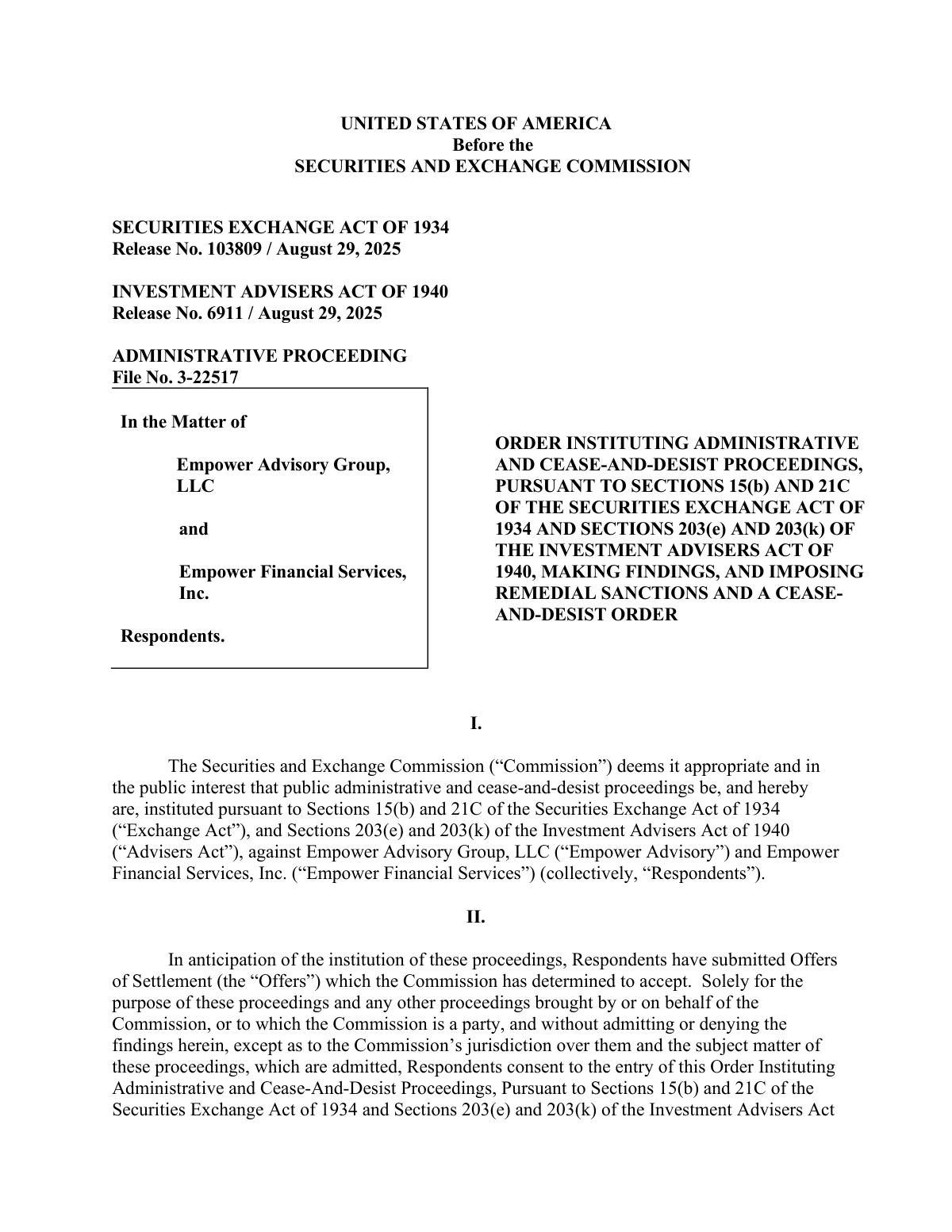
This document is an official Order from the U.S. Securities and Exchange Commission (SEC) instituting administrative and cease-and-desist proceedings against Empower Advisory Group, LLC and Empower Financial Services, Inc. It outlines the SEC's findings that the firms failed to adequately disclose conflicts of interest related to compensation incentives for their advisors, leading to remedial sanctions and a cease-and-desist order. For financial firms needing to manage their own complex disclosure documents, such as the Form ADV and Form CRS mentioned in this order, AI-powered services like Instafill.ai can help ensure they are filled out quickly and accurately. Instafill.ai can also convert non-fillable PDF versions of compliance forms into interactive, fillable formats.
SEC Administrative Proceeding File No. 3-22517 is part of the
Section 8 forms, investment forms, administrative forms, SEC forms, securities forms and UK investment forms categories on Instafill.
Rather not fill this in by hand? Instafill is an online form filler that completes PDF forms automatically — upload the blank form, answer a few questions, and the AI fills every field.
Form specifications
| Form name: | Order Instituting Administrative and Cease-and-Desist Proceedings, Pursuant to Sections 15(b) and 21C of the Securities Exchange Act of 1934 and Sections 203(e) and 203(k) of the Investment Advisers Act of 1940, Making Findings, and Imposing Remedial Sanctions and a Cease-and-Desist Order |
| Number of pages: | 1 |
| Language: | English |
Our AI automatically handles information lookup, data retrieval, formatting, and form filling.
It takes less than a minute to fill out SEC Administrative Proceeding File No. 3-22517 using our AI form filling.
Securely upload your data. Information is encrypted in transit and deleted immediately after the form is filled out.
Instafill Demo: How to fill out PDF forms in seconds with AI
How to Fill Out SEC Administrative Proceeding File No. 3-22517 Online for Free in 2026
Are you looking to fill out a SEC ADMINISTRATIVE PROCEEDING FILE NO. 3-22517 form online quickly and accurately? Instafill.ai offers the #1 AI-powered PDF filling software of 2026, allowing you to complete your SEC ADMINISTRATIVE PROCEEDING FILE NO. 3-22517 form in just 37 seconds or less.
Follow these steps to fill out your SEC ADMINISTRATIVE PROCEEDING FILE NO. 3-22517 form online using Instafill.ai:
- 1 Navigate to Instafill.ai and upload a relevant compliance form, such as a Form ADV or Form CRS, or select one from a template library.
- 2 Use the AI assistant to automatically populate known business information, such as company name, address, and registration numbers.
- 3 Carefully review and complete the sections detailing business practices, fees, and services, ensuring all information is accurate and up-to-date.
- 4 Pay special attention to the conflict of interest disclosure sections, using AI guidance to draft clear, complete, and fair disclosures regarding compensation structures and other potential conflicts.
- 5 Review the entire completed form for accuracy and completeness, using Instafill.ai's validation checks to catch potential errors or omissions before submission.
- 6 Securely sign the document electronically and download the final version for your records and for submission to the appropriate regulatory body like the SEC.
Our AI-powered system ensures each field is filled out correctly, reducing errors and saving you time.
Why Choose Instafill.ai for Your Fillable SEC Administrative Proceeding File No. 3-22517 Form?
Speed
Complete your SEC Administrative Proceeding File No. 3-22517 in as little as 37 seconds.
Up-to-Date
Always use the latest 2026 SEC Administrative Proceeding File No. 3-22517 form version.
Cost-effective
No need to hire expensive lawyers.
Accuracy
Our AI performs 10 compliance checks to ensure your form is error-free.
Security
Your personal information is protected with bank-level encryption.
Frequently Asked Questions About SEC Administrative Proceeding File No. 3-22517
This document is not a form for you to fill out. It is a legal order from the U.S. Securities and Exchange Commission (SEC) detailing findings and sanctions against Empower Advisory Group and Empower Financial Services for inadequate disclosures.
The SEC found that Empower incentivized its Retirement Plan Advisors with bonuses to enroll clients in a fee-based 'Managed Account' service. However, they failed to properly disclose this financial conflict of interest to the plan participants.
This order primarily affects retirement plan participants in Empower's Government Markets segment who were advised to enroll in the Managed Account service between July 1, 2019, and December 31, 2022.
The SEC ordered Empower to create a 'Fair Fund' of nearly $6 million to compensate affected clients. If you were an eligible plan participant who enrolled in the Managed Account service during the specified period, you will receive a distribution from this fund.
No, you do not need to take any action or file a claim. Empower is responsible for identifying all affected plan participants and distributing the funds directly to them according to a plan approved by the SEC.
In this case, it means the advisors had a personal financial incentive to recommend the Managed Account service because it helped them achieve performance goals tied to bonuses and raises. This incentive could conflict with their duty to act in the client's best interest.
A Retirement Readiness Review was a meeting between an Empower Retirement Plan Advisor and a plan participant. During this meeting, the advisor would gather financial information and provide advice, which sometimes included a recommendation to enroll in the Managed Account service.
Empower has undertaken remedial actions, including removing the financial incentive for enrolling participants in the Managed Account service. They also hired new compliance staff and improved disclosures to clients about advisor roles and potential conflicts.
Empower was ordered to pay a total of $5,989,969.94. This amount consists of disgorgement (returning profits), prejudgment interest, and civil monetary penalties.
Yes, services like Instafill.ai use AI to help auto-fill forms accurately and save time. While this isn't a form to fill, such tools can also help summarize complex documents and extract key information, making them easier to understand.
For actual forms that are non-fillable PDFs, you can use a service like Instafill.ai. It can convert flat, non-interactive PDFs into fillable forms that you can easily complete and sign online.
You can use Instafill.ai to securely and quickly fill out various financial or retirement-related forms, such as rollover requests or beneficiary designations. The AI helps auto-fill your information, reducing time and preventing errors.
Compliance SEC Administrative Proceeding File No. 3-22517
Validation Checks by Instafill.ai
1
SEC Registration Number Format Validation
Checks that the SEC registration numbers for broker-dealers (e.g., 8-XXXXX) and investment advisers (e.g., 801-XXXXX) are entered in the correct format. This ensures data integrity for internal records and external filings. An incorrect format could lead to filing rejections or incorrect entity identification in compliance systems.
2
Logical Validation of Date Ranges
Ensures that for any defined period, such as the 'Relevant Period' mentioned in legal documents, the start date occurs before the end date. This basic check prevents illogical data entry that could corrupt reports, calculations, and legal records. If this validation fails, the user would be prompted to correct the dates before the form can be saved.
3
Advisor Dual-Licensing Onboarding Check
Verifies that any employee designated as a 'Retirement Plan Advisor' has valid, non-expired license numbers entered for both an investment adviser representative and a registered representative. This is critical for regulatory compliance, as advisors were required to be dually licensed. Failure to have both licenses on file would prevent the employee's profile from being activated for client interaction and trigger a notification to a compliance manager.
4
Performance Goal Weighting Summation
Validates that the sum of all weighted performance goals for an employee's annual review equals exactly 100%. This check ensures the logical integrity of the performance management system and prevents miscalculation of annual ratings and bonuses. If the weights do not sum to 100%, the system would prevent the goal set from being finalized and alert the manager to correct the entries.
5
Prohibited Compensation Incentive Validation
Scans the text fields for performance goals to detect and block keywords related to prohibited incentives, such as 'Managed Account AUM Goal', 'enrollment target', or 'product-specific assets'. This check is a direct remediation for the conflict of interest identified in the SEC order, preventing managers from creating goals that incentivize advisors to act against a client's best interest. A failed validation would reject the goal and require rewriting.
6
Mandatory Role Declaration for Client Meetings
Requires an advisor to affirmatively select their current capacity (e.g., 'Investment Adviser Representative' or 'Registered Representative') from a dropdown menu within the CRM at the start of any logged client interaction. This addresses the failure to properly disclose the advisor's role, shifting the burden away from the client. The meeting log cannot be saved without this field being completed.
7
Written Disclosure Delivery Confirmation
Ensures that a checkbox confirming the delivery of required written disclosures (like Form CRS or a Reg BI Disclosure) is ticked before an advisor can conclude a client meeting record in the system. This validation creates an auditable record that the firm is complying with its written disclosure obligations under regulations like Reg BI. The system could also require an attachment of the actual document provided.
8
Vague Language Detection in Disclosure Forms
Analyzes the text of draft disclosure documents (e.g., Form ADV, Form CRS) for weak or potentially misleading phrases identified as problematic by regulators, such as 'may be indirectly compensated,' 'may consider,' or 'factors unrelated to.' This automated check helps compliance officers identify and strengthen language to ensure full and fair disclosure of conflicts. Flagged phrases would require review and approval before the document can be finalized.
9
Consistency Check Between Compensation and Disclosures
Performs a logical cross-reference between an advisor's active compensation plan and the disclosures provided to their clients. If the compensation plan includes incentives related to any specific service, the system validates that the disclosure form explicitly and clearly describes this specific conflict of interest. A mismatch would trigger a high-priority alert for the compliance department to resolve the discrepancy.
10
Balanced Discussion of Client Options
Validates that during a 'Retirement Readiness Review,' the advisor has logged a discussion of multiple client options, not just the 'Managed Account service.' This could be implemented by requiring the advisor to enter notes or check boxes for each alternative (e.g., 'Self-manage', 'Target Date Fund'). The system would flag reviews where only one option is documented, prompting a supervisory review to ensure advice is balanced and in the client's best interest.
11
Financial Sanction Component Summation
Verifies that the sum of individual disgorgement, prejudgment interest, and civil penalty amounts equals the total sanction amount specified in a legal order. For example, it would check that the components for Empower Advisory and Empower Financial Services correctly sum to the total of $5,989,969.94. This ensures accuracy in financial reporting and payment processing for legal settlements.
12
Settlement Action Item Deadline Tracking
Automatically calculates and monitors deadlines for actions required by a settlement order, such as submitting a distribution calculation within 90 days of the order date. The system would validate that the planned completion date for a task is on or before the deadline. It would generate alerts to responsible parties as the deadline approaches to ensure timely compliance and avoid further penalties.
Common Mistakes in Completing SEC Administrative Proceeding File No. 3-22517
This mistake involves using ambiguous terms like 'may be indirectly compensated' or 'opportunity to earn' when describing financial incentives, as seen in Empower's disclosures. It often happens when firms attempt to downplay significant conflicts of interest to appear more objective. The consequence is a failure to provide 'full and fair disclosure' as required by regulators, leading to enforcement actions, fines, and loss of client trust. To avoid this, firms must use direct, unambiguous language that clearly explains how compensation is structured and what specific client actions it incentivizes.
Firms commit this error by failing to disclose the full nature of a conflict, such as not revealing that advisors are specifically incentivized to recommend one service over other, less expensive alternatives. This is a critical omission because it prevents clients from understanding the potential bias in the advice they receive, which can lead to significant financial harm and severe regulatory penalties. To prevent this, all material facts about a conflict must be disclosed, including the specific incentives and how they might influence a recommendation. AI-powered form filling tools like Instafill.ai can help ensure that all required disclosure fields on forms like Form ADV and Form CRS are completed, reducing the risk of accidental omission.
This occurs when representatives make verbal statements to clients, such as claiming to be 'salaried' or 'non-commissioned,' that are technically true but misleading because they omit the existence of performance bonuses tied to sales goals. This creates a false sense of security for the client and directly undermines the purpose of written disclosures. The consequences include misleading clients and violating fiduciary duties or best interest standards. Firms must rigorously train representatives to ensure their verbal communications are fully consistent with, and do not contradict, the detailed information provided in written disclosure documents.
This mistake involves providing a confusing disclosure about whether a representative is acting as a broker or an investment adviser and placing the burden on the client to ask for clarification. As detailed in the SEC order, this fails to meet regulatory requirements for clarity. This ambiguity can confuse clients about the standards of conduct that apply to their interaction. To avoid this, firms must provide a clear, affirmative disclosure, in writing, stating the capacity in which the representative is acting when making a recommendation.
The SEC order noted that Empower's capacity disclosure was made verbally, not in writing as required by Regulation Best Interest. Compliance rules often specify the exact format and delivery method for disclosures (e.g., written, electronic, delivered before a transaction). Ignoring these technical requirements can result in a violation, even if the information was conveyed in some other way. Using a compliance management or form-filling tool can help ensure that disclosures are generated and delivered according to the specific formatting and procedural rules required by regulators.
This error occurs when a firm has a written policy for conflicts of interest but fails to design or enforce it in a way that actually mitigates the conflicts. Empower had a policy and a review committee, but they did not take steps to mitigate the conflict from the incentive compensation. A 'paper policy' is insufficient; regulators expect to see procedures that are reasonably designed and implemented to address, mitigate, or eliminate conflicts. Firms must periodically audit their procedures to ensure they are effective in practice.
Firms make this mistake by using generic phrases like 'asset goals' or 'success in gathering client assets' in their disclosures instead of specifying the exact metric, such as a goal for assets enrolled in a particular managed account service. This lack of specificity obscures the direct link between a product recommendation and an advisor's compensation, preventing clients from making a fully informed decision. Disclosures must be precise enough for a client to understand the specific incentives that could influence the advice they are given.
This involves making actively misleading statements in disclosure documents, such as claiming incentive pay is based on 'factors unrelated to an account holder’s adoption of... services' when, in fact, it is directly tied to that adoption. This is a direct misrepresentation and a serious violation that erodes trust and invites severe regulatory scrutiny. All descriptions of compensation structures must be completely truthful and transparent, accurately reflecting all factors used in calculations. Many compliance documents are only available as flat, non-fillable PDFs, but tools like Instafill.ai can convert them into fillable versions to streamline the completion process and reduce manual data entry errors.
This fundamental error occurs when a firm's disclosures require the client to ask for essential information, rather than providing it proactively. The SEC order highlights this with the capacity disclosure, where the client was told to 'please ask me' for clarification. Regulatory obligations, particularly under Regulation Best Interest, require the firm to provide clear and complete information without prompting. Relying on a client's inquisitiveness is not a valid compliance strategy and demonstrates a failure to prioritize the client's interests.
Saved over 80 hours a year
“I was never sure if my IRS forms like W-9 were filled correctly. Now, I can complete the forms accurately without any external help.”
Kevin Martin Green
Your data stays secure with advanced protection from Instafill and our subprocessors




Robust compliance program
Transparent business model
You’re not the product. You always know where your data is and what it is processed for.
ISO 27001, HIPAA, and GDPR
Our subprocesses adhere to multiple compliance standards, including but not limited to ISO 27001, HIPAA, and GDPR.
Security & privacy by design
We consider security and privacy from the initial design phase of any new service or functionality. It’s not an afterthought, it’s built-in, including support for two-factor authentication (2FA) to further protect your account.
Fill out SEC Administrative Proceeding File No. 3-22517 with Instafill.ai
Worried about filling PDFs wrong? Instafill securely fills order-instituting-administrative-and-cease-and-desist-proceedings-pursuant-to-sections-15b-and-21c-of-the-securities forms, ensuring each field is accurate.
