
Yes! You can use AI to fill out Uniform Domestic Relations Form – Affidavit 1 AFFIDAVIT OF BASIC INFORMATION, INCOME, AND EXPENSES
Don't type 282 fields by hand. Tell our AI about yourself, or upload a document you already have, and it fills every field in seconds. You check it, then download, print or sign.
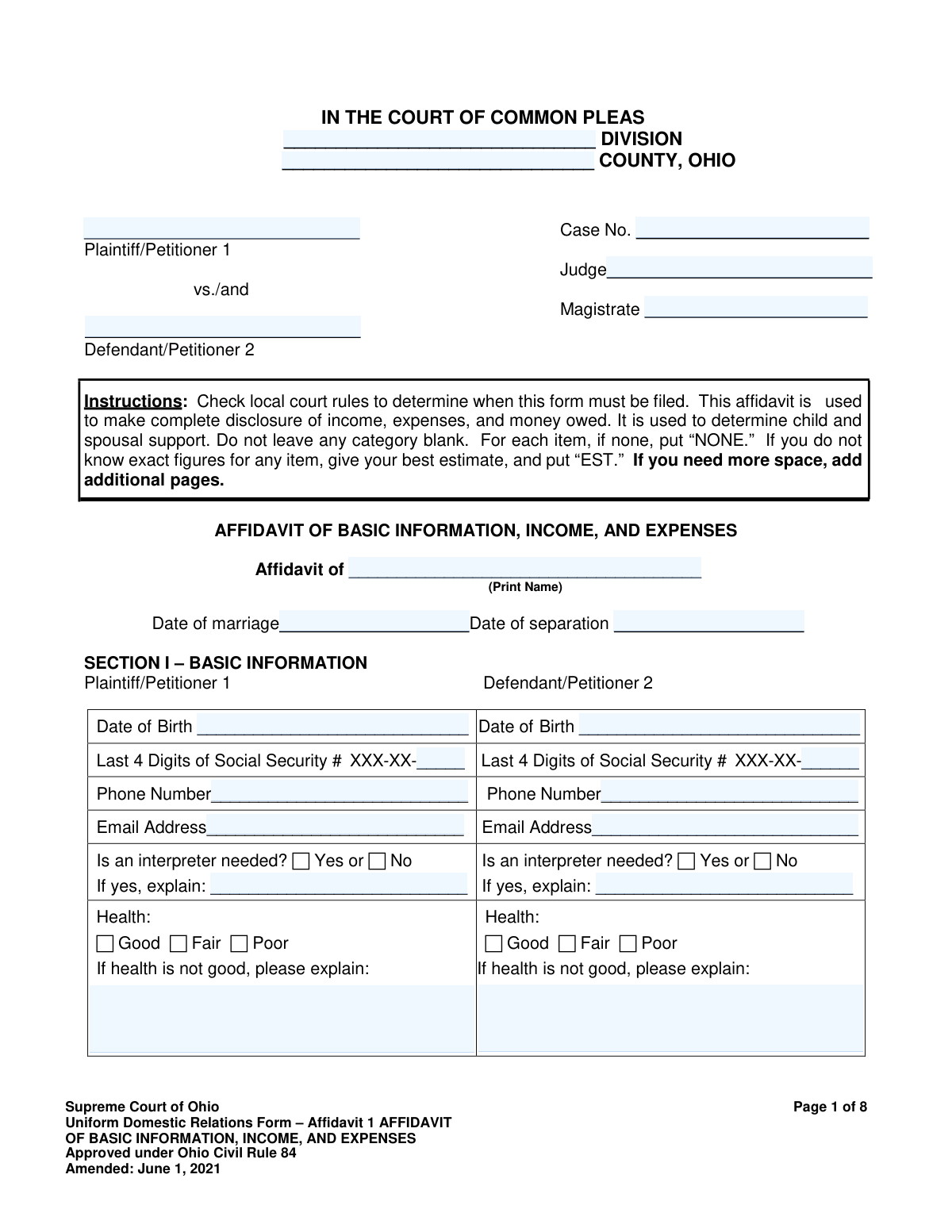
The AI does the filling. You just check it.
No typing into boxes, nothing to install.
What this form asks for
The AI fills all of it, from your answers or your documents.
The AI checks your answers before you download
15 checks built for this form, so a wrong date or a missing answer is caught before anyone else sees it.
This check ensures that the 'Date of separation' is on or after the 'Date of marriage'. A separation cannot logically occur before a marriage begins. This validation is crucial for establishing the correct timeline of the marriage for legal purposes, such as determining the division of assets. If the separation date precedes the marriage date, the form submission will be rejected with an error asking the user to correct the dates.
This validation checks if the explanation field for an interpreter is filled out when the 'Interpreter needed?' checkbox is marked 'Yes'. The court needs to know the specific language or type of assistance required to make appropriate arrangements. If 'Yes' is selected and the explanation is blank, a prompt will appear requiring the user to provide details before they can proceed.
This check verifies that the health explanation field is completed if a party's health is marked as 'Fair' or 'Poor'. This information is vital as health conditions can impact earning capacity, medical expenses, and support calculations. If 'Fair' or 'Poor' is checked without an accompanying explanation, the user will be required to provide details on the health issues.
This validation ensures that the 'Last 4 Digits of Social Security #' field contains exactly four numeric digits. This specific format is required for proper identification while protecting the individual's full SSN. Any entry that is not four numbers will trigger an error, prompting the user to enter the correct four-digit value.
This check ensures that if a party's employment status is marked as 'Yes', then all related employment fields (Name of Employer, Payroll Address, Date of Employment, etc.) are completed. This information is fundamental for income verification and calculating support obligations. If 'Employed - Yes' is checked but the details are missing, the form will be considered incomplete and require the user to fill in the employer information.
This validation verifies that the three years entered in Section II-A for income history are sequential and logical (e.g., 2023, 2022, 2021). This ensures the income data is reported for the correct, consecutive time periods as required by the form. If the years are non-sequential, duplicated, or in the future, an error will be displayed requesting correction.
And 9 more checks
- Average Overtime Income Calculation
- Total Yearly Income Summation
- Minor Child's Date of Birth Validity
- Grand Total Monthly Expenses Calculation
- Affiant Name Consistency Check
- Notary Commission Expiration Date
- Email Address Format Validation
- Phone Number Format Validation
- Completeness of Installment Payment Details
Let AI fill out your Uniform Domestic Relations Form – Affidavit 1
No typing. Every field filled in seconds, checked, ready to sign.
How to Fill Out Uniform Domestic Relations Form – Affidavit 1 Online for Free in 2026
What the AI walks you through.
- Navigate to Instafill.ai and upload or select the 'Affidavit of Basic Information, Income, and Expenses' form.
- Enter the case details, including the court, county, case number, and names of the parties involved.
- Complete Section I (Basic Information) and Section II (Income) by providing personal details, employment history, and income data for the past three years for both parties.
- Fill in Section III with information about children from the relationship and any other household residents.
- Methodically complete Section IV by detailing all monthly expenses, including housing, living costs, child-related expenses, insurance, and installment payments.
- Carefully review all the information you have entered across all sections to ensure it is accurate and complete.
- Download the completed affidavit, then print it to be signed in the presence of a Notary Public as required by the oath section.
Common Mistakes in Completing Uniform Domestic Relations Form – Affidavit 1
The ones the AI is built to catch.
Leaving Fields Blank Instead of Writing 'NONE'
Miscalculating Monthly Expenses
Incorrectly Reporting Paycheck Frequency
Prematurely Signing the Affidavit
Inaccurate Historical Income Reporting
Duplicating Expenses Across Sections
Omitting Case-Identifying Information
Failing to Provide Required Explanations
Miscategorizing Child-Related Expenses
Using Estimates Without Proper Notation
Frequently Asked Questions About Uniform Domestic Relations Form – Affidavit 1
Is it really free for 7 days?
Can I fill other forms too?
How do I cancel?
How does the AI fill out Uniform Domestic Relations Form – Affidavit 1?
What happens to my information?
How complex is Uniform Domestic Relations Form – Affidavit 1 to fill out?
What is the purpose of the Affidavit of Basic Information, Income, and Expenses form?
Who is required to fill out this affidavit?
What should I do if I don't know the exact amount for an expense or income?
What do I write if a category does not apply to me?
Do I need to fill out the information for the other party?
Why does the form ask for my income from the last three years?
How should I list my expenses if I pay them weekly or annually, not monthly?
Does this form need to be notarized before I file it?
What documents should I have ready before I start filling out this form?
I am currently unemployed. How do I complete the income section?
Can I use an AI tool to help me complete this affidavit?
How can I fill out this form online?
The PDF of the form I downloaded isn't fillable. What can I do?
In Section IV, do I list only my personal expenses or the entire household's expenses?
Get your Uniform Domestic Relations Form – Affidavit 1 filled out by AI
$0 today. Cancel before Nov 1 and you pay nothing.
Other forms like this one
income forms: Form SSA-44, Medicare Income-Related Monthly Adjustment Amount - Life-Changing Event, Form 1040-X, Amended U.S. Individual Income Tax Return, Form 1040-C, U.S. Departing Alien Income Tax Return, Form 4137, Social Security and Medicare Tax on Unreported Tip Income, Form 8960, Net Investment Income Tax, Form 1042-S, Foreign Person’s U.S. Income, Form 990-T, Exempt Org Business Income Tax Return, Form 945, Annual Return of Withheld Federal Income Tax, Form 568, LLC Income Return, Form FTB 3514, California Earned Income Tax Credit, Form 1099-INT, Interest Income, Form 1120-S, U.S. Income Tax Return for an S Corporation, Form 1065, U.S. Return of Partnership Income, Form 1040, U.S. Individual Income Tax Return, Form FL-150, Income and Expense Declaration, Form 122A-1, Chapter 7 Statement of Current Monthly Income, Arizona Form 285-I, Individual Income Tax Disclosure/Representation Authorization Form, Form SSA-8000-BK, Application for Supplemental Security Income (SSI), Judicial Council of California Form FL-150, Income and Expense Declaration, Form 1120-S (2025), U.S. Income Tax Return for an S Corporation
income and expense forms: Form FL-150, Income and Expense Declaration, Judicial Council of California Form FL-150, Income and Expense Declaration, TC201, Income and Expense Schedule for Rent-Producing Property, Loan Rehabilitation: Income and Expense Information, William D. Ford Federal Direct Loan (Direct Loan) Program/Federal Family Education Loan (FFEL) Program, Form TC201, Income and Expense Schedule for Rent Producing Properties, Form FL-141, Declaration Regarding Service of Declaration of Disclosure and Income and Expense Declaration, Form EM-115, Emancipation of Minor Income and Expense Declaration
domestic relations forms: I.B.E.W. & Electrical Industry Local 697 Money Purchase Plan and Trust Direct Rollover Request Form Due to Qualified Domestic Relations Order, Elevator Constructors Union Local No.1 Annuity and 401(k) Fund Distribution Request Due to Qualified Domestic Relations Order, Supreme Court of Ohio Uniform Domestic Relations Form 17, Petition for Dissolution of Marriage and Waiver of Service of Summons, Form MC 21, Confidential Case Inventory (Domestic Relations and Juvenile Code), MC 281b, Domestic Relations Mediator Application, Supreme Court of Ohio Uniform Domestic Relations Form 7, Complaint for Divorce with Children, Form FL-460, Qualified Domestic Relations Order for Support (Family Law), Supreme Court of Ohio Uniform Domestic Relations Form – Affidavit 2, AFFIDAVIT OF PROPERTY AND DEBT
affidavit forms: Affidavit for Collection of Personal Property California Probate Code Section 13100, Form I-864, Affidavit of Support Under INA, Form DS-5507, Affidavit of Physical Presence, Form 12.902(b), Family Law Financial Affidavit (Short Form), Form E, Affidavit of Personal Service, Form I-361, Affidavit of Financial Support, Form EX550, Affidavit (Order to attend for questioning/suspended committal order), Form CJA-23, Financial Affidavit, Affidavit and Representations Regarding Next of Kin (Preference Beneficiary Affidavit) (The Hartford) – Form LC-7086-17, Affidavit for Service by Publication/Posting (Circuit Court of Cook County, Illinois) (CCG 0013 A/B), In Forma Pauperis Affidavit/Petition (AOPC 622A) – Pennsylvania Magisterial District Court, In Forma Pauperis Affidavit Petition (AOPC 622A) — Pennsylvania Magisterial District Court, Form P3 (Rule 25-3(2)) — Affidavit of Applicant for Grant of Probate or Grant of Administration with Will Annexed (Short Form) (Supreme Court of British Columbia), TIAA Brokerage Durable Power Of Attorney Affidavit Of Full Force And Effect, Form L-4260, Property Transfer Affidavit, Affidavit - Supporting Documents Not Attached to Eviction Complaint, Missouri Motion and Affidavit in Support of Request to Proceed As a Poor Person, Form AOC-SP-300, Petition And Affidavit/Affirmation For Involuntary Commitment, Florida Supreme Court Approved Family Law Form 12.902(d), Uniform Child Custody Jurisdiction and Enforcement Act (UCCJEA) Affidavit, Form 35.1A: Affidavit (child protection information)
income expense forms: Form TC201, Income and Expense Schedule for Rent Producing Properties, Form FL-150, Income and Expense Declaration, Judicial Council of California Form FL-150, Income and Expense Declaration, TC201, Income and Expense Schedule for Rent-Producing Property, Loan Rehabilitation: Income and Expense Information, William D. Ford Federal Direct Loan (Direct Loan) Program/Federal Family Education Loan (FFEL) Program, ACORD 810, Business Income / Extra Expense / Rental Value, Form FL-141, Declaration Regarding Service of Declaration of Disclosure and Income and Expense Declaration, Form EM-115, Emancipation of Minor Income and Expense Declaration
Let AI fill out your Uniform Domestic Relations Form – Affidavit 1
Your trial starts once a card is added. You pay nothing before Nov 1.
Our AI already knows this form, all 282 fields of it. Skip the typing: tell it about yourself, or upload what you have, and it fills the whole form in seconds.
- AI fills every field on all 8 pages, tables and checkboxes included
- No typing into boxes: answer a few questions, or upload a document you already have, an old copy of this form, a photo of a document
- The AI checks the answers; you review and change anything before you download
- Download the finished PDF, print it, or sign it online
- Encrypted, and never used to train AI
Cancel before Nov 1 and you pay nothing.
A card is needed to start the trial. Cancel in two clicks from your account.
Terms · Privacy