Fill out income and expense forms
with AI.
Income and expense forms are essential financial disclosures used across various legal and administrative sectors to provide a snapshot of a person or entity's financial health. Whether you are dealing with property tax assessments, family law proceedings, or loan rehabilitation, these forms require a detailed breakdown of monthly earnings, assets, and liabilities. Accuracy is paramount, as courts and government agencies rely on this data to determine support obligations, evaluate property values, or establish affordable repayment plans.
By continuing, you acknowledge Instafill's Privacy Policy and agree to get occasional product update and promotional emails.
About income and expense forms
These documents are commonly required by individuals going through domestic relations cases, such as divorce or child support hearings, where forms like the California FL-150 or the Ohio Affidavit of Basic Information are mandatory. Property owners in jurisdictions like New York City also utilize these forms, specifically the TC201, to appeal property tax assessments by reporting rent-producing income. Additionally, students seeking to rehabilitate defaulted federal loans may need to submit income and expense declarations to negotiate manageable monthly payments based on their actual financial capacity.
Completing these extensive financial disclosures can be time-consuming and prone to manual error, but tools like Instafill.ai use AI to fill these forms in under 30 seconds while ensuring data is handled accurately and securely. This technology simplifies the process by extracting relevant information and populating complex fields automatically, allowing you to focus on the legal or financial matter at hand rather than the paperwork.
Every form on this page can be completed without typing. Instafill is form filling software that reads a PDF and fills it for you — including flat and scanned documents that carry no fillable fields at all.
Forms in This Category
The forms in this category have a median Form Complexity Index of 78/100 (Complex), measured across 8 forms by field count, input difficulty, length, conditional logic and structure. See how it is calculated.
- Enterprise-grade security & data encryption
- 99%+ accuracy powered by AI
- 1,000+ forms from all industries
- Complete forms in under 60 seconds
How to Choose the Right Form
Navigating income and expense forms can be confusing because the term covers everything from personal divorce filings to commercial property tax appeals. To choose the right document, you must first identify the legal jurisdiction (such as California or New York City) and the specific financial goal you are trying to achieve.
Family Law and Support Cases
If you are involved in a divorce, legal separation, or child support dispute, you are likely required to provide a sworn statement of your financial health. These forms help judges determine ability to pay and calculate support obligations.
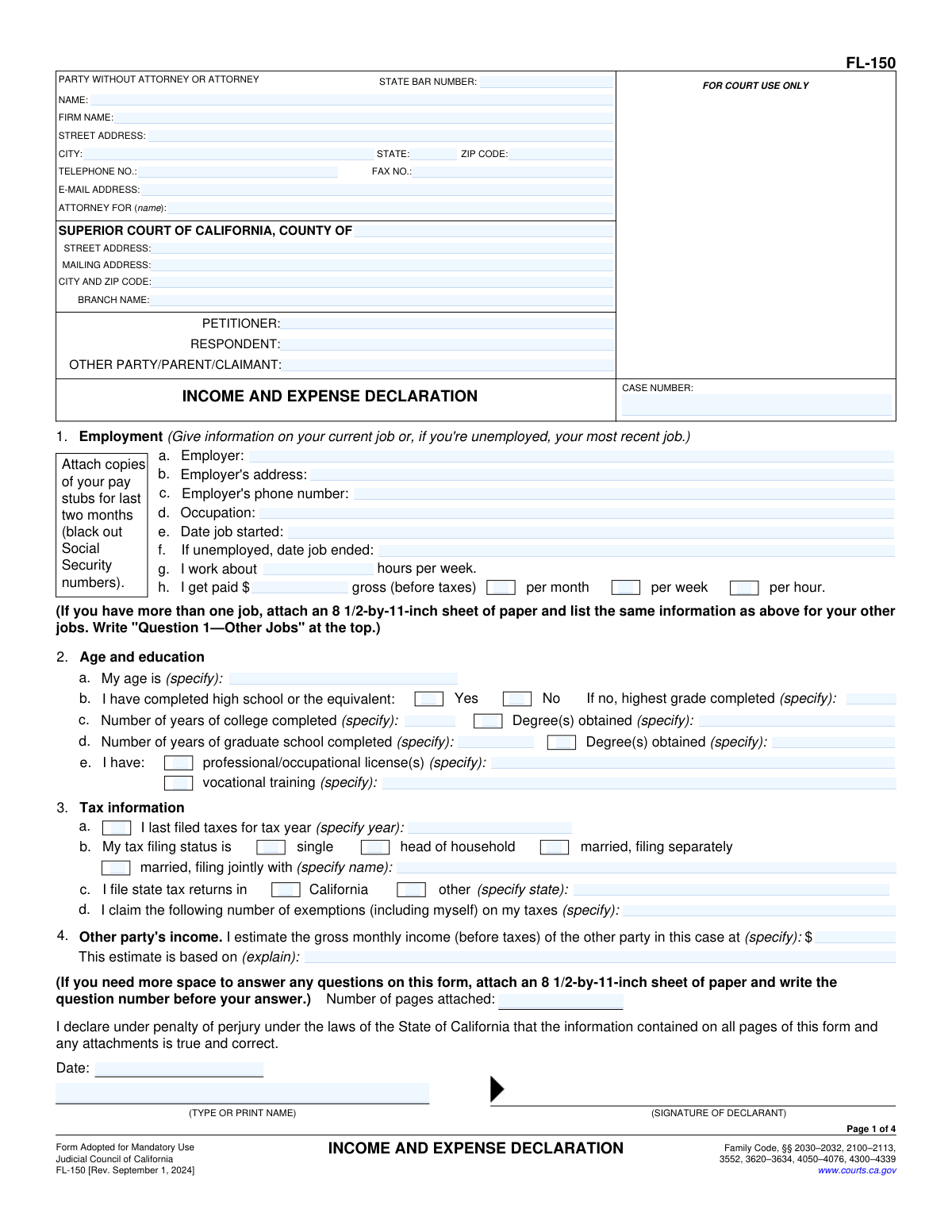
- California Residents: Use Form FL-150, Income and Expense Declaration (also listed as Judicial Council of California Form FL-150). This is a mandatory document for family law cases in California used to set child and spousal support.
- Ohio Residents: Choose the Uniform Domestic Relations Form – Affidavit 1 (Affidavit of Basic Information, Income, and Expenses). This is the standard requirement for the Ohio Court of Common Pleas to assess personal data and monthly living costs.
NYC Real Estate and Property Tax Appeals
For property owners in New York City, income and expense reporting is a tool for reducing tax liability. If you believe your property has been over-assessed, you will need specialized real estate tax forms.
- Form TC201, Income and Expense Schedule for Rent-Producing Property: This form is specifically for the New York City Tax Commission. It must be attached to your assessment appeal for any residential or nonresidential property that generates rent. It tracks two years of financial data to help the commission evaluate if the assessed value is appropriate.
Federal Student Loan Management
If you are dealing with debt rather than taxes or domestic litigation, your needs will be focused on federal programs.
- Loan Rehabilitation: Income and Expense Information: Use this form if you have defaulted on a William D. Ford Federal Direct Loan or FFEL Program loan. It allows you to provide a detailed breakdown of your finances to negotiate an affordable, alternative payment plan to bring your loan back into good standing.
Form Comparison
| Form | Purpose | Jurisdiction / Agency | Key Focus |
|---|---|---|---|
| Form FL-150, Income and Expense Declaration | Determining child support, spousal support, and attorney fee orders. | California Superior Court (Family Law) | Personal income, tax deductions, and monthly living costs. |
| Judicial Council of California Form FL-150, Income and Expense Declaration | Disclosing financial status for support and asset division. | Judicial Council of California | Employment history, assets, and household member contributions. |
| TC201, Income and Expense Schedule for Rent-Producing Property | Appealing real estate tax assessments for rent-producing properties. | New York City Tax Commission | Commercial and residential rental income and operating expenses. |
| Income and Expense Declaration (California Judicial Council Form FL-150) | Establishing financial circumstances in family law proceedings. | California Judicial Council | Comprehensive breakdown of monthly expenses, debts, and assets. |
| Uniform Domestic Relations Form – Affidavit 1 AFFIDAVIT OF BASIC INFORMATION, INCOME, AND EXPENSES | Providing sworn financial data for domestic relations cases. | Ohio Court of Common Pleas | Personal identification, total gross income, and basic expenses. |
| Loan Rehabilitation: Income and Expense Information, William D. Ford Federal Direct Loan (Direct Loan) Program/Federal Family Education Loan (FFEL) Program | Requesting alternative payment plans for defaulted student loans. | Federal Direct Loan / FFEL Program | Detailed household budget to calculate discretionary income. |
Tips for income and expense forms
Before starting forms like the FL-150 or TC201, collect your last two months of pay stubs, recent tax returns, and bank statements. Having these documents on hand ensures that the figures you enter are exact, which is critical for forms submitted under penalty of perjury.
A frequent error is reporting net take-home pay when the form specifically requests gross income. Always check the instructions for each section to ensure you are providing the total amount earned before taxes and other deductions are removed.
For costs that change monthly, such as utilities or groceries, calculate a six-month average rather than using a single month's high or low. This provides the court or tax commission with a more realistic and stable picture of your financial obligations.
AI-powered tools like Instafill.ai can complete these complex financial forms in under 30 seconds with high accuracy. This is a significant time-saver for those managing multiple filings, and your sensitive financial data stays secure throughout the automated process.
When filing NYC tax forms like the TC201, ensure you include both residential and nonresidential occupancy data as required. Failing to provide the full two-year financial history or lease details can result in your assessment appeal being rejected.
Incomplete forms are often returned or delayed, which can be costly in legal or tax matters. If a specific category of income or expense does not apply to you, enter '0' or 'N/A' to show the reviewer that the section was intentionally addressed rather than overlooked.
Frequently Asked Questions
These forms are designed to provide a transparent financial snapshot to a governing body, such as a court, a tax commission, or a loan servicer. They help authorities determine support payments, evaluate property assessments, or calculate affordable loan repayments based on an individual's or entity's actual cash flow.
You will most commonly encounter these forms in family law cases involving divorce, child support, or spousal maintenance. Additionally, they are used in property tax appeals to prove a building's income-producing value and in federal student loan rehabilitation programs to set monthly payments.
Yes, AI tools like Instafill.ai can fill these forms in under 30 seconds by accurately extracting data from your source documents and placing it into the correct fields. This technology ensures that figures from pay stubs or tax records are transcribed precisely into the PDF.
Most jurisdictions require you to attach proof of the figures you report, such as recent pay stubs, W-2 forms, or federal tax returns. For property-specific forms like the NYC TC201, you may need rent rolls, lease agreements, and detailed utility or maintenance records to justify the reported expenses.
While manual completion can take several hours due to the detailed financial calculations required, using an AI-powered platform can complete the process in less than a minute. The AI handles the data mapping from your uploaded financial documents directly into the required PDF fields.
Many income and expense forms, such as the California FL-150 or the Ohio Affidavit 1, are legal declarations. By signing, you are swearing that the information is true to the best of your knowledge; providing false information can lead to legal sanctions or negatively impact the outcome of your case.
Personal forms focus on household income, living expenses, and personal debts to determine individual financial health for support or loan cases. Property-specific forms, like the NYC TC201, focus specifically on the revenue generated by a building and the costs associated with its operation to determine its fair market value for tax purposes.
For property tax appeals, filing is usually an annual requirement during the assessment period. In family law or loan rehabilitation, you typically file them at the start of the legal process or whenever there is a significant change in your financial circumstances that necessitates a modification of a court order.
The submission location depends on the form's purpose: family law forms go to the local Clerk of Court, property tax forms are submitted to the relevant Tax Commission or Assessor's office, and loan forms are sent to your loan servicer or the Department of Education.
Most legal and financial processes require you to provide updated information if your situation changes significantly before a final decision is made. In court cases, this often involves filing an 'Amended' version of the form to ensure the judge is making decisions based on your most current data.
Glossary
- Form Complexity Index
- Instafill’s 0–100 measure of how much effort a form takes to complete, calculated deterministically from the form’s own structure rather than estimated. It combines the number of fillable fields (the largest factor), how difficult those fields are to complete based on their type, the number of pages that contain fields, the amount of conditional “fill-only-if” logic, and how many sections the form is divided into, then adds modifiers for tables and repeating lists, bundled instruction pages, and dense page layouts. A higher score means the form is harder to fill out by hand. The forms in this category have a median Form Complexity Index of 78/100 (Complex). See exactly how it is calculated.
- Spousal Support
- Financial payments made by one spouse to another after a divorce or legal separation, often calculated based on the income and expenses reported on these forms.
- Assets and Liabilities
- Assets are everything you own that has value, such as cash or property, while liabilities are debts or financial obligations you owe to others.
- Penalty of Perjury
- A legal warning stating that providing false information on the form is a crime and can lead to criminal prosecution.
- Assessed Value
- The dollar value assigned to a property by a public tax assessor to determine how much property tax the owner must pay.
- Loan Rehabilitation
- A process that allows a borrower to bring a defaulted federal student loan back into good standing by making a series of affordable, on-time payments.
- Rent-Producing Property
- Real estate that generates income through leasing space to tenants, such as apartment buildings, office spaces, or commercial storefronts.
- Declarant
- The person who is completing, signing, and formally submitting the income and expense statement to a court or government agency.
- FFEL
- An abbreviation for the Federal Family Education Loan program, which includes older federal student loans that may require specific income forms for rehabilitation.